President Donald Trump has ignited a firestorm in Hollywood and beyond after declaring plans to impose a 100% tariff on all films produced outside the United States. The announcement has stunned entertainment executives, alarmed global trade experts, and raised deep concerns across the film industry—both in the U.S. and internationally.
Trump’s Justification: “Reviving American Filmmaking”
Trump, in a series of comments and social media posts, claimed that foreign-made films are contributing to the decline of the American film industry. He cited “national and economic security” as the justification for the unprecedented measure.
“The movie industry in America is DYING a very fast death,” Trump wrote on Truth Social. “Other countries are offering all sorts of incentives to draw our filmmakers and studios away. Therefore, I’m authorizing a 100% tariff on any and all movies produced outside our country.”
Trump added that the policy is meant to bring back jobs and production to the United States, restoring what he called “the golden age of American cinema.”
Hollywood in Disbelief: “This Could Cripple Us”
The response from Hollywood has been swift and sharp. Top executives, studio insiders, and actors have voiced alarm over the feasibility, legality, and potential damage of the proposed tariff.
“On first blush, it’s shocking and would represent a virtually complete halt of production,” one studio insider told . “But in reality, he has no jurisdiction to do this, and it’s too complex to enforce.”
Jay Sures, Vice Chairman of United Talent Agency, added:
“The fact is it’s cheaper for Hollywood studios to pay for everyone to get on planes and film overseas because of labor costs, tax incentives, and production capabilities. A blanket tariff could bring the industry to a standstill—especially after we just weathered dual strikes and a content recession.”
Economic Impacts Already Showing: Stock Market Reacts
The announcement triggered a ripple effect through the financial markets. Stocks of major entertainment and streaming companies—including Netflix, Disney, and Paramount—fell by over 2% the day after the announcement, reflecting investor anxiety over potential disruptions to content pipelines and production costs.
CNBC noted that a 100% tariff could force U.S.-based companies to abandon foreign shoots or pass higher production costs onto consumers.
Moreover, industry analysts worry the plan would undermine co-productions, deter international partnerships, and destabilize the already fragile recovery of the post-pandemic film sector.
Legal Experts Push Back: Is It Even Possible?
There is broad skepticism about whether such a tariff is legally enforceable. Under the Berman Amendment to the International Emergency Economic Powers Act (IEEPA), the U.S. government is barred from regulating or restricting informational materials, including films, books, and music, even if produced abroad.
“Movies are services, not goods, and services aren’t typically subject to import tariffs,” explained Georgetown trade law expert Susan Aaronson in MarketWatch. “This move would almost certainly face lawsuits and constitutional challenges.”
The argument that foreign films represent a “national security threat” is unlikely to stand in court, given the entertainment sector’s historic exemption from such trade designations.
Production Realities: How Hollywood Actually Works Today
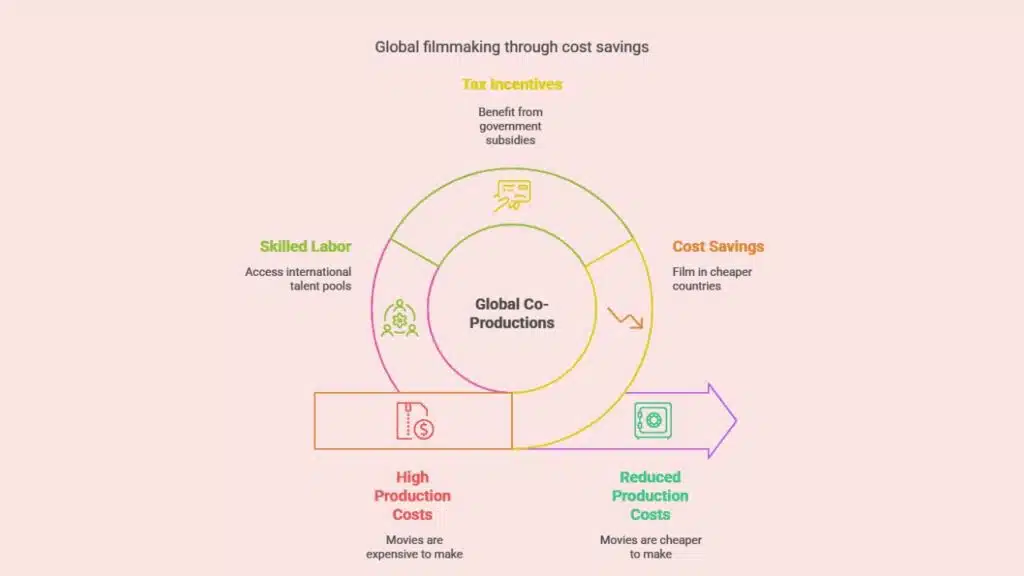
Modern filmmaking is a global endeavor. Even movies financed and distributed by U.S. studios are frequently shot overseas due to:
- Cost savings (especially in countries like Canada, Hungary, New Zealand)
- Generous tax incentives
- Access to skilled labor and diverse landscapes
Films like Dune, James Bond, and Harry Potter are prime examples of global co-productions. Even shows like Emily in Paris are filmed in their titular locations.
That reality led some executives to joke whether Trump’s plan includes taxing movies filmed where the story is actually set.
“If two minutes of a movie are filmed abroad, does that trigger a tariff?” one executive quipped.
Is Trump Targeting Hollywood’s Politics?
The entertainment industry has often been critical of Trump, leading some insiders to question whether the tariff threat is politically motivated.
“Is he trolling us because we didn’t vote for him?” asked a senior studio executive.
Others point out that Trump has long had a strained relationship with Hollywood. However, he has appointed a few allies from the industry—such as Jon Voight, Mel Gibson, and Sylvester Stallone—as informal ambassadors to explore ways to “revive the American film industry.”
According to source, Trump recently met with Voight and producer Steven Paul at Mar-a-Lago to discuss alternative plans to support domestic filmmaking—ones that emphasized tax incentives, not tariffs.
International Reaction: European Film Industry in Shock
The proposal has sparked alarm across Europe, where many U.S. films are shot and post-produced. Countries like the UK, France, Germany, and Hungary host a significant share of American film production.
Variety described “shock and disbelief” among European film studios. “This would be a direct hit to our shared film economy,” said a French production agency.
Retaliatory trade measures are a growing concern. If the U.S. slaps tariffs on foreign films, European and Asian markets may respond in kind—hurting Hollywood’s global reach.
A Misguided Move? The Data Says U.S. Film Is Thriving Abroad
Contrary to Trump’s assertion, the U.S. film industry has maintained a positive trade surplus. According to the Motion Picture Association (MPA):
- In 2023, U.S. films generated $22.6 billion in exports
- The industry maintained a $15.3 billion surplus
- Over 70% of global box office revenue came from international audiences
Such data challenges the narrative that foreign films are hurting the American film economy.
White House Walks It Back—Slightly
On Monday, White House spokesperson Kush Desai told reporters:
“No final decisions on foreign film tariffs have been made. The administration is exploring all options to safeguard national and economic security while Making Hollywood Great Again.”
Meanwhile, Commerce Secretary Howard Lutnick wrote on X (formerly Twitter): “We’re on it,” in response to Trump’s directive.
Trump himself clarified that he plans to meet with Hollywood executives before deciding on a course of action, saying:
“We’re going to meet with the industry; I want to make sure they’re happy about it.”
Some observers believe this could be more of a negotiation tactic—a starting point to pressure studios into agreeing to new domestic production incentives, rather than a finalized policy.
What’s Next?
For now, the industry is left in limbo. While some believe the plan will fade away due to legal and logistical hurdles, others are preparing for potential policy shifts that could reshape international film production as we know it.
Key questions remain:
- How will “foreign” be defined in a globalized industry?
- Will exceptions be made for joint productions?
- Could this lead to an all-out trade war in entertainment?
Regardless of the final outcome, Trump’s proposal has reignited debate over Hollywood’s outsourcing practices, the need for domestic film incentives, and the broader role of government in cultural production.
The Information is Collected from CNN and NBC News.