President Donald Trump said Israel has agreed to an “initial withdrawal line” inside Gaza as part of a U.S.-brokered plan. If Hamas formally confirms, an immediate ceasefire would begin along with a hostage–prisoner exchange and a phased Israeli redeployment.
Israeli Prime Minister Benjamin Netanyahu said Israel is “on the verge of a very big achievement,” and that he hopes during Sukkot to announce the return of all hostages—living and deceased—in one phase. Negotiators are being dispatched to Cairo, Egypt to finalize the technical details. Fighting and airstrikes, however, have not fully halted, underscoring the fragility of the moment.
What Trump announced
In a Truth Social post on Saturday (Oct. 4, 2025, U.S. time), Trump said the United States had “shown and shared” the proposed withdrawal line with Hamas. He added that if Hamas confirms its acceptance, the ceasefire would take effect immediately, triggering the start of a hostage–prisoner exchange and the first phase of Israeli redeployment inside Gaza. Trump framed the announcement as a step toward ending what he called a “3,000-year catastrophe,” while pressing Hamas to “move quickly.”
Key points from Trump’s message:
- A defined initial withdrawal line for the IDF inside Gaza.
- Immediate ceasefire once Hamas confirms.
- Sequenced releases: Israeli hostages and Palestinian prisoners to be exchanged.
- Further phases of withdrawal to follow if phase one holds.
What Israel is saying
In a recorded statement, Prime Minister Netanyahu said Israel is “on the brink of a very big achievement,” emphasizing the deal is not final but expressing hope that all hostages could return within days, potentially during Sukkot. He said that in the first stage, the IDF would redeploy but retain control of key strategic areas inside Gaza, and that he had instructed a team led by Strategic Affairs Minister Ron Dermer to go to Egypt to “nail down the technical details” of releases and sequencing. Israel and the U.S., he added, intend to limit negotiations to a few days to avoid drawn-out haggling.
Netanyahu: “We are on the brink of a very great achievement” as hostage deal nears completionhttps://t.co/tmtEDwLDJG pic.twitter.com/M2GwuGnU59
— The Jerusalem Post (@Jerusalem_Post) October 4, 2025
Hamas’s current position and the sticking points
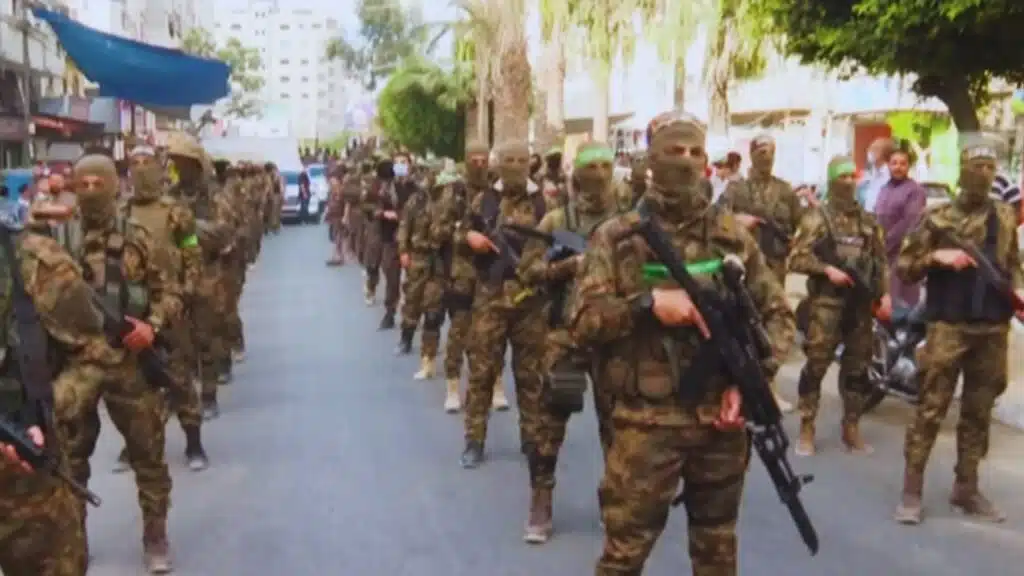
Publicly, Hamas has signaled readiness to enter negotiations around a package that includes a ceasefire, a hostage exchange, and an Israeli withdrawal, but several sensitive terms remain unresolved—notably disarmament and the question of who governs and secures Gaza after the war. These issues are expected to dominate the indirect talks in Cairo in the coming days.
What would phase one look like?
While neither side has published a full legal text, credible reports and on-record statements outline a first phase that would likely include:
- Ceasefire activation once Hamas provides formal confirmation.
- Redeployment of Israeli forces to the “initial withdrawal line,” while keeping a presence in certain “controlling areas.”
- Start of hostage–prisoner exchanges, with early reporting citing the return of living hostages and remains in exchange for a significant number of Palestinian prisoners (figures have varied in press accounts and may be finalized at Cairo).
Important: The exact coordinates of the “initial withdrawal line,” the verification mechanism, and the release lists have not been made public. Those details—plus monitoring and sequencing—are precisely what negotiators are expected to finalize.
Phase two and beyond: demilitarization and governance
Netanyahu has said that Hamas must be disarmed and Gaza demilitarized—ideally through diplomacy under the U.S. plan, but if necessary, by force. That demand intersects with unresolved questions about postwar governance, border security, and reconstruction oversight. Any durable settlement will need to clarify who polices Gaza, how armed groups are handled, and which international actors (e.g., Egypt, the U.S., regional partners, or international organizations) verify compliance and aid flows. These remain open.
Cairo talks: who’s going and what they’ll tackle
Netanyahu said he would send a negotiating team headed by Ron Dermer to Egypt to “finalize the technical details” of the hostage release and to set tight timelines. Mediators are expected to press both sides on verification, timelines for releases, IDF redeployments, and humanitarian corridors. Given the complexity, observers caution that even with momentum, slippage is possible if either side balks at verification terms or sequencing.
Reality check: strikes and casualties continue
Despite Trump’s calls and the diplomatic push, Israeli airstrikes continued on Saturday, with dozens reported killed by local health officials. That underscores the urgency of a verified ceasefire mechanism and how easily the effort could unravel if violence persists while talks are underway. The broader war—triggered by Hamas’s Oct. 2023 attack—has produced massive civilian suffering and international pressure for a negotiated end.
Coalition politics and pressure on both sides
Inside Israel, the idea of a phased withdrawal and potential prisoner releases faces criticism from far-right coalition partners, raising the risk of political instability for Netanyahu if he moves ahead. Hamas, for its part, faces internal and regional pressure to secure relief for Gaza without appearing to capitulate on disarmament or long-term political control. These domestic constraints are a critical variable in whether a ceasefire deal can be implemented and sustained.
Clarifying a claim about B-2 bombers and Iran’s Fordow site
Your provided text mentions Netanyahu thanking Trump for dispatching B-2 bombers to strike Iran’s Fordow nuclear facility. Here’s what reliable reporting supports:
- In June 2025, the U.S. conducted a large strike on three Iranian nuclear sites—Fordow, Natanz, and Isfahan. Reuters reported that the operation was the largest operational strike ever by B-2 bombers, employing GBU-57 “bunker-buster” munitions; satellite imagery and official statements indicated severe damage, though assessments vary on how long Iran’s program was set back. FactCheck.org noted that the attack damaged—but did not obliterate—Iran’s nuclear capabilities.
- As for Netanyahu’s personal “thanks” to Trump in this specific phrasing: some outlets have reported such a remark. Treat that specific quote with caution unless corroborated by multiple high-quality sources; the core facts (B-2 participation and strikes on Fordow) are well-documented by wire services and nonpartisan fact-checkers.
What to watch in the next 48–96 hours
- Formal confirmation from Hamas. This is the trigger for an immediate ceasefire under Trump’s stated sequencing.
- Details from Cairo. Look for documented parameters: geographic coordinates of the initial line, monitoring, and release schedules.
- Humanitarian access. Whether a pause translates into sustained relief operations across Gaza.
- Israeli domestic politics. Signals from coalition partners that could either stabilize or destabilize Netanyahu’s latitude to proceed.
There is real movement toward a ceasefire and hostage releases: Israel says it is close to a major breakthrough, Trump says Israel has agreed to an initial withdrawal line and that a ceasefire would be immediate once Hamas confirms, and negotiators are preparing for Cairo. But core issues—verification, demilitarization, and governance—remain unresolved. Whether this turns a public announcement into a sustained reality depends on those details and on both sides’ willingness—and political ability—to follow through.
The Information is Collected from Fox News and NDTV.