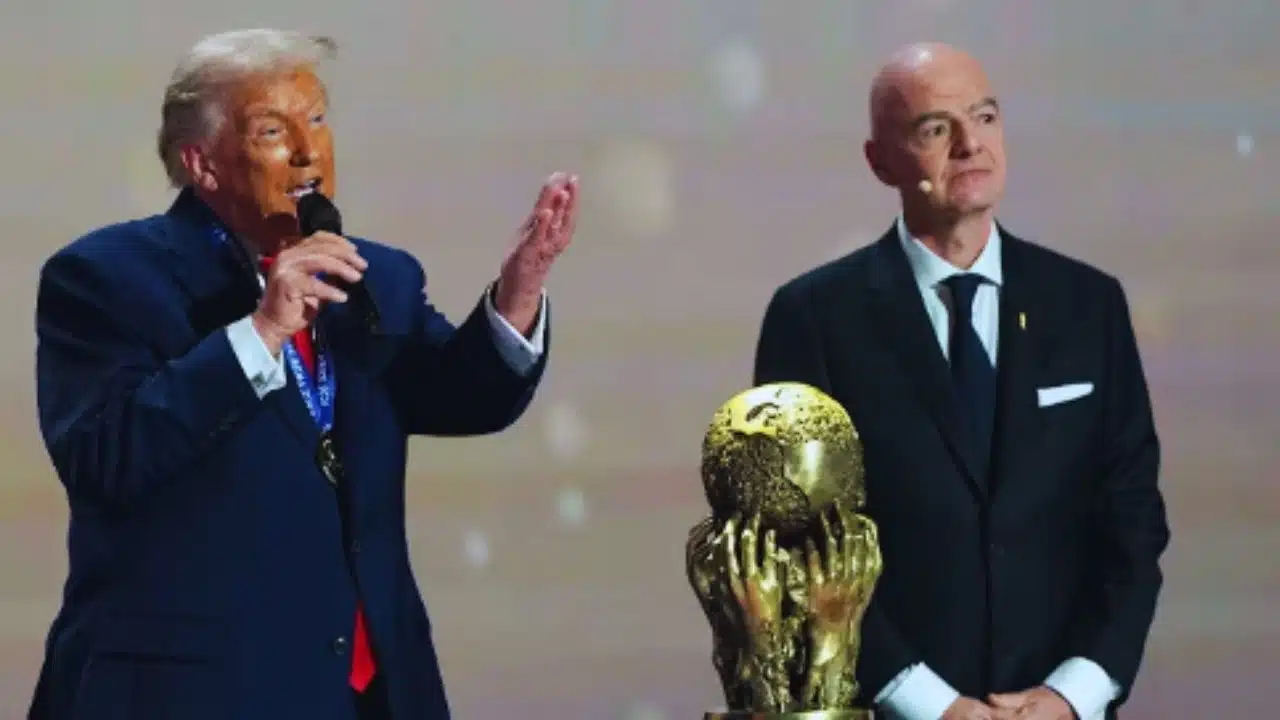
The worlds of global football and international politics came together on Friday, as President Donald Trump was honored with FIFA’s inaugural Peace Prize at the Kennedy Center in Washington, D.C. The ceremony was held alongside the revealing of the World Cup’s group stage draw for 2026, a tournament that will be co-hosted by the United States, Canada, and Mexico. The event was attended by world leaders, sports icons, and the world’s media, as FIFA President Gianni Infantino presented Trump with a gold medal and a unique trophy depicting hands supporting a globe—symbolizing unity and the power of football to bring people together.
Trump received applause as he accepted the honor, describing it as “one of the great honors of my life.” Infantino’s remarks during the ceremony highlighted Trump’s diplomatic achievements, including facilitating the Abraham Accords during his first presidential term and brokering a Gaza ceasefire in his second. The FIFA leader stressed that Trump epitomizes leadership that makes a genuine difference, stating, “This is what we want from a leader—a leader that cares about the people.” The strong relationship between Trump and Infantino was visible throughout the event, with Infantino stating that Trump could always rely on FIFA’s support moving forward.
Peace Prize Sparks Surprise and Criticism
While the award celebration showed unity on camera, the creation of the FIFA Peace Prize drew backlash inside and outside the organization. Many senior figures in FIFA’s leadership were caught off guard by the announcement, with council members revealing they were not consulted or informed before the public press release in November. The lack of transparency troubled long-time observers and led to a flurry of questions about the legitimacy and intent of the award.
The controversy deepened when Human Rights Watch sent a formal letter to FIFA, demanding clarity on the creation, nomination process, and the makeup of the judging panel for the Peace Prize. Human Rights Watch’s Minky Worden spoke on the issue during a press conference, stating, “There is no process, there are no nominees, and there is no jury”—raising questions about whether the award genuinely reflected global opinions or was more a product of FIFA’s internal politics. Despite requests, FIFA did not respond to Human Rights Watch or other media inquiries on these matters.
The timing of the award added fuel to the fire, emerging only three weeks after Trump did not receive this year’s Nobel Peace Prize, which was instead awarded to Venezuelan opposition leader María Corina Machado for her role in championing democracy and human rights. Critics have also highlighted Trump’s recent foreign policy decisions, including increased military activity near Venezuela and controversial immigration rhetoric, as being at odds with the spirit of a peace prize.
World Cup 2026: A Historic Tournament in the Making
Amidst the debate over the Peace Prize, preparations for the 2026 FIFA World Cup are now in full swing. Trump established a White House task force earlier this year dedicated to overseeing every aspect of the tournament’s preparations. As co-host, the U.S. will welcome the majority of games, hosting 11 of the 16 total host cities. The championship final is set for July 19, 2026, at MetLife Stadium in East Rutherford, New Jersey, which is already undergoing upgrades to reflect the magnitude of the event.
The group stage draw—an eagerly watched segment of the night—saw hosts selecting their groups in person. Trump took the stage to place the United States in Group D, while Mexico’s President-elect Claudia Sheinbaum and former Canadian banker Mark Carney picked groups for their countries. The draw produced exciting matchups:
- Group A: Mexico, South Africa, Korea Republic, UEFA Playoff D Winner
- Group B: Canada, UEFA Playoff A Winner, Qatar, Switzerland
- Group C: Brazil, Morocco, Haiti, Scotland
- Group D: USA, Paraguay, Australia, UEFA Playoff C Winner
- Group E: Germany, Curaçao, Côte D’Ivoire, Ecuador
- Group F: Netherlands, Japan, UEFA Playoff B Winner, Tunisia
- Group G: Belgium, Egypt, Iran, New Zealand
- Group H: Spain, Cabo Verde, Saudi Arabia, Uruguay
- Group I: France, Senegal, FIFA 2 Winner, Norway
- Group J: Argentina, Algeria, Austria, Jordan.
Joining the leaders onstage were international stars such as Shaquille O’Neal, highlighting the global spirit and excitement around the tournament.
Economic and Political Ripples
The 2026 World Cup is forecasted to have a profound impact on North America, with organizers estimating that eight million international visitors will participate, generating about $40 billion in economic activity. The selection of the Kennedy Center as the venue for the draw—despite the cancellation of holiday shows—was reportedly pushed by Trump, illustrating his direct involvement in the event’s image and logistics. Trump’s longstanding connection with FIFA and Infantino has only grown stronger in recent years, with regular meetings and even discussions of FIFA using office space in Trump Tower.
Infantino continues to defend his close relationship with Trump, insisting that their partnership is vital for the World Cup’s success. As the tournaments approaches, questions about FIFA’s governance and independence, as well as Trump’s influence on global sporting events, remain central topics among both fans and political observers.
In sum, Trump accepting FIFA’s first Peace Prize marks an unprecedented intersection of sport, diplomacy, and controversy that will be discussed well beyond the final whistle of the 2026 World Cup.