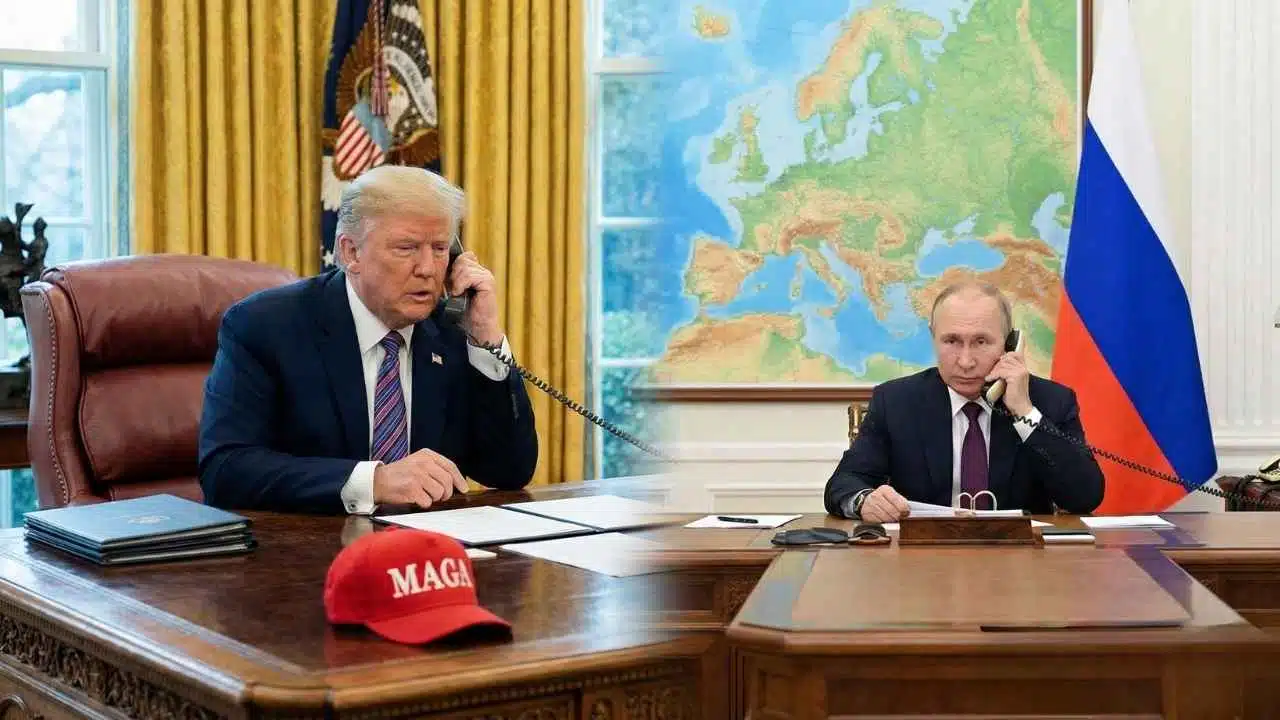
In a significant geopolitical shift that complicates the path to peace, the Kremlin announced Sunday that Russian President Vladimir Putin and U.S. President Donald Trump have jointly opposed a European-Ukrainian proposal for a temporary ceasefire. The rejection comes amidst a high-stakes diplomatic flurry, with Moscow hardening its stance that Ukraine must cede full control of the Donbas region before any lasting peace agreement can be signed.
Kremlin foreign policy aide Yuri Ushakov disclosed that the two leaders spoke by phone for one hour and 15 minutes on Sunday, just hours before President Trump’s pivotal summit with Ukrainian President Volodymyr Zelenskyy at Mar-a-Lago.
“The option of a temporary ceasefire proposed by the Ukrainians and the Europeans… only leads to a prolongation of the conflict and is fraught with renewed hostilities.” — Yuri Ushakov, Kremlin Foreign Policy Aide
During the call—described by Trump on Truth Social as “good and very productive”—the leaders reportedly agreed to establish two joint working groups focused on security and economic issues to fast-track a final resolution, effectively bypassing the concept of a temporary truce.
The Donbas Ultimatum: “Bold Decisions” Required
Russia, which currently occupies approximately 90% of the Donbas region, has issued a de facto ultimatum: Kyiv must withdraw its forces from the remaining 10% of the territory to end the war. Ushakov framed this demand as a necessary “bold decision” for the Ukrainian leadership, citing the deteriorating situation on the front lines.
Frontline Flashpoints: Huliaipole & Myrnohrad
Tensions have spiked following President Putin’s claim on Saturday that Russian forces had captured the strategic logistics hubs of Huliaipole (Zaporizhzhia region) and Myrnohrad (Donetsk region). Putin warned that if a peaceful transfer is refused, Russia will achieve its goals “by force.”
-
Russian Claim: Full control of both towns.
-
Ukrainian Response: The General Staff explicitly rejected these assertions as false, stating that “defensive operations” are ongoing and the towns remain contested.
-
Independent Assessment: Recent data from the Institute for the Study of War (ISW) suggests Russian forces control approximately 50-55% of these urban areas, with fierce urban combat continuing in the remaining sectors.
Leaked Details: The “Free Economic Zone” & Security Clauses
While the full text of the peace plan remains classified, sources close to the negotiations have leaked pivotal details of the 20-point proposal currently on the table at Mar-a-Lago. These details suggest a shift from traditional territorial concessions to complex administrative compromises.
-
The Donbas Compromise: Instead of a simple cession of territory, U.S. negotiators have proposed a “Free Economic Zone” in the Russian-occupied Donbas. This would theoretically allow Ukraine to withdraw troops without legally recognizing Russian sovereignty. However, Moscow has yet to agree to the specific mechanics, particularly regarding customs and governance.
-
15-Year Security Deal: Zelenskyy reportedly pushed for permanent security guarantees, but the current draft offers a 15-year binding security agreement with the U.S. and European allies. Zelenskyy stated on X (formerly Twitter) that this component is “100% agreed” upon by the Western partners.
-
Nuclear Standoff: Control of the Zaporizhzhia Nuclear Power Plant (ZNPP) remains a major hurdle. Ukraine is proposing a split-control model involving international monitors, while the Kremlin insists on retaining full administrative oversight or a “joint management” structure that excludes hostile Western powers.
High-Stakes Summit at Mar-a-Lago
President Trump and President Zelenskyy met Sunday afternoon at 3 p.m. local time in Palm Beach to hammer out the final details of the comprehensive peace proposal, which Zelenskyy stated is “90% ready.” The meeting included high-level U.S. officials, including Secretary of State Marco Rubio and Defense Secretary Pete Hegseth, alongside Trump’s key negotiators, Steve Witkoff and Jared Kushner.
Key Issues on the Table:
-
Territorial Integrity: Ukraine and European allies fear a deal may force the permanent cession of territory, a concern heightened by the daily loss of 12–17 square kilometers of land to Russian advances throughout 2025.
-
Security Guarantees: Zelenskyy is pushing for binding security assurances. Reports indicate a U.S. offer of a 15-year security guarantee, though Kyiv initially sought a permanent arrangement.
European Fallout: The “Coalition of the Willing”
The exclusion of European leaders from the primary Trump-Putin axis has triggered a rapid response in EU capitals, revealing deep fractures in the Western alliance’s approach to the endgame.
-
Paris Summit Announced: Following a call with Trump and Zelenskyy, French President Emmanuel Macron announced he will convene a “Coalition of the Willing” meeting in Paris in early January. The goal is to finalize Europe’s concrete contributions to the security guarantees, ensuring the continent isn’t sidelined by a Washington-Moscow deal.
-
EU Warning: European Commission President Ursula von der Leyen welcomed the “progress” but warned that any deal must include “ironclad security guarantees from day one,” signaling Brussels’ fear that a rushed deal could leave the continent vulnerable to future Russian aggression.
-
Russian Pushback: Meanwhile, Russian Foreign Minister Sergey Lavrov explicitly labeled the EU the “main obstacle” to peace, accusing Brussels of sabotaging the Trump-led initiative by fueling ongoing resistance.
The Referendum “Catch-22”
A major logical contradiction has emerged in the peace process, creating a potentially insurmountable deadlock. President Zelenskyy has stated he is willing to submit the final peace deal to a national referendum, but emphasized this can only happen under a 60-day ceasefire to ensure a free and safe vote.
-
The Deadlock: With Putin and Trump today explicitly rejecting a temporary ceasefire as a “pretext” for delay, it is unclear how Zelenskyy can legally or politically ratify any deal involving territorial compromises. Without a ceasefire, a referendum is impossible; without a referendum, Zelenskyy lacks the mandate to sign away territory.
The Path Forward
President Trump, who has repeatedly vowed to end what he terms the “deadliest conflict in Europe since World War II,” expressed optimism following his call with Putin, stating, “I think he is serious about peace.” However, with the rejection of a temporary truce, the pressure is now squarely on Kyiv to accept difficult territorial compromises or face an intensified Russian offensive.