

The way we travel is changing faster than ever. In just a few years, we’ve moved from paper tickets and one-size-fits-all package tours to mobile boarding passes, instant price comparison, and ultra-personalized recommendations. Low-cost airlines reshaped the skies, home-sharing disrupted hotels, and remote work turned the world into an office for millions of digital nomads.
Now, the travel and tourism industry stands at another turning point. Technology, climate pressure, shifting demographics, and geopolitics are all colliding. The result is a future where trips are smarter, more data-driven, and more responsible — but also more complex.
Let’s explore 18 bold, research-informed travel predictions for the next decade. These are not science fiction fantasies. They are grounded in current tourism trends, early policy experiments, and real investments already underway.
We look at the future of travel through three lenses:
- How technology and AI will transform planning and booking.
- How climate change and sustainability will reshape where and how we move.
- How societies, governments, and travelers will respond to a more volatile world.
By the end, you will have a clearer picture of what travel might look like by around 2035—and what it means for travelers, businesses, and policymakers.
What Will Shape Travel by 2035?
Before diving into specific tourism trends, it helps to understand the main forces that will drive travel predictions for the next decade.
1. Technology and AI Everywhere
AI will sit behind most travel platforms. From dynamic pricing to personalized itineraries and predictive maintenance for aircraft, algorithms are already influencing decisions.
In the next ten years, this influence will expand into:
- Real-time disruption management.
- Hyper-personalized travel suggestions.
- Automated customer support is available in any language.
Travel technology innovations will not be a side story; they will be the backbone of the tourism industry.
2. Climate Crisis and Net-Zero Tourism
Travel is under intense scrutiny for its emissions. Aviation, cruising, and mass tourism are all being pushed to decarbonize.
Targets for net-zero tourism and climate-friendly infrastructure will influence:
- How often do people fly?
- Which destinations grow or shrink?
- How governments regulate airlines, hotels, and tour operators.
Sustainable travel will move from niche choice to mainstream expectation.
3. Remote Work, Ageing Populations, and Gen Z Preferences
Digital nomadism trends are reshaping visa policies and urban neighborhoods. At the same time, societies are ageing while younger generations bring different values to travel, prioritizing experiences, mental health, and ethical choices.
4. Geopolitics, Regulation, and Risk
Travel corridors, changing visa rules, regional blocs, and security concerns will continue to alter routes and hubs. A more fragmented world will not stop tourism, but it will change its shape.
With this backdrop in mind, let’s explore 18 major travel predictions for the next decade.
18 Bold Travel Predictions for the Next Decade
The next decade will transform global travel through powerful shifts in technology, climate resilience, traveler behavior, and geopolitical dynamics. These 18 predictions highlight how AI, sustainability pressures, new mobility patterns, and evolving social values will reshape the way we explore the world.
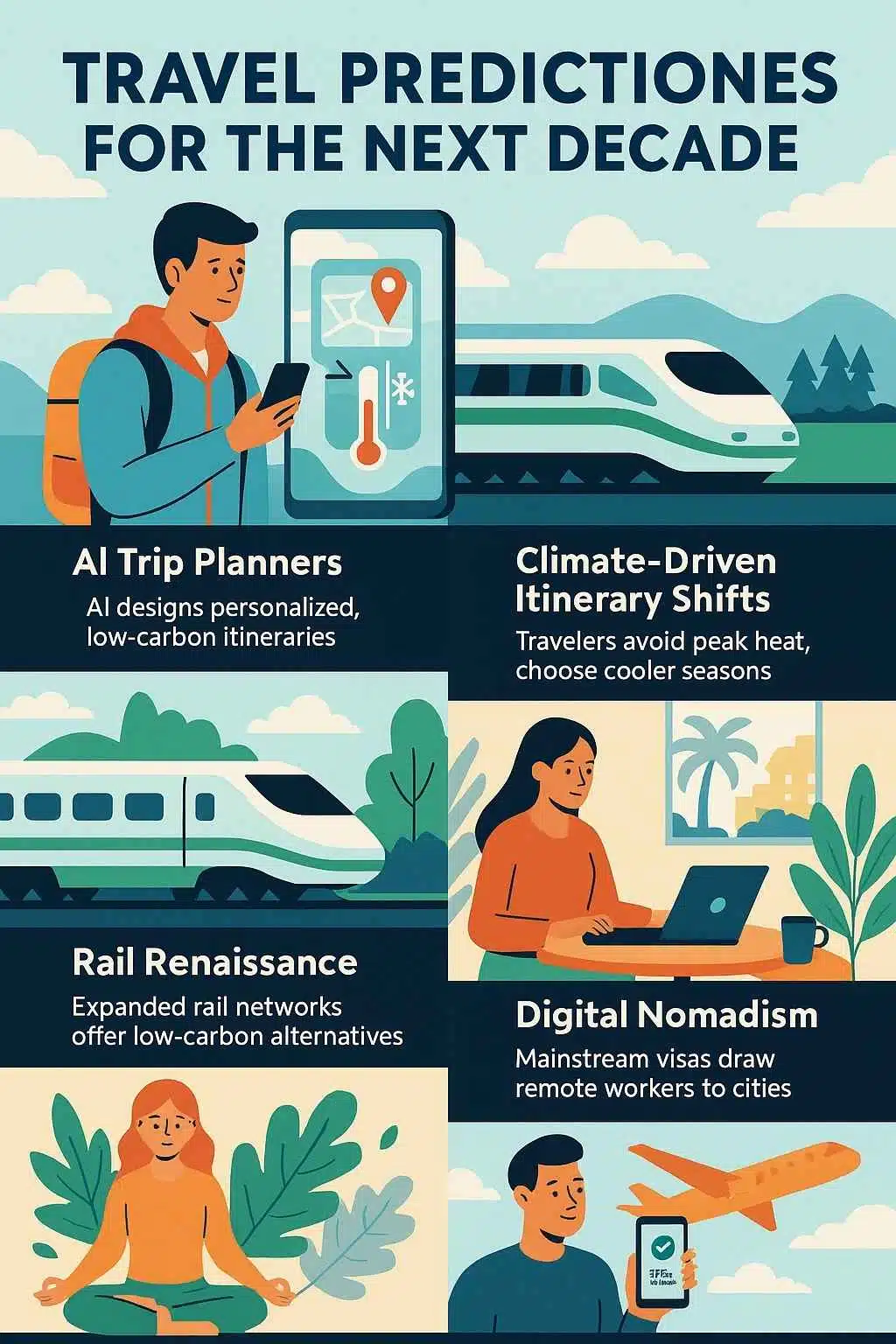
1. AI Trip Planners Become the Default Starting Point
Within a few years, most travelers will turn first to an AI-powered assistant rather than a traditional search box.
These tools will:
- Design end-to-end itineraries in seconds.
- Compare flights, rail, hotels, and experiences across hundreds of options.
- Adjust instantly when a delay, strike, or weather disruption hits.
Instead of browsing dozens of tabs, travelers will ask, “Plan me a seven-day, low-carbon, family-friendly trip to Southern Europe in April,” and receive a complete, bookable plan.
Implication: Human agents will still matter for complex or luxury trips, but AI will dominate everyday planning and become the backbone of customer support across the future of the tourism industry.
2. Travel Pricing Becomes Hyper-Personalized
Expect pricing to feel more like streaming or ride-hailing platforms.
Over the next decade:
- Algorithms will set fares based not only on demand, but on loyalty status, flexibility, booking history, and even sustainability preferences.
- Dynamic bundles (flight + hotel + local transit) will be priced uniquely for each user.
- Loyalty programs will expand into full ecosystems that include banks, retailers, mobility apps, and wellness brands.
For travelers, this can mean better deals if they share data and commit to a brand ecosystem. It can also raise questions about fairness and transparency.
3. Biometrics, Digital Passports, and Smart Borders Go Mainstream
Single-line queues and manual passport stamping will gradually give way to:
- Biometric gates that recognize your face or fingerprint in seconds.
- Secure digital identities stored on your phone.
- Pre-cleared security profiles for frequent travelers.
Smart airports will use sensors and real-time data to manage flows, reduce waiting times, and reroute passengers during disruption. These technologies improve efficiency but also intensify debates about privacy and surveillance.
4. Climate-Driven Itinerary Shifts: Chasing Cooler Seasons
As heatwaves, wildfires, and extreme weather become more frequent, traditional high season patterns will be disrupted.
- Some Mediterranean and tropical destinations may find peak summer increasingly uncomfortable or even unsafe.
- Shoulder seasons—spring and autumn—could become the new prime periods.
- Cooler destinations, higher latitudes, and mountains are likely to see increased interest.
Travelers will search more for “best time to go” based on temperature and climate risk, pushing tourism boards to reposition their calendars and invest in climate-resilient infrastructure.
5. Carbon Scores and Net-Zero Itineraries Become Standard
One of the clearest tourism trends for 2035 will be the rise of transparent carbon information:
- Booking platforms will display carbon scores for different routes and accommodation types.
- Travelers will be able to filter by emissions as easily as by price or rating.
- Corporations will adopt stricter travel policies with carbon budgets, especially for business trips.
Over time, high-emission options such as ultra-short flights on routes with strong rail alternatives may face higher taxes, fees, or social pressure. Eco-friendly travel options will move from marketing slogan to operational reality.
6. Rail Renaissance and Night-Train Networks
As governments and travelers seek low-carbon alternatives, rail will enjoy a significant revival:
- High-speed rail lines will expand in regions where population density and policy support align.
- Night trains will become more comfortable, with private cabins, Wi-Fi, and curated food experiences.
- Multi-modal tickets will integrate local buses, metros, and shared micromobility into a single booking.
This rail boom will not be limited to Europe. Parts of Asia, the Middle East, and even some longer-term North American corridors will explore or expand major rail projects as part of the sustainable travel future.
7. Overtourism Pushes Destinations to Impose Hard Limits
Overtourism will force cities and natural sites to move from gentle nudges to strict controls:
- Daily caps on visitor numbers in historic districts and national parks.
- Reservation systems for popular viewpoints and hiking trails.
- Entry fees for day-trippers to iconic locations.
At the same time, undertourism—regions with rich culture but low visitation—will be actively promoted. Tourism boards will design campaigns to spread visitors across wider areas, easing pressure on hotspots and boosting local economies elsewhere.
8. “Playlist Travel”: Multi-Stop Regional Trips Replace Single Destinations
Instead of flying to one city and staying put, more travelers will design multi-stop itineraries within a region.
- A rail and food journey through three European capitals.
- Island-hopping routes across Southeast Asia.
- Road and rail combinations that explore both major cities and small towns.
Travel platforms will respond by offering pre-designed “trip playlists” that bundle several destinations into a single, flexible package. Visa arrangements and regional passes will support this trend, especially in blocs where cross-border travel is being liberalized.
9. Digital Nomadism Becomes a Mainstream Mobility Channel
Digital nomadism trends will mature beyond a lifestyle niche and become an accepted form of temporary migration.
- More countries will introduce or refine digital nomad visas, often with clear income thresholds and tax rules.
- Cities will compete on co-working spaces, broadband quality, safety, walkability, and cultural offerings.
- Co-living brands will expand, offering membership models that include housing, offices, and local experiences across multiple cities.
The challenge will be managing housing pressure and inequality. Local residents may push for safeguards to prevent neighborhoods from becoming unaffordable, leading to new regulations and tax models.
10. Wellness, Longevity, and Mental Health Travel Explodes
Travel will increasingly be framed as an investment in health:
- Wellness retreats will evolve into integrated programs focused on sleep, stress, menopause, burnout, fitness, and nutrition.
- Destinations will blend traditional healing (such as Ayurveda or thermal spas) with advanced diagnostics and personalized treatments.
- “Digital detox” programs will gain traction as people seek time away from always-on screens.
The wellness travel trend will touch every segment of the industry—from spas and resorts to airlines and airports, designing calmer, healthier spaces.
11. Ageing and Multi-Generational Travel Reshape Product Design
As populations age, demand for accessible travel will soar:
- Hotels, cruises, and attractions will invest more in step-free access, clear signage, mobility support, and medical backup.
- Multi-generational trips (grandparents, parents, and children traveling together) will drive demand for villas, family cabins, and flexible activities.
- Age-friendly itineraries will place comfort, healthcare access, and shorter travel times at the center of product design.
Brands that treat accessibility as a core feature—not an afterthought—will gain a strong competitive edge.
12. Community-Led and Indigenous Tourism Moves to the Centre
Travelers are increasingly aware of the social impact of their trips.
Over the next decade:
- More experiences will be co-designed and led by local and indigenous communities.
- Authentic storytelling, language, and cultural practices will be central to itineraries instead of optional add-ons.
- Certification schemes will help travelers identify experiences that are genuinely fair and beneficial.
This shift will challenge “extractive” models of tourism and push brands to prove how much money stays in the local economy.
13. Augmented Reality, Virtual Reality, and Destination Digital Twins
Mixed reality will change how travelers plan and experience trips:
- Augmented reality (AR) layers will provide live translations, historical reconstructions, or art overlays as travelers move through cities.
- Virtual reality (VR) previews will help people explore hotels, cabins, museums, and even hiking routes before booking.
- Cities and resorts will develop “digital twins”—virtual replicas used to simulate crowd flows, climate risks, and infrastructure changes.
These travel technology innovations will not replace in-person experiences, but they will set expectations and help manage demand more intelligently.
14. Travel in a Fragmented World: Corridors, Blocs, and New Gateways
Geopolitics will continue to shape the future of travel:
- Regional blocs may deepen cooperation, leading to expanded visa-free areas and shared airspace agreements.
- Some destinations could become harder to reach due to sanctions, instability, or security concerns.
- New hub airports will emerge or strengthen in the Gulf, South Asia, and parts of Africa, positioning themselves as global connectors.
Travelers will need to stay more informed about political risk, insurance requirements, and shifting regulations.
15. Safety, Resilience, and Insurance Become Central to Trip Planning
Climate disasters, cyberattacks, health risks, and social unrest will make resilience a core concern:
- Travelers will pay more attention to cancellation policies, medical coverage, and evacuation options.
- Platforms may offer “risk dashboards” that show health advisories, weather alerts, and safety scores for destinations.
- Insurance products will become more flexible, with options for instant rebooking, cash payouts, and on-trip support.
Destinations that invest in resilient infrastructure and transparent risk communication will be more attractive in the long run.
16. Space and Edge-of-Space Tourism Stay Niche but Influential
Space tourism will likely remain limited to very wealthy travelers in the next decade.
However, its symbolic impact will be large:
- It will fuel debates about climate responsibility and inequality in travel.
- “Edge-of-space” experiences—such as high-altitude balloon flights and dark-sky reserves—will become more accessible, giving people a taste of the cosmic perspective without rocket emissions.
- Destinations with exceptional stargazing conditions will brand themselves around astronomy tourism.
Even if only a tiny fraction of people ever go to space, the narrative of “planetary travel” will shape how we think about Earth-bound journeys.
17. Subscription and Membership Models Turn Travel into a Utility
The concept of “all-you-can-travel” will mature:
- Airlines, rail companies, and bus networks will offer subscription passes for a certain number of monthly trips or unlimited travel within defined zones.
- Co-living and co-working brands will bundle stays across multiple cities into membership programs.
- Some consumers will budget for travel the way they do for streaming services—via predictable monthly payments.
For frequent travelers and remote workers, this could reduce friction and encourage more spontaneous trips, while also deepening brand loyalty.
18. Travel as an Ethical and Climate Responsibility Choice
Finally, one of the most important travel trends 2030 and beyond will be ethical awareness:
- Younger generations in particular will weigh climate impact, labor rights, and local benefits when choosing where and how to travel.
- Social media will amplify both positive and negative examples of tourism behavior.
- New “impact ratings” will grade trips on carbon footprint, social contribution, and biodiversity protection.
In this vision, bragging rights shift from distance covered to quality and responsibility: fewer but longer trips, more immersive stays, and deeper respect for places and people.
How Travelers, Businesses, and Governments Should Prepare
The coming decade will demand smarter decisions from everyone involved in travel. Travelers will need to prioritize resilience, sustainability, and digital tools; businesses must reinvent services through decarbonization, accessibility, and community partnerships; and governments will play a critical role in shaping policies, infrastructure, and visitor management.
For Travelers
- Plan with purpose
- Consider taking fewer, longer trips instead of many short ones.
- Use carbon labels and sustainability filters when booking.
- Embrace smart tools, but stay in control
- Use AI travel planners to save time and compare options, but double-check important details.
- Keep a balance between personalization and data privacy.
- Build resilience into every journey
- Prioritize flexible tickets, robust insurance, and emergency plans.
- Travel in shoulder seasons to avoid heat, crowds, and high prices.
For the Travel and Hospitality Industry
- Invest in decarbonization and transparency
- Improve energy efficiency, adopt cleaner fuels where possible, and measure emissions honestly.
- Offer clear information on environmental impact to support sustainable travel choices.
- Redesign products for accessibility and ageing
- Make barrier-free access, clear communication, and medical support standard, not premium.
- Create offerings tailored to multi-generational families and solo older travelers.
- Partner with local communities
- Share revenue fairly and support community ownership of tourism assets.
- Co-create experiences that preserve cultural heritage and avoid commodifying it.
- Upgrade digital infrastructure
- Integrate AI responsibly for customer service, personalization, and reputation monitoring.
- Protect customer data against cyberthreats.
For Governments and Destinations
- Align tourism with climate and development goals
- Set clear emissions targets for tourism and integrate them into national climate plans.
- Support rail infrastructure, public transport, and active travel options.
- Manage visitor flows proactively
- Use data and digital twins to forecast peaks, protect fragile sites, and improve crowd management.
- Implement visitor caps or reservation systems where needed to prevent overtourism.
- Modernize visas and labor rules
- Develop clear frameworks for digital nomads, seasonal workers, and cross-border tourism professionals.
- Ensure that growth in tourism does not undermine housing or local services.
Final Thought: Writing the Next Chapter of Travel
The future of travel will not be shaped by technology alone. It will be written by the choices of travelers, businesses, and governments reacting to climate realities, social expectations, and geopolitical shifts.
These 18 bold travel predictions for the next decade show a world where:
- AI and data make trips smarter and more seamless.
- Climate change alters when and where we go.
- Ethics, wellness, and community impact matter as much as price and convenience.
Travel will remain a powerful source of discovery, connection, and opportunity. But in the coming decade, it will also become a clearer test of our values. Whether you are a frequent flyer, a digital nomad, a tourism operator, or a policymaker, now is the time to ask:
How will I travel—and how will I help others travel—in a way that respects both people and the planet over the next ten years?
Quick FAQs: Travel Predictions for the Next Decade
What will travel look like in 2035?
By around 2035, travel is likely to be more personalized, more digital, and more climate-aware. AI planners, biometric borders, and integrated rail networks will make journeys smoother, while carbon labels, wellness travel, and community-led tourism will reshape the choices people make.
How will climate change affect where we travel?
Climate change will push travelers away from extremely hot or disaster-prone destinations during peak seasons. Cooler regions, mountains, and off-season travel will gain popularity. Destinations that invest in climate-resilient infrastructure and clear risk communication will have a strong advantage.
Will business travel decline in the next decade?
Traditional business travel is unlikely to return fully to its past patterns, as video calls and hybrid work remain common. However, trips that deliver high relationship value—conferences, strategic meetings, and incentive travel—will continue, often with a stronger focus on sustainability and carbon budgets.
Are digital nomad visas here to stay?
Yes. Many countries see digital nomads as a valuable source of long-stay spending and global talent. Over the next decade, digital nomad visas will likely become more structured, with clearer tax rules, income thresholds, and residency rights.
How can I make my trips more sustainable over the next 10 years?
You can reduce flights where alternatives exist, choose rail or bus for regional routes, travel for longer but less often, stay in certified sustainable accommodation, and support community-led experiences. Paying attention to carbon scores and local impact is one of the most effective ways to align personal travel with a sustainable travel future.






























