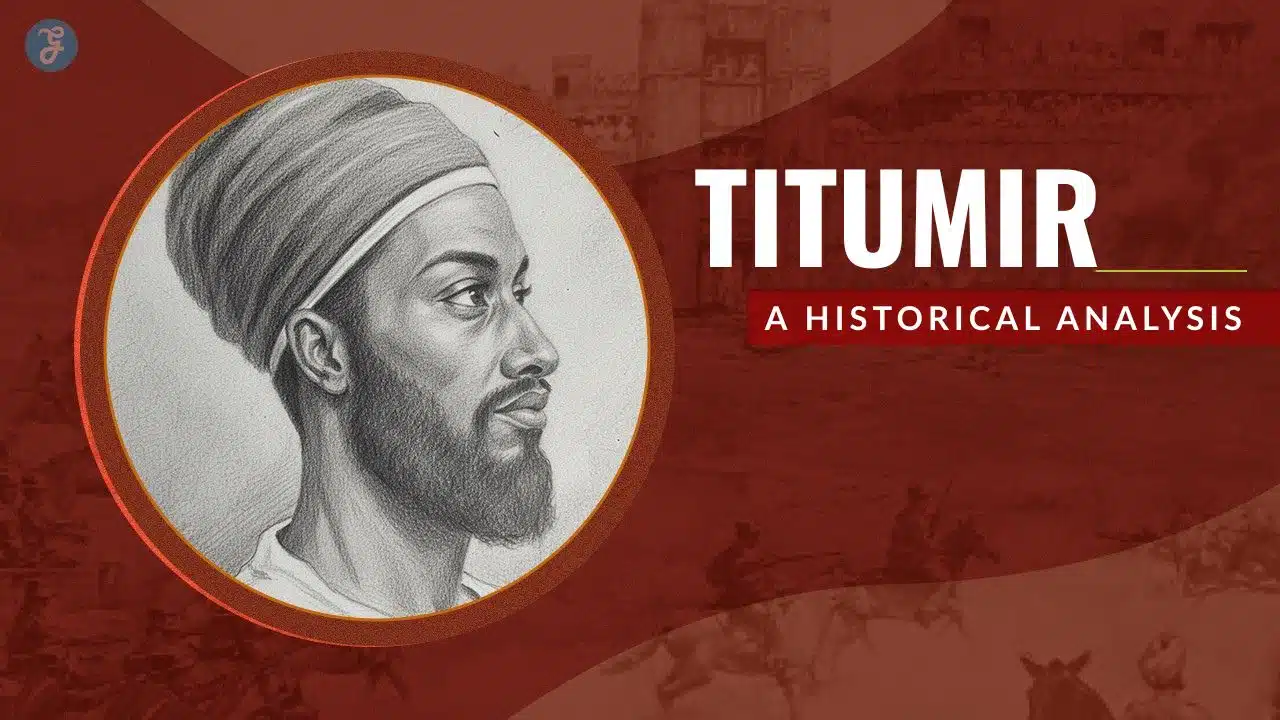
You know how the history of India’s freedom struggle often jumps from the Battle of Plassey straight to the great Revolt of 1857. This common framing can make you wonder about the decades in between, especially about the role of early Bengali Muslim resistance fighters. One of the most significant is Titumir.
Syed Mir Nisar Ali, better known as Titumir, constructed a legendary bamboo fort and orchestrated an armed peasant uprising against both the exploitative zamindars (landlords) and the British East India Company. His rebellion was a landmark event, showcasing a powerful blend of religious revivalism and agrarian protest that sent shockwaves through early colonial Bengal.
In this analysis, we’ll explore why Titumir is such a crucial figure in South Asian history. We will look at how he merged Islamic theology with a fight for peasant rights, what made his bamboo fort an enduring symbol of defiance, and why his final battle cemented his legacy for generations.
Key Takeaways
- Titumir, born Syed Mir Nisar Ali in 1782, was a Bengali freedom fighter who led a peasant revolt against the British East India Company and the oppressive zamindari system.
- After his Hajj to Mecca in 1822, he was deeply influenced by the revivalist preacher Syed Ahmad Barelvi and began a movement for religious and social reform among Bengali Muslims.
- His famous bamboo fort, built in Narikelberia in 1831, became the epicenter of his armed resistance, symbolizing the power of rural peasants using local materials to challenge a colonial superpower.
- On November 19, 1831, the British army destroyed the fort with cannons; Titumir died fighting and is remembered as a “Shaheed” (martyr). His nephew and commander, Ghulam Masum, was executed, and hundreds of followers were imprisoned.
- His uprising is considered a precursor to larger freedom movements, including the First War of Independence in 1857, and is studied by historians like Atis Dasgupta and immortalized in literature by authors like Mahasweta Devi.
- Titumir remains a celebrated figure in modern Bangladesh, honored with the naming of Government Titumir College in Dhaka and the naval base BNS Titumir.
Who was Titumir and What was His Early Life Like?
Syed Mir Nisar Ali, who would become famously known as Titumir, was born on January 27, 1782, in the village of Chandpur in the 24 Parganas district of Bengal, then under British rule. His family traced their lineage to Mir Sayyid Shahadat Ali, a preacher who had migrated from Persia to spread Islam.
His father was Syed Mir Hasan Ali, and his mother was Abidah Ruqayyah Khatun.
From a young age, Titumir showed great promise. He received his education at a local madrasa, becoming a hafiz (one who has memorized the Quran) by the age of 20. He was also skilled in Bengali, Arabic, and Persian. Beyond his scholarly pursuits, he was a talented wrestler and gymnast, which led him to work as a bodyguard for a local zamindar.
This role gave him a front-row seat to the injustices of the zamindari system. His time in this position was cut short after he was imprisoned following disputes with landowners over their high taxes on farmers. This experience was formative, hardening his resolve against the oppressive structures of both the local elite and the British East India Company. After his release, he embarked on the Hajj pilgrimage to Mecca in 1822, a journey that would profoundly shape his future as a leader of resistance.
Religious and Political Activism
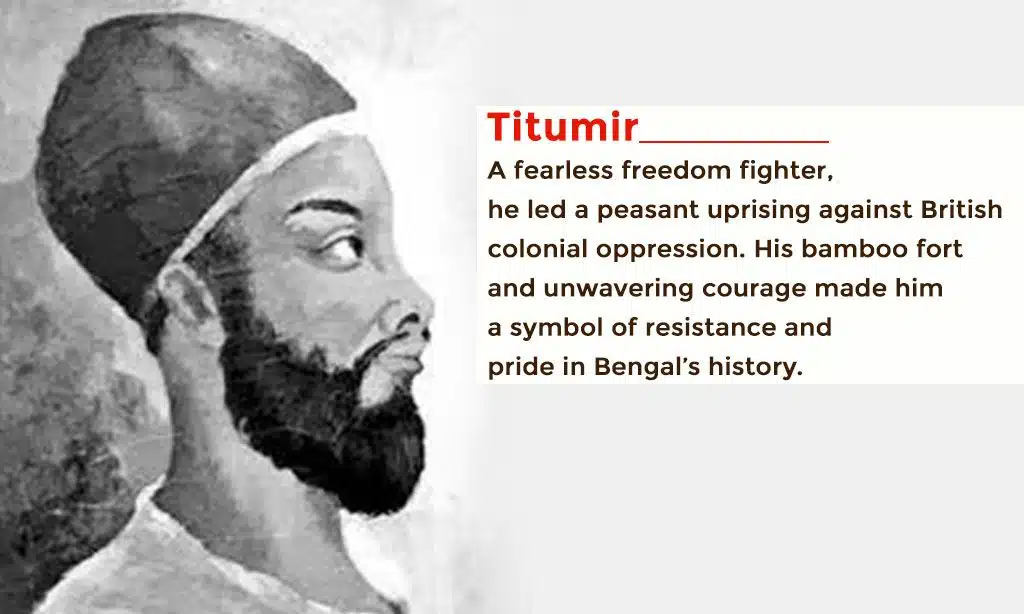
Titumir returned from his pilgrimage with a renewed mission to purify Islamic practices and fight for social justice. His activism was deeply influenced by the teachings he encountered in Mecca, leading to a powerful movement that challenged both religious and political norms in Bengal.
What was Titumir’s role in Islamic revivalism?
During his time in Mecca, Titu Mir met and became a disciple of “Syed Ahmad Barelvi,” a prominent Islamic reformer and a central figure in the “Tariqah-i-Muhammadiya” movement. This movement aimed to purge Indian Islam of what its leaders saw as corrupting influences and un-Islamic practices, such as the veneration of Sufi graves and the adoption of local customs.
Upon his return to Bengal in 1827, Titumir began preaching this revivalist message with great passion. He urged the Bengali Muslim peasantry to return to the core tenets of Islam. His fatwas (religious edicts) called for men to grow beards and women to wear burqas, establishing a distinct identity for his followers.
His goal was not just spiritual purification but also social liberation. He directly linked the economic oppression of the peasants to the power structures of the Hindu zamindars and the British East India Company, framing his movement as a struggle for both faith and justice.
How did Titumir lead the Wahabi movement?
While often associated with the term “Wahabi,” Titumir’s movement is more accurately described as part of the Tariqah-i-Muhammadiya, inspired by Syed Ahmad Barelvi. He adapted these revivalist ideas to address the specific grievances of the Bengali peasantry, who were suffering under the economic pressures of the Permanent Settlement of 1793. This system had empowered a new class of zamindars, who often imposed crippling taxes and rents.
Titumir’s message found a receptive audience among the poor and landless. He preached that resisting the injustice of the zamindars and the British was a religious duty. His movement grew rapidly, with some estimates suggesting his followers numbered up to 15,000.
He blended Islamic teachings with a direct challenge to colonial and feudal authority. This unique combination turned his religious movement into one of the earliest mass uprisings in South Asia against the British army and their local allies, setting the stage decades before the more widely known Sepoy Mutiny of 1857.
Peasant Uprising and Resistance
Titumir’s campaign for religious reform quickly evolved into a full-blown peasant rebellion. His confrontation with the local landlords and the British colonial authorities was direct and uncompromising, culminating in the construction of his famous bamboo fort as a bastion of defiance.
How did Titumir confront the Zamindars?
The conflict escalated in June 1830 when **Krishnadeva Rai**, the zamindar of Punra, imposed a punitive “beard tax” on Muslim tenants who followed Titumir’s teachings. This tax was a direct challenge to the religious identity of Titumir’s followers and served as the final spark for open conflict.
Titumir advised the peasants to refuse payment. In retaliation, Krishnadeva’s forces attacked a village and destroyed a mosque. This led Titumir’s followers to organize and fight back. His movement wasn’t limited to a single landlord; he also confronted other powerful zamindars like Kaliprasanna Mukherjee of Gobardanga and Debnath Roy of Gobra-Gobindapur.
The movement grew into a wider class struggle that transcended religious lines. Though his leadership was rooted in Islamic revivalism, Titumir’s fight for economic justice attracted many oppressed lower-caste Hindu peasants as well, who were equally burdened by the zamindars’ exploitative practices.
In October 1830, Titumir took a decisive step by declaring himself the sovereign ruler of the region, effectively establishing a parallel government and collecting taxes directly from the people. He and his followers attacked the properties of oppressive moneylenders and landlords, shaking the foundations of feudal and colonial authority in rural Bengal.
In what ways did Titumir oppose British colonial rule?
Titumir’s rebellion was a direct challenge to the authority of the British East India Company. After local police and the private armies of the zamindars failed to suppress his forces, the British administration became directly involved. An initial confrontation with a force led by the Joint Magistrate of Barasat, Alexander, ended in a defeat for the British.
This victory emboldened Titumir. By 1831, he had established control over a significant area covering parts of the 24 Parganas, Nadia, and Faridpur districts. His declaration of sovereignty was an act of open defiance against British rule in India.
The growing rebellion alarmed the highest levels of the British administration. The Governor-General, **Lord William Bentinck**, ultimately authorized a full-scale military operation to crush the uprising. This decision transformed a local conflict into a direct war between Titumir’s peasant militia and the formidable British army.
Why is the Bamboo Fort a Symbol of Resistance?
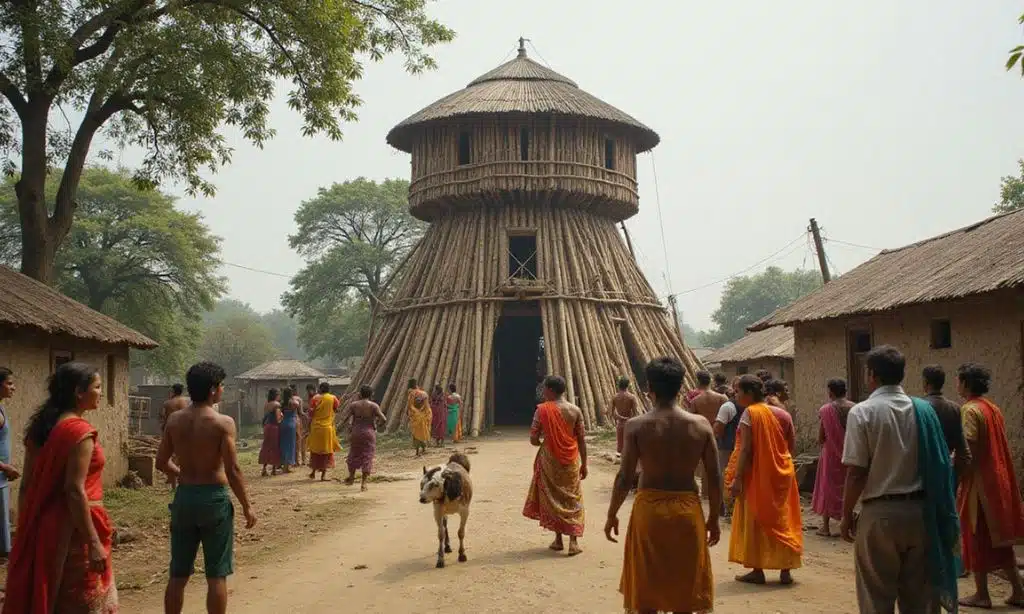
In October 1831, Titumir constructed his famous bamboo fort, or *Basher Kella*, at Narikelberia. This structure was not just a military base; it became a powerful symbol of peasant defiance and ingenuity.
Built entirely from bamboo and mud, materials readily available to the rural poor, the fort represented the people’s ability to resist with the resources they had. It was a testament to their collective will against a technologically superior enemy. The fort’s double-layered bamboo walls, packed with earth, proved surprisingly resilient, even against early British attacks.
The bamboo fort stood as a physical manifestation of Titumir’s independent state. Its very existence was a challenge to British authority and a rallying point for oppressed peasants across the region. The legend of the fort quickly spread, inspiring future generations of freedom fighters and cementing its place in Bengali folklore.
- Symbol of Ingenuity: It showed how everyday materials could be used for military defense.
- Center of Power: It served as the capital of Titumir’s self-declared independent territory.
- A Beacon of Hope: It proved that organized peasants could successfully challenge both the zamindars and the British army.
Even British officers who participated in the final assault were reportedly impressed by its strength, noting the surprising difficulty they had in breaching its bamboo walls with artillery.
What Happened in Titumir’s Final Battle and How Did He Become a Martyr?
The final confrontation took place on November 19, 1831. Determined to crush the rebellion, the British dispatched a well-equipped force under Lieutenant Colonel Stewart. The army consisted of cavalry, 300 native infantry, and, crucially, two cannons.
Titumir’s militia, armed mostly with spears, swords, and bamboo staves, was no match for the disciplined British army and its modern artillery. The cannons bombarded the bamboo fort for hours, eventually breaching its walls.
Titumir fought to the end but was killed during the assault, struck down by the advancing soldiers. His death marked the end of the uprising, but it also cemented his status as **Shaheed Titumir**—a martyr for his cause. The aftermath was brutal: around 50 of his followers were killed in the battle, and approximately 800 were arrested. His nephew and second-in-command, Ghulam Masum, was captured and later hanged in front of the fort’s ruins.
Though the rebellion was defeated, Titumir’s final stand turned him into a legendary figure, symbolizing the ultimate sacrifice in the fight against oppression.
Legacy of Titumir
Titumir’s rebellion left an indelible mark on the history of resistance in Bengal and beyond. Though his fight was short-lived, its influence echoed through subsequent freedom movements, and his story continues to be a subject of academic study and cultural celebration.
How did Titumir influence freedom movements?
Titumir’s uprising is widely seen by historians as a critical forerunner to the First War of Independence in 1857. It demonstrated that localized grievances against economic exploitation could fuel a large-scale, organized armed revolt against British rule.
His movement ran parallel to another significant Bengali peasant movement, the **Faraizi Movement**, led by Haji Shariatullah. Founded in 1818, the Faraizi Movement also combined Islamic reform with resistance against oppressive landlords and British indigo planters. Together, these movements highlighted a growing trend of faith-based, anti-colonial activism in the region.
The story of his heroic defiance, particularly the symbol of the bamboo fort, inspired countless others to challenge British authority. Writers and intellectuals like **Mahasweta Devi** and historians such as **Atis Dasgupta** have analyzed his rebellion as a key moment in the history of subaltern resistance, where ordinary people fought back against a powerful colonial system.
How is Titumir recognized in modern history?
Titumir’s legacy is prominently honored today, especially in Bangladesh. In a 2004 BBC poll of the “Greatest Bengali of All Time,” he was ranked 11th, a testament to his enduring impact.
His name is preserved through numerous institutions and landmarks:
- Government Titumir College in Dhaka, one of Bangladesh’s largest colleges, was renamed in his honor in 1971.
- BNS Titumir is the main naval base of the Bangladesh Navy, located in Khulna.
- A commemorative stamp was issued by the Bangladesh government on November 19, 1992, to mark the anniversary of his martyrdom.
His story has also been kept alive through art. Mahasweta Devi’s novella *Titu Mir* explores his life from a subaltern perspective, while the renowned playwright Utpal Dutt staged a celebrated play about him in 1978. This ongoing recognition in culture, education, and national symbolism ensures that Titumir’s fight for justice remains part of the collective memory of the region.
Takeaways
Titumir’s story is a powerful reminder that the struggle for freedom is often built on the courage of those who defy seemingly insurmountable odds. His bamboo fort, though temporary, became an eternal symbol of resistance, proving that a fight for justice can be waged with the simplest of tools.
He effectively merged religious conviction with a powerful campaign for peasant rights, challenging the dual oppression of the British East India Company and the local zamindars. His legacy endures in the names of colleges and naval bases, but more importantly, in the spirit of defiance he represents.
Titumir’s rebellion shows that long before the large-scale revolts of the mid-19th century, the seeds of independence were being sown in the fields of Bengal by leaders who dared to stand for their people. His life remains a vital chapter in the story of South Asian freedom.