Have you ever felt like your website simply blends in on Google? Many website owners spend hours creating content, only to see very few visitors arriving from search results. It can be frustrating—especially when click-through rates stay low or titles appear cut off on mobile searches.
Optimizing title tags can make a significant difference. Studies suggest that well-crafted title tags can increase page visits by as much as 37% by improving click-through rates.
This guide explores practical strategies for Title Tags in 2026: CTR Optimization Tricks, including simple optimization techniques, ideal length guidelines, and the use of modern AI tools to create titles that attract more clicks and visibility in search results.
What Are Title Tags?
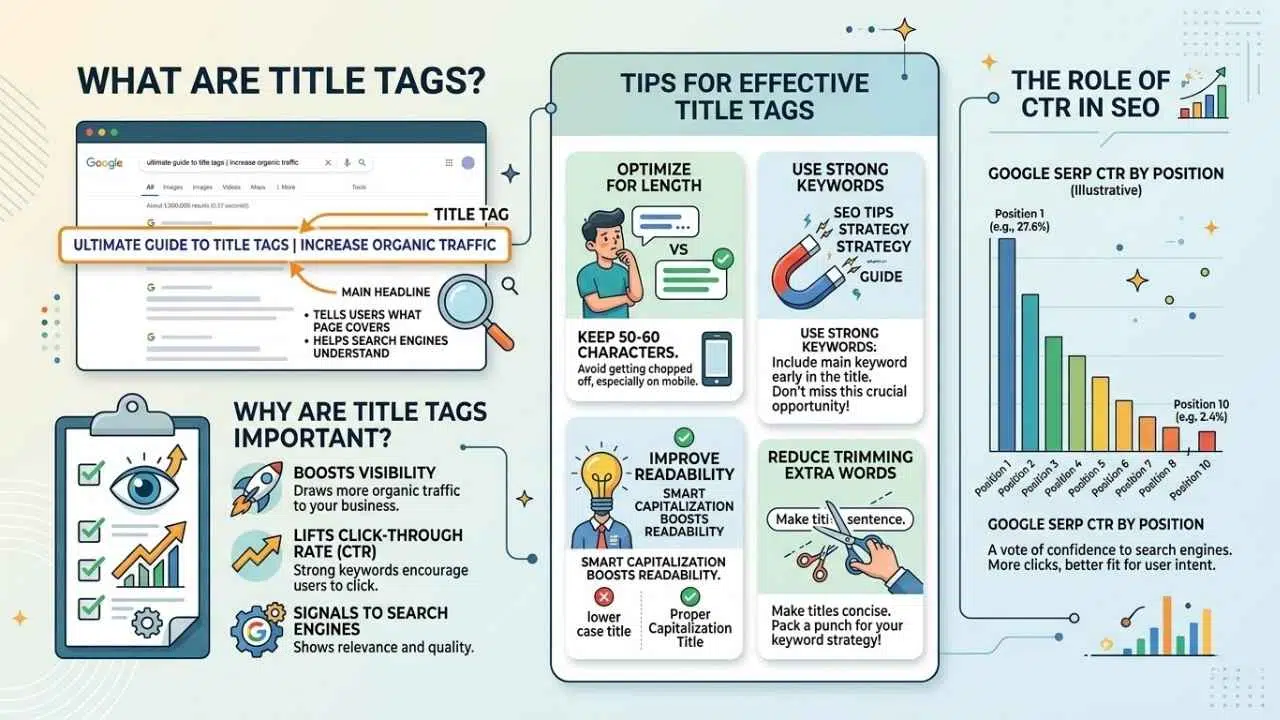
Title tags are short lines of text that show up as the main headline in Google search results. They tell both users and search engines exactly what a page covers. Think of them like the labels on boxed goods at a store.
Search engine optimization SEO depends on smart title optimization. Data shows that 73% of websites miss their main keyword in titles. Using strong keywords boosts web visibility and draws more organic traffic to your US-based business.
A good title tag lifts your clickthrough rate CTR fast. You want to keep it between 50 to 60 characters so it does not get chopped off. We know that 68% of titles are cut short on mobile screens right now.
Smart use of capitalization boosts readability. Trimming extra words packs a punch for your keyword strategy too. Nailing those clickable meta descriptions and actionable titles helps improve site ranking.
The Importance of CTR in SEO
Clickthrough rate, or CTR, acts as a vote of confidence to search engines like Google. More clicks on your link tell Google that your site fits what users want. The numbers show this matters a lot.
A 2025 Backlinko study found that the number one result in Google gets an average clickthrough rate of 27.6%, while position ten gets just 2.4%.
Well-crafted title tags boost CTR by up to 37 percent. Better click rates send more people your way and signal strong user engagement. Keeping SEO title tag length between 50 and 60 characters keeps titles clear for readers.
Every time you raise CTR with smarter wording, you make your content more visible on the SERP Search Engine Results Page. This brings real gains in organic traffic for any digital marketing campaign.
Trends for Title Tags In 2026: CTR Optimization Tricks
Search engines move fast. Fresh tricks for title tags keep popping up, so keep reading to catch the next wave.
Shifts in Search Engine Algorithms
Google updates now pay close attention to user engagement. If a title tag grabs clicks, search engines notice and boost its position. A 2025 study from Search Engine Land revealed that Google rewrites title tags 76% of the time across the board. This means you must write titles that satisfy both the user and the search bot.
When Google ignores your title tag, it needs a backup. Ahrefs data shows that Google pulls the new title from your H1 tag 50.76% of the time. You should always ensure your H1 matches the intent of your title tag.
Emerging SEO Practices
Voice search and mobile-first indexing keep shifting SEO strategies. Smart marketers use action verbs and trim stop words to boost keyword density. A massive trend right now involves how you use punctuation.
A 2025 report from Zyppy analyzed over 80,000 title tags to see how punctuation affects Google rewrites. They found a huge difference between brackets and parentheses.
| Punctuation Type | Google Removal Rate |
|---|---|
| Brackets [ ] | 32.9% |
| Parentheses ( ) | 19.7% |
If you want to emphasize text, always use parentheses. Google is much less likely to remove them. Small changes like this lead to big jumps in organic traffic.
Key Techniques to Enhance CTR
You want titles that grab attention and boost clicks. Here are some clever tricks to get those fingers tapping.
Use of Power Words
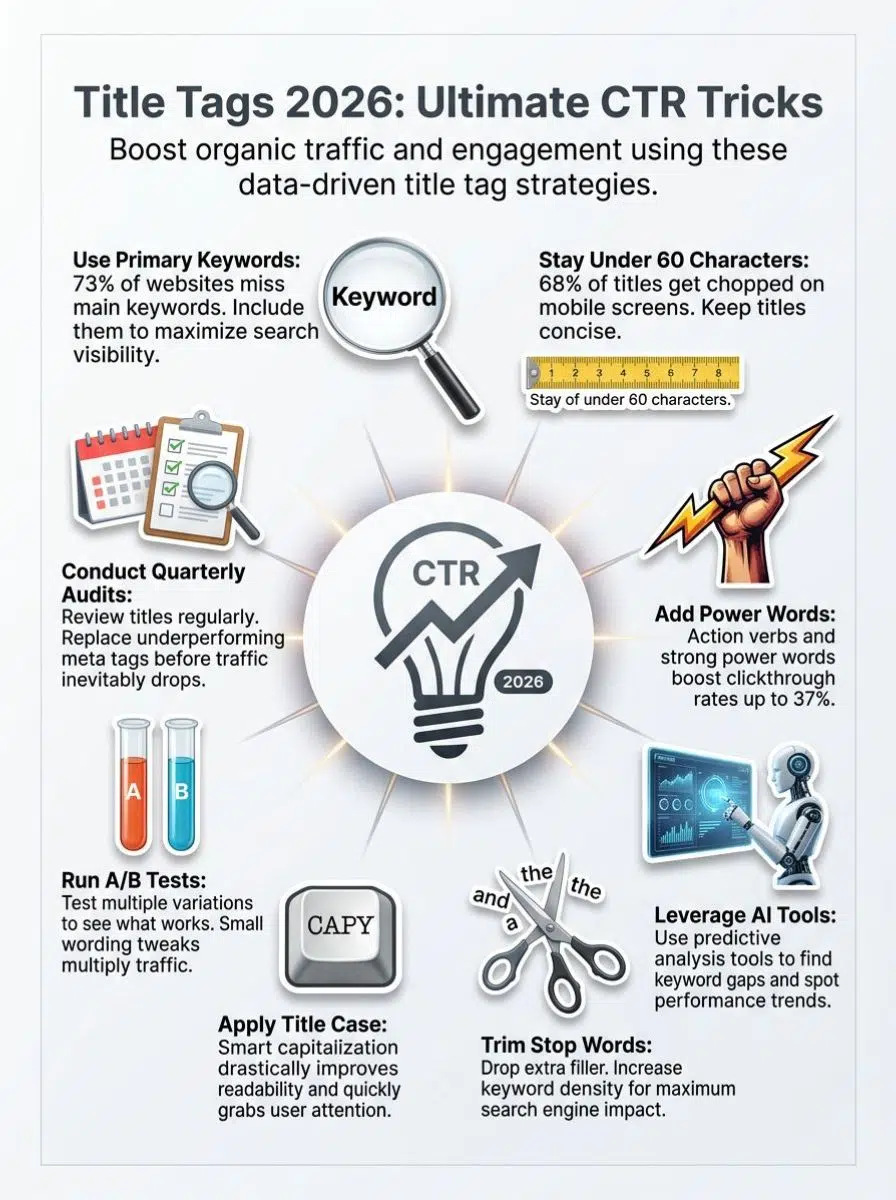
Power words turn a plain title tag into an actionable title that stands out on the SERP. Words like “boost” or “proven” spark excitement and push people to click. In digital marketing, using these strong words gets more eyes on your content.
A 2024 case study by SEO expert Tomislav Horvat proved this perfectly. He updated old articles by cutting fluff and adding specific power words. He saw CTR improvements ranging from 37% to a staggering 640%.
Here are the top additions that drove those results:
- The exact phrase “Ultimate Guide”
- The exact phrase “Complete Guide”
- The current year (e.g., 2026)
- Words like “Updated for”
Skip stop words to pack in keywords. You do not want to be among the 73% of sites that miss their main keyword.
Length and Clarity of Title Tags
Short titles grab attention fast. If they run too long, Google chops them off mid-sentence. Clarity is king for clickthrough rate CTR.
The 2025 Zyppy study found that the sweet spot for title tags is exactly 51 to 60 characters. Titles in this range had the lowest rewrite rate. If you write a title shorter than 20 characters, Google rewrites it over 50% of the time.
Keep your titles inside that 51 to 60 character window. This protects your keywords from getting lost. Simple tweaks in word order put you ahead of big competitors fighting for space.
The Role of AI in Title Tag Optimization
Smart machines spot trends faster than any human. This makes it easier for your site to rise in search results.
AI Tools for Predictive Analysis
AI tools take the guesswork out of SEO. They spot trends, predict performance, and help you scale your efforts.
Top AI Tools for Title Generation
- Clearscope and SurferSEO scan top-ranking pages fast, finding gaps in your titles that real users want filled.
- kemb GmbH offers an AI Title Generator that processes up to 100 rows of product data in bulk, which is perfect for US e-commerce stores.
- SEMrush uses predictive analysis to check which keywords drive higher clickthrough rates, letting you craft title tags around proven terms.
- Machine learning identifies word patterns, tone shifts, and emoji use that spark up to 37% more organic traffic.
Advanced AI Auditing Tools
- AI checks if your title is under the optimal length of 50 to 60 characters so Google will not truncate it.
- Programs highlight primary keywords missing from your titles, fixing an error found on 73% of sites.
- Quarterly audits powered by AI flag underperforming title tags so you can replace them before clicks drop.
- Predictive tools provide title case suggestions to lift readability and user engagement at first glance.
- Software recommends trimming stop words to squeeze more keywords into every slot.
Case Studies on AI Successes
Using AI tools generates real financial returns. A 2025 case study from Result First highlighted how Rocky Brands, a US footwear company, used AI to revamp their content.
They used the Bright Edge AI platform to identify relevant keywords and optimize their page titles and meta descriptions. After implementing these AI-driven changes, Rocky Brands saw a 30% increase in organic search revenue and a 13% rise in total visitors.
Another major news platform ran quarterly audits powered by machine learning. The tool flagged over 70% of meta descriptions missing primary keywords. Adding strong call-to-action phrases helped drive more clicks from content marketing campaigns without increasing ad spend.
Testing and Measuring Title Tag Effectiveness
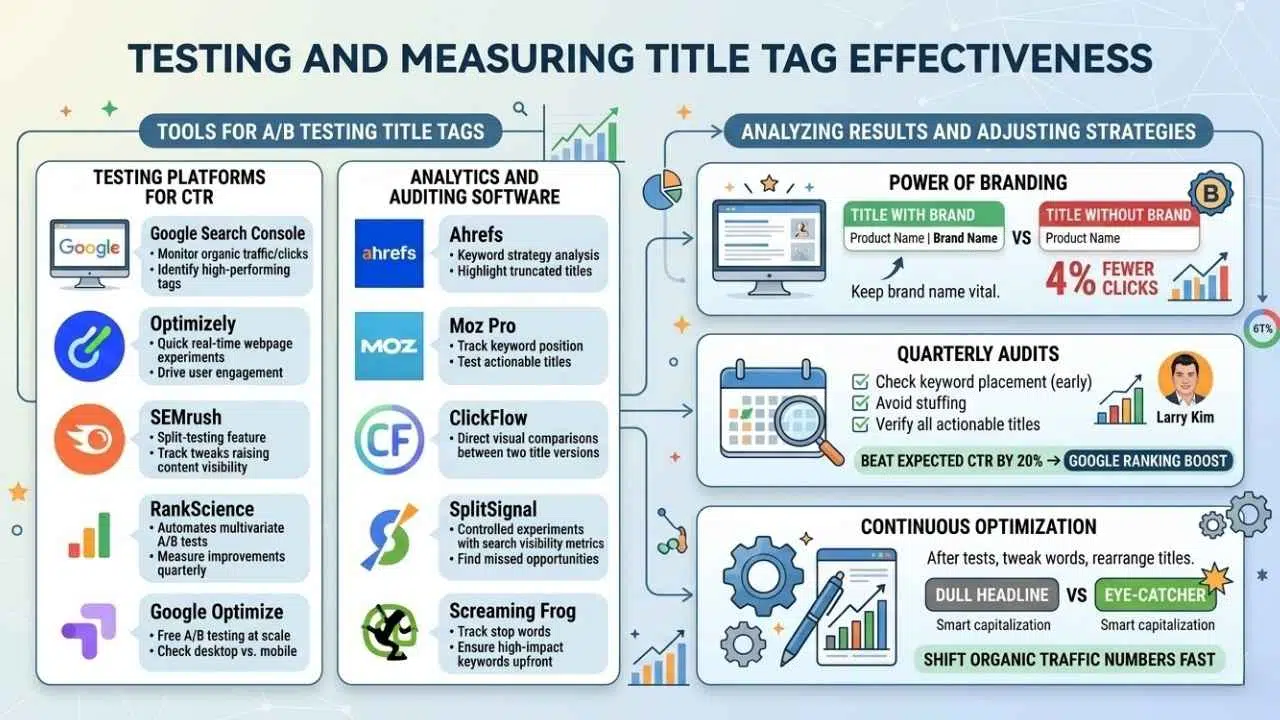
Curious how your titles stack up against each other? Give testing a shot and see which one steals the show.
Tools for A/B Testing Title Tags
Running A/B tests on title tags shows what works best for your audience. Many tools make this process simple and save you time.
Testing Platforms for CTR
- Google Search Console lets you monitor organic traffic and clicks to spot which SEO title tags get attention.
- Optimizely allows quick experiments on webpages in real time to see which title drives higher user engagement.
- SEMrush offers a split-testing feature to track how small tweaks in wording raise content visibility.
- RankScience automates multivariate A/B tests just for title tag changes and measures improvements every quarter.
- Google Optimize enables free A/B testing at scale for fast checks on desktop versus mobile results.
Analytics and Auditing Software
- Ahrefs provides keyword strategy analysis and highlights if titles get truncated on mobile devices.
- Moz Pro tracks keyword position and tests different actionable titles to support your quarterly audits.
- ClickFlow shows direct comparisons between two versions of a title tag using clear visuals.
- SplitSignal gives you controlled experiments with search visibility metrics to find missed opportunities.
- Screaming Frog helps track stop words within large sites to ensure high-impact keywords appear up front.
Analyzing Results and Adjusting Strategies
Data tells the real story. SEO Sherpa recently noted that keeping your brand name in your title tag is vital. They cited a test where a page displayed without the brand name got 4% fewer clicks.
You should conduct quarterly audits on your title tags and meta descriptions. Check if your keywords appear early and often, but do not stuff them in awkwardly. Research from SEO expert Larry Kim suggests that if you beat your expected CTR by 20 percent, Google will give you a ranking boost.
After gathering results from A/B tests, tweak words or rearrange titles as needed. Switching to smart capitalization or cutting stop words turns a dull headline into an eye-catcher. Adjusting these small details shifts organic traffic numbers fast without reinventing your entire content strategy.
Future Outlook
AI and smarter title tricks are waiting to take your clicks higher. This is just the beginning.
Recap of Key Points
Title tags matter a lot. One word change can spark a massive boost in clickthrough rate CTR. Many sites miss out because 73% of them skip the primary keyword.
Mobile users lose even more information. About 68% see chopped-off titles since they go past that golden 50 to 60 character sweet spot for search engine optimization SEO. You need to use smart title case and power words to invite clicks.
Action verbs pull readers in like magnets. Clearing stop words lifts your keyword density so Google finds you faster. Compelling meta descriptions signal relevance to both users and the search results page SERP.
Quarterly audits weed out weak titles before they drag down organic traffic or web visibility. Title Tags In 2026: CTR Optimization Tricks will continue to evolve, so stay sharp.
Predictions for Title Tags in the Next Decade
AI will shape how title tags work in search engine optimization SEO for years to come. Expect smart tools that predict which words boost clickthrough rate CTR automatically. You can imagine titles crafted by AI after reading real user intent and daily web trends in seconds.
Mobile use keeps rising, so short actionable titles under 60 characters will become the strict rule. More sites will switch to power words, title case, and fewer stop words to lift CTR by up to 37%.
Quarterly audits may be automatic soon, with systems flagging weak spots before you blink. Google rewards higher CTRs as a ranking signal, so anyone skipping regular updates will watch their organic traffic vanish.
Final Thoughts
Optimizing title tags remains one of the simplest yet most powerful ways to improve search performance. A well-crafted title not only helps search engines understand your content but also encourages users to click on your page instead of a competitor’s.
By focusing on clear keywords, keeping titles within the ideal length, and using proven CTR optimization techniques, websites can gain better visibility and attract more organic traffic. As search behavior continues to evolve in 2026, regularly testing and refining title tags will remain an essential part of any successful SEO strategy.