Sitting in front of a visa officer can feel scary. Your hands get cold. Your heart beats fast. You worry about saying the wrong thing. You want to study in the United States, but the student visa interview stands in your way. Did you know that in 2023, the denial rate for F-1 student visas reached a record high of nearly 36%? That is a big number. It means more than one out of every three students walked away without a visa.
But here is the good news. Most of those refusals happen because of simple mistakes or poor preparation. Knowing what to expect changes everything. This post shares seven top tips for a successful student visa interview. You will learn how to talk about yourself with confidence. I will show you how to prove strong ties to your home. We will also cover exactly which documents to keep ready. Grab a notebook. Let’s get you ready to pass this interview.
7 Tips For a Successful Student Visa Interview
Ready to feel cool and calm in your student visa interview? These tips can help you show your best self from start to finish.
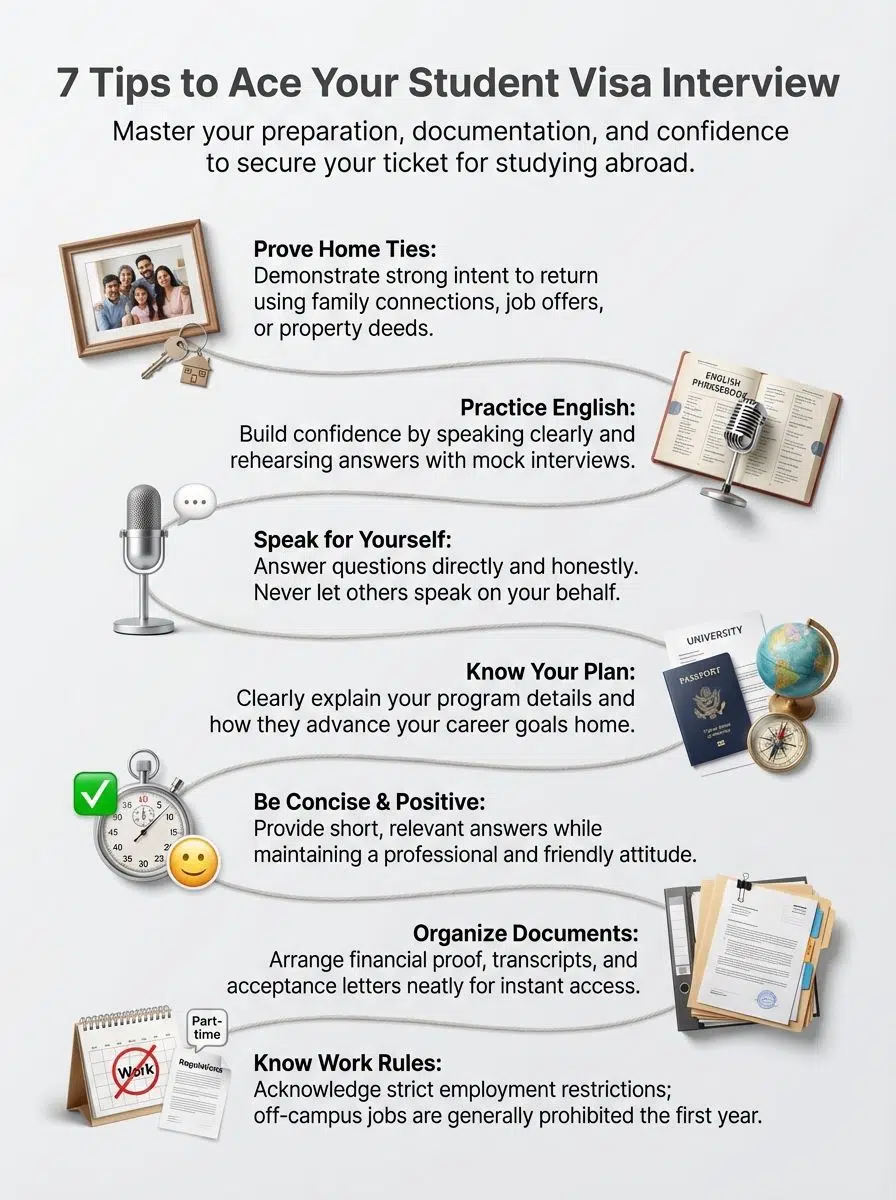
1. Understand the Importance of Ties to Your Home Country
This is the most critical part of your interview. Under U.S. law, specifically Section 214(b) of the Immigration and Nationality Act, every visa applicant is viewed as an intending immigrant until they prove otherwise. This means the officer assumes you want to stay in the U.S. forever unless you convince them you will return home.
You must prove you have “strong ties” that will pull you back after graduation. These ties can be social, economic, or family-based.
- Social Ties: Mention your involvement in your local community or specific family responsibilities.
- Economic Ties: Bring proof of property ownership, a family business, or a letter from a future employer in your home country.
- Family Ties: Explain clearly that your parents or spouse remain back home and rely on you.
“My grandmother waits for fresh mangoes from our tree every summer” creates a vivid picture. It helps the officer see you are rooted in your culture.
Bring physical proof if you have it. Letters from previous employers or deeds to family land build trust quickly. They show you have a life waiting for you when you return.
2. Practice Your English Skills
Speaking clear English brings you closer to your visa approval. The interview will be conducted entirely in English, and the officer needs to know you can survive in a U.S. classroom.
You do not need to have a perfect accent. You just need to be understood. Use simple words. Keep your sentences short. Practice speaking out loud with friends or record yourself on your phone.
Pro Tip: Do not just read textbooks. Watch American news clips on YouTube to hear the natural pace of conversation. This helps your ear get used to how people actually speak in the U.S.
Mock interviews make a massive difference. Ask a friend to act as the Consular Officer. Have them quiz you on your study plans and career goals. This practice calms your nerves and helps you spot words that trip you up.
3. Speak for Yourself During the Interview
Visa officers want to hear from you. They do not want to hear from your parents or a travel agent. If a family member tries to answer for you, the officer may think you are not ready for independent study. Speak clearly and directly. Look the officer in the eye. Eye contact shows you are telling the truth and have nothing to hide.
Your answers must come from your own thoughts. If you do not know the answer, be honest. Saying “I am not sure about that detail, but I can check my documents” is much better than making something up. Honesty builds trust.
4. Know Your Program and Career Plans
You must know the details of your program inside and out. Officers often ask specific questions to see if you are a serious student or just trying to enter the country.
Be ready to state the name of the university, the length of the course, and your specific major. But do not stop there. Explain why you picked this specific program.
Connect the degree to your future career in your home country. Do not just say you want to study “business.” Say you want to learn supply chain management to help your family’s export business back home.
| Vague Answer (Avoid) | Strong Answer (Use) |
|---|---|
| “I want to study at XYZ University because it has a nice campus and a good ranking.” | “I chose XYZ University because Professor Smith leads a research project on renewable energy, which is a growing sector in my home country.” |
This level of detail shows you have a clear plan. It proves you are serious about your education and your future career.
5. Be Concise and Stay Positive
Visa officers are busy. They often have only two or three minutes to make a decision. Long, rambling stories can hurt your chances. Keep your answers short and to the point. Aim for responses that are 2-3 sentences long. If the officer wants more details, they will ask for them. Do not wander off-topic.
Keep a smile on your face. Even if a question feels aggressive, stay polite. Positivity shows confidence. Treat the interview like a conversation with a colleague, not an interrogation. Leave your nerves at the door.
6. Prepare and Organize Your Supporting Documentation
Having your papers in order helps you feel calm. It also looks professional. Fumbling through a messy bag makes you look unprepared. You need to organize your documents in a clear folder. Here is the checklist of what you typically need:
- Mandatory Government Forms: Your valid passport, the DS-160 confirmation page, and your Form I-20.
- Proof of Payments: The receipt for your SEVIS I-901 fee and your visa application fee.
- Academic Evidence: Original transcripts, diplomas, and standardized test scores (like TOEFL, SAT, or GRE).
- Financial Proof: Recent bank statements showing “liquid assets.” This means money that is available immediately to pay for your first year of school.
- Ties to Home: Property deeds, family records, or employment letters that prove you will return.
Arrange these in a specific order so you can pull them out instantly. When the officer asks for your “financials,” you should be able to hand them over in two seconds flat. This quick access makes you look organized and responsible.
7. Be Aware of Employment Restrictions
The U.S. has strict rules about working on a student visa. F-1 students generally cannot work off-campus during their first academic year. You are usually limited to on-campus work for up to 20 hours per week while school is in session. This might include jobs at the library, bookstore, or cafeteria.
If you tell the officer you plan to “work to pay for school,” you will likely be denied. You must show you have enough money to pay for tuition and living expenses without working. Working is a privilege, not a funding plan. Read the guidelines from your international student office carefully to avoid saying the wrong thing.
Address Questions About Dependents Staying at Home
Visa officers often ask if your spouse or children will stay behind while you study. This is actually a good opportunity to prove your ties to home.
Be clear and honest about their plans. Explain exactly who will care for them while you are away. Mention that a trusted family member will support them.
This helps prove you plan to return. If your entire family is in your home country, you have a very strong reason to go back. Keep these answers simple. Do not give too much detail unless the officer asks for it.
Avoid Common Mistakes
Making mistakes can cost you your student visa. Small errors add up fast. Paying attention to these traps can save your application.

Don’t Give Vague Answers
Visa officers hear thousands of stories. Vague answers make you sound unprepared or suspicious. You need to be specific.
Instead of saying “I want a better future,” explain exactly what skills you will gain. For example, “This Master’s degree will certify me to manage large construction projects, which qualifies me for a promotion at my current firm in Brazil.”
If an officer asks about funding, do not just say “my uncle will help.” State the specific source. “My uncle has set aside $30,000 in this savings account specifically for my tuition, as shown in this bank statement.” Specifics build trust.
Don’t Memorize or Recite Responses
Sounding like a robot is a major red flag. Officers can spot a memorized speech immediately. They want to have a conversation, not hear a script. If you sound rehearsed, the officer might think you are coached or hiding something. It is okay to pause and think. It is okay to use simple words.
Focus on the core ideas of your answers, not the exact wording. This allows you to speak naturally. When your responses come from real experiences, your confidence shines through.
Additional Tips for Success
Little things can make a big splash on interview day. These simple tweaks may help you breeze through with flying colors.
Research Cultural Norms and Expectations
In the U.S., business culture values directness. Sit up straight. Make eye contact. Give a firm nod or greeting when you approach the window. It is common to call officers “Sir” or “Ma’am.”
This shows good manners. Listen carefully. Do not interrupt the officer. Wait until they finish the question before you start speaking. These small actions show respect. They set a professional tone for the meeting right from the start.
Dress Professionally for the Interview
First impressions happen before you say a word. Treat this like a job interview. You want to look like a serious student.
Formal or “Business Casual” is best:
- Men: A button-down shirt and slacks. A tie is nice but not strictly required.
- Women: A blouse with dress pants or a professional skirt.
Avoid sneakers, t-shirts with slogans, or ripped jeans. A polished appearance tells the officer you respect the process. It also helps you feel more confident and capable.
Be Prepared for Common Questions
Interviewers usually stick to a few main topics. Brush up on these popular questions so nothing catches you off guard.
“Why did you choose this program?”
This is your chance to connect your study plan to your career goals. Avoid generic praise for the school.
Example Answer: “I chose the Data Science program at this university because it focuses on healthcare analytics. My goal is to return to my home country and modernize the patient record systems at my family’s hospital chain. This specific curriculum gives me the technical skills I need to do that.”
This answer is strong because it connects the school directly to a job back home. It shows research and intent.
“How will you fund your education?”
You must prove you can pay for school without working illegally in the U.S. Be ready to list your sponsors clearly. State the exact amount of money you have available. Mention your parents, scholarships, or personal savings. Match these numbers to the documents you placed on the counter.
If you have a loan, explain how you plan to repay it after you return home. Clear financial answers remove one of the biggest hurdles to visa approval.
Prepare for Potential Visa Denial Outcomes
Sometimes, despite your best efforts, the answer is “no.” If this happens, do not argue with the officer. It will not change their mind. Ask for the refusal letter. This document will tell you why you were denied. The most common reason is Section 214(b), which means you did not prove enough ties to your home country.
You can apply again. But you should only reapply if your situation changes or if you can provide new evidence that you did not show the first time. Double-check your paperwork. Practice your answers. Many students succeed on their second try.
Wrapping Up
Getting ready for your student visa interview can feel like a big mountain to climb. But the right tools make it easier. Practice your answers. Iron those clothes. Organize every piece of documentation you need. Step into that room with confidence. Strong communication skills show that you are prepared and serious about studying abroad.
Officers notice clear presentation and honesty. Keep documents handy in case they ask questions about funding or home country ties. Use these moments to shine. Each answer brings you closer to your goal of learning in a new place.
Stay positive even if nerves buzz around inside. Sometimes a deep breath works better than luck!