

Artificial intelligence has a branding problem, and in my opinion, it is not the one the industry keeps trying to solve. The public debate still circles around job disruption, model safety, and energy demand. Those are real issues, but 2026 exposed a quieter pressure point that is harder to spin. The modern AI boom has made the cloud visibly, uncomfortably thirsty, and zero-water data centers have become the clearest symbol of a forced course correction.
For years, “the cloud” worked as a convenient metaphor that separated digital life from physical consequence. We streamed, searched, generated, and stored as if computation floated in the sky. In 2026, that illusion finally collapsed under a very earthly constraint. AI infrastructure is not only made of chips and cables. It is also made of cooling systems, pipes, evaporation, and local water politics.
I see this year as a pivot from optional sustainability to mandatory stewardship. Not because companies suddenly found a conscience, but because water scarcity turns technical choices into public conflict. When a data center’s cooling demand competes with a town’s drinking supply or a farmer’s irrigation, the conversation changes fast. In my view, the “Year of Zero-Water Data Centers” arrived the same way most industry transformations arrive. It came when the old approach stopped being socially tolerable.
The CloudWas Never Weightless
The most persistent myth in modern tech is that a digital scale is clean by default. The products feel intangible, so we assume the infrastructure is light. But data centers have always been physical factories for computation. They are industrial sites with land footprints, power contracts, supply chains, and cooling needs.
In the 2010s, the industry learned how to talk about energy efficiency with confidence. Power Usage Effectiveness, or PUE, became the headline metric. Companies bragged about squeezing waste out of facilities and buying more renewable electricity. That era taught executives that if you can measure something, you can market it.
Water did not get the same attention because it was easier to ignore. In many regions, water prices stayed artificially low, and policy remained fragmented. So the sector treated water as a local utility detail rather than a strategic constraint. In my opinion, that was a major misread of what scarcity does to public tolerance.
By 2026, Water Usage Effectiveness, or WUE, is no longer a niche engineering metric. It is the new public scoreboard. If PUE was the gold standard of the last decade, WUE is the uncomfortable mirror of this one. It forces the industry to admit that the AI boom is not just power-hungry. It is water-dependent.
Why 2026 Became The Breaking Point
I do not think the water debate exploded because one company crossed a line. It escalated because multiple pressures converged at once. AI adoption surged, hardware density spiked, and drought conditions intensified in several high-growth regions. That combination squeezed both reality and narrative.
The late 2025 to early 2026 period created what I would call a stewardship stress test. Data center clusters in places like Northern Virginia, parts of the American Southwest, and other expansion corridors faced rising scrutiny. Local officials had to answer questions that used to be buried in permitting documents. How much water will this facility use? Where will it come from? Who loses if supply tightens?
In my view, this is the moment when the industry lost the ability to frame water as “just operations.” Water is social. It is emotional. It is political. People may tolerate abstract carbon math for a while, but they react immediately to the idea of someone else drinking from their tap, even indirectly through evaporation.
This is why I believe 2026 became the year of hard language. Words like “water stewardship,” “social license,” and “regenerative” moved from NGO circles into corporate statements. Not because they are trendy, but because the alternative is public resistance, permit delays, and reputational damage.
AI Changed The Physics Of Data Centers
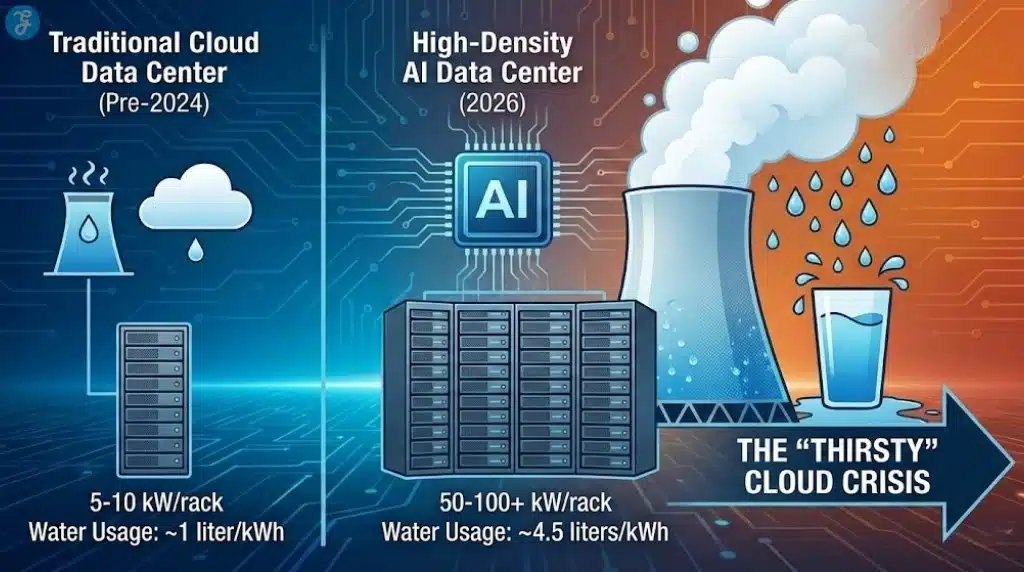
A major reason this crisis feels sudden is that AI workloads are not simply “more computing.” They are a different thermal problem. Traditional workloads like web hosting and storage spread heat more predictably. AI training and high-volume inference concentrate heat at the chip level and push racks toward extreme densities.
This shift breaks old cooling assumptions. Air cooling can work, but it becomes inefficient when heat density climbs too fast. The result is a greater reliance on liquid-based systems and, in many facilities, evaporative cooling that effectively consumes water by turning it into vapor.
I see the AI boom as a structural amplifier. It takes an industry that already has a water footprint and accelerates it in the most visible way possible. The same action that feels like a harmless prompt to a user becomes a chain of physical consequences at scale. That chain is the “thirsty cloud.”
The New Heat Reality In Numbers
The water debate becomes clearer when you compare the operating profile of older facilities with AI-optimized builds. In my opinion, the most important change is not only total compute. It is the intensity of compute per rack that forces different cooling choices.
| Metric | Traditional Cloud Data Center (Pre-2024) | High-Density AI Data Center (2026) |
| Typical Heat Density | 5–10 kW per rack | 50–100+ kW per rack |
| Common Cooling Method | Air and evaporative | Direct-to-chip and immersion |
| Water Consumption Pattern | Lower and steadier | Higher and burst-driven |
| Primary Efficiency Metric | PUE | WUE |
When heat density rises, cooling stops being a background function. It becomes the core design constraint. That is why I think the water issue is not a temporary PR flare-up. It is an engineering reality that is now colliding with local resource politics.
The “Invisible Deluge” Nobody Wanted To Brand
The industry did not want a water narrative for the same reason it did not want an e-waste narrative. It complicates the clean image of innovation. But water is hard to hide because communities can measure it. They can see tankers, infrastructure upgrades, and municipal reports. They can watch reservoirs.
In my view, the most damaging phrase for the sector is not “AI uses water.” It is “AI uses drinking water.” That framing creates immediate moral friction. Even if a facility’s water share is legal and contracted, the perception of competing with households is toxic.
This is also why water discussions have escalated into broader questions. Should a community prioritize a data center over housing growth? Should a region allocate scarce water to industrial cooling rather than agriculture? Who gets to decide what is “worth it”
Those questions do not have purely technical answers. They force value judgments. That is exactly why the industry has been forced toward zero-water data centers as a visible and defensible direction.
What “Zero-Water Data Centers” Actually Means
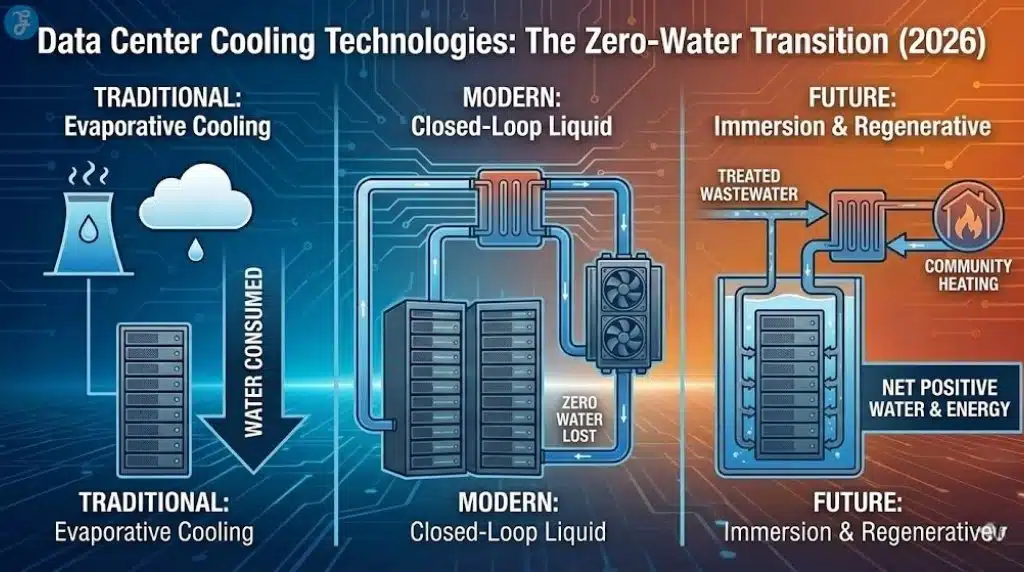
In my opinion, “zero-water” is both a technical target and a rhetorical promise. Technically, it usually means eliminating evaporative loss and avoiding the use of potable water for cooling. It does not always mean the facility never touches water. It often means the system is closed-loop and does not consume water through evaporation.
The mainstream approaches in 2026 fall into a few categories:
- Closed-Loop Liquid Cooling: Sealed circulation that rejects heat without evaporation.
- Immersion Cooling: Submerging servers in dielectric fluids to move heat efficiently.
- Advanced Heat Exchangers: Liquid-to-air or liquid-to-liquid designs that reduce water dependency.
- Non-Potable Water Strategies: Using treated wastewater or greywater when water is needed.
What matters to me is not the label. It is the outcome. Can a facility scale AI compute without draining local drinking supplies? Can it maintain reliability while being a better neighbor? Can it survive the next drought cycle without becoming a political target?
Cooling Options And Water Impact
Here is the comparison I think most readers need. It shows why the industry is moving away from evaporation and toward sealed systems.
| Technology Type | Mechanism | Water Impact |
| Evaporative Cooling | Cools air using water that evaporates | High consumption |
| Closed-Loop Liquid | Sealed fluid loop with no evaporation | Near-zero consumption |
| Immersion Cooling | Servers submerged in non-conductive liquid | Near-zero consumption |
| Wastewater Recovery | Uses treated municipal or industrial water | Reduced potable impact |
| Hybrid Approaches | Switch cooling modes based on load | Optimized balance |
In my view, the biggest change is the cultural one. Cooling is no longer just “facility engineering.” It is corporate citizenship. Water choices now determine whether an expansion plan looks responsible or exploitative.
Why Wastewater Is Becoming A Strategic Asset
If I had to pick the most practical trend of 2026, it is not immersion cooling. It is the normalization of non-potable water use. Treating and reusing wastewater turns a reputational liability into a resilience strategy.
When a facility uses treated municipal wastewater, it reduces pressure on drinking supplies. It also creates a narrative that is easier to defend publicly. Instead of “we took water,” the story becomes “we worked with the city to reuse water that would otherwise be discharged.”
This is where I see “regenerative thinking” moving from slogan to infrastructure. The most serious operators are not just trying to use less. They are trying to integrate into local water cycles in a way that improves outcomes.
From Sustainability To Regenerative Thinking
I have grown skeptical of the word “sustainability” because it often means “less bad.” That is not enough when the scale of AI is accelerating faster than infrastructure reform. In my opinion, the industry needs a higher bar, because AI is not a small feature. It is becoming a foundation layer for everything from business operations to consumer devices.
Regenerative thinking is controversial because it implies responsibility beyond compliance. It pushes companies to invest in watershed restoration, leakage reduction, aquifer recharge, and community water resilience. Critics call it expensive. I call it the cost of operating at scale in a constrained world.
I also think regenerative framing helps clarify the real issue. It is not only about reducing consumption. It is about avoiding conflict. If a company returns more water value to a region than it extracts, it lowers the chance of political backlash. It also builds permit resilience.
The Permit Wars And The New Reality Of Expansion
In 2026, you can no longer assume that tax incentives and fiber access will guarantee approvals. The most important factor is whether a community believes a data center will strain its future.
I see this as a shift from infrastructure competition to infrastructure legitimacy. Communities are asking tougher questions, and regulators are learning that water is a public trust issue. This changes the game in three ways:
- Project timelines lengthen due to hearings and litigation risk.
- Disclosures become unavoidable because the public demands data.
- Location strategy shifts toward regions with stronger water security.
In my opinion, this is healthy pressure. It forces a sector that grew accustomed to quiet approvals to operate with more transparency. It also pushes innovation where it belongs. Toward efficiency that respects shared resources.
Water Stewardship Is Now A Geopolitical Filter
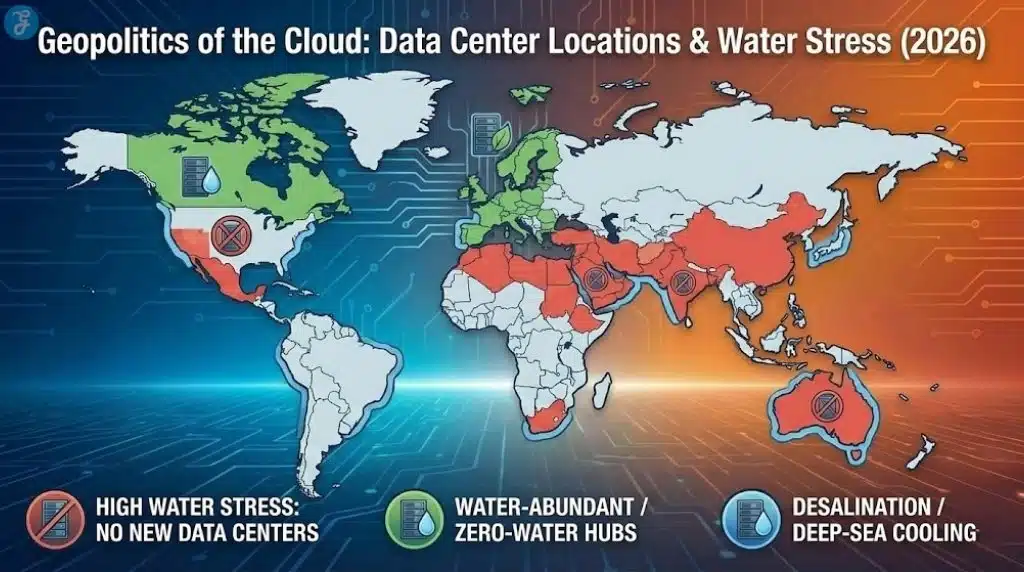
There is a bigger story here that goes beyond individual towns. Water abundance is becoming a competitive advantage in the same way cheap electricity once was. This creates a new map of “water haves” and “water have-nots” in the tech world.
Regions with stable water supplies and strong governance will attract investment. Regions under water stress will either tighten rules or demand compensating benefits. In my view, this reshuffling will define the next decade of infrastructure decisions.
I also think it will create tension. When computing power shifts geographically, economic power shifts too. Data centers bring construction jobs, operations roles, and tax revenue. Communities want those benefits, but they do not want the risk. That is why stewardship commitments are becoming part of economic bargaining.
The Efficiency Paradox We Do Not Want Ignored
There is a trap in the “zero-water” narrative that I think needs blunt discussion. Some “zero-water” designs reduce water use by relying more on mechanical chillers. That can increase electricity demand, which can increase emissions if the grid is not clean.
So the question becomes: are we solving water by creating a carbon problem? In my opinion, the industry sometimes treats water and carbon as separate scoreboards. They are not. They are linked through energy systems, climate patterns, and public trust.
Here is how I would frame the risk:
- Less water can mean more electricity.
- More electricity can mean more emissions.
- More emissions worsen climate volatility.
- Climate volatility worsens drought.
That cycle is why I believe single-metric optimization is outdated. The next era of infrastructure needs multi-constraint design.
My Preferred Direction: Hybrid Cooling And Real-Time Optimization
If you ask me what “responsible AI infrastructure” looks like, I think it is adaptive. It is not one cooling method everywhere. It is systems that respond to local conditions and real-time constraints.
A practical hybrid approach can include:
- Using air cooling when ambient conditions allow it
- Using liquid or immersion for high-density zones
- Using stored non-potable water strategically during peak loads
- Coordinating with the grid to avoid peak stress periods
This is the point where AI should help optimize AI. Machine learning can predict thermal loads, detect hotspots, and adjust systems dynamically. In my opinion, that is one of the most legitimate uses of AI inside infrastructure. It is self-governance through measurement.
And around this point in the discussion, the phrase zero-water data centers should mean “zero waste,” not just “zero evaporation.” It should mean designs that minimize both water and carbon harm.
Why The Smart Home Is Now Part Of This Story
The most interesting part of 2026 is how quickly this infrastructure debate is reaching consumers. It is no longer only a hyperscaler issue. Consumers are becoming aware that smart features are not free. They have upstream costs.
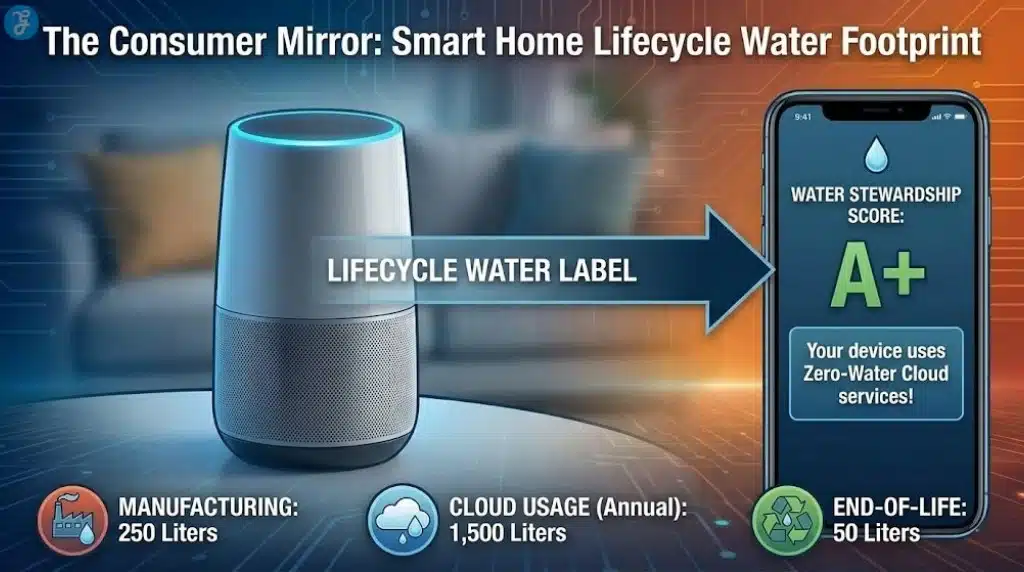
In my opinion, the smart home sector is entering a new phase where devices will be judged by more than electricity. They will be judged by total lifecycle impact, including cloud dependency. The more a device relies on constant cloud inference, the more it inherits the cloud’s water footprint.
That is why I think edge AI is not just about latency or privacy. It is about resource accountability. If you can process locally, you reduce the demand on centralized, water-intensive compute hubs.
How Consumer Expectations Are Shifting
Here is the shift I see in product expectations, especially for “smart” appliances and home hubs.
| Smart Device Category | 2024 Buyer Focus | 2026 Stewardship Focus |
| Home Monitoring | Energy tracking | Leak detection, water quality alerts |
| Smart Appliances | Remote control | Water efficiency plus reuse features |
| AI Assistants | Response speed | Local processing, lower cloud dependency |
| Home Energy Systems | Solar integration | Whole-home resource optimization |
This shift matters because consumers influence policy indirectly. When buyers start asking “how much water does this feature cost upstream,” companies will be forced to simplify, localize, or redesign.
The Hidden Lifecycle Footprint Of “Always On” AI
One of my strongest opinions on this topic is that convenience has been underpriced. “Always on” AI feels magical, but it is built on constant compute cycles. Those cycles become heat. Heat becomes cooling. Cooling becomes water or electricity, or both.
If the industry wants public trust, it needs to explain this chain honestly. I do not think people will reject AI because it uses resources. People accept that modern life consumes energy and materials. What they reject is perceived arrogance. They reject the idea that tech gets special permission to ignore scarcity.
So the opportunity here is not only technical. It is narrative and behavioral. Companies can design features that do more on-device, batch tasks intelligently, and reduce unnecessary inference. That is stewardship at the product layer.
And at this stage, it is worth repeating the central phrase again because it grounds the argument. Zero-water data centers are not only an infrastructure story. They are a product story because product demand determines infrastructure load.
What Can We Expect Next In 2026 And 2027
I do not think this debate will fade. I think it will harden into new standards the same way carbon reporting did. Once a metric becomes comparable, it becomes competitive. Once it becomes competitive, it becomes political.
Here are the milestones we can expect:
- Water-positive pledges become table stakes for major cloud providers.
- Standardized WUE reporting spreads across regions and regulators.
- Water credits emerge in a more formal way, similar to carbon mechanisms.
- Edge AI adoption accelerates as brands market it as a resource-saving choice.
- Local opposition grows in water-stressed areas unless projects prove net benefit.
I also expect a new class of “water-first” infrastructure developers. Their selling point will not be the cheapest. It will be the most permit-resilient compute. In my view, that is the real market signal behind stewardship. It is risk management.
What We Want The Industry To Admit
If I could ask the sector for one honest sentence, it would be this: AI is not just software. It is industrial-scale infrastructure that must live within ecological limits.
Once you say that out loud, the rest follows logically. You design data centers like utilities, not like secret warehouses. You publish water plans. You invest in community resilience. You stop treating local resources as someone else’s problem.
This is why I see 2026 as a credibility test. The industry can either evolve into a responsible infrastructure actor or become the next symbol of extractive growth. The public will decide that based on behavior, not slogans.
The Cloud Must Respect The Well
The transition toward zero-water data centers is more than a technical shift. It is a cultural shift in how the digital economy values natural resources. The cloud is finally being forced to acknowledge that it cannot survive on electricity alone. It must also respect water, place, and community.
In my opinion, this is overdue. It is also an opportunity. If the AI industry uses this moment to build regenerative infrastructure and more responsible product design, it can earn trust instead of demanding it.
The “thirsty cloud” is not a metaphor anymore. It is a measurement. And in 2026, measurement is becoming accountability.






























