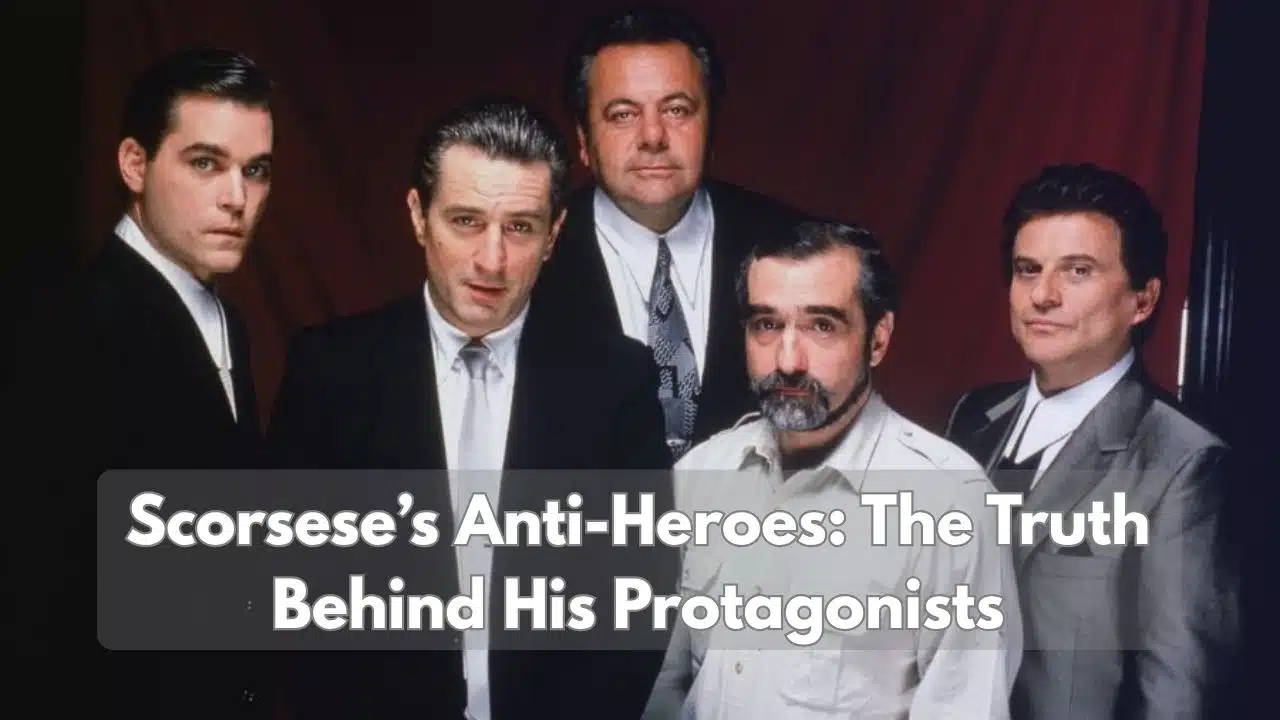
From the neon-lit gutters of New York to the bruised interior of a boxing ring, the protagonists of Martin Scorsese’s films rarely tread the path of classical heroism. We do not watch them ascend triumphantly, nor do we see them as paragons of virtue. Instead, they stagger, stumble, clash with their own impulses and the world’s demands. Socrsese characters are anti-heroes, enmeshed in moral ambiguity.
In Scorsese’s universe, the hero’s cape is absent. Instead, we find tortured ambition, flawed morality, and existential despair. This article will explore the director’s worldview, dissect his protagonists’ traits, examine three emblematic characters, and reflect on what this means for audiences, culture, and storytelling.
Scorsese’s World-View: Roots, Setting & Vision
Catholic Guilt, Ethnic Origins, and the Urban Margin
Martin Scorsese’s cinematic vision is deeply influenced by his upbringing in an Italian-American Catholic enclave in New York’s Little Italy. From early on, he was steeped in a culture of sin, guilt, redemption, and suffering. These themes, deeply rooted in Catholicism, are central to Scorsese’s understanding of the world and often form the backbone of his character-driven narratives. His characters are frequently caught in the crossfire between their desires, their guilt, and the search for redemption.
Growing up in this ethnic and religious milieu, Scorsese was attuned to the underbelly of urban life—its violence, its decay, and its moral rot. The city is not simply a backdrop for his stories; it is a character in itself. His films often explore the harsh realities of inner-city life, where survival is a daily struggle and morality is blurred. For Scorsese, the protagonist’s internal conflicts are inseparable from the environment that shapes them. His films are not about clear moral choices but about how these characters navigate an ethically compromised world. The hero’s journey, in Scorsese’s universe, is not a neat ascent to glory but a messy battle for survival amidst overwhelming moral ambiguity.
Violence, Masculinity, and Existential Stakes
One of the recurring themes in Scorsese’s films is the portrayal of masculinity in its most raw, unrefined form. His protagonists are often men defined by violence, ambition, and an almost nihilistic struggle for identity. These men are not heroes in the traditional sense but are instead driven by personal demons, insecurity, and a deep-seated desire to prove themselves. For Scorsese, the concept of masculinity is far from idealized; it is tainted, bruised, and often self-destructive.
His protagonists frequently engage in violent acts, not as acts of righteousness or to protect others, but as a means of asserting themselves in a world that seems indifferent to their existence. This violence, however, is not glorified. Rather, it serves as a mechanism by which the characters try to make sense of their fragmented lives. In this sense, Scorsese’s characters are emblematic of a modern masculinity that is caught in a downward spiral of self-doubt, rage, and existential despair.
The Decline of Heroism in the Modern City
Scorsese’s settings matter. His protagonists are not placed in golden kingdoms where a champion rises. Instead, they exist in decaying cities, ruled by organized crime, corruption, and moral decay. In such a world, the classical hero is almost impossible. There is no clean victory, no charming savior. Instead, survival becomes the primary goal, and redemption, if it comes at all, is always flawed and incomplete.
In many of Scorsese’s films, the city itself becomes a metaphor for the protagonist’s internal struggles. The dark, chaotic streets, the violence that pervades every corner, and the constant sense of impending doom reflect the fractured psyches of his characters. There is no bright light at the end of the tunnel—just more darkness. Scorsese presents us with a world where the rules of classical heroism do not apply and where the notion of a hero’s journey is turned upside down.
Defining the Protagonist: Why They Aren’t Heroes
Scorsese’s protagonists are defined by their internal struggles, moral complexity, and the choices they make in flawed, often corrupt systems. Their journeys reflect a deeper exploration of human imperfection, far removed from the traditional hero’s path. For example:
Internal Conflict Over External Victory
Traditional heroes are defined by their external victories. They conquer their adversaries, rise to greatness, and emerge triumphant. Scorsese’s protagonists, however, are often locked in an internal struggle that overshadows any external victories they may achieve. Their battles are not only against external forces, but also against their own demons—guilt, rage, insecurity, and the search for meaning in an indifferent world.
Take Travis Bickle, the protagonist of Taxi Driver. He is a disillusioned Vietnam War veteran who becomes a taxi driver in the gritty streets of New York. Rather than seeking external victory, Bickle’s primary battle is within himself. His quest for redemption, his desire to save the world, and his attempts to reconcile his own sense of worth are all plagued by inner turmoil. Even when he does save a young prostitute, the act is not so much heroic as it is a reflection of his own desperation and need for validation.
In this way, Scorsese’s protagonists do not follow the traditional trajectory of heroes who rise above their internal conflicts to achieve greatness. Instead, their internal struggles shape their actions, often leading them down destructive paths. In the world of Scorsese’s films, external victory is less important than the internal battle for identity, purpose, and meaning.
Moral Ambiguity and Compromised Choices
Another defining feature of Scorsese’s protagonists is their moral ambiguity. These characters often make choices that are ethically questionable or outright immoral. However, these choices are not presented as purely villainous. Instead, Scorsese paints a complex picture of moral compromise, showing that his characters are products of their environments and circumstances.
Scorsese’s films often blur the lines between right and wrong, making it difficult for the audience to definitively categorize the characters as either heroes or villains. For example, in GoodFellas, Henry Hill starts as a young man dreaming of a life in organized crime. Over the course of the film, he becomes entangled in a web of betrayal, violence, and corruption. While Hill may initially appear as the protagonist, his actions—lying, cheating, betraying his friends—undermine any sense of traditional heroism. He is neither a pure hero nor a clear villain but a morally complex character shaped by the corrupt system in which he operates.
In this sense, Scorsese’s protagonists are not heroes because they are not bound by a strict moral code. Their actions are often driven by self-interest, ambition, or survival rather than any sense of justice or righteousness. They make compromises, and those compromises have consequences.
Systemic Entrapment, Flawed Redemption, and Collapse
In Scorsese’s films, the protagonist is often trapped—not only by their own choices but by the systems that surround them. Whether it is the family, the criminal underworld, or societal pressures, Scorsese’s characters are caught in a web of circumstances that they cannot escape. Their downfall is not simply a result of personal failure but also a reflection of the flawed systems in which they are embedded.
For example, in Raging Bull, Jake LaMotta’s violent temper and jealousy drive him to self-destruction. However, his downfall is not merely the result of his own actions. It is also a consequence of the toxic masculinity that permeates his world, the corrupting influence of fame, and the lack of support from those around him. LaMotta’s journey is not one of redemption, but rather one of collapse. Even when he tries to atone for his past sins, it is too little, too late. Scorsese shows us that redemption in this world is elusive and often unattainable.
The Anti-Hero as Mirror: Definition and Characteristics
The term “anti-hero” refers to a protagonist who lacks the conventional qualities of a hero—virtue, courage, and altruism. Anti-heroes often act out of self-interest, and their actions are driven by personal flaws or weaknesses. In Scorsese’s films, the anti-hero is not simply a rebellious character but someone whose moral standing is always in question. These characters are often portrayed as products of their environment—shaped by the world around them and unable to break free from it.
In this sense, Scorsese’s anti-heroes are not just individuals on a journey of personal growth or redemption. They are reflections of the moral ambiguity that exists in the world around them. They do not embody traditional heroism; instead, they expose the flaws and contradictions inherent in the human condition.
Socrsese Characters: Three Illustrative Cases
The three iconic Scorsese characters—Travis Bickle, Jake LaMotta, and Henry Hill—highlight how their stories embody the traits of anti-heroes. Each character offers a unique perspective on ambition, violence, and moral ambiguity, reinforcing the themes of Scorsese’s filmmaking.
Travis Bickle – Taxi Driver
Travis Bickle is one of the most iconic Scorsese protagonists. A war veteran turned taxi driver, Bickle is isolated, mentally unwell, and consumed by rage. He views the city as a breeding ground for corruption, and in his mind, he is the only one who can cleanse it. However, his actions—driven by paranoia, frustration, and a warped sense of justice—are not those of a hero. Bickle’s “rescue” of a young prostitute is a desperate, misguided act, and even when he is hailed as a hero at the end of the film, the audience is left questioning his motivations and the cost of his actions.
Jake LaMotta – Raging Bull
Jake LaMotta is a boxer whose rage and jealousy drive him to alienate those around him, including his wife and brother. His personal demons are as much a part of his character as his physical prowess in the ring. LaMotta’s journey is not one of triumph, but of self-destruction. Scorsese presents him not as a hero but as a man who is trapped by his own anger and insecurity. The film does not offer him redemption but instead shows the devastating consequences of his actions.
Henry Hill – GoodFellas
In GoodFellas, Henry Hill is the protagonist who rises through the ranks of the mafia. The film paints a glamorous picture of the criminal world, filled with power, money, and respect. However, as Hill becomes more entrenched in the mafia’s criminal activities, he is faced with betrayal, violence, and the collapse of his own identity. Hill is not a hero but a product of the system he inhabits, and his story is one of moral decay rather than redemption.
Why It Matters: Audience, Culture & Storytelling
Scorsese’s anti-heroes invite audiences to engage with moral complexity, reflecting the imperfections and struggles we all face. By challenging conventional notions of heroism, these characters redefine storytelling, encouraging a deeper, more reflective understanding of human nature and culture.
Engagement Through Imperfection
Audiences are drawn to Scorsese’s protagonists because they reflect the imperfections that exist in all of us. We see ourselves in these flawed, complex characters, and their struggles resonate with our own. Scorsese’s anti-heroes invite us to empathize with them, not because they are perfect, but because they are human. They are not idealized figures but people who navigate a world of contradictions, just as we do.
Challenge to the Hero Myth
In a time dominated by superhero films and clear-cut narratives of good versus evil, Scorsese’s films offer a stark contrast. His protagonists are not heroes in the traditional sense, and their stories challenge the conventional hero myth. Scorsese’s films remind us that the world is messy, that morality is often ambiguous, and that real heroes are few and far between.
Moral Ambiguity in Modern Life
Scorsese’s portrayal of moral ambiguity is not just relevant to film—it reflects the complexities of modern life. In business, politics, and leadership, the lines between right and wrong are often blurred. Leaders and organizations are not always virtuous; they are products of their environments, shaped by the systems in which they operate. Scorsese’s anti-heroes serve as a mirror to this reality, showing us that the world is not black and white but filled with shades of gray.
Legacy & Implications for Creators
Scorsese’s legacy is not just as a master filmmaker, but as a storyteller who rejected easy answers. For content creators, filmmakers, and journalists, Scorsese offers a model: give your protagonists flaws, provide them with complex motivations, and allow their actions to have real consequences. Avoid the temptation to create simple heroes and villains; instead, explore the moral gray areas that define the human experience.
Conclusion
In Martin Scorsese’s world, protagonists may dominate the frame, but they do not stand on a pedestal. They walk among us, flawed and accountable. Scorsese’s films remind us that the true story is not about the hero’s ascent but about the complexity of the human condition. Next time you watch a film—or observe a leader or business—ask yourself: Is this figure a hero? Or just a complicated human navigating a compromised world?