
If you have ever watched a new Netflix show blow up online and still get cancelled, you have bumped into the logic behind the Netflix 28-day rule. It is not a public policy Netflix posts on a help page. It is the shorthand fans, creators, and industry watchers use for the platform’s most intense evaluation window: the first four weeks after a title drops.
During that first month, Netflix is not only asking, “Did people press play?” It is asking, “Did people keep going, finish it, and come back for more?” That is where completion rate enters the conversation. Completion rate is not the only number Netflix cares about, but it is one of the easiest ways to understand why a show with loud hype can still look weak on a spreadsheet.
This guide breaks down what the “28-day rule” really means, how completion rate works, why it matters, and what patterns usually separate renewals from cancellations.
What People Mean By The 28-Day Rule
The phrase “28-day rule” is mostly a fan-made label. It describes a reality of streaming economics: platforms need fast, measurable signals that a show is worth funding again.
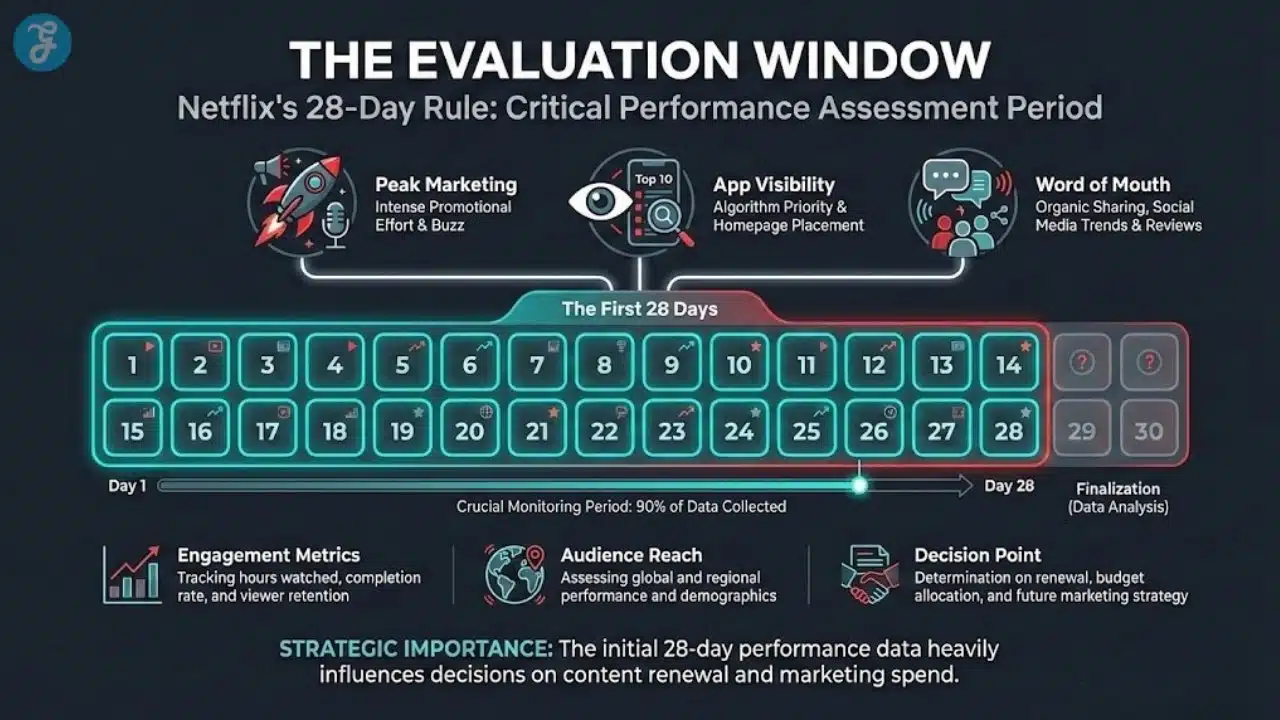
28 Days Is A Decision Window, Not A Magic Number
Netflix does not flip a renewal switch on Day 29. Some series are renewed quickly, some take months, and some decisions are delayed for budgeting or scheduling. Still, the first four weeks are often the cleanest window to compare titles because:
- Marketing is at its peak.
- The show is most visible in the app.
- Word of mouth either catches fire or fizzles out.
- Viewer behavior is freshest and easiest to attribute to that title.
So when people talk about the Netflix 28-day rule, they are usually pointing at the platform’s early performance snapshot.
Why The First 28 Days Matter To Streaming
Streaming services are not only selling ads or tickets. They are selling ongoing subscriptions. That means early engagement is crucial, because early engagement correlates with:
- Keeping subscribers from cancelling
- Attracting new subscribers
- Getting viewers to watch more Netflix content next
- Proving the show is a “franchise seed” Netflix can build on
A show that is “interesting” but unfinished by most viewers can be risky. Netflix needs evidence that the audience is not just curious, but committed.
Netflix 28-Day Rule: The Metrics That Actually Move The Needle
Completion rate matters because it sits inside a larger performance picture. Netflix looks at a set of signals, not one magic stat. Think of it like a funnel.
Starts, Views, And Sampling
Most new shows get sampling. Sampling is the viewer pressing play because the trailer looked good, the thumbnail popped, or Netflix autoplayed it after another title.
Starts are useful, but they can be misleading. A show can generate huge starts and still underperform if people drop quickly.
Completion Rate And Why It Is Different
Completion rate is about follow-through. The simplest way to think about it is: How many people who started the season actually finished it?
A show with moderate starts but strong finishing behavior can look healthier than a show with massive starts and a big fall-off.
Netflix also cares about where people quit. If a lot of viewers stop after Episode 1, the show may have a packaging problem. If they stop around Episode 4, the story may be losing momentum.
Season-Level Vs Episode-Level Completion
There are two practical layers:
- Episode completion: Do viewers finish the episode they started?
- Season completion: Do viewers finish the whole season?
Season completion is often more meaningful for renewals because it suggests satisfaction, not just curiosity.
Time To Finish And Binge Velocity
A related concept is binge velocity: how quickly people move from Episode 1 to the finale. Faster completion can signal higher urgency and stronger word of mouth. Slower completion is not always bad, but in a crowded release calendar, slow burns can struggle to show up strongly inside the first month.
How Completion Rate Is Calculated In Practice
Netflix does not fully disclose its internal formulas. Still, we can explain how completion rate tends to be interpreted across streaming.
Defining “A Viewer” And The First Few Minutes
One reason streaming metrics create confusion is that “a view” is not always the same as “a meaningful watch.” Most platforms use a minimum watch threshold so that accidental clicks do not count the same as real interest.
Even with thresholds, the early minutes matter a lot. A show that loses people in the opening scene might generate starts but weak retention signals.
What Counts As “Finished”
Completion can be assessed at different levels:
- Finished the episode
- Finished the season
- Finished within a certain time window
If Netflix is evaluating a show during the first month, it naturally cares whether viewers finish quickly enough to create measurable momentum.
The Problem With Long Runtimes And Slow Burns
Completion rate is not equally easy for every show:
- A 6-episode season is easier to finish than a 10-episode season.
- A 30-minute comedy is easier to binge than a 70-minute drama episode.
- A mystery with constant cliffhangers pushes completion better than a quiet character study.
That is why completion rate is best understood as part of a package: it is a strong signal, but it needs context.
A Simple Example
Imagine two shows released the same week:
- Show A: 10 million people start. 3 million finish the season in 28 days.
- Show B: 6 million people start. 3.5 million finish the season in 28 days.
Even though Show A had more starts, Show B created more finishers. Depending on cost and audience value, Show B may look like the safer renewal.
The Funnel Netflix Watches In The First Month
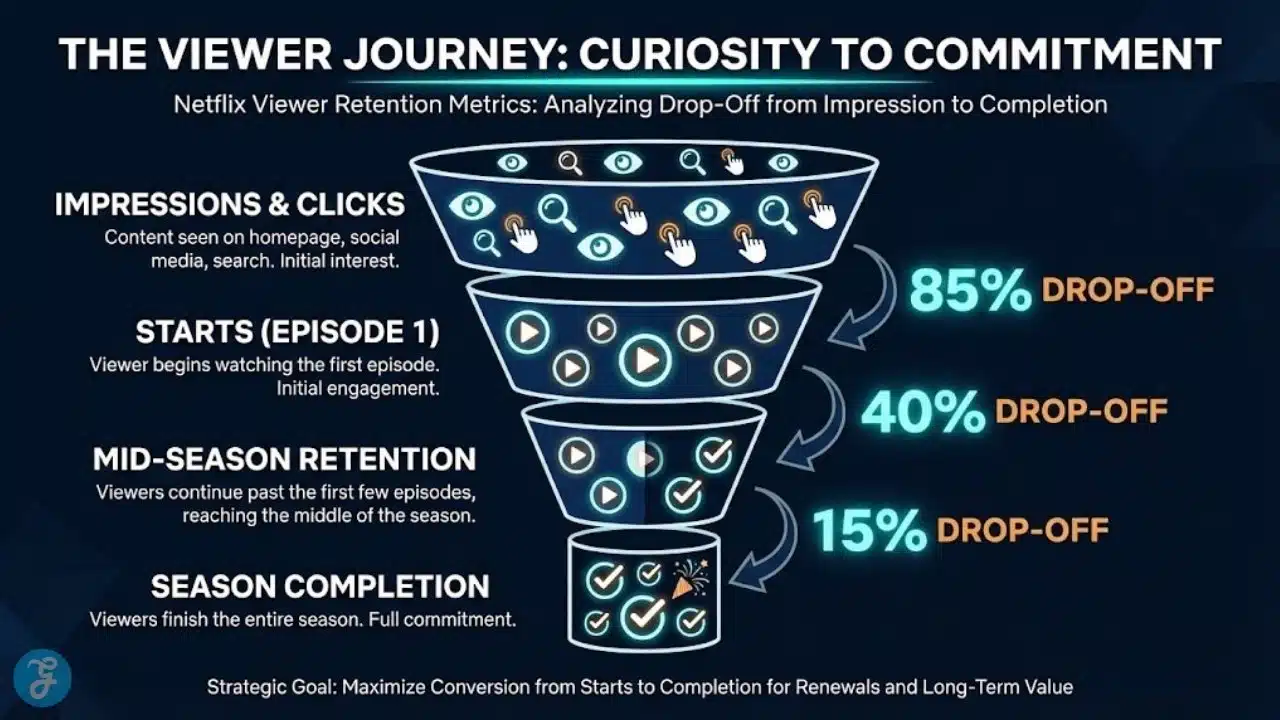
Think of Netflix’s evaluation as a journey from curiosity to commitment. Completion rate lives near the end of that journey.
The Viewer Funnel, Simplified
| Funnel Stage | What It Measures | What It Suggests |
| Impression and click | Packaging appeal | Title, thumbnail, concept clarity |
| Starts (Episode 1) | Sampling | Marketing pull and curiosity |
| Episode 1 completion | First-hour quality | Hook strength, tone clarity |
| Episodes 2–3 retention | Momentum | Story engine, pacing, characters |
| Mid-season retention | Consistency | No sag, no confusion, no drag |
| Season completion | Satisfaction | Viewers felt it was worth finishing |
| Rewatch and follow-up viewing | Loyalty | Strong fandom and lasting value |
A lot of cancellations become easier to understand when you imagine a show that looks great at the top of the funnel but collapses in the middle.
Where The “Episode 3 Problem” Shows Up
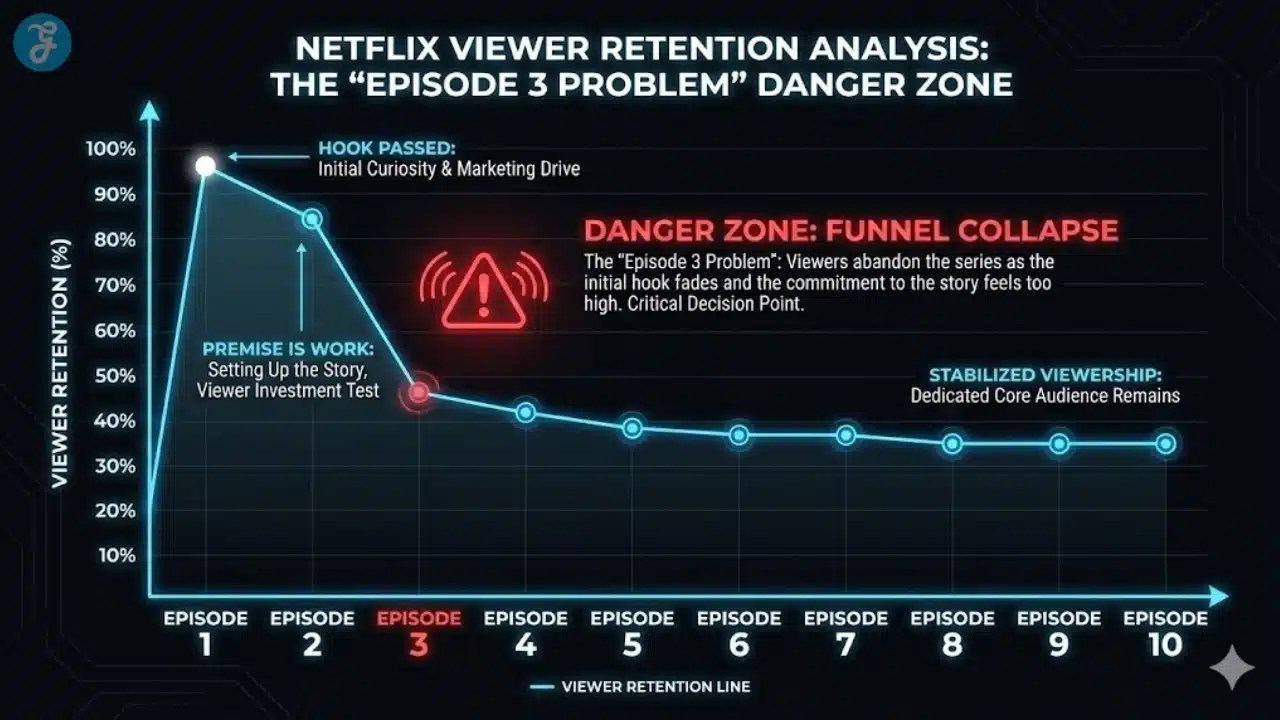
Many series have a hidden danger zone around Episodes 2 and 3:
- The hook has passed.
- The premise is now “work.”
- Viewers decide whether the story engine is strong enough.
When people say, “Everyone watched it but nobody finished it,” they are describing a funnel collapse, and completion rate captures that collapse.
Why Completion Rate Can Beat Raw Popularity
It is tempting to treat popularity as the only thing that matters. Streaming does not work that way.
Retention, Satisfaction, And Recommendation Loops
Netflix is a recommendation machine. If viewers finish a show, it creates a clear signal that:
- The show delivered on its promise.
- Viewers were satisfied enough to stick with it.
- Netflix can safely recommend it to more people.
High completion supports the algorithm. That can create a second wave of viewership after the initial release.
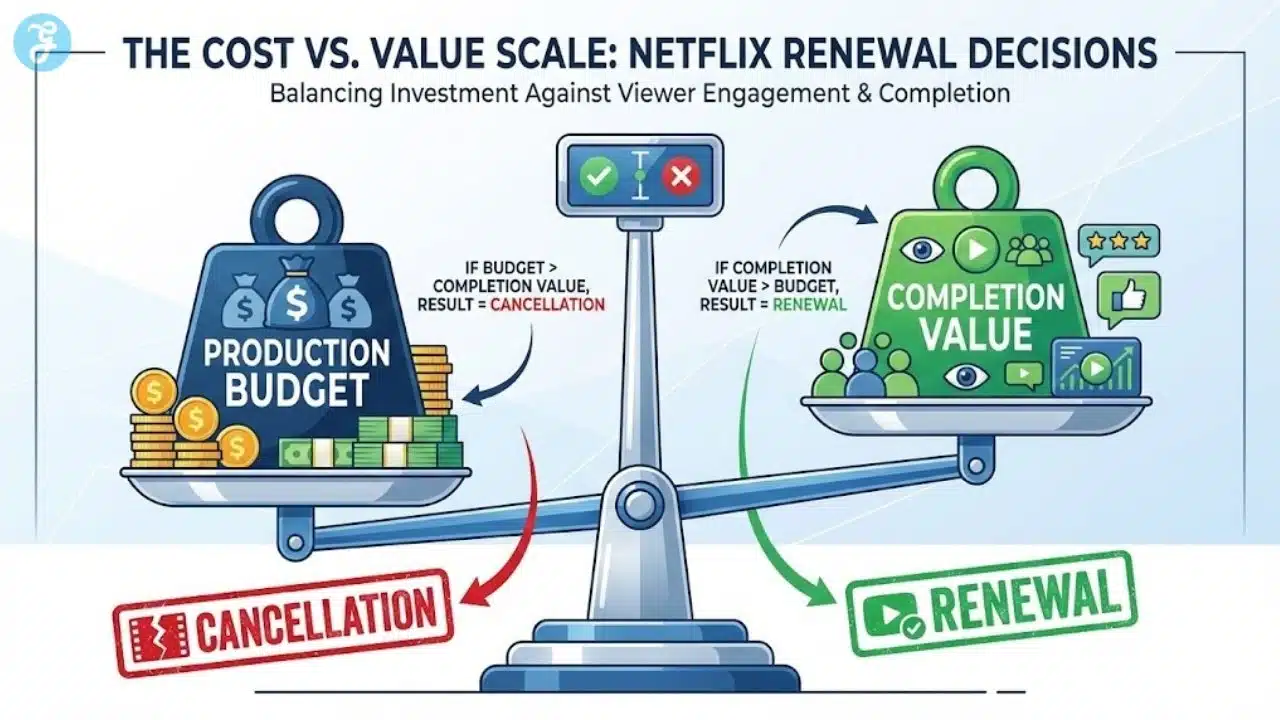
Cost Vs Value
Renewals are business decisions, not fan awards. A show can have decent engagement and still get cancelled if:
- The budget is high
- The cast contracts become expensive
- Visual effects costs jump
- Production timeline is slow
- The show does not drive enough subscription value relative to cost
Completion rate helps Netflix estimate value. If most people do not finish, it is harder to justify a big Season 2 bill.
What Low Completion Rate Usually Signals
Low completion rate does not always mean a show is “bad.” It usually means the show is not matching viewer expectations or not sustaining urgency.
The Concept-Execution Gap
This is the classic “great trailer, weak follow-through” situation. The premise sells, but the show does not deliver the experience viewers expected.
Confusing Tone Or Genre Identity
Tone confusion kills completion. If Episode 1 feels like one kind of show and Episode 2 becomes something else, viewers drop. Streaming audiences can be impatient because there is always something else to watch.
Episodic Bloat And Padding
Some shows feel stretched:
- Scenes repeat information
- Side plots do not connect to the core
- Episodes end without a strong forward pull
If viewers sense padding, they stop. Completion rate sinks even if starts are high.
Niche Appeal Without A Strong Core Hook
Niche shows can succeed, but they need either:
- A sharp hook that pulls non-fans in, or
- Extremely high completion and loyalty within the niche
If a niche title gets broad sampling but low finishing, it can look like it failed to convert curiosity into commitment.
What High Completion Rate Does Not Guarantee
A strong completion rate helps. It does not automatically lock a renewal.
Budget Still Wins Arguments
If two shows perform similarly, the cheaper show often looks better. High completion rate cannot erase a budget that does not make sense.
Global Mix Matters
Netflix is global. A show might perform well in one region but not travel well internationally. For some titles, Netflix is looking for broad global value, not only local success.
Timing, Scheduling, And Production Risk
Sometimes Netflix likes a show but cannot align:
- Actor availability
- Production location costs
- Showrunner schedule
- Post-production complexity
Those realities can delay decisions or push toward cancellation even when engagement looks decent.
How Creators Can Improve Completion Without Selling Out
Completion rate is not only about cliffhangers. It is about clarity, pacing, and payoffs.
Make The Promise Clear Fast
In the first 10 minutes, viewers want to know:
- Who is the story about?
- What is the central problem?
- Why should I keep watching?
A strong cold open helps, but clarity matters more than flash.
Design Episodes With Forward Motion
Each episode should deliver at least one of these:
- A major answer
- A major twist
- A major emotional payoff
- A major new question that feels urgent
Viewers quit when episodes feel optional.
Protect The Middle
Many shows start strong, sag in the middle, and recover at the end. The middle is where completion dies. If Episodes 4–6 feel slower, viewers drift and never return.
Earn The Finale
Completion is easier when the finale feels like a real payoff, not a pause. If Season 1 ends like half a story, viewers can feel tricked. That can hurt completion and future trust.
Be Careful With “Homework” Storytelling
Complex storytelling can work, but viewers need progress. If the show feels like homework, completion drops. You can be smart and still be clear.
What Fans Can Do In The First 28 Days
If you want to support a show, your behavior matters more than a hashtag. Petitions can be loud, but Netflix’s core language is viewing patterns.
Finish The Season
If you only do one thing, finish the season. The Netflix 28-day rule logic is about early signals, and finishing is one of the clearest signals you can send.
Watch Like A Real Viewer, Not Background Noise
Background watching can happen, but the strongest signal is intentional viewing that reaches the later episodes. If you start five new shows and finish none, you are telling the platform you like sampling, not committing.
Avoid Long Gaps
If you watch Episode 1 and then wait three weeks, you may not finish within the evaluation window. Binge speed is not everything, but early finishing concentrates the signal.
Bring New Viewers In
If you recommend the show to a friend who actually finishes it, that is powerful. Word of mouth that converts into completion matters.
Rewatch Helps Less Than Finishing For The First Time
Rewatching can signal fandom, but completion from first-time viewers is usually the bigger business signal. A small group rewatching obsessively is less valuable than a larger group finishing once.
A Practical Checklist To Estimate Renewal Strength
You cannot perfectly predict renewals from the outside, but you can sanity-check a title using completion-minded questions.
- Does the show get people past Episode 1 easily?
- Do episodes end with a forward pull?
- Is there a clear “Episode 3 hook” that confirms the premise?
- Does the season feel short enough to finish?
- Does it trend in conversation beyond the first weekend?
- Does it look expensive relative to its audience size?
- Does it travel across regions and languages?
If a show is expensive, slow, and widely sampled but rarely finished, it is in danger. If it is moderately priced, highly finished, and steadily discussed, it is safer.
How Public Netflix Charts Connect To Completion Rate
Even though Netflix does not publish completion rate, you can often spot clues in the way a new release behaves on public charts during the Netflix 28-day rule window. A show that spikes hard and disappears fast can indicate heavy sampling with weak follow-through. A show that holds steady for multiple weeks can hint at stronger retention, slower but consistent discovery, or both.
Here are a few practical patterns to watch:
- A big Week 1 debut followed by a sharp Week 2 drop can suggest many viewers tried Episode 1 but did not keep going.
- A modest Week 1 start with a stronger Week 2 can signal word of mouth, which often pairs with higher completion.
- A title that stays in the Top 10 for several weeks may be converting new viewers steadily, even if it is not a viral sensation.
These signals are not proof, but they are useful context when trying to understand how a show is performing beyond raw hype.
Quick Read Table: Visible Signals Vs What They May Mean
| What You Can Observe | What It Often Suggests | Why It Matters In 28 Days |
| Strong debut, fast drop | High sampling, low stickiness | Weak conversion from starts to finishers |
| Steady chart presence | Consistent viewing and discovery | Shows can build momentum past launch weekend |
| Growth from Week 1 to Week 2 | Word of mouth is working | New viewers are arriving and continuing |
| Lots of chatter, little chart time | Loud conversation, limited viewing | Social buzz alone may not translate to completion |
Completion-Friendly Story Design Signals
Some shows are built in a way that naturally supports completion. When Netflix sees these behaviors early, it can reduce risk in renewal decisions.
- A clear hook in the first episode that matches the trailer’s promise
- Short, purposeful episodes with minimal filler
- Escalation every episode, not just at the finale
- A mid-season turning point that changes the stakes
- A season ending that feels complete while still inviting another chapter
If you are tracking a series you love, the most important thing is still simple. During the Netflix 28-day rule period, finishing the season quickly creates a stronger signal than sampling multiple titles and abandoning all of them.
Closing Thoughts
The Netflix 28-day rule is not a mystical deadline. It is a useful way to think about how Netflix evaluates a title during its most intense month of data. Completion rate sits near the heart of that evaluation because it reflects satisfaction and commitment, not just curiosity.
If you want to understand why Netflix renews one show and cancels another, stop only asking, “How many people watched?” Start asking, “How many people finished, and how quickly did the show turn curiosity into loyalty?” That is where the real story usually is.