In 2026, the global workplace is grappling with AI-driven burnout and a growing disconnect between leadership and staff. While many nations are searching for new playbooks, Sweden continues to refine a centuries-old philosophy that prioritizes collective trust, radical transparency, and a sustainable pace. By moving away from “busy work” and focusing on intentional collaboration, the Swedish model offers a roadmap for organizations looking to re-engage their workforces without resorting to superficial perks. The Sweden employee engagement philosophy is built on the belief that a happy, autonomous worker is a productive one.
How We Selected Our 7 Best Sweden Employee Engagement Philosophy Facts
To identify the most impactful elements of this model, we analyzed current 2026 workplace trends from Nordic leadership studies and recent legislative updates from the Swedish Ministry of Employment. Our selection was filtered based on their portability to global markets and their proven ability to drive long-term productivity. We focused on concepts like the flattened hierarchy, consensus-based decision-making, and the 2026 expansion of parental care benefits. These facts represent the modern reality of a culture where work is designed to fit life, rather than compete with it.
The following seven pillars define how the Swedish approach transforms the daily experience of work into a meaningful, trust-based endeavor.
The 7 Most Essential Facts About Sweden’s Employee Engagement Philosophy
The Swedish approach to engagement is not a single initiative but a social contract that values the employee as a whole person. Each of these facts illustrates a different facet of how this culture maintains world-class innovation while keeping stress levels at a record low.
1. Fika as a Strategic Relationship-Building Institution
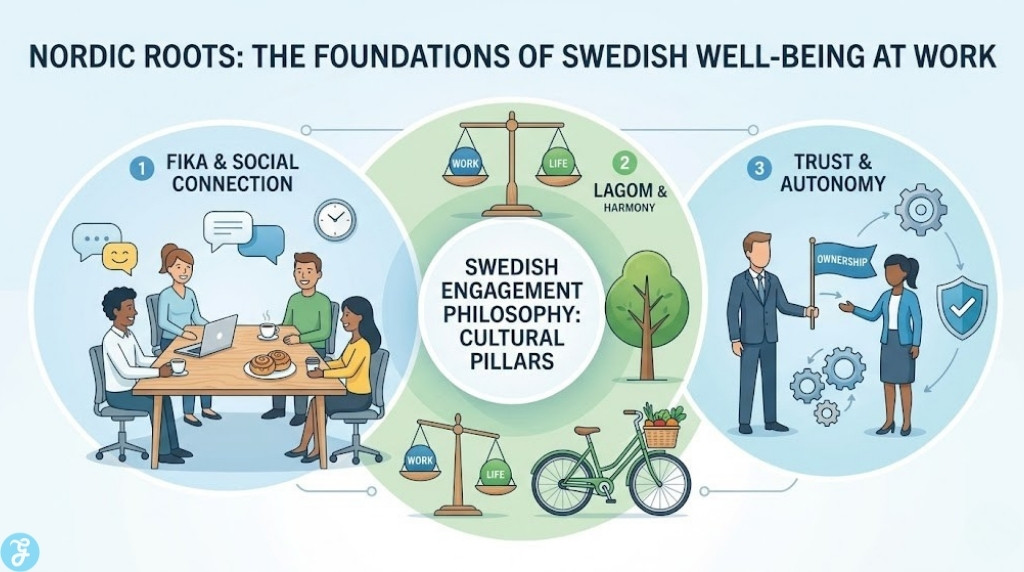
While many cultures see a coffee break as a moment of isolation or a quick caffeine hit, Sweden treats “Fika” as a mandatory social institution. In 2026, top Swedish firms use Fika to break down silos, ensuring that senior executives and junior interns share the same table without a formal agenda.
Best for: Organizations struggling with departmental silos or those looking to improve cross-functional communication.
Why We Chose It:
-
It humanizes the workplace by removing the pressure of a formal meeting environment.
-
It fosters weak ties across departments, which are essential for sparks of innovation.
-
It acts as a natural pressure valve, reducing workplace stress through consistent social connection.
Things to consider: For global teams, the spirit of Fika can be replicated virtually, but it requires a strict “no-work-talk” rule to remain effective as an engagement tool.
2. The Dominance of the “Platt” Hierarchy
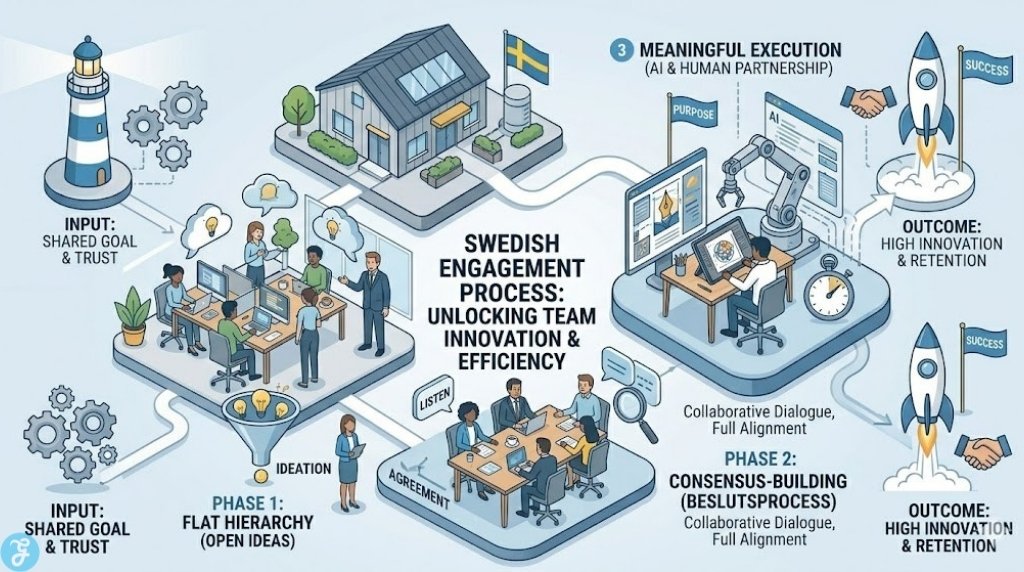
Statistics from 2026 indicate that over 80% of Swedish companies operate with a “Platt” or flat organizational structure. In this model, the role of a manager is not to command but to facilitate. This egalitarian approach encourages junior staff to challenge decisions openly, ensuring that the best ideas rise to the top regardless of tenure or title.
Best for: Tech startups and creative agencies where rapid innovation and diverse perspectives are critical to success.
Why We Chose It:
-
It empowers employees at every level to take ownership of their specific projects.
-
It reduces the bureaucratic lag often found in traditional top-down corporations.
-
It creates a culture of accountability where competence is valued over status.
Things to consider: Moving to a flat structure requires a high level of self-discipline from employees and a willingness from leaders to let go of traditional power symbols.
3. Consensus-Driven Decision Making over Top-Down Orders
The Swedish “Beslutsprocess” often involves multiple meetings to reach a consensus, a process that can feel slow to outsiders. However, by 2026, global analysts recognize this as a “slow-to-start, fast-to-finish” model. Once a decision is made, the entire team is already aligned, leading to an implementation phase that is almost entirely free of internal resistance.
Best for: Large-scale infrastructure or long-term strategic projects where internal buy-in is a prerequisite for success.
Why We Chose It:
-
It minimizes the risk of project failure due to hidden dissent from key stakeholders.
-
It ensures that every team member understands the logic behind a strategic shift.
-
It boosts morale by making every employee feel integral to the company’s direction.
Things to consider: This method requires patience and can be challenging in emergency situations where rapid, autocratic action is needed.
4. Lagom and the 2026 Shift to Work-Life Harmony
The concept of “Lagom”—not too little, not too much—is the foundation of the Swedish work ethic. In 2026, this has evolved into “Work-Life Harmony,” where work adapts to the rhythms of life. Swedish labor culture strictly protects personal time, with minimal overtime and a societal expectation that employees should disconnect fully at the end of the day.
Best for: High-pressure industries like finance or law where burnout rates are traditionally elevated.
Why We Chose It:
-
It prioritizes sustainable performance over short-term, exhaustive bursts of effort.
-
It reduces healthcare costs and absenteeism by preventing chronic workplace stress.
-
It attracts top-tier talent who are seeking long-term professional viability.
Things to consider: Organizations must lead from the top; if a CEO sends emails at midnight, the philosophy of Lagom will be undermined by the staff’s implied expectations.
5. Trust as a Starting Line, Not a Reward
In the Swedish workplace, trust is the default setting. Managers assume employees are capable, self-driven professionals from their first day on the job. This trust-first approach eliminates the need for intrusive micromanagement and surveillance, allowing employees to manage their own schedules and workflows.
Best for: Distributed or remote-first companies that rely on high levels of autonomous productivity.
Why We Chose It:
-
It creates an immediate sense of psychological safety and professional respect.
-
It frees up management time for strategic coaching rather than task-tracking.
-
It fosters a culture of proactivity where employees feel safe to experiment and fail.
Things to consider: This model assumes that the recruitment process is rigorous enough to identify individuals with high levels of intrinsic motivation.
6. VAB and the 2026 Expansion of Parental Support
Sweden’s “VAB” (Vård av Barn) laws allow parents to take paid time off to care for sick children. As of January 1, 2026, these rights have been expanded to include more flexible meetings regarding a child’s disability or long-term care. This legislative support ensures that “family vs. work” is never a choice an employee has to make.
Best for: Modern corporations looking to build a truly inclusive, gender-neutral workplace.
Why We Chose It:
-
It removes the guilt associated with parenting, allowing for full focus when at work.
-
It promotes gender equity by ensuring that caregiving duties are shared across the workforce.
-
It demonstrates a long-term commitment to the employee’s holistic well-being.
Things to consider: For companies outside of Sweden, replicating this requires a robust contingency plan so that team goals can be met during an employee’s absence.
7. Meaningful AI Integration as an Engagement Tool
In 2026, Swedish firms are leading the way in integrating AI as a tool for intentional engagement. Instead of using AI to measure keystrokes, they are using it to automate administrative drudgery, freeing up employees to focus on high-value creative tasks. This shift ensures that technology enhances the human experience of work rather than replacing it.
Best for: Organizations undergoing digital transformation that want to avoid AI anxiety among staff.
Why We Chose It:
-
It refocuses the employee’s energy on high-value, creative, and relational tasks.
-
It reduces cognitive overload by streamlining complex data management.
-
It aligns with the 2026 goal of purposeful productivity over mere busy-ness.
Things to consider: Leaders must be explicit about how AI will be used to ensure that employees view the technology as a partner rather than a competitor.
Comparing the Swedish Model to Traditional Engagement Strategies
To understand how the Sweden employee engagement philosophy differs from standard corporate approaches, it is helpful to look at the underlying mechanics of their 2026 workplace standards. The transition from managing effort to managing impact is the key differentiator.
The table below outlines the core shifts that define the Swedish engagement philosophy in the current year.
| Feature | Traditional Engagement Model | Swedish Philosophy (2026) |
| Social Rituals | Occasional team building | Daily, mandatory Fika |
| Hierarchy | Pyramidal / Command-and-control | Platt (80% flat adoption) |
| Decision Style | Executive-led / Top-down | Consensus (Beslutsprocess) |
| Trust Model | Trust is earned over time | Trust is the default starting point |
| Well-being | Perks and digital high fives | Holistic life-integration (Lagom) |
| Parental Care | Discretionary / Company-specific | Legislative mandate (VAB) |
Our Top 3 Picks and Why?
Of the seven facts discussed, the Dominance of Flat Hierarchies, Trust as a Default, and the Strategic Power of Fika are the most critical. These three elements form the DNA of the Swedish model. Flat hierarchies ensure everyone is heard, trust-first leadership allows for rapid autonomy, and Fika provides the social glue that keeps the team connected in a distributed work environment. Together, they create a resilient culture that is capable of navigating the rapid technological shifts of 2026 without losing its human core.
Manager’s Guide: Integrating Swedish Principles into Your Local Team
Successfully adopting these Nordic principles requires a shift from oversight to enablement. By standardizing these practices, you can improve team cohesion and long-term retention.
The Selection Framework:
-
Identify Siloed Areas: Start by introducing Fika in departments where communication is stalled to build organic relationships.
-
Audit Your Trust Levels: If you are using keystroke trackers or mandatory green light statuses, consider how moving to a Trust-first model could unlock proactivity.
-
Normalize Consensus: For your next non-emergency project, use a consensus-based decision model to test for improved team alignment.
Decision Matrix (Table):
The matrix below helps determine which Swedish principle to prioritize based on your current team challenge.
| If your team is facing… | Then prioritize this principle… |
| High burnout or turnover rates. | Lagom / Work-Life Harmony |
| Slow execution due to hidden dissent. | Consensus-Driven Decision Making |
| Low innovation or yes-man culture. | The Platt (Flat) Hierarchy |
Final Audit: 5-point Checklist for Nordic-Style Leadership
-
Have you designated a specific, non-work-related time for Fika this week?
-
Are you giving immediate trust to new hires rather than making them earn it?
-
Does your team have a clear Right to Disconnect policy for after-hours?
-
Are you rewarding consensus-building behaviors in your performance reviews?
-
Have you integrated AI tools to reduce administrative friction for your staff?
Exporting the Swedish Model to the Global Stage
The 2026 workplace is no longer a physical location but a relational ecosystem. By embracing the Swedish philosophy of flat hierarchies, intentional trust, and the sustainable pace of Lagom, organizations can build a future that is both highly productive and deeply human. Sweden proves that engagement is not a campaign to be run but a culture to be lived—a culture where the employee’s success is inseparable from their well-being. As we move further into an automated age, these human-centric values will become the ultimate competitive advantage for companies worldwide.
Frequently Asked Questions (FAQs) on Sweden Employee Engagement Philosophy
What is the real difference between a coffee break and Fika?
A coffee break is usually a functional pause intended to refuel. Fika is a social institution focused on connection. In a Swedish Fika, the coffee and pastry are secondary to the act of sitting down together, without a hierarchy or an agenda, to build relationships.
Does consensus decision-making actually slow down a company?
While the initial decision-making phase takes longer in the Swedish model, the implementation phase is significantly faster. Because every stakeholder has had their voice heard and is aligned with the plan, there is very little internal resistance or sabotage once the project launches.
How does a flat hierarchy work if no one is in charge?
Flat doesn’t mean leaderless. In a flat organization, the manager’s role shifts from taskmaster to facilitator or coach. Leaders still make final calls when necessary, but the default is for teams to operate with high levels of autonomy.
Is Lagom just another word for being lazy?
Not at all. Lagom is about optimal performance rather than maximum performance. It recognizes that working 60-hour weeks leads to diminishing returns and errors. By working a focused, high-quality 40 hours and then fully disconnecting, employees stay sharp and engaged for the long term.
Can VAB benefits be applied in countries without Swedish labor laws?
Yes. While the Swedish government subsidizes VAB, many global companies in 2026 are adopting similar family-first policies internally. They view the cost of paid parental leave for sick children as an investment in employee loyalty and long-term retention.