
Netflix’s global sensation Squid Game has officially wrapped up its run with the third and final season, leaving fans with an unforgettable ending and the promise of a possible future beyond Korea. The series, known for its brutal games, philosophical themes, and emotional storytelling, concluded with a surprise cameo by one of Hollywood’s most respected actresses, adding even more intrigue to its already gripping narrative.
The Final Scene: Cate Blanchett’s Unexpected Entry into the Squid Game Universe
In the closing moments of the Season 3 finale, viewers are taken to downtown Los Angeles. The scene opens with the character known as the Front Man—whose real name is In-ho and played by South Korean actor Lee Byung-hun—stopped at a red light. As he waits in his vehicle, his attention is drawn to a nearby alleyway, where he spots a familiar-looking recruitment game unfolding.
A woman in a dark coat is seen engaging in a tense game of ddakji with a desperate-looking man. This small but significant moment mirrors how contestants were recruited into the deadly competition in earlier seasons. But what truly shocks viewers is the identity of the mysterious woman. As she looks up briefly and acknowledges In-ho before turning her attention back to her recruit, the camera reveals her to be none other than two-time Academy Award-winning actress Cate Blanchett.
Blanchett’s brief but powerful appearance marks a major turning point for the franchise. She plays a U.S.-based recruiter, suggesting that the Squid Game operations may now be expanding to North America. Her cool demeanor and calm authority instantly communicate that she is not just a cameo, but potentially a key figure in the story’s future direction. The scene ends with her recruit eagerly requesting another round of ddakji, which she accepts with a smirk, hinting that the recruiting process in the U.S. may be just as manipulative and dangerous as it was in Korea.
Gi-hun vs. Front Man: A Philosophical Battle Reaches Its Climax
The third season of Squid Game continued the tense rivalry between Seong Gi-hun, portrayed by Lee Jung-jae, and the Front Man, In-ho. This time, their conflict took on an even deeper philosophical dimension. Gi-hun, having experienced the trauma and corruption behind the game, sets out with a mission: to dismantle the entire system that thrives on exploiting human desperation for entertainment.
On the other hand, In-ho, who had once been a contestant and then rose to become one of the system’s enforcers, finds himself torn between maintaining order and questioning his own role in the dehumanizing structure. Throughout the season, the two characters clash—both physically and ideologically—while new contestants are forced into increasingly dangerous games.
These new games are darker, more complex, and more emotionally charged than ever before. With the stakes raised and the moral lines blurred, Season 3 pushes the characters to their limits, examining what it truly means to survive in a system designed to strip away humanity.
Global Recognition and Awards: Squid Game Makes History
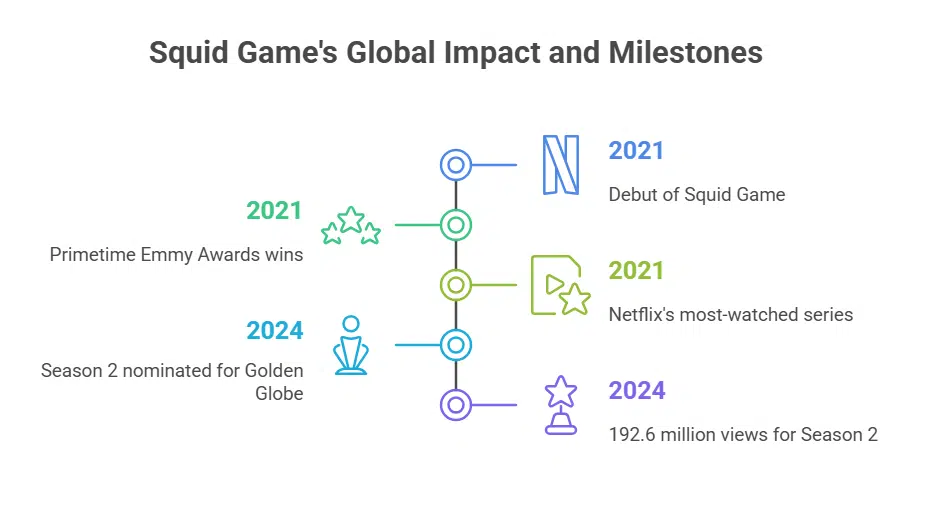
Since its debut in 2021, Squid Game has broken numerous records and received widespread acclaim for its bold storytelling and unique concept. It became the first non-English language series to win major categories at the Primetime Emmy Awards, including Outstanding Lead Actor for Lee Jung-jae and Outstanding Directing for creator Hwang Dong-hyuk.
The show also earned recognition at the Screen Actors Guild Awards and won multiple other international honors. Season 2 continued this momentum by being nominated for a Golden Globe in the Best Television Series – Drama category, further establishing its reputation as a global entertainment powerhouse.
In terms of viewership, the numbers speak for themselves. According to Netflix, Season 1 of Squid Game remains the platform’s most-watched series to date, with a staggering 265.2 million views. Season 2 also performed exceptionally well, garnering 192.6 million views and securing the second spot in the all-time rankings. These statistics highlight the show’s ability to engage viewers across different cultures and languages, proving that powerful storytelling transcends borders.
Future of the Franchise: A Possible U.S.-Based Spin-off?
While Season 3 marks the end of the original Korean story arc, the final scene featuring Cate Blanchett has sparked widespread speculation about the future of the Squid Game universe. Reports from industry sources, including Deadline, have indicated that Netflix is already in the early stages of developing a new English-language spin-off. This upcoming project is rumored to be led by acclaimed filmmaker David Fincher, known for directing award-winning films such as The Social Network, Fight Club, and Gone Girl.
Although Netflix has not officially confirmed the development of this new series, the appearance of an American recruiter in the final scene strongly suggests that the deadly competition may be expanding beyond South Korea. If true, this would open up a new chapter in the franchise, potentially exploring how different cultures react to the same twisted game and what new psychological and moral challenges await future players.
Given Fincher’s background in creating dark, suspenseful dramas with psychological depth, fans are already excited about what an American version of Squid Game could look like. This shift could also allow the franchise to explore systemic issues such as poverty, inequality, and power from a Western perspective, adding new layers to the already rich narrative.
A Landmark Moment for Global Television
The end of Squid Game Season 3 is more than just the conclusion of a story. It marks a cultural milestone in the evolution of global streaming content. What began as a Korean-language thriller about people gambling their lives for money has transformed into a global phenomenon that challenges viewers to reflect on society, ethics, and human nature.
Cate Blanchett’s appearance is not just a celebrity cameo—it’s a symbol of the show’s international influence and its transition into a broader, more diverse narrative universe. With new spin-offs likely on the horizon, Squid Game is no longer just a Korean success story. It has become a defining force in international storytelling and a benchmark for what is possible in global streaming entertainment.
As the lights dim on the original series, the stage is being set for a new kind of game—one that could span continents, languages, and ideologies. And if the final scene is any indication, the next phase of Squid Game may be even more unpredictable, philosophical, and emotionally gripping than the last.