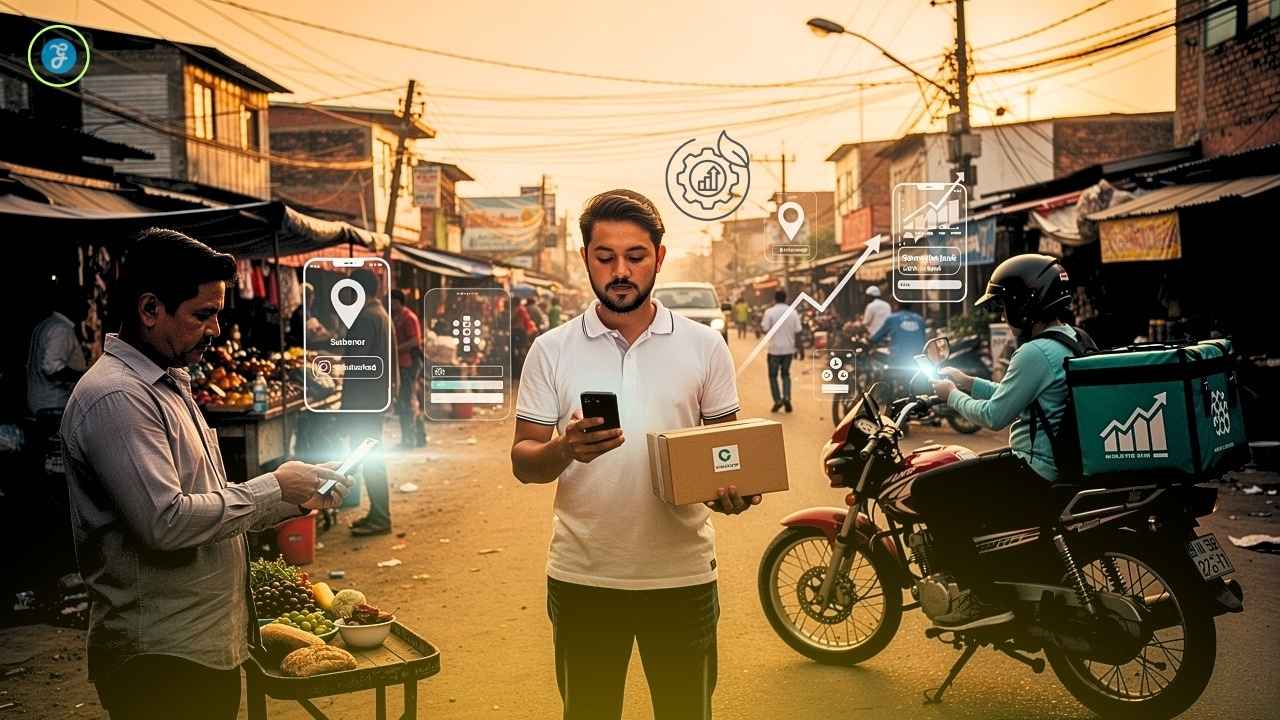

Do you ever come home from a trip feeling more tired than when you left? You race from one landmark to the next, snap a thousand photos, and cross places off a list like you are grocery shopping. You are not the only one feeling this way. A recent 2025 travel report found that 57% of Americans now plan to take longer trips specifically to avoid this burnout. They want connection, not just a collection of passport stamps.
This is where slow travel mindset comes in. It prioritizes quality over quantity. It means slowing down to make memories that actually stick.
Exactly how to shift your mindset, save money, and finally enjoy your travels again. Let’s look at how this simple change can transform your next trip.
What is Slow Travel?
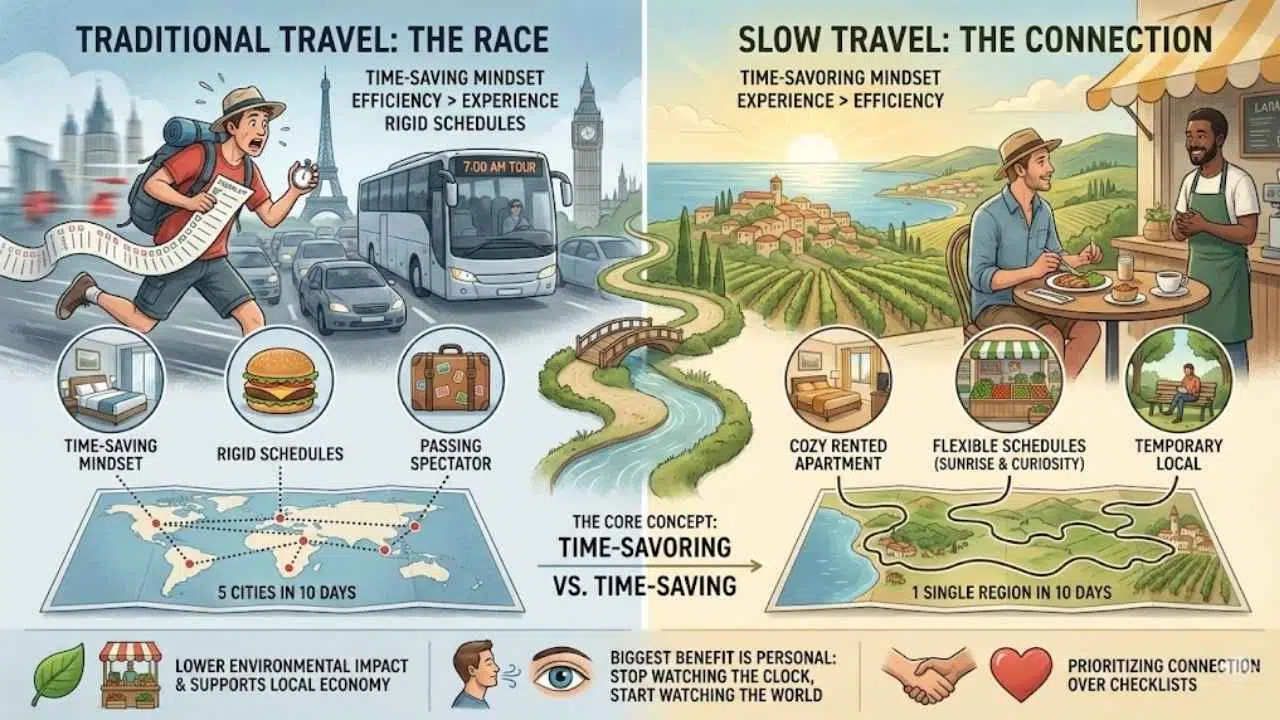
Slow travel is the art of prioritizing connection over checklists. Instead of frantically searching for the quickest route between tourist traps, you focus on the journey itself.
Think of it as the difference between grabbing a fast-food burger and sitting down for a home-cooked Sunday dinner. One fills you up; the other feeds you.
The Core Concept: Time-Savoring vs. Time-Saving
Researchers Dickinson and Lumsdon describe slow travel as shifting from a “time-saving” mindset to a “time-savoring” one. It is not about how fast you can get there, but how much you can enjoy the movement and the moment.
Definition of the Slow Travel Mindset
Adopting this mindset means valuing your experience more than your efficiency. Travelers who choose this path often stay in one location for a week or more. They rent apartments instead of hotel rooms and shop at neighborhood grocers.
They let go of rigid schedules. Instead of waking up to an alarm for a 7:00 AM tour bus, they wake up when the sun rises and wander where curiosity leads them. This approach naturally lowers your environmental impact and supports the local economy, but the biggest benefit is personal.
You stop watching the clock and start watching the world.
How it Differs from Traditional Travel
Traditional tourism often feels like a race. You might visit five cities in ten days, spending more time on trains and in security lines than exploring. Slow travel flips this script.
You might spend those same ten days in a single region, like the Hudson Valley in New York or the coast of Maine. You learn the barista’s name at the local coffee shop. You find a favorite park bench. You become a temporary local rather than a passing spectator.
Why Choose Quality Over Quantity in Travel?
Rushing through a destination often leaves you with a blur of memories and a distinct sense of exhaustion. By 2025, travel burnout has become a recognized phenomenon, pushing travelers to seek “JOMO”—the Joy of Missing Out.
Building Meaningful Experiences
When you stop rushing, you start seeing. Imagine sitting in a diner in a small town in Vermont. Because you aren’t checking your watch, you strike up a conversation with the owner.
She tells you about the best hiking trail that isn’t on any map. You spend your afternoon there, completely alone with nature, instead of fighting crowds at a famous overlook.
These are the stories you tell for years. According to psychological research on the “broaden-and-build” theory, these positive, unhurried emotions broaden your awareness and build lasting personal resources, like resilience and joy.
Fostering Deeper Connections with Local Cultures
Speed creates barriers. When you are always moving, you are always an outsider. Slowing down opens the door to genuine interaction.
If you stay in a rental in New Orleans for two weeks, you stop being a tourist and start being a neighbor. You might help someone with their groceries or get invited to a backyard crawfish boil. These moments define a trip.
Reducing Travel Fatigue
Constant movement is physically draining. The stress of catching flights, packing bags, and navigating new transit systems every two days spikes your cortisol levels.
Signs You Need to Slow Down:
- You wake up dreading the day’s itinerary.
- You can’t remember the name of the town you visited two days ago.
- You spend more time looking at your phone’s map than the scenery.
- Your feet hurt constantly, and you rely on caffeine to keep going.
Staying put allows your body to rest. You return from your vacation actually feeling rejuvenated, which was the point of taking a break in the first place.
Benefits of Slow Travel
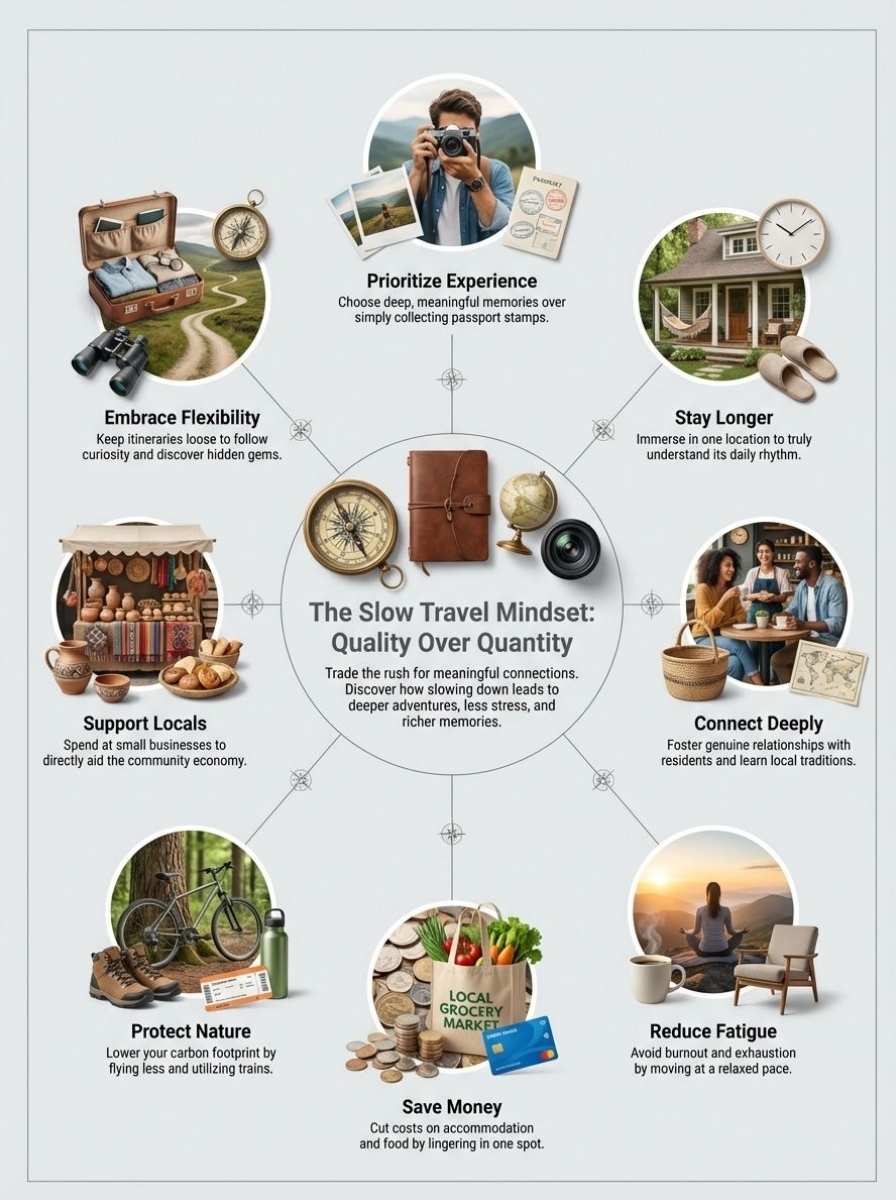
The perks of slowing down go beyond just feeling rested. The data shows that this style of travel is better for your wallet, the planet, and the communities you visit.
Enriched Travel Experiences
Quality over quantity means you actually taste the food you eat and hear the music you find. Travelers often report that their fondest memories come from unplanned moments—a sudden rainstorm that forced them into a cozy bookstore, or a wrong turn that led to a beautiful garden.
By spending more time in fewer places, you peel back the layers of a destination. You move past the “Instagram spots” and find the real character of a city.
Positive Environmental Impact
Fast travel is heavy on carbon. Frequent short-haul flights are one of the biggest contributors to personal carbon footprints. Slow travel swaps planes for trains and buses.
The Data on Carbon Savings:
| Transport Mode | CO2 Emissions (approx per passenger/km) | Impact Note |
|---|---|---|
| Short-Haul Flight | ~255g | Highest impact option. |
| Driving (Solo) | ~192g | Better than flying, but still high. |
| Train (Amtrak/Rail) | ~41g | Reduces emissions by over 80%. |
By choosing a train route, like Amtrak’s Empire Builder across the northern US, you drastically cut your emissions while seeing parts of the country inaccessible by air.
Cost-Effective Travel Options
Staying longer saves you money. Monthly rentals on platforms like Airbnb or Vrbo often come with discounts of 30% to 50% compared to nightly rates. You also gain access to a kitchen.
Cooking your own breakfast and dinner using local ingredients can save you hundreds of dollars a week compared to eating out three times a day. Plus, slow transport deals are unbeatable. For example, the Amtrak USA Rail Pass offers 10 ride segments for around $499, allowing you to explore the country for a fraction of the cost of flights.
Supporting Local Communities
When you rush, you tend to stick to convenient, global chains near major landmarks. When you slow down, you find independent businesses.
This shift has a massive economic impact. A study by Civic Economics found that for every $100 spent at a local independent business, roughly $52 stays in the local economy. In contrast, only about $14 stays local when you spend that same amount at a national chain. Your slow travel dollars directly pay for dance lessons for a local kid or put food on a family’s table.
How to Embrace the Slow Travel Mindset
You don’t need to quit your job and travel for a year to do this. You can apply these principles to a standard two-week vacation.
Stay Longer in One Destination
Pick a “base camp” and stick to it. Instead of a road trip that hits five states, rent a cabin in the Great Smoky Mountains or a condo in San Diego for the full duration.
For an even deeper experience, look into platforms like Trusted House sitters. In 2024 alone, this platform facilitated over 2.2 million nights of pet sitting. It allows you to stay in a real home for free in exchange for caring for pets, instantly giving you a local’s perspective and pace.
Embrace Flexible Itineraries
Leave at least 50% of your schedule blank. If you plan every minute, you kill the possibility of serendipity.
Wake up and ask, “What do I feel like doing today?” Maybe you read a book in a park. Maybe you take a local pottery class. This flexibility removes the stress of “falling behind” on your schedule.
Opt for Sustainable Transportation
Treat the journey as part of the vacation. In the US, taking the train is a fantastic way to decompress. Routes like the Coast Starlight (Seattle to Los Angeles) offer stunning ocean and mountain views that drivers on I-5 completely miss.
You can walk around, eat in the dining car, and meet fellow travelers. The travel time becomes leisure time, not dead time.
Immerse Yourself in Local Life
Skip the souvenir shops and head to the grocery store or farmers market. In Seattle, this might mean bypassing the crowded first Starbucks to find the neighborhood markets in Capitol Hill.
Actionable Tips for Immersion:
- Use “EatWith”: This app connects you with locals who host dinners in their homes. It is a shortcut to authentic food and conversation.
- Find the “Third Place”: Look for the community hub—a library, a public square, or a popular coffee shop—and spend a few hours there just people-watching.
- Take a Class: Learn something native to the area. Take a surfing lesson in California or a barbecue cooking class in Texas.
Top Destinations for Slow Travel
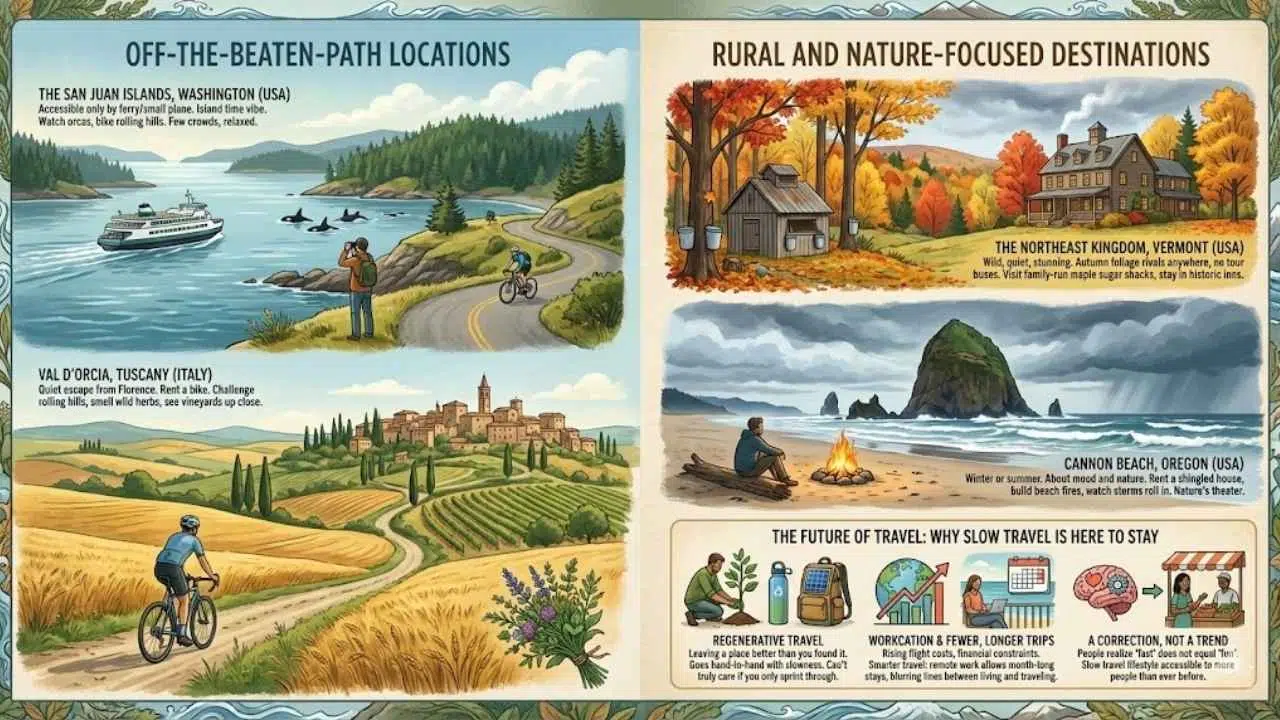
Some places practically beg you to slow down. Here are a few spots perfect for unhurried exploration, both in the US and abroad.
Off-the-Beaten-Path Locations
The San Juan Islands, Washington (USA): Accessible only by ferry or small plane, these islands operate on “island time.” You can spend days just watching for orcas from the shore of San Juan Island or biking the rolling hills of Lopez Island. The lack of bridges keeps the crowds manageable and the vibe relaxed.
Val d’Orcia, Tuscany (Italy): While Florence is packed, the small towns of this region, like Pienza, offer a quiet escape. A pro-tip for this area: rent a bike. The rolling hills are challenging but allow you to smell the wild herbs and see the vineyards up close in a way a car window never permits.
Rural and Nature-Focused Destinations
The Northeast Kingdom, Vermont (USA): This corner of Vermont is wild, quiet, and stunning. In autumn, the foliage rivals anywhere in the world, but without the tour buses of the southern routes. You can visit family-run maple sugar shacks and stay in historic inns that have been hosting guests for a hundred years.
Cannon Beach, Oregon (USA): Winter or summer, the Oregon coast is about mood and nature. It is perfect for renting a shingled house, building beach fires, and watching the storms roll in off the Pacific. It is nature’s own theater, requiring nothing from you but your attention.
The Future of Travel: Why Slow Travel is Here to Stay
This is not just a trend; it is a correction. People are realizing that “fast” does not equal “fun.”
According to the 2025 IPX1031 Travel Trends report, 92% of Americans plan to travel this year, but financial constraints are making them smarter about how they do it. Taking fewer, longer trips is the logical answer to rising flight costs.
We are also seeing the rise of “Regenerative Travel”—leaving a place better than you found it. This goes hand-in-hand with slowness. You can’t truly care for a place you only sprint through. As remote work continues to be an option for many, the “workcation” (working from a vacation rental for a month) is blurring the lines between living and traveling, making the slow travel lifestyle accessible to more people than ever before.
Final Thoughts
Choosing the slow travel mindset lets you trade long checklists for real moments that matter. You now know how simple steps, like staying longer or trying local foods, can make your trips richer and friendlier to both your wallet and the planet.
Have you thought about where you might linger next time instead of rushing? Even small changes can spark big memories and leave footprints lighter than a feather. Once spent a whole week in a tiny town, sharing stories with locals. It changed view on what adventure means. Maybe it is your turn to find joy in slowing down too.