Your hardwood floors are the aesthetic anchor of your home—a timeless investment that adds warmth, character, and significant value. However, unlike tile or carpet, wood is a living material that reacts to foot traffic, humidity, and time. Even the highest-quality hardwood floors eventually lose their luster and protection.
The challenge for most homeowners isn’t knowing that their floors are aging, but knowing when to act. Waiting too long can turn a routine maintenance job into a costly restoration nightmare involving board replacement.
If you are searching for signs hardwood floors need refinishing, this guide is your definitive resource. We will walk you through the 12 critical indicators, the instant “Water Droplet Test,” and the 2026 cost expectations to help you make an informed decision.
Key Takeaways
-
Don’t ignore gray wood: It is the final warning before your floor rots.
-
Use the Water Test: It’s the most objective way to measure finish integrity.
-
Screening saves money: If your damage is only surface-level, a screen and recoat is 50% cheaper than refinishing.
-
Plan for the mess: A full refinish requires moving all furniture and vacating the area for several days.
The “Water Droplet Test”: How to Check Your Floor’s Seal Instantly
Before diving into visual inspections, you can perform a simple, scientific test to check the integrity of your floor’s protective layer (usually polyurethane). Professionals use this to determine if the finish is merely dirty or chemically compromised.
-
Find a high-traffic area (like a hallway or near the kitchen sink).
-
Pour a tablespoon of water directly onto the wood.
-
Observe the reaction:
| Reaction | Diagnosis | Action Required |
| Water beads up | The seal is intact. | Clean or polish; no refinishing needed. |
| Water soaks in slowly | The finish is thinning/porous. | Plan to refinish or “screen and recoat” soon. |
| Water soaks in immediately | The finish is breached. | Refinish immediately to prevent rot. |
| Wood turns dark/black | Moisture has penetrated deep. | Urgent repair; board replacement may be needed. |
The 3 Stages of Floor Wear: Understanding the Urgency
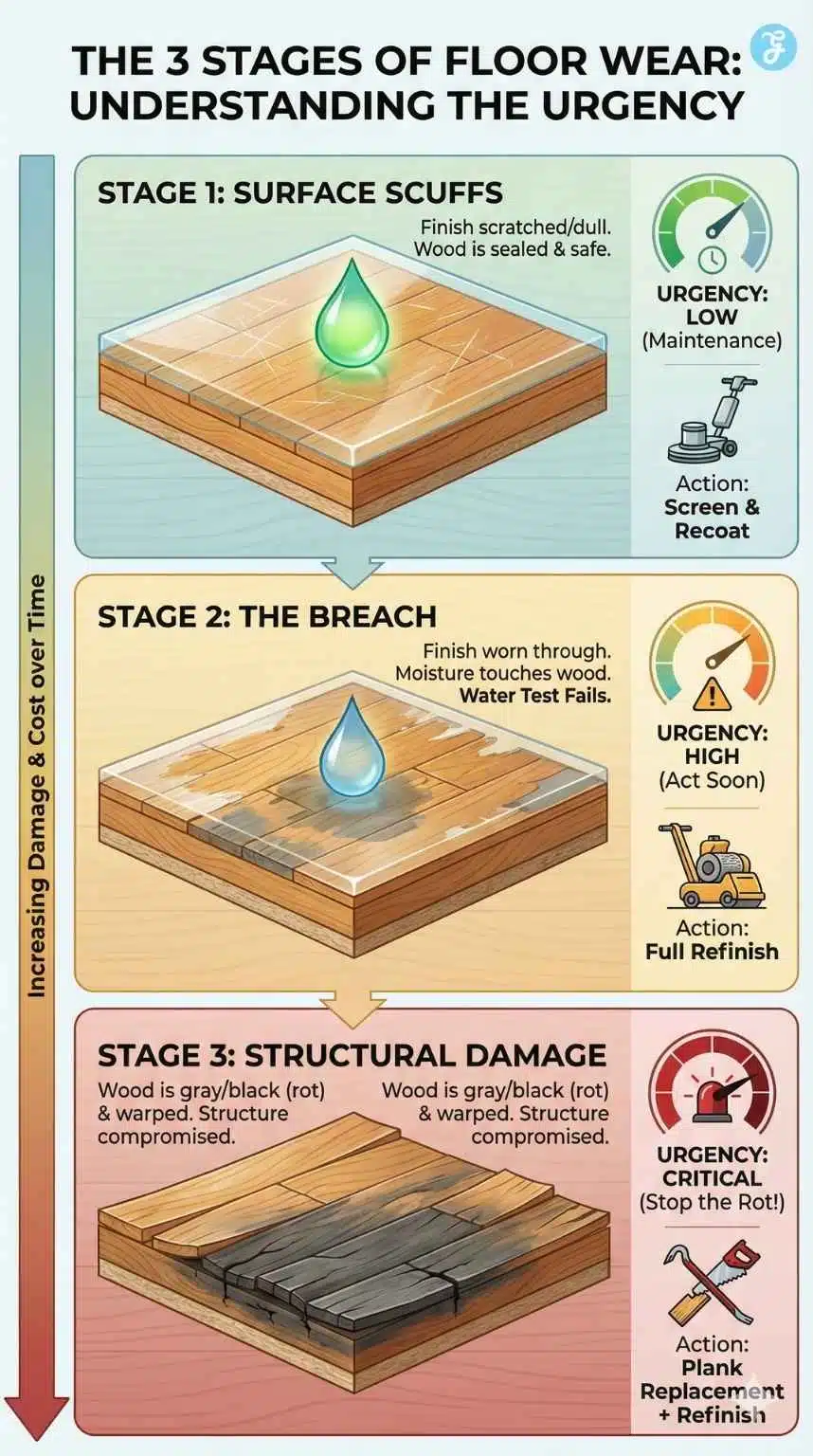
Before you check the specific signs of damage, it helps to understand what is actually happening beneath your feet. A hardwood floor is not a single solid block; it is a system composed of the structural wood and a sacrificial finish layer (usually polyurethane).
Think of the finish as a shield. Its job is to take the abuse so the wood doesn’t have to. Wear happens in three distinct stages, and identifying which stage you are in will dictate the cost of your repair.
Stage 1: Surface Scuffs (The “Screen & Recoat” Window)
-
What it is: The finish is scratched or dull, but the shield is still intact. The wood underneath is safe.
-
The Fix: You can often skip the heavy sanding and opt for a “Screen and Recoat.” This is cheaper, faster (1 day), and less messy.
-
Urgency: Low, but maintenance now saves money later.
Stage 2: The Breach (The “Refinish” Zone)
-
What it is: The finish has worn through in spots. Water, dirt, and oil are now touching the raw wood fiber. This is where you will see the “Water Droplet Test” fail.
-
The Fix: You need a full refinish (sanding down to raw wood) to reset the system.
-
Urgency: High. Every month you wait allows moisture to penetrate deeper.
Stage 3: Structural Damage (The “Replacement” Risk)
-
What it is: The wood has been exposed for so long that it has turned black (rot) or warped (cupping).
-
The Fix: Sanding alone won’t work. Damaged boards must be ripped out and replaced before the rest of the floor is refinished.
-
Urgency: Critical.
If your floor passed the water test, you are likely in Stage 1. If it failed, you are entering Stage 2. Now, let’s look at the specific visual clues that tell you exactly how deep the damage goes.
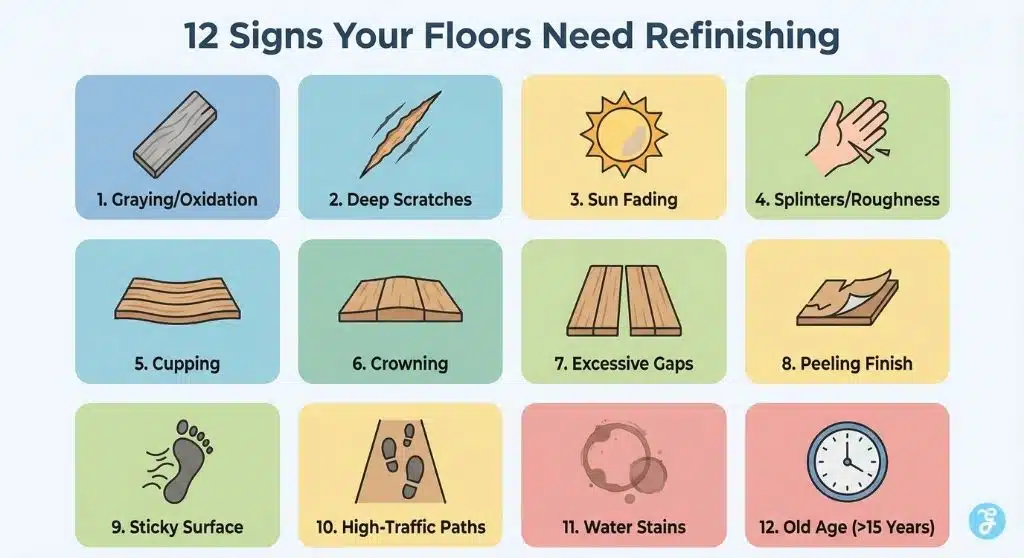
1. Graying or Oxidizing Wood (The Danger Zone)
One of the most urgent signs hardwood floors need refinishing is a change in color—specifically, turning gray. This is not just a cosmetic issue; it is a structural warning.
When the polyurethane finish wears off completely, the bare cellulose fibers of the wood are exposed to oxygen and moisture. This process, known as oxidation, turns the wood gray. If you see gray patches in high-traffic zones, your floor has zero protection. If left untreated, this gray will turn black (mold and rot), meaning the structure of the board is destroyed, and sanding will no longer fix it.
2. Deep Scratches That Cut Through the Stain
All hardwood floors get scratched. However, you must distinguish between surface-level scuffs and deep gouges.
-
White Lines: If a scratch leaves a white line, it usually means you have only scratched the clear topcoat. This can often be fixed with a “screen and recoat.”
-
Raw Wood Color: If the scratch reveals the raw, lighter (or different colored) wood beneath the stain, the seal has been penetrated.
-
The Fingernail Test: Run your fingernail perpendicular to the scratch. If your nail catches in the groove, the scratch is deep enough to trap water and dirt, signaling a need for sanding.
3. Sun Fading and Discoloration (UV Damage)
Sunlight is a natural enemy of wood dye and finish. Over the years, UV rays act as a bleach, leading to significant discoloration. This is often most shocking when you move an area rug and discover a dark, preserved square of wood surrounded by lighter, faded flooring.
While this doesn’t always mean the protection is gone, it ruins the aesthetic uniformity of the room. Refinishing is the only process that can sand away the sun-bleached layer and allow you to apply a fresh, modern stain color that resists UV damage better than older formulas.
4. Splinters and Rough Texture
Hardwood floors should feel satin-smooth underfoot. If walking in socks feels like a hazard, or if you catch distinct splinters, the topcoat has deteriorated.
This occurs when the finish wears away, allowing the wood grain to “raise” due to humidity changes. Splintering is particularly common in older floors or softwoods like Pine and Douglas Fir. Beyond being a painful annoyance, it indicates the wood is drying out and becoming brittle.
5. Cupping (The “Washboard” Look)
Look at your floor at an eye-level angle. Do the edges of the planks look higher than the centers, creating a wavy, washboard-like appearance? This is called cupping.
Cupping is caused by a moisture imbalance, typically, moisture trapped beneath the floorboards. While it can be a sign of a leak, it often happens over time in humid climates. If the moisture source is resolved but the boards remain cupped, a drum sander is required to flatten the floor back to a level surface.
6. Crowning (The Reverse Cup)
Crowning is the opposite of cupping: the center of the board is higher than the edges. This typically happens if a floor was sanded while it was still cupped (moisture was high), and then the boards dried out later. It can also occur from surface moisture sitting on top of the floor. Like cupping, crowning requires professional sanding to level the floor.
7. Excessive Gapping Between Planks
Wood is hygroscopic, meaning it expands and contracts with the seasons. Small gaps in winter are normal. However, if you have large, permanent gaps (width of a dime or larger) that never close up, your floor’s structural integrity is compromised.
During a full refinish, professionals use a trowel-fill method to push wood filler into these gaps before the final sanding. This seals the floor into a monolithic surface, preventing dirt and water from accumulating between the boards.
8. The Finish is Peeling or Flaking
If your floor looks like it is shedding skin after a sunburn, the finish is failing. This flaking is often a sign that a previous refinishing job was done poorly—perhaps the layers weren’t allowed to cure properly, or the wrong chemistry was used (e.g., applying a water-based finish over oil-based without a primer).
Once peeling starts, it accelerates. Every time you vacuum or walk on the area, more finish chips away, leaving the wood exposed.
9. Stickiness That Won’t Clean Away
Does your floor feel tacky or sticky even after a thorough mopping? This is a subtle but telling sign. It usually indicates one of two things:
-
Finish Breakdown: The chemicals in the old polyurethane are depolymerizing and becoming soft.
-
Contamination: Years of using oil soaps or acrylic waxes (like Mop & Glo) have built up a layer of grime that has embedded into the texture of the worn floor.
In either case, cleaning won’t solve it. The sticky layer must be sanded off.
10. High-Traffic “Pathways”
Examine the flow of your home. Can you visually trace the path people take from the front door to the kitchen? If these high-traffic lanes appear dull, matte, or darker than the areas near the walls, your wear layer is uneven.
Spot-repairing these paths is difficult because the new finish won’t blend seamlessly with the aged finish surrounding it. A full refinish is necessary to reset the visual consistency of the entire room.
11. Water Stains and Dark Spots
Dark, circular stains are almost always pet urine or potted plant leaks. Pet urine is particularly damaging because the ammonia turns the wood black and can penetrate deep into the subfloor.
If the stains are relatively shallow, sanding will remove them. If they are deep, a refinishing pro may need to weave in new planks (patching) before sanding the whole floor to match.
12. It Has Been Over 15-20 Years
Even with meticulous care, the chemical lifespan of a standard polyurethane finish is about 15 to 20 years. After this period, the resin becomes brittle and yellow (ambering). If you know your floors haven’t been touched since the early 2000s, you are likely living on “borrowed time” before significant wear occurs.
Refinishing vs. Screening: Which Do You Need?
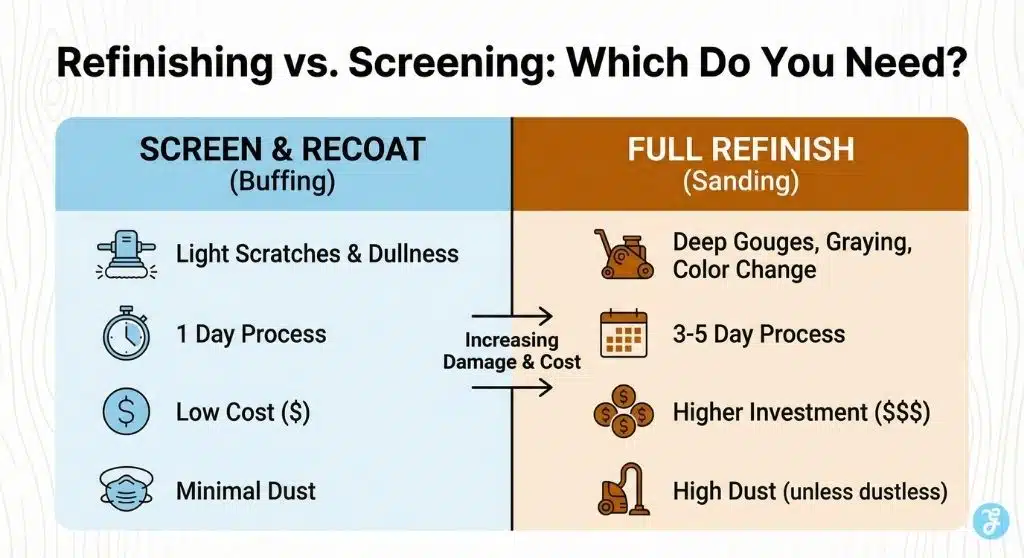
Not every worn floor needs the “full treatment.” Understanding the difference can save you thousands of dollars.
| Feature | Screen & Recoat (Buffing) | Full Refinish (Sanding) |
| Process | A light abrasion of the top finish layer, followed by a fresh coat of polyurethane. | Sanding down to raw wood (removing all stain/finish), filling gaps, staining, and sealing. |
| Best For | Dullness, light surface scratches, refreshing shine. | Deep gouges, graying wood, changing color, water damage, peeling finish. |
| Duration | 1 Day | 3 – 5 Days |
| Mess Level | Low dust | High dust (unless “Dustless” system is used) |
| Cost Impact | Low ($) | High ($$$) |
2026 Cost Estimates: What to Expect
As we look toward 2026, labor and material costs in the USA have adjusted. Budgeting accurately is key to planning your renovation.
-
Standard Refinishing: Expect to pay $3.50 to $8.00 per square foot.
Includes: Sanding, staining, and 2-3 coats of polyurethane.
-
Screen and Recoat: Expect to pay $1.75 to $3.00 per square foot.
-
Dustless Sanding: Add $1.00 – $1.50 per square foot.
Recommendation: Highly recommended for inhabited homes to prevent fine dust from clogging HVAC systems.
-
Stairs: Refinishing stairs is labor-intensive, often costing $60 – $120 per step.
Trending Styles for 2026
If you decide to refinish, you have the chance to change your home’s style. For 2026, the trends are moving away from dark, glossy Mahoganies.
-
Colors: Natural “blonde” woods, White Oak, and “Greige” (Grey-Beige) stains.
-
Sheen: Matte or Satin finishes are preferred over Semi-Gloss. They hide scratches better and look more modern.
DIY vs. Professional Refinishing: Is It Worth the Risk?
With the rise of YouTube tutorials, many homeowners consider renting a drum sander from a local hardware store to save on labor costs. While DIY refinishing can save you roughly 50-60% upfront, it carries significant risks that can end up costing more than hiring a pro.
Here is a realistic comparison to help you decide:
1. The Equipment Gap
-
DIY: Rental sanders run on standard 110v household outlets. They are lighter and less powerful, which often leads to “chatter marks” (waves) in the floor that are permanent once stained.
-
Pro: Professionals use 220v industrial sanders that are heavy and precise. They cut the wood flat and collect about 90-95% of the dust (compared to the 50% dust collection of rental units).
2. The “Sand-Through” Risk
-
DIY: The biggest mistake DIYers make is pausing for a split second with the drum sander running. This instantly digs a divot into the wood that cannot be fixed without replacing the board.
-
Pro: Pros are trained to feather the machine up and down while moving, ensuring a perfectly flat surface.
3. The Finish Quality
-
DIY: Most DIYers use “big box store” polyurethane, which often lacks the commercial-grade hardeners found in professional products. This means your floor may need refinishing again in 5-7 years.
-
Pro: Pros have access to two-component (2k) water-based finishes that are significantly harder and cure faster.
Verdict: If you are refinishing a small, low-stakes bedroom or a rental property, DIY is a viable budget option. However, for a main living room or high-value home, the risk of permanently damaging the wood usually outweighs the labor savings.
Frequently Asked Questions (FAQ)
1. Can I refinish engineered hardwood floors?
Yes, but with caution. Engineered floors have a thin top layer of real hardwood. They can typically be refinished 1 or 2 times maximum before the veneer wears through to the plywood core. Always check the thickness of your wear layer before sanding.
2. How long does the smell last after refinishing?
If you use oil-based polyurethane, the strong solvent smell can linger for 5-7 days and requires good ventilation (high VOCs). If you choose water-based polyurethane, the smell is mild and usually dissipates within 24 hours.
3. Do I really have to move all my furniture?
Yes. Sanding equipment is large and bulky. To get an even sand and consistent stain application, the floor must be completely clear. Most flooring companies do not move heavy furniture for liability reasons, so you may need to hire movers.
4. How many times can a solid hardwood floor be refinished?
A standard 3/4-inch solid hardwood floor can be refinished 4 to 6 times over its lifespan. Given that refinishing happens every 15-20 years, a solid wood floor can easily last 100+ years.
5. Why are my floors turning yellow?
This is likely due to an oil-based finish. Oil-based polyurethanes naturally “amber” or yellow as they age and react to UV light. If you want your floors to stay their true color (especially for gray or white stains), you must request a water-based non-yellowing finish.
The Bottom Line: Timing Is Everything
Hardwood floors are more than just a surface; they are the soul of your home’s character and a significant financial asset. Recognizing the signs hardwood floors need refinishing early is the key to preserving that legacy.
Don’t let a simple maintenance task turn into a structural nightmare. If your floors failed the water droplet test or are showing those tell-tale gray oxidation spots, the time to act is now. While the upfront cost of a 2026 restoration might seem significant, it is a fraction of the price you will pay to replace rotted boards later.
Restore the warmth, protect your investment, and enjoy the renewed beauty of your home for decades to come.