The landscape of American finance is undergoing a seismic shift as federal oversight moves from the periphery to the very core of blockchain innovation. As the transition towards a more regulated environment accelerates, understanding the specific mechanisms of this transformation is essential for both institutional investors and retail participants.
How We Selected Our 7 Best SEC Crypto Regulations Impact Points
To curate this list, we analysed recent litigation outcomes, proposed rule changes, and public testimony from commission leadership. Our selection was filtered based on three primary criteria: the immediate impact on market liquidity, the long-term shift in investor protection, and the precedent-setting nature of each policy shift within the broader US digital asset framework.
The Most Significant 7 SEC Crypto Regulations Reshaping the Market
The following points represent the most influential ways in which the current regulatory climate is altering the trajectory of digital finance in the United Kingdom and abroad.
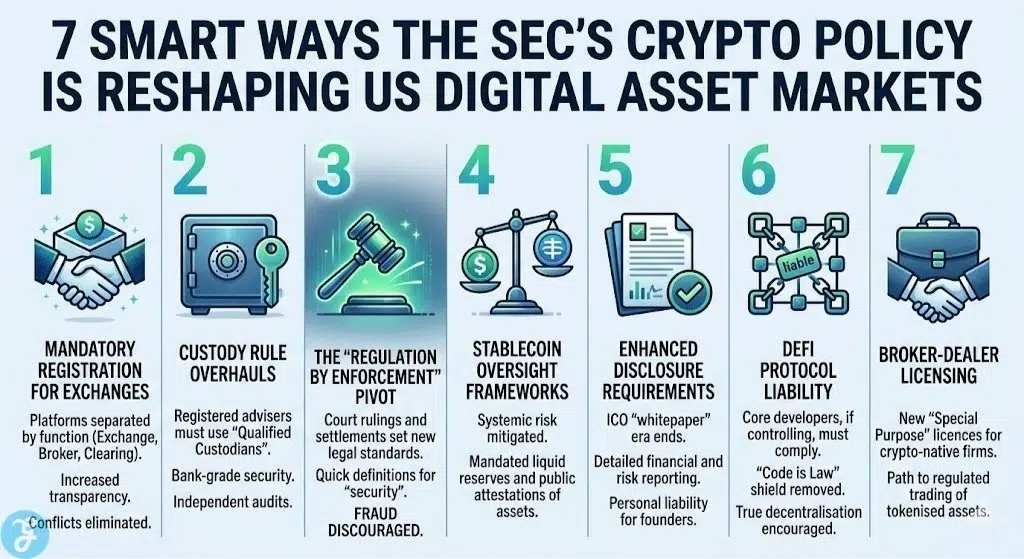
1. Mandatory Registration for Exchanges
The SEC is increasingly categorising crypto platforms as national securities exchanges, requiring them to separate their exchange, broker-dealer, and clearing functions. This move is intended to eliminate the inherent conflicts of interest found in vertically integrated platforms.
-
Best for: Enhancing market integrity and preventing wash trading.
-
Why We Chose It:
-
It provides a standardised level of transparency similar to traditional stock exchanges.
-
It forces platforms to implement robust anti-money laundering (AML) protocols.
-
It ensures that customer assets are legally segregated from corporate funds.
-
-
Things to consider: The high cost of compliance may force smaller, innovative startups out of the US market.
2. Custody Rule Overhauls
New amendments to the Safeguarding Rule aim to ensure that registered investment advisers (RIAs) keep client crypto assets with “qualified custodians.” This policy effectively mandates a higher tier of security for digital holdings held on behalf of the public.
-
Best for: Institutional investors requiring bank-grade security.
-
Why We Chose It:
-
It reduces the risk of total loss due to exchange hacks or insolvency.
-
It mandates independent audits of asset holdings.
-
It brings digital assets under the same protection umbrella as traditional equities.
-
-
Things to consider: Finding a “qualified” custodian for certain niche altcoins remains a technical challenge.
3. The “Regulation by Enforcement” Pivot
Rather than waiting for new legislation from Congress, the commission has utilised high-profile lawsuits to establish legal precedents. This approach has turned courtroom victories into de facto SEC Crypto Regulations that the rest of the industry must follow.
-
Best for: Defining the boundaries of “security” versus “commodity” in real-time.
-
Why We Chose It:
-
It provides immediate clarity on specific token behaviours.
-
It discourages “bad actors” from launching fraudulent schemes.
-
It leverages existing securities laws to cover modern digital assets.
-
-
Things to consider: This method creates a “compliance by fear” environment that can stifle experimental development.
4. Stablecoin Oversight Frameworks
The SEC has taken a firm stance on stablecoins that are marketed as investment vehicles or backed by securities. By treating these as regulated products, the commission aims to prevent a repeat of the algorithmic collapses seen in previous market cycles.
-
Best for: Protecting the broader financial system from “bank run” scenarios.
-
Why We Chose It:
-
It ensures stablecoin issuers maintain 1:1 liquid reserves.
-
It requires regular, public attestations of reserve assets.
-
It limits the systemic risk posed by unbacked “synthetic” dollars.
-
-
Things to consider: Over-regulation may drive stablecoin liquidity toward offshore, less transparent issuers.
5. Enhanced Disclosure Requirements for ICOs
The era of the “whitepaper-only” fundraise is effectively over, as the SEC now demands detailed financial disclosures and risk assessments from any entity issuing tokens to the public.
-
Best for: Retail investors who lack the technical expertise to audit smart contracts.
-
Why We Chose It:
-
It provides a legal “truth in advertising” standard for crypto projects.
-
It allows investors to compare token metrics side-by-side.
-
It holds founders personally liable for misleading statements.
-
-
Things to consider: The disclosure process is time-consuming and can delay project launches significantly.
6. DeFi Protocol Liability
The commission is increasingly looking past the “decentralised” label, suggesting that if a core group of developers maintains control over a protocol, they must comply with the same rules as centralised entities.
-
Best for: Closing the regulatory gap between CeFi and DeFi.
-
Why We Chose It:
-
It prevents platforms from using “code is law” as a shield for illegal activity.
-
It encourages the development of truly decentralised governance models.
-
It ensures that “front-ends” used by US citizens are properly vetted.
-
-
Things to consider: Identifying a “liable party” in a truly global, open-source project is legally complex.
7. Broker-Dealer Licensing for Crypto Native Firms
The SEC is creating a pathway for crypto-focused firms to become “Special Purpose Broker-Dealers.” This allows them to legally facilitate the trading of digital asset securities while remaining within the federal regulatory perimeter.
-
Best for: Bridging the gap between Silicon Valley and Wall Street.
-
Why We Chose It:
-
It allows traditional financial institutions to partner with crypto firms safely.
-
It provides a clear legal roadmap for firms wanting to “go legit.“
-
It creates a regulated marketplace for security tokens (STOs).
-
-
Things to consider: The current requirements for this licence are extremely difficult for most crypto firms to meet.
An Overview Of Recent SEC Crypto Regulations And Market Trends
While the intensity of these policies has sparked debate, their cumulative effect is a professionalisation of the asset class. Understanding how these rules interact is the first step toward long-term market stability.
Overview Comparison Table
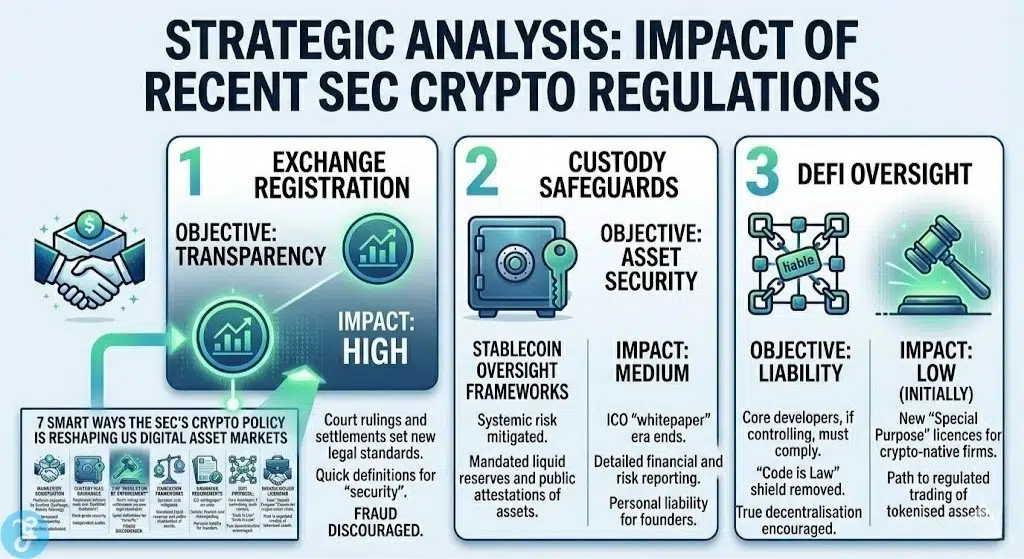
| Regulation Type | Primary Objective | Impact on Retail Users |
| Exchange Registration | Transparency | High |
| Custody Safeguards | Asset Security | Medium |
| DeFi Oversight | Liability | Low (Initially) |
Our Top 3 Picks and Why?
Of the seven points discussed, the Mandatory Registration for Exchanges, Custody Rule Overhauls, and Stablecoin Oversight stand out as the most critical. These three pillars provide the foundational safety net required for the “mass adoption” of digital assets by the general public and institutional treasuries.
Buyer’s Guide: How to Choose the Right SEC Crypto Regulations Strategy by Yourself?
Navigating this space requires a proactive approach to compliance. Rather than reacting to news headlines, investors should look for platforms and assets that align with the following “future-proof” criteria.
The Selection Framework:
-
Jurisdictional Clarity: Only use platforms that are registered or actively seeking registration in the US or UK.
-
Audit Transparency: Prioritise projects that release monthly, third-party attestations of their reserves.
-
Insurance Coverage: Check if the platform carries private insurance against hacks or “qualified” custody status.
Decision Matrix (Table):
| Choose Project A if… | Choose Project B if… |
| You prioritise regulatory safety. | You prioritise high-yield “degen” opportunities. |
| You are an institutional entity. | You are a technical user with self-custody skills. |
| You require a 1099-B tax form. | You prefer anonymous on-chain interaction. |
The Final Checklist: 5-point Checklist Before Choosing a Platform
-
Is the platform registered as a Money Services Business (MSB) or Exchange?
-
Does the project have a known legal entity based in a transparent jurisdiction?
-
Are the terms of service clear regarding who owns the private keys?
-
Has the platform’s smart contract been audited by a reputable firm within the last six months?
-
Does the platform provide clear documentation on how it handles SEC Crypto Regulations?
The shift toward a regulated crypto market is not an ending, but rather the beginning of a more mature phase of global finance. By embracing these standards, the industry can finally move past its “Wild West” reputation and integrate into the global economic fabric.