
Sean “Diddy” Combs, once one of the most powerful figures in the music industry, is now waiting to learn whether his two convictions under the Mann Act will stand as he approaches a critical sentencing hearing. The federal judge overseeing his case has yet to decide if the defense team’s arguments to vacate those convictions carry weight. The ruling will determine whether Combs faces years in prison or potentially secures a shorter path to freedom.
Background of the Trial
Combs, 55, faced a lengthy federal trial in Manhattan over the summer of 2025 that spanned eight weeks and attracted intense media coverage. Prosecutors had charged him with sex trafficking, racketeering, and related offenses tied to allegations of organizing so-called “freak-off” parties involving drugs, sex workers, and his long-term partners.
The case was closely watched because of Combs’ stature in the entertainment world and the seriousness of the charges. A jury ultimately acquitted him of the most severe allegations of racketeering and sex trafficking. However, they convicted him on two lesser but still significant counts: transporting individuals across state lines for the purpose of prostitution, a violation of the Mann Act.
These two convictions alone expose Combs to a possible maximum of 20 years in prison, with each count carrying a potential 10-year sentence. Since his arrest in September 2024, he has been held at a federal detention center in Brooklyn.
Defense Strategy: Narrow Interpretation of the Mann Act
Combs’ legal team is now pressing the court to vacate those convictions, arguing that the statute should not apply to his case.
The Mann Act, passed in 1910 and updated over time, criminalizes the transportation of individuals across state lines for prostitution or sexual activity. The defense claims that this law has historically been applied to cases where defendants either directly engaged in prostitution or financially benefited from it.
According to their interpretation, Combs did not fall into either category. Evidence presented at trial showed that Combs had funded the hiring and travel of male sex workers for encounters with his long-term girlfriends. These events, which insiders referred to as “freak-off” parties, often lasted for days and were fueled by drugs, music, and elaborate staging. While Combs allegedly arranged and financed the encounters, his attorneys emphasize that he did not personally engage in the sexual acts nor profit from them.
The Defense’s Additional Claims: Expression and Voyeurism
Beyond the statutory argument, the defense has also framed Combs’ conduct in terms of expression and production. Witnesses testified that Combs often filmed the events, directed lighting and music, and even guided wardrobe choices. His lawyers contend that this role resembled that of a film producer rather than someone committing prostitution offenses. They argue that criminalizing his actions under the Mann Act amounts to a violation of his First Amendment rights by treating voyeuristic filming and creative direction as criminal acts.
The legal team has urged the judge to adopt a narrow reading of the law and consider that voyeurism and expression, however controversial, were not meant to be swept into the Mann Act’s broad scope.
Prosecutors’ Position: Why the Convictions Should Stand
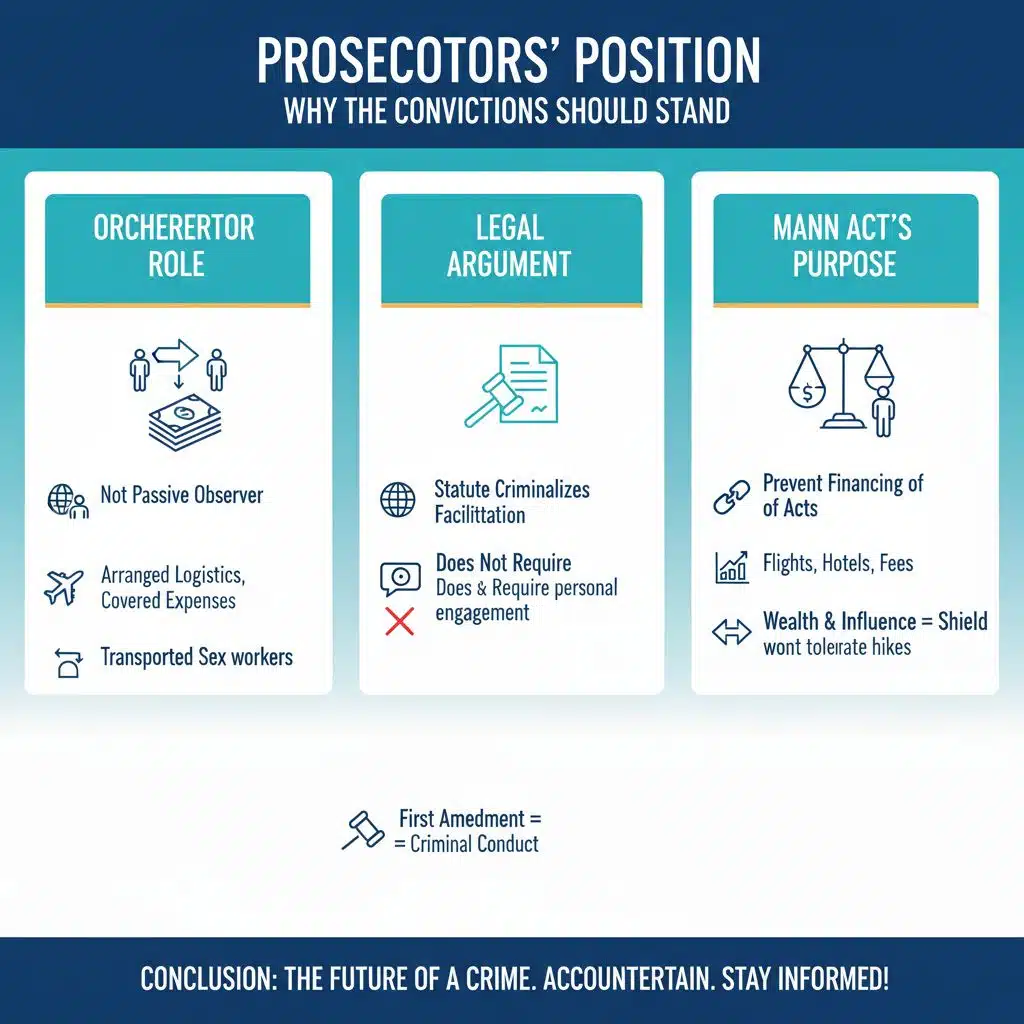
Federal prosecutors strongly oppose the defense motion. They argue that Combs was not a passive observer but the orchestrator of the events, arranging logistics, covering expenses, and ensuring the sex workers were transported for the purpose of prostitution.
The government maintains that the statute clearly criminalizes paying for and facilitating such acts, regardless of whether the defendant personally engages in them. Prosecutors have dismissed the free expression claim as irrelevant, noting that the First Amendment does not protect criminal conduct.
To them, Combs’ financing of flights, hotels, and fees for sex workers is exactly the kind of activity the Mann Act was designed to prevent, and his wealth and influence should not shield him from accountability.
Judge’s Pending Ruling
Judge Arun Subramanian heard arguments on September 26, 2025, just over a week before Combs’ scheduled sentencing. He has promised to issue a decision soon on whether to vacate the convictions or move toward sentencing. Court observers noted that the judge signaled the urgency of the matter, indicating either a ruling in Combs’ favor or a sentencing hearing on October 3.
As of the most recent court update, no ruling has been announced. The uncertainty leaves Combs, his legal team, prosecutors, and the public waiting to see whether the sentencing will go ahead or if the case will be extended into a new phase of litigation.
Sentencing Possibilities
If the convictions stand, Combs faces a wide range of possible outcomes.
-
Defense Recommendation: His attorneys have filed a sentencing memorandum asking for a maximum of 14 months. Given that Combs has already spent more than a year in federal custody since September 2024, this would likely mean release as early as November 2025.
-
Prosecutors’ Recommendation: Federal prosecutors have suggested that Combs should serve a significantly longer term. While exact details have not been disclosed, sources close to the case say the government may ask for at least four years in prison, arguing that a lighter sentence would not reflect the seriousness of the crimes.
-
Statutory Maximum: Under federal law, the judge could impose up to 20 years, though such an outcome is considered unlikely given sentencing guidelines and the jury’s acquittals on more serious charges.
The judge has wide discretion to balance the acquittals against the convictions when determining the appropriate punishment.
Why the Case Matters Beyond Combs
This case carries weight far beyond one celebrity’s fate.
-
Mann Act Precedent: The ruling could clarify how the Mann Act is applied in modern cases, especially those involving consensual arrangements, voyeurism, and recording. If the court accepts the defense’s narrow interpretation, it could make future prosecutions under the law more difficult.
-
Celebrity Accountability: The outcome will also influence perceptions of accountability for high-profile figures accused of sexual misconduct. Critics argue that leniency for Combs could reinforce a double standard where wealth and fame reduce criminal liability.
-
First Amendment Issues: By framing his conduct as creative direction, Combs’ legal team has pushed constitutional arguments into the debate. Whether courts accept or reject these claims will affect how freedom of expression interacts with criminal law in future cases.
What Happens Next
-
Judge Subramanian is expected to issue a decision before October 3, 2025.
-
If he denies the defense motion, Combs will face sentencing on that date.
-
If he grants the motion, the convictions could be vacated or a retrial ordered, significantly changing the trajectory of the case.
-
Whatever the outcome, the decision will set a legal marker in how U.S. courts handle cases at the intersection of prostitution laws, expressive conduct, and high-profile defendants.
Sean “Diddy” Combs’ legal battle is entering a decisive phase. With sentencing only days away, the defense is fighting to erase his convictions by challenging the reach of the Mann Act and reframing his actions as voyeuristic expression rather than criminal facilitation. Prosecutors argue that the evidence proves he arranged and financed prostitution, and that the law is clear.
The judge’s upcoming ruling will determine not only Combs’ immediate future but also how this century-old statute is interpreted in an era where questions of sex, power, and expression increasingly overlap.