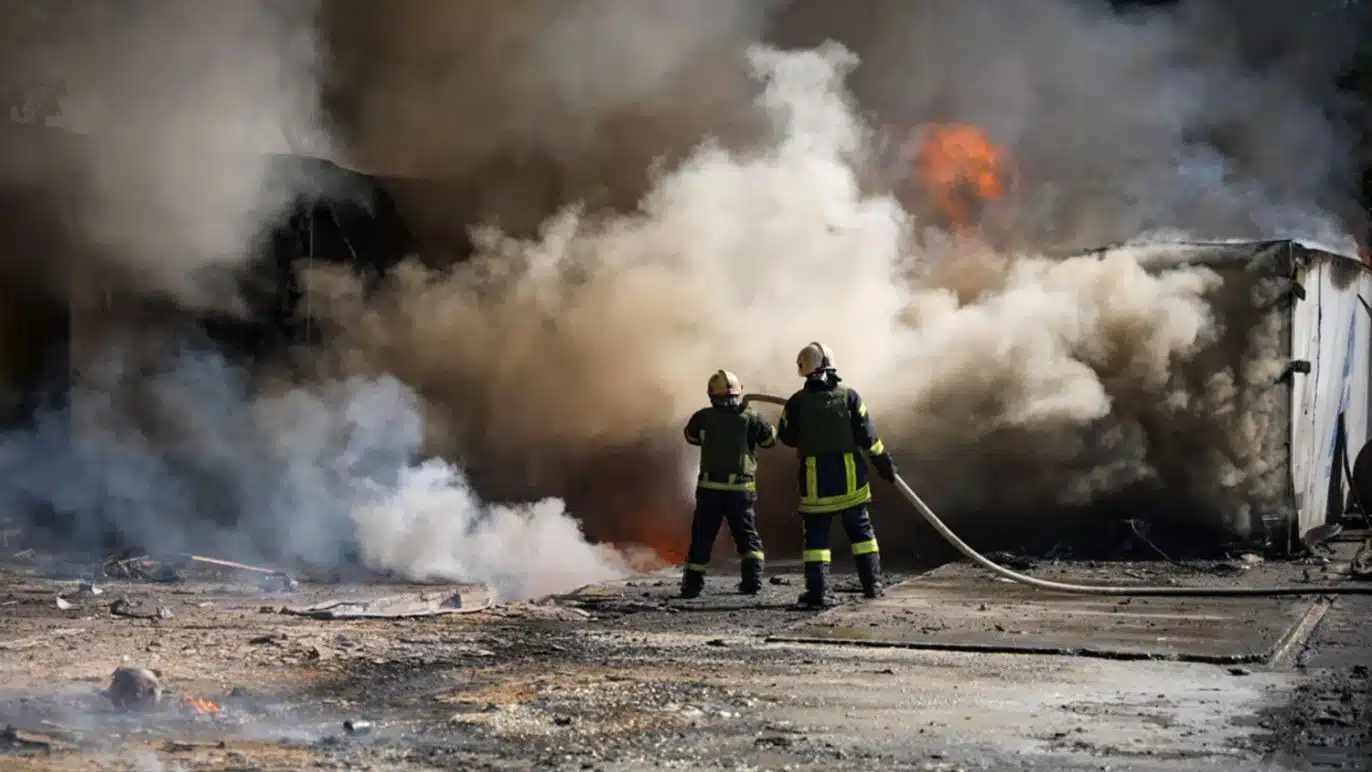
Russia Launches Massive Assault on Kyiv with Nearly 500 Drones and 40 Missiles Ahead of Critical Trump-Zelenskyy Summit
In one of the most intense barrages of the ongoing war, Russia hammered Ukraine’s capital Kyiv overnight into Saturday with almost 500 drones and 40 missiles, killing at least two civilians and injuring dozens more. The nearly 10-hour attack targeted energy infrastructure and residential areas, leaving parts of the city without power or heat as Ukrainian President Volodymyr Zelenskyy prepares for high-stakes talks with U.S. President Donald Trump. Zelenskyy condemned the strikes as a deliberate response to peace initiatives, underscoring Moscow’s reluctance for diplomacy.
Attack Details Unfold
The assault began in the early hours of December 27, 2025, around 2 a.m. local time, with Russian forces unleashing a combination of Shahed drones, Kinzhal hypersonic missiles, Iskander ballistic missiles, and Kalibr cruise missiles. Ukrainian air defenses intercepted many threats, but debris and direct hits caused widespread damage across Kyiv’s districts, including Dniprovskyi, Darnytskyi, Obolonskyi, and Holivskyi. Fires erupted in high-rise apartment buildings, with one 18-story structure in Dniprovskyi seeing flames spread across multiple floors and a resident potentially trapped under rubble.
Kyiv Mayor Vitali Klitschko reported initial injuries at five, later updated to 14, with one in serious condition, while police confirmed 32 wounded, including two children. An elderly man perished in Dniprovskyi when his home was struck, his wife left in critical condition. In the broader Kyiv region, emergency teams in Vyshhorod rescued another individual from a collapsed house. Zelenskyy specified the tally: 519 drones—many Shahed types—and 40 missiles, marking it among the heaviest since the war’s escalation.
Air raid sirens wailed for nearly 10 hours, forcing residents into metro stations and shelters as anti-aircraft fire lit the night sky. Power outages affected over a million households nationwide, with 75,000 still in the dark by afternoon, primarily from hits on TPP-5 power plant and other grid facilities. Russian state media claimed the targets were military-industrial sites and energy assets, but Ukrainian officials highlighted civilian impacts.
Zelenskyy’s Fierce Response
President Zelenskyy, en route from Kyiv amid the chaos, addressed the nation via Telegram and audio messages, framing the attack as Putin’s rejection of peace. “Russia’s answer to peace efforts is hundreds of missiles and drones. Putin does not want a political solution—he wants to destroy us,” he declared. He detailed the Kinzhal and Shahed drones filling Ukrainian skies, urging the U.S., Europe, G7, and G20 for decisive action to cripple Russia’s war machine.
Foreign Minister Dmytro Kuleba echoed this on X, noting devastation to residential buildings and civilian casualties, demanding escalated repercussions for Moscow. Head of the Presidential Office Andriy Yermak called it a war on civilians, pushing for tougher Western sanctions. Klitschko urged sheltering during the “massive” assault, while military admin head Tymofiy Tkachenko revised fatality counts upward after rubble searches.
Zelenskyy linked the timing directly to diplomacy: “Today, Russia has shown how it responds to peaceful negotiations between Ukraine and the United States aimed at ending this war.” Analysts view it as Kremlin intimidation ahead of Zelenskyy’s Florida trip, signaling no concessions on territorial demands.
Strategic Targets and Broader Impact
Moscow prioritized Ukraine’s energy grid, echoing winter tactics to freeze civilians into submission, though defenses downed most drones. TPP-5’s damage disrupted heating in freezing weather, compounding humanitarian strain after nearly four years of invasion. Residential hits—over 15 sites—sparked vehicle fires and structural collapses, with “dozens” of apartments gutted.
Nationwide, alerts hit multiple regions; neighboring Poland scrambled jets near its border. Ukraine’s air force reported active intercepts, but the scale overwhelmed some areas. Casualties stood at two confirmed dead in Kyiv, 46 injured including children, though numbers may rise. Rescue operations continued into Sunday, with fires in courtyards and trapped victims.
This fits Russia’s pattern of massive barrages, surpassing some prior peaks like August’s 614 munitions, amid stalled frontlines. Independent monitors call it one of Kyiv’s worst since 2022.
Trump-Zelenskyy Talks Loom Large
The strikes precede Zelenskyy’s December 28 meeting with President Trump at Mar-a-Lago, Palm Beach, rescheduled from earlier amid holiday pauses. Set for early afternoon, the talks focus on a “90% ready” 20-point U.S.-brokered peace plan, covering ceasefires, security guarantees, and Donbas/Zaporizhzhia status. Trump, vacationing since December 20, paused for this after phone links with envoy Steve Witkoff and Jared Kushner.
Trump previously demanded Ukraine halt hostilities first, retracting “dictator” barbs at Zelenskyy, while Kyiv insists on guarantees against future Putin breaches. Zelenskyy arrived in Miami optimistic: “A lot can be decided before the New Year,” raising territorial integrity. Trump told Politico it would “go well” but nothing final without his approval.
Europeans see U.S.-Ukraine ties as constructive; unresolved issues include eastern Ukraine and occupied nuclear plants. Trump hinted at meeting Putin too, only for a “final” deal. Zelenskyy eyes economic/security pacts.
| Key Meeting Stakes | Ukraine’s Position | U.S./Trump Stance | Russian Implications |
|---|---|---|---|
| Ceasefire Terms | Immediate halt with guarantees | Prioritize quick end to fighting | Likely rejection via strikes |
| Territorial Control | Full sovereignty over Donbas, Zaporizhzhia | Negotiable for peace | Demand recognition of gains |
| Security Guarantees | NATO-like protections | Bilateral U.S. aid commitments | View as provocation |
| Economic Aid | Reconstruction funding | Tied to deal approval | Oppose as prolonging war |
War’s Mounting Toll
Since February 2022, Russia nears 1 million casualties, with 243,300–351,400 Russian deaths by late 2025 per BBC, excluding proxies. Ukraine’s General Staff logs 1,181,680 Russian losses by early December, averaging 1,000+ daily. Verified Russian fatalities hit 152,142+ by November, per BBC/Mediazona.
Ukraine suffers heavily too; Trump cited 8,000 deaths since January 2025 versus 112,000 Russian. Total war dead likely exceeds 1 million combined, with infrastructure ruined. Energy attacks aim to demoralize, but resilience persists via Western aid.
| Recent Casualty Snapshots | Russian Losses | Ukrainian Impacts |
|---|---|---|
| Daily Average (Late 2025) | 930–1,570 killed/wounded | Varies; 32 injured in this attack |
| Cumulative (Feb 2022–Dec 2025) | 900K–1.3M total | Hundreds of thousands |
| Verified Deaths | 152K–351K Russians | Official figures classified |
International Echoes and Reactions
Global powers condemned the assault; Poland restricted airspace, allies deployed jets. EU officials push sanctions; U.S. voices call for resolve pre-Trump meet. Aid flows continue, but fatigue grows amid stalemate.
Zelenskyy demands “stringent response,” targeting Russia’s production. Analysts say strikes test Trump’s deal-making, potentially hardening lines. Humanitarian crisis deepens: millions displaced, winters brutalized.
Diplomatic Path Forward
As Zelenskyy lands in Florida, the Mar-a-Lago summit tests Trump’s pledge to end the war swiftly. A deal could reshape Europe, but Putin’s barrage signals hurdles. Ukraine vows retaliation, eyes total victory; Russia digs in.