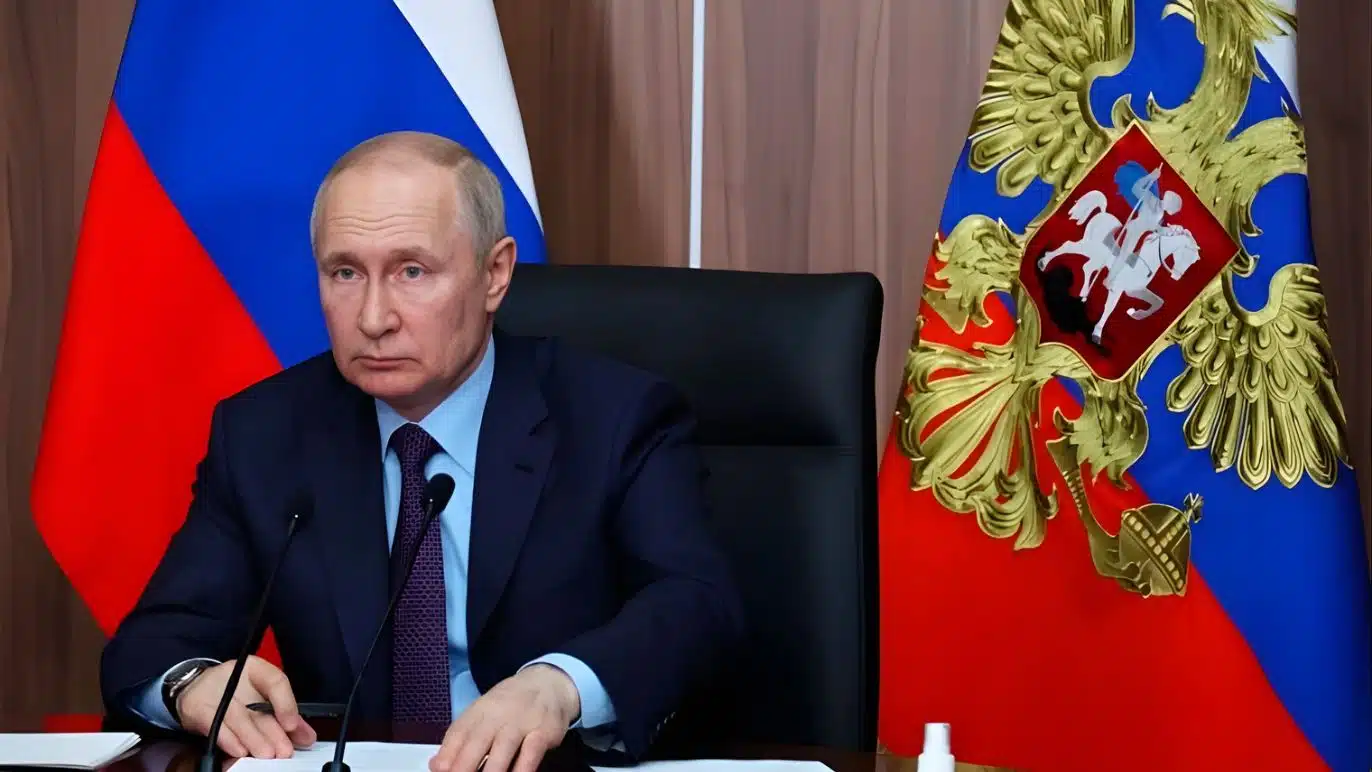
In a stunning escalation that has rocked ongoing peace negotiations, Russia claims Ukraine launched a massive drone swarm targeting President Vladimir Putin’s heavily fortified residence on Lake Valdai. The allegation, voiced directly by Foreign Minister Sergei Lavrov, paints a picture of 91 long-range drones descending on the site overnight from December 28 to 29, 2025—all intercepted by Russian defenses with no damage reported. Kyiv swiftly dismissed the charges as fabricated propaganda designed to torpedo U.S.-brokered talks, raising fears that this war of words could unravel delicate diplomatic progress.
The Alleged Attack: Details Emerge from Moscow
Russian Foreign Minister Sergei Lavrov broke from protocol—typically leaving drone reports to the Defense Ministry—to personally announce the incident in an audio statement on Telegram. He described Ukraine deploying “91 long-range unmanned aerial vehicles” aimed at Putin’s state residence in the Novgorod region’s Valdai area, a site nestled between Lakes Valdai and Uzhin. Lavrov emphasized that Russian air defenses neutralized every single drone, preventing any casualties or structural harm, though debris fallout was contained without broader impact.
The timing could not have been more charged: the purported assault unfolded just one day after Ukrainian President Volodymyr Zelenskyy held a three-hour summit with U.S. President Donald Trump in Florida, where the two leaders reportedly aligned on 90% of a peace framework. Lavrov labeled the operation “state terrorism,” vowing that the Russian military had already selected “targets for retaliatory strikes” and would adjust Moscow’s stance in negotiations—without fully exiting the U.S.-led process. Russia’s Defense Ministry corroborated parts of the narrative earlier that day, reporting 89 Ukrainian drones downed nationwide, including 18 over Novgorod, though it stopped short of confirming the residence as a specific target.
Local reports from Valdai residents added intrigue: no unusual activity, explosions, or increased military presence was noted in the town or surrounding areas, which lies northeast of the residence across Lake Valdai. Independent outlets like The Moscow Times highlighted this discrepancy, noting Lavrov’s unusual role in the disclosure as a potential sign of political theater. Satellite imagery and past analyses show the Dolgiye Borody complex—also called “Valdai,” “Uzhin,” or “Object 201″—spans 250 hectares on a fortified peninsula, complete with a four-story palace, pavilions, helipads, and a private rail line.
Putin’s Valdai Fortress: A Symbol of Power and Paranoia
The targeted residence stands as one of Putin’s crown jewels, a sprawling Soviet-era estate transformed into a modern bastion of luxury and security. Built originally as “Object 201” and hosting events like Joseph Stalin’s daughter’s wedding, Dolgiye Borody occupies 100 hectares on a secluded peninsula, shielded by water on multiple sides and encircled by Federal Protective Service (FSO) perimeters. Amenities include a 3,500-square-meter main palace, Chinese-style pavilions, greenhouses, chapels, and guest houses—plus recent additions like a mansion reportedly for Putin’s rumored companion Alina Kabaeva and their children.
Security has ramped up dramatically amid the war. Recent satellite images reveal up to 12 Pantsir-S1 anti-aircraft towers—evoking WWII German “Flaktürme” bunkers—deployed around the site, alongside S-400 long-range systems. This buildup followed earlier Ukrainian drone incursions near Putin’s other homes, like Novo-Ogaryovo outside Moscow, which saw strikes in May targeting elite neighborhoods. Experts note Valdai’s role as Putin’s summer retreat, making it a high-profile but distant target—360 kilometers northwest of Moscow, beyond typical frontline drone ranges but within Ukraine’s evolving capabilities.
Whether Putin was present remains unconfirmed by Moscow, a deliberate omission that fuels speculation. Lavrov’s statement avoided specifics, focusing instead on the symbolic breach. For Russia, the narrative underscores vulnerability at the Kremlin’s core, echoing the 2023 Kremlin drone incident where two UAVs hit the Senate Palace roof—branded an assassination bid.
Ukraine’s Fierce Denial: “Complete Fabrication”
Kyiv’s response was immediate and blistering. President Zelenskyy branded Lavrov’s claims “a complete fabrication” on social media, arguing they emerged suspiciously post his Trump meeting to justify escalated Russian strikes on Ukrainian cities like Kyiv. Foreign Minister Andrii Sybiha echoed this, calling it “fake” disinformation aimed at derailing peace efforts. Zelenskyy urged global intelligence agencies to verify the truth, insisting Ukraine prioritizes diplomacy over desperation.
Analysts aligned with Kyiv question the logistics: launching 91 drones from alleged sites near Moscow and St. Petersburg would require unprecedented coordination inside Russian territory, risking detection by layered defenses. The Institute for the Study of War (ISW) noted scant evidence, pointing to minor air defense activations that paled against claimed scale—allowing Ukrainian drones to slip through elsewhere. ABC News consulted experts who deemed the strike “technically feasible” with Ukraine’s 3,000-km range drones but “strategically foolish,” as it hands Putin propaganda fodder during talks.
Ukraine’s drone prowess has evolved rapidly. Recent tests boast 1,800-3,000 km one-way strikes, shattering records to hit Russian airfields and refineries—outpacing limited missile supplies like Storm Shadow or ATACMS. Yet scaling to 91 simultaneous long-range UAVs strains even Kyiv’s production ambitions of millions annually for swarm tactics. Zelenskyy has pushed these innovations publicly, tying them to national security without claiming residence hits.
Diplomatic Fallout: Trump’s Balancing Act
The accusation landed like a grenade in U.S.-mediated talks. President Trump, fresh from his Zelenskyy huddle, confirmed a “positive” call with Putin that morning—where the Russian leader personally flagged the “attack.” “It’s no good… not the right time,” Trump fumed to reporters at Mar-a-Lago, expressing anger over the timing amid “delicate” progress toward a deal. His administration reports 90% alignment on a framework, with envoy Steve Witkoff eyeing Moscow visits and minor details like ceasefires and territorial concessions pending.
Lavrov acknowledged U.S. proposals rooted in Trump-Putin August 2025 Alaska understandings but signaled revisions post-“terrorism.” European leaders, including Poland’s PM, voiced optimism—”peace is on the horizon”—while urging restraint. Yet Trump’s envoy Dan Driscoll noted Putin’s belief in seizing Donetsk either via deal or force, complicating dynamics. The White House stressed no withdrawal from talks, but retaliation looms as Russia eyes “reckless actions.”
This episode recalls 2023 Kremlin drones and May 2025 Novo-Ogaryovo strikes, patterns Kyiv denies but Russia amplifies for leverage. With Trump pushing deadlines—flexibly past Thanksgiving—the specter of stalled progress haunts 2026 forecasts.
Expert Verdict: Propaganda or Genuine Threat?
Military analysts split on credibility. ISW and ABC experts see no smoking gun: no wreckage photos, seismic data, or third-party verification beyond Lavrov’s word. CNN reported Russia’s repetition sans evidence, while locals’ calm undercuts drama. Pro-Kremlin outlets like TASS amplify the “91 drones” from urban launch points, but skeptics argue it’s classic hybrid warfare—blending real intercepts with exaggeration.
Technically, Ukraine’s drones could reach Valdai: 2025 models hit 3,000 km, evading Pantsir via low-altitude swarms or AI targeting beyond radio horizons. Strategically, though, it risks U.S. backlash—Trump’s ire signals potential aid cuts. France 24 and BBC frame it as mutual barbs, with Kyiv accusing Moscow of lies to prolong conflict.
Broader context: Russia’s war economy strains under sanctions, while Ukraine’s drone surge compensates for artillery shortages. If true, it marks audacious escalation; if false, masterful psyops. Valdai’s fortification boom—12 Pantsir towers—betrays Putin’s unease.
Historical Echoes of Drone Escalations
This isn’t Russia’s first “assassination” claim. May 2023 Kremlin drones prompted terror probes; 2025 Tver strikes injured civilians near Moscow. Ukraine’s arc—from FPV tacticals to deep strikes—mirrors asymmetric evolution, forcing Russian reallocations. Putin’s residences, from Kremlin to Bocharov Ruchey, now bristle with defenses.
Regional Ripples and Global Stakes
Novgorod’s relative quiet amplifies doubts, but the narrative bolsters Putin’s strongman image domestically. For Ukraine, denial preserves diplomatic high ground; for Trump, it tests deal-making mettle. As 2025 ends, with ceasefires teased and retaliation whispered, the world watches if drones dictate destiny or diplomacy prevails.
The saga underscores war’s fog: 91 drones or zero? Truth may emerge in strikes or signatures. Stakeholders—from Zelenskyy’s resilience to Putin’s revisions—navigate a razor-edge path to potential peace or peril.