The “Quiet Wellness” movement has reached a critical tipping point in 2026, as global society pivots from mindless digital consumption to intentional mental reclamation. This shift is not merely a lifestyle trend but a survival mechanism against the “noise pollution” of the hyper-digital era.
For decades, the trajectory of human progress was measured by connectivity. From the first dial-up tones to the rollout of global satellite internet, our success was defined by how quickly we could access information and each other. However, by the mid-2020s, this dream of constant connection transformed into a psychological cage. The “always-on” culture, fueled by dopamine-engineered algorithms and the erasure of work-life boundaries, led to a global epidemic of cognitive fragmentation. Research from the Global Wellness Institute (GWI) reveals that by 2024, mental unwellness and chronic stress had become the leading “hidden” drivers of the global economy, forcing a radical re-evaluation of what it means to be truly healthy.
We arrived at this moment through a decade of sensory escalation. The rise of short-form video, the gamification of social interactions, and the intrusion of workplace communication apps into domestic spaces created a state of “continuous partial attention.” By 2025, the novelty of the metaverse and hyper-connected wearables began to sour, replaced by a profound longing for the “analog” and the “unseen.” The Quiet Wellness movement emerged from this exhaustion—a collective realization that the most valuable luxury in 2026 is no longer information, but the cognitive space to process it.
The Neuroscience of Silence: Rebuilding the Fragmented Mind
At the heart of the Quiet Wellness movement is a growing understanding of how external stimuli affect our internal architecture. In 2026, neuroscientific research has finally bridged the gap between ancient meditative practices and modern clinical psychology. Silence is no longer viewed as an absence of sound, but as a presence of restorative potential. When the brain is released from the task of processing external “pings” and background noise, it enters what researchers call the “Default Mode Network” (DMN). This state is essential for self-reflection, creative problem-solving, and emotional regulation.
Data suggests that even low-intensity environmental noise—the hum of a refrigerator or the distant drone of traffic—can elevate cortisol levels and trigger a mild “fight or flight” response. In contrast, intentional silence has been shown to stimulate neurogenesis in the hippocampus, the region of the brain responsible for memory and learning. This is why “Quiet Wellness” focuses heavily on sensory deprivation and acoustic management as primary health interventions.
| Stimulus Type | Physiological Response | Impact on Cognitive Focus |
| High Digital Noise | Spiked Cortisol & Adrenaline | Fragmented; “Ping-Pong” Attention |
| Ambient Urban Noise | Elevated Heart Rate; Sleep Decay | Reduced Creativity; High Fatigue |
| Intentional Silence | Neurogenesis; DMN Activation | Deep Work Capacity; Emotional Clarity |
| Natural Soundscapes | Parasympathetic Activation | High Recovery; Lowered Anxiety |
Acoustic Architecture and the Rise of Urban Micro-Wellness
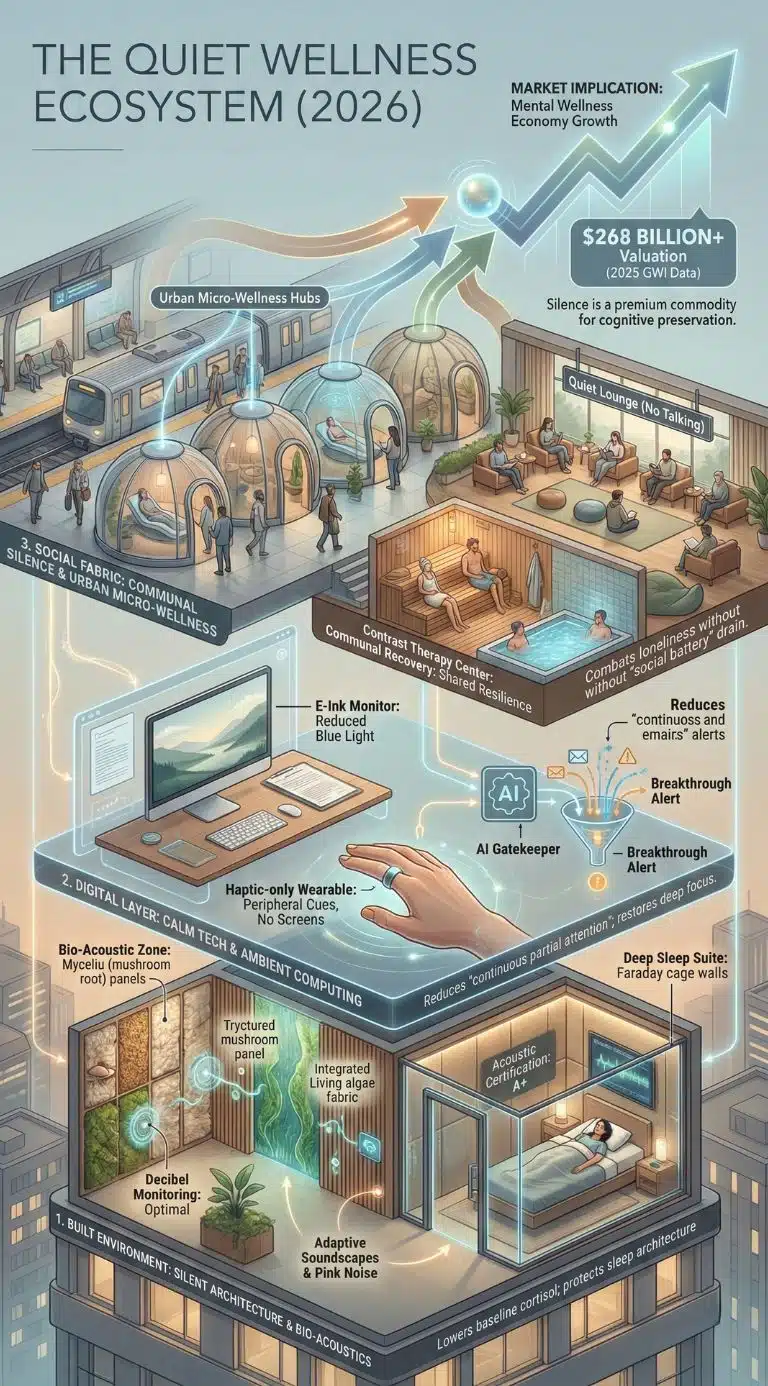
As the Quiet Wellness movement matures, it is moving out of rural retreats and into the heart of our cities. The concept of “Acoustic Wellness” is now a standard in high-end real estate and office design. We are seeing a shift from open-plan layouts—once the darling of Silicon Valley—to “Bio-Acoustic Zones.” These spaces use sound-absorbing materials, “green” sound barriers (like living walls), and intentional silence rooms to protect the cognitive integrity of workers.
In 2026, urban micro-wellness centers are proliferating. These are not gyms or spas in the traditional sense, but “sensory sanctuaries” where individuals can pay for 30 minutes of absolute silence in soundproof pods. This reflects a shift in consumer behavior: wellness is no longer about “doing” more (more reps, more steps, more supplements) but about “doing” less. The goal is to lower the baseline of neurological arousal so that the body can perform its natural maintenance.
The Cultural Pivot Toward Intentionality: Reclaiming Focus in a Hyper-Digital Era
The Quiet Wellness movement is driven by a fundamental shift in how we value our time and attention. While the digital economy once thrived on constant engagement and the pressure to stay connected, 2026 marks a turning point where social prestige is increasingly found in being “unreachable.” The modern cultural “flex” has moved away from high social media visibility toward cultivating a low digital footprint.
The Paradox of Connectivity
This transition is most visible among Gen Z and Millennials. Despite being digital natives, these generations report the highest levels of anxiety and loneliness related to screen time. McKinsey’s 2025 health reports highlight a significant paradox: being more “connected” via technology has frequently resulted in a deeper sense of social isolation.
The Emergence of Quiet Socializing
In response to this digital fatigue, “Quiet Socializing” has become a cornerstone of modern wellness. Rather than high-energy events that demand social performance, people are choosing environments that prioritize shared presence and mental clarity:
-
Silent Book Clubs: Gathering in community to read without the obligation of discussion.
-
Digital Detox Dinners: Prioritizing face-to-face connection by removing devices from the table.
-
Collective Meditation: Focusing on shared silence to foster authentic, grounded interaction.
By moving away from the pressure of constant performance, individuals are reclaiming their mental focus and redefining what it means to be truly “connected” in a hyper-digital world.
The Economic Engine of the Quiet Economy
The Quiet Wellness movement is not just a cultural shift; it is a massive economic force. The global wellness economy reached $6.8 trillion in 2024 and is projected to hit $9.8 trillion by 2029. Within this, the “Mental Wellness” and “Wellness Real Estate” sectors are the fastest-growing segments, expanding at double-digit rates.
Investors are pouring capital into “Quiet Tech”—technologies designed to disappear rather than distract. This includes “dumb phones” with E-ink screens, wearable devices that communicate through haptic pulses rather than screens, and AI assistants that act as “digital gatekeepers,” filtering out non-essential information to protect the user’s focus.
| Market Segment | 2024 Value (Actual) | 2026 Forecast (Estimated) | Annual Growth Rate (CAGR) |
| Mental Wellness | $180 Billion | $228 Billion | 12.4% |
| Wellness Real Estate | $430 Billion | $612 Billion | 19.5% |
| Wellness Tourism | $820 Billion | $1.1 Trillion | 16.2% |
| Quiet Technology | $12 Billion | $28 Billion | 52.0% |
Digital Minimalist Tech and the “Neuro-Quiet” Era
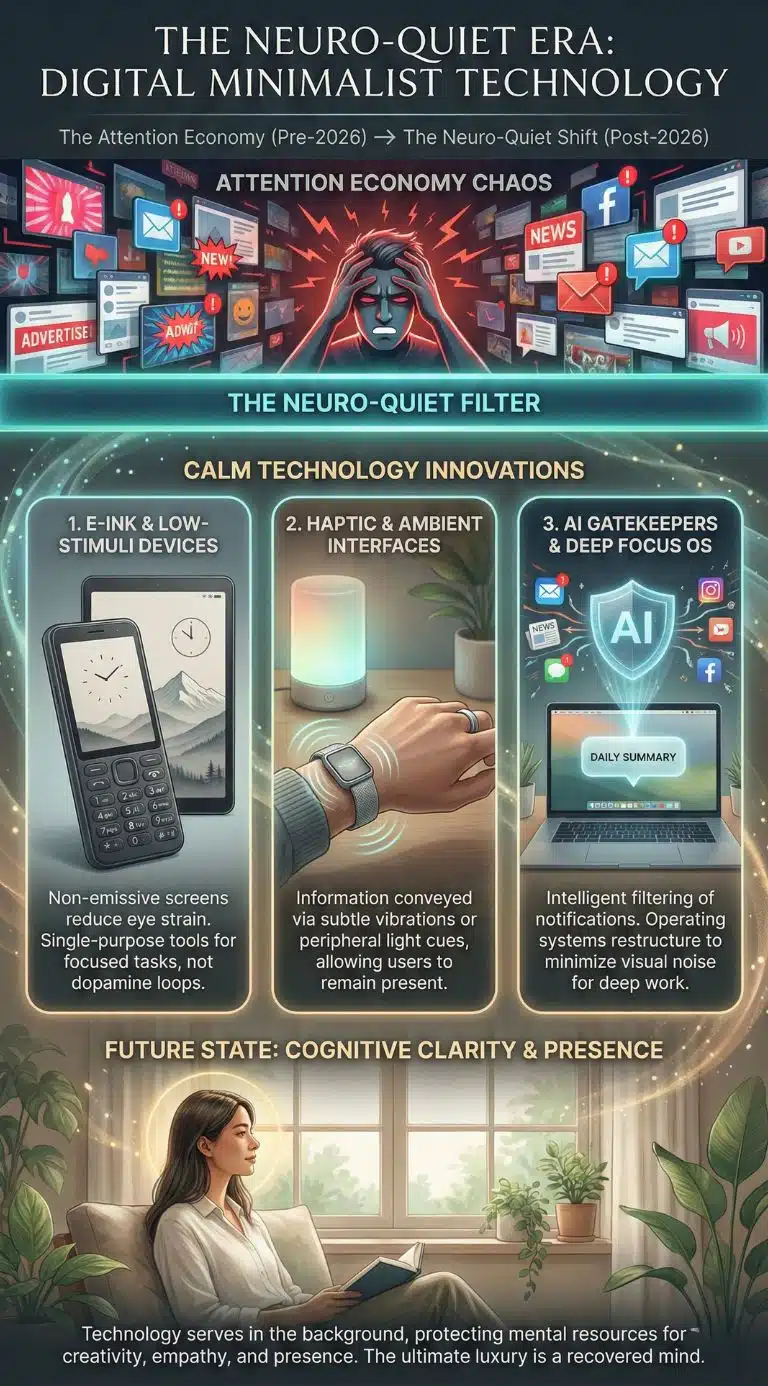
The technological arm of the Quiet Wellness movement is characterized by “Neuro-Quiet” innovations. These are products designed to soothe the nervous system rather than stimulate it. In 2026, we have seen the rise of “Auditory Health” supplements and devices that target the brain-ear connection to reduce sensory overload.
Furthermore, “Digital Detox” is no longer an occasional weekend retreat; it is a daily practice facilitated by software. Operating systems in 2026 now feature “Deep Focus” modes that don’t just silence notifications but actively restructure the user interface to minimize visual noise. We are moving toward an era of “Ambient Computing,” where technology serves us in the background without demanding our visual attention.
Expert Perspectives: The Debate Over Productive Rest
While the Quiet Wellness movement is overwhelmingly viewed as a positive development, it is not without its critics. Some economists argue that the focus on “quiet” and “rest” could lead to a decline in aggregate productivity, especially in fast-paced innovation sectors. They suggest that the movement might be a “luxury of the elite,” accessible only to those who can afford to be offline.
Conversely, proponents argue that our current “productivity” is an illusion built on burnout and shallow work. They cite data showing that “Quiet Wellness” practitioners actually demonstrate higher levels of deep work capability and long-term retention. The counter-argument is that “rest is not a reward for work; it is the prerequisite for it.” In 2026, the debate has shifted from whether we should rest to how we can make cognitive recovery accessible to all socioeconomic classes.
The Look Ahead: Future Outlook and Implications
As we look toward 2027 and beyond, the Quiet Wellness movement is set to become even more integrated into our institutional structures. We can expect “Silence Mandates” in public transportation, where certain train cars or flight zones are designated as “Zero-Digital-Noise” areas. Educational systems may also adopt “Quiet Curriculum” blocks, teaching children not just how to use technology, but how to disconnect from it.
The ultimate goal of Quiet Wellness is a recalibrated relationship with the digital world. It is not about a return to the stone age, but about creating a sustainable future where human cognition and digital innovation can coexist without the former being sacrificed for the latter. The “Quiet Revolution” is just beginning, and its success will be measured by our ability to find silence in an increasingly loud world.
Key Statistics of the Quiet Wellness Era (2026)
- $6.8 Trillion: Current value of the global wellness economy as of early 2026.
- 12.4%: Annual growth rate of the mental wellness sector, outperforming traditional fitness.
- 73%: Percentage of Gen Z consumers who prioritize “restorative experiences” over “active entertainment.”
- 66%: Productivity loss attributed to ambient noise in traditional open-office environments.
- 15 minutes: The minimum daily duration of intentional silence required to significantly lower resting heart rates.
Final Thoughts
As we navigate the complexities of 2026, it is becoming increasingly clear that Quiet Wellness is not a luxury afforded to the few, but a vital necessity for the many. The “hyper-digital” era promised us unprecedented efficiency and connection, yet it inadvertently created a landscape of cognitive depletion and sensory exhaustion. The rise of this movement signifies a collective “return to center”—a realization that our most precious resource is not the data we consume, but the clarity of the mind that processes it.
The economic and social shifts we are witnessing—from the surge in acoustic architecture to the commoditization of silence—suggest that the “Quiet Wellness” movement has successfully transitioned from a niche lifestyle choice to a pillar of modern public health. In an age where artificial intelligence and constant connectivity are the defaults, intentional silence has become the ultimate form of human rebellion and self-preservation.