
Federal prosecutors have narrowed the scope of their racketeering case against hip-hop mogul Sean “Diddy” Combs, informing the presiding judge that they will no longer pursue legal theories related to attempted arson and attempted kidnapping. These specific allegations were originally part of the broader racketeering conspiracy charge listed as Count One in the indictment filed against Combs. The update was formally communicated in a letter submitted to Judge Arun Subramanian on June 25, just ahead of closing arguments.
The decision means the government will not ask the jury to consider attempted arson or kidnapping when evaluating the racketeering charge. Prosecutors stated that since they are no longer pursuing these particular lines of liability, the court no longer needs to include them in the jury instructions. This move simplifies the case as it heads into the final phase, aiming to keep the jury focused on the more substantiated criminal claims.
Case Background: Complex Racketeering Allegations
The federal indictment against Combs outlines a sprawling criminal network involving multiple alleged offenses. According to the court documents, Combs is accused of orchestrating a racketeering conspiracy that includes a combination of sex trafficking, forced labor, bribery, witness tampering, drug distribution, and violent crimes. The indictment references laws from both California and New York.
Some of the now-excluded accusations—such as attempted arson and kidnapping—were based on incidents involving other music industry figures, including rapper Kid Cudi and Combs’ former assistant, Capricorn Clark. These incidents were originally considered predicate acts under the racketeering statute but have now been set aside due to insufficient evidence directly linking Combs to them.
In racketeering cases, the jury must unanimously find the defendant committed at least two predicate acts in order to convict. With the arson and kidnapping claims withdrawn, the jury will instead focus on the remaining charges, including those involving sex trafficking, drug distribution, transportation for prostitution, and corruption-related offenses.
High-Profile Testimonies Under Scrutiny
Among the most notable testimonies presented during the trial was that of Kid Cudi, whose real name is Scott Mescudi. He testified that Sean Combs forcibly entered his home after learning about Cudi’s alleged romantic connection with singer Cassie Ventura, Combs’ former partner. Not long after this alleged break-in, Cudi’s luxury Porsche vehicle was set on fire in the driveway of his Los Angeles home.
Although Cudi stated that he believed Combs had something to do with the arson, there was no direct evidence to confirm Combs’ involvement. No one has been criminally charged in relation to the car fire. As a result, prosecutors chose not to continue pursuing that claim in court.
Capricorn Clark, Combs’ former assistant, also delivered powerful testimony. She claimed that she was abducted by Combs, who was allegedly armed with a gun, and forced into a vehicle. According to her testimony, she was then driven to Kid Cudi’s residence while Combs broke into the artist’s home. Clark further testified that she had reached out to Ventura to alert Cudi about the situation, expressing concern for his safety.
These dramatic incidents had initially formed part of the racketeering narrative presented by the government. However, without concrete legal proof tying Combs to these actions beyond witness claims, the prosecution opted to omit these elements from the case before the final jury deliberations.
How the Case Has Progressed
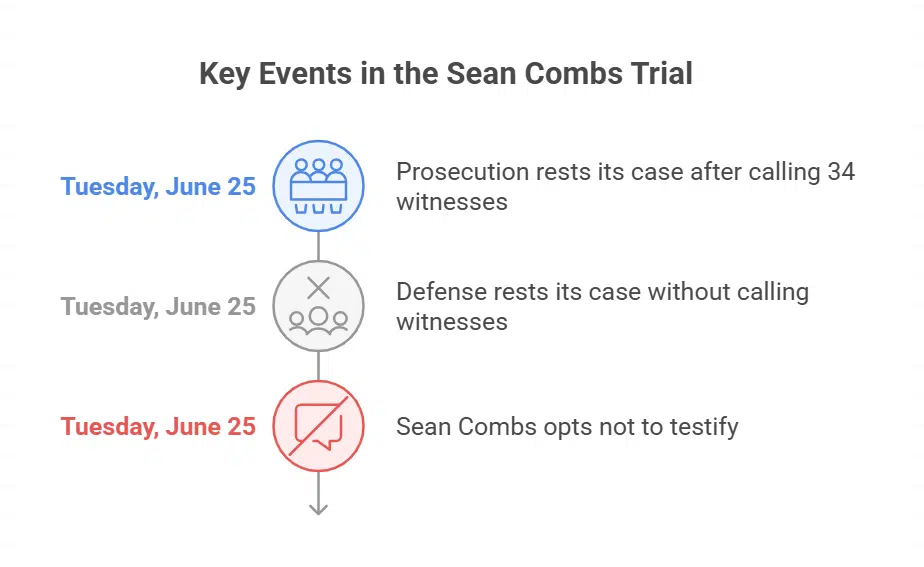
The prosecution formally rested its case on Tuesday, June 25, after calling 34 witnesses over a month-long trial. Witnesses included alleged victims, former employees, insiders from Combs’ business and personal circles, and law enforcement officials. The testimonies sought to illustrate a long-standing pattern of criminal behavior, including coercion, manipulation, and exploitation in both personal and professional settings.
The defense, in contrast, took a very brief approach. Combs’ legal team rested its case without calling any witnesses to the stand and without presenting any direct rebuttals through live testimony. Instead, the defense submitted certain text messages and communications into the record, arguing that the prosecution’s case was built on speculation and lacked direct evidence of criminal conduct.
Importantly, Sean Combs himself opted not to testify in his own defense. Judge Arun Subramanian instructed the jury not to interpret Combs’ silence as an admission of guilt, emphasizing that it is a constitutional right for a defendant to refrain from testifying.
What Remains in the Jury’s Hands
Although the attempted arson and kidnapping allegations have been removed, Sean Combs still faces several serious charges that remain active and are being considered by the jury. These include:
-
Racketeering conspiracy involving the coordination of multiple illegal activities over a span of years.
-
Transportation of individuals across state lines for the purpose of prostitution.
-
Sex trafficking using coercion, fraud, or force.
-
Bribery and witness tampering.
-
Forced labor schemes.
-
Distribution and possession of controlled substances.
These charges reflect a complex and wide-reaching case that spans multiple states and legal jurisdictions. For a conviction on the racketeering conspiracy count, the jury must unanimously agree that Combs committed at least two of the predicate crimes included in the indictment.
Timeline of Key Events
-
Early June 2025: Trial begins in New York with Judge Arun Subramanian presiding.
-
June 24, 2025: The prosecution rests after 34 witnesses testify.
-
June 25, 2025: Prosecutors notify the court that they are dropping the attempted arson and kidnapping allegations.
-
June 26, 2025: Final discussions over jury instructions take place.
-
June 27, 2025: Closing arguments are expected to conclude.
-
End of June or early July 2025: Jury deliberations and potential verdict.
Strategic Implications for the Verdict
By removing the more speculative charges of arson and kidnapping, prosecutors are streamlining their arguments and focusing on allegations where they believe the evidence is strongest. Legal analysts suggest that this strategy may help reduce confusion among jurors and strengthen the prosecution’s credibility.
For the defense, the decision may be seen as a partial victory, as it eliminates some of the more inflammatory elements of the case. However, the remaining charges still carry significant weight, particularly those related to sex trafficking and drug offenses, which could result in decades of imprisonment if Combs is convicted.
The trial continues to draw widespread public and media attention, given Combs’ high-profile status in the entertainment industry and the disturbing nature of many of the allegations. With closing arguments underway and jury deliberations set to begin, the next several days will be critical in determining the outcome of this closely watched case.