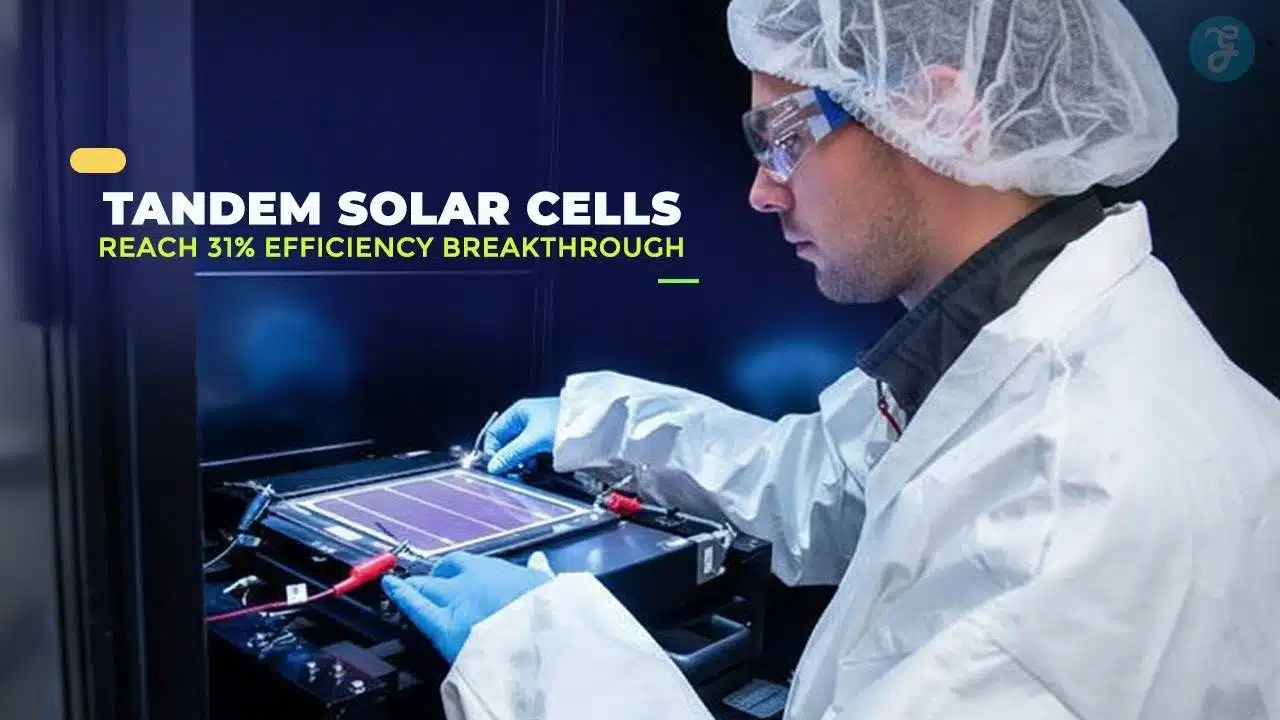
The solar industry has spent decades colliding with the invisible wall known as the Shockley-Queisser limit, but a new breakthrough in perovskite-silicon tandem solar cells has just cracked the code on bypassing it entirely. On January 19, 2026, researchers from Northwestern Polytechnical University (NPU) in China announced a major leap forward, achieving a certified efficiency of 31.13% using a novel “2D seeding” technique.
The Stability Revolution
While global giants like LONGi and Jinko Solar race for higher raw numbers, this specific development is arguably more critical for the industry’s future. It doesn’t just produce more power; it introduces a chemical method to tame the notorious instability of perovskite materials, potentially turning laboratory miracles into mass-manufacturable reality. For years, engineers have known that silicon, the material powering 95% of the world’s solar panels, is nearing its theoretical dead end. With standard silicon cells capping out near 29% efficiency in physics simulations and stalling around 26% in real-world commercial markets, the only way up is “tandem” technology.
By stacking a perovskite cell on top of a silicon one, manufacturers can capture a broader spectrum of sunlight. However, these high-performance “sandwiches” have been plagued by a fatal flaw: the perovskite top layer is fragile and prone to degrading into useless chemicals. The NPU team’s discovery of using all-inorganic 2D CsPb2Br5 flakes as a “seeding agent” solves this by forcing the crystals to grow in a stable, vertical structure, effectively “growing” a tougher solar cell from the inside out.
The “Silicon Ceiling” and the Tandem Solution

To understand the magnitude of this 31.13% achievement, one must first understand the physics that has handcuffed the solar industry. Traditional single-junction silicon cells are bound by the Shockley-Queisser limit, a theoretical maximum efficiency of approximately 29.4%. In layman’s terms, silicon is excellent at absorbing red and infrared light but is terribly inefficient at converting high-energy blue and visible light, much of which is lost as heat.
Commercial manufacturers like Trina Solar and Canadian Solar have pushed silicon to its absolute industrial limits, with TopCon and HJT (Heterojunction) cells reaching 25-26% efficiency. To go beyond this, the industry has turned to perovskite-silicon tandem solar cells.
- The Top Layer (Perovskite): Engineered to have a “wide bandgap” (around 1.68–1.80 eV), this layer eagerly absorbs the high-energy blue visible light that silicon wastes.
- The Bottom Layer (Silicon): Captures the red and infrared light that passes through the top layer.
- The Result: A combined voltage that shatters the 29% ceiling.
However, constructing this “solar sandwich” is not as simple as gluing two layers together. The wide-bandgap perovskites required for the top layer are chemically temperamental. They suffer from “phase separation,” where the ingredients literally unmix themselves under sunlight, destroying the cell’s ability to generate power. This is where the NPU team’s innovation fundamentally changes the game.
The Innovation: Deconstructing the “2D Seeding Agent”
The secret to the NPU team’s success, published in their recent study, is not a new machine but a new ingredient. Led by researchers Chenxin Ran, Weiyin Gao, and Wei Huang, the team identified that the chaos of crystal growth was the enemy. When perovskite films are made, they typically crystallize randomly, leaving gaps and defects that trap electricity.
To fix this, the team introduced 2D CsPb2Br5 flakes into the manufacturing process. These flakes act as a “seeding agent”, similar to how a grain of sand can trigger the formation of a pearl or how cloud seeding triggers rain.
How Heteronucleation Works
The process, known technically as “heteronucleation,” fundamentally alters how the solar cell forms:
- The Seed Drops: Because the 2D CsPb2Br5 flakes have low solubility, they precipitate immediately when the solution is applied.
- Top-Down Control: Instead of growing from random spots, the perovskite crystals latch onto these 2D seeds.
- Vertical Growth: The seeds force the crystals to grow vertically (downwards) rather than laterally. This creates a dense, uniform “highway” for electrons to travel, drastically reducing resistance.
The impact of this chemical guidance system is measurable in the device’s Fill Factor (FF). The NPU device achieved a record-high Fill Factor of 85.39%. In solar physics, the Fill Factor is essentially a quality control metric; a high FF means the cell is extracting nearly all the power it generates without internal losses, proving that the crystal quality is nearly perfect.
The “2D Seeding” Advantage
It helps to understand why the new method is better.
| Feature | Standard Perovskite Process | New “2D Seeded” Process (NPU) |
| Crystal Growth | Random, chaotic nucleation | Guided, vertical (Top-Down) |
| Defects/Gaps | High (Traps electricity) | Low (Dense, uniform film) |
| Fill Factor (Quality) | Typically 80-82% | 85.39% (Record High) |
| Stability (Unsealed) | Degrades rapidly under light | >80% retained after 300 hours |
| Primary Risk | Phase Separation (Unmixing) | Suppressed Phase Separation |
Performance Data: Stability is the New Efficiency
While the headline figure of 31.13% efficiency is impressive, the most exciting data points for investors and engineers are found in the stability tests. Perovskites are infamous for dying young, often degrading within hours or days when exposed to moisture or intense light.
The NPU team subjected their unencapsulated (unprotected) devices to a “torture test” of continuous light soaking.
- The Result: The device maintained 80% of its initial performance after 300 hours of continuous operation.
- The Comparison: The control device (made without the 2D seeding agent) failed rapidly, dropping below the 80% threshold almost immediately.
This data proves that the 2D seeding agent doesn’t just make the cell more powerful; it makes it chemically resilient. By preventing the “phase separation” that typically kills wide-bandgap perovskites, the NPU team has demonstrated a pathway to longevity that doesn’t rely solely on expensive external packaging, but on the intrinsic strength of the material itself.
Global Landscape: NPU vs. The Solar Giants

To place this news in a proper global context, it is vital to compare NPU’s academic breakthrough with the commercial giants currently dominating the headlines. As of early 2026, the landscape of perovskite-silicon tandem solar cells is a fierce battleground.
| Metric | NPU / Xi’an Shiyou (Jan 2026) | LONGi Green Energy (Record Holder) | Commercial Benchmark (Trina/Jinko) |
| Top Efficiency | 31.13% (Certified) | ~34.85% (NREL Verified) | ~26-27% (Standard Silicon) |
| Primary Innovation | 2D Seeding / Crystallization Control | Interface Passivation / Wafer Quality | Mass Production / Large Format |
| Strategic Focus | Process Stability & Longevity | Absolute Peak Performance | Reliability & Cost Reduction |
While LONGi Green Energy currently holds the absolute world record at roughly 34.85%, their methods often involve highly complex, expensive “interface passivation” techniques that are difficult to replicate at the scale of millions of panels per year.
The significance of the NPU research is that it offers a scalable chemical solution. The researchers successfully scaled their method from a tiny 0.05 cm² lab sample to a larger 1 cm² device with minimal loss in performance. This suggests that the “2D seeding” method is not just a lab trick, but a viable recipe for industrial coating machines (slot-die coaters) used in factories.
The Geopolitical Dimension: China’s Monopoly on the “Next Oil”
The NPU breakthrough is not happening in a vacuum; it is the latest signal of China’s tightening grip on the future of energy. As of 2026, Chinese manufacturers already control approximately 98% of global silicon wafer production. Western competitors like Oxford PV (UK/Germany) and First Solar (USA) are currently fighting an uphill battle against a Chinese supply chain that is vertically integrated and government-backed.
This new 31.13% record reinforces a specific strategic advantage: technological velocity. While US and European firms often spend years validating stability before scaling, the Chinese “lab-to-fab” pipeline is accelerating. Companies like Renshine Solar and UtmoLight have already begun pilot production of gigawatt-scale perovskite lines in Jiangsu Province. If NPU’s “2D seeding” method is adopted by these domestic giants, it could render Western attempts to “onshore” solar manufacturing obsolete before they even begin. The message to global markets is clear: China intends to own not just the current generation of solar (silicon), but the patent-heavy future of it (tandem) as well.
Manufacturing Implications and Economic Impact
If perovskite-silicon tandem solar cells can be reliably manufactured at 31% efficiency, the economic shockwaves will be felt across the energy sector. Currently, the “balance of system” (BOS) costs, land, racking, wiring, and labor make up a huge chunk of a solar farm’s price tag.
- Higher Density, Lower Cost: A 31% efficient panel generates roughly 20% more power per square meter than a standard 25% silicon panel. This means a developer needs 20% less land and 20% fewer racking systems to generate the same amount of electricity.
- LCOE Reduction: This density drives down the Levelized Cost of Electricity (LCOE), making solar power cheaper than even the most efficient natural gas plants, even without subsidies.
The “45-Minute” Revolution: Why Investors Are Watching
Beyond efficiency, the real economic killer app of perovskite technology is production speed. A traditional high-purity silicon solar cell takes up to three days to manufacture, requiring massive energy inputs to melt silicon at 1,400°C. In stark contrast, a perovskite layer, especially one using NPU’s low-temperature seeding method, can potentially be printed from start to finish in roughly 45 minutes.
This drastic reduction in “energy payback time” (the time it takes for a panel to generate the energy used to make it) changes the financial calculus. If manufacturers can use the NPU method to print 31% efficient layers on existing silicon wafers without complex high-temperature annealing, the capital expenditure (CapEx) for new factories could drop by 50-70% compared to traditional silicon plants. For Wall Street, this isn’t just about green energy; it’s about a manufacturing process that behaves more like printing newspapers than smelting metal.
The “Arctic” Connection
This high efficiency is particularly crucial for markets in high-latitude regions like Northern Europe, Canada, and the Arctic (relevant to recent geopolitical interests in Greenland). In low-light environments, the superior light-harvesting ability of tandem cells, capturing both the visible and infrared spectrums, can make solar viable in places where standard silicon fails to perform.
Remaining Challenges: The Road to Commercialization
Despite the optimism, significant hurdles remain before homeowners can buy these panels at Home Depot.
- The “300 Hour” Reality Check: While NPU’s 300-hour stability test is promising for a lab, commercial panels must survive 25 years (approx. 200,000 hours) of rain, hail, and UV radiation. The gap between 300 hours and 25 years is the “valley of death” for new solar technologies.
- Lead Toxicity: The high-efficiency perovskites used by NPU (and almost everyone else) contain lead. While the amount is small relative to a lead-acid battery, regulatory bodies in the EU and California may impose strict recycling mandates that could complicate the supply chain.
- Encapsulation Tech: To protect these sensitive 2D-seeded crystals, manufacturers will need to develop advanced encapsulation (glass and film) technologies that seal out moisture completely, adding cost to the final product.
The “Lead” Elephant in the Room: Is it Safe?
A common critique of high-efficiency perovskites, including the NPU device, is their reliance on lead (Pb). Critics argue that deploying millions of tons of lead-based panels could create an environmental hazard. However, context is vital.
According to recent lifecycle assessments, the total amount of lead in a commercial perovskite panel is less than 2 grams per square meter, roughly equivalent to the amount of lead in a single solder joint on a standard circuit board, and vastly less than the kilogram-scale quantities found in a car battery (which are 99% recycled). The real challenge, which NPU’s research helps address, is leaching prevention.
By using the 2D seeding agent to create a denser, defect-free crystal structure, the material itself becomes more resistant to dissolving in water. When combined with modern glass-glass encapsulation, the risk of lead leakage even during hail damage drops to negligible levels, satisfying even strict EU environmental regulations.
Final Words: The End of the Silicon Era
The announcement from Northwestern Polytechnical University is more than just a new number on a chart; it is a proof-of-concept for the post-silicon era. By using 2D CsPb2Br5 flakes to guide crystal growth, scientists have turned the chaotic chemistry of perovskites into a disciplined, high-performance power source.
As we move deeper into 2026, the race will shift from “who can get the highest efficiency” to “who can make these high-efficiency cells last for 20 years.” With the stability provided by this new seeding technique, the industry has taken one giant step closer to that finish line. The “Silicon Ceiling” has been broken; now, the challenge is building the floor for the next generation of global energy.