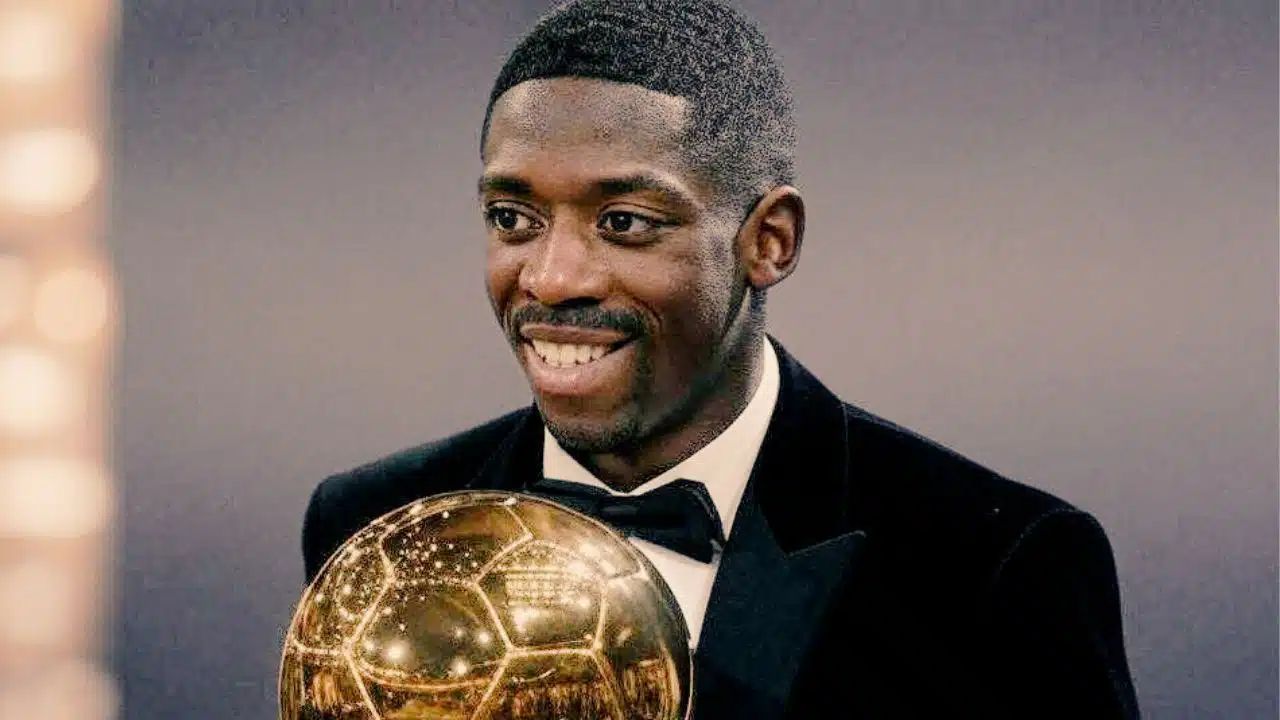
The football world finally received its answer after weeks of anticipation: Paris Saint-Germain and France forward Ousmane Dembélé has been crowned the 2025 Ballon d’Or winner. This award, regarded as the most prestigious individual honor in world football, confirms Dembélé’s transformation from a talented yet inconsistent winger to one of the sport’s most complete forwards. His achievement not only marks a personal milestone but also strengthens France’s position in Ballon d’Or history.
France Joins Argentina at the Summit of Ballon d’Or Records
Dembélé’s success means France now has eight Ballon d’Or titles, placing the nation level with Argentina for the most awards by a single country. The way both nations achieved this milestone, however, could not be more different.
-
France’s eight wins are spread across six different players: Raymond Kopa, Michel Platini, Jean-Pierre Papin, Zinedine Zidane, Karim Benzema, and now Dembélé. This wide distribution highlights the depth of French talent across different generations and positions.
-
Argentina’s eight wins, in contrast, belong solely to Lionel Messi. From 2009 to 2023, Messi dominated the award with unmatched consistency, setting a record for the highest number of Ballon d’Or wins by an individual.
This contrast emphasizes France’s ability to produce world-class players across eras, while Argentina’s tally reflects the once-in-a-lifetime brilliance of a single footballer.
French Winners Before Dembélé
Dembélé is only the sixth French player to claim the Ballon d’Or. His predecessors established a legacy that spans nearly seven decades:
-
Raymond Kopa (1958): The Real Madrid star became the first Frenchman to win the award after helping the club dominate European football in its early years.
-
Michel Platini (1983, 1984, 1985): Platini remains the only French player to win the Ballon d’Or three times in succession, cementing his status as one of the greatest midfielders of all time.
-
Jean-Pierre Papin (1991): Known for his lethal finishing at Marseille, Papin carried France’s presence into the 1990s with his Ballon d’Or triumph.
-
Zinedine Zidane (1998): Zidane’s combination of vision, elegance, and leadership inspired France to its first FIFA World Cup, earning him the award in the same year.
-
Karim Benzema (2022): After years of consistency at Real Madrid, Benzema finally won the award in recognition of his Champions League heroics and dominance in La Liga.
Now in 2025, Dembélé joins this illustrious list, ensuring that the tradition of French excellence continues.
Dembélé’s Career-Defining Season
The 2024–25 campaign will be remembered as the year Ousmane Dembélé reached his peak. After years of battling injuries and inconsistency during his spell at Barcelona, his move to PSG under manager Luis Enrique reignited his career.
-
Goals and Assists: He scored 35 goals and provided 16 assists across all competitions, ranking among Europe’s most effective forwards.
-
Champions League Glory: Dembélé’s performances were pivotal in PSG’s historic first UEFA Champions League victory. He scored crucial goals in the knockout stages and created decisive chances that turned matches in PSG’s favor.
-
Domestic Success: PSG swept through Ligue 1 and the Coupe de France, while also lifting the UEFA Super Cup, achieving an unprecedented quadruple.
-
UEFA Recognition: His efforts were rewarded when he was named UEFA Champions League Player of the Season, further validating his Ballon d’Or credentials.
Football experts point to his improved finishing, tactical intelligence, and creativity as reasons for his transformation. His lightning pace and dribbling remain intact, but the addition of consistent goal-scoring made him unstoppable.
The Ballon d’Or 2025 Rankings
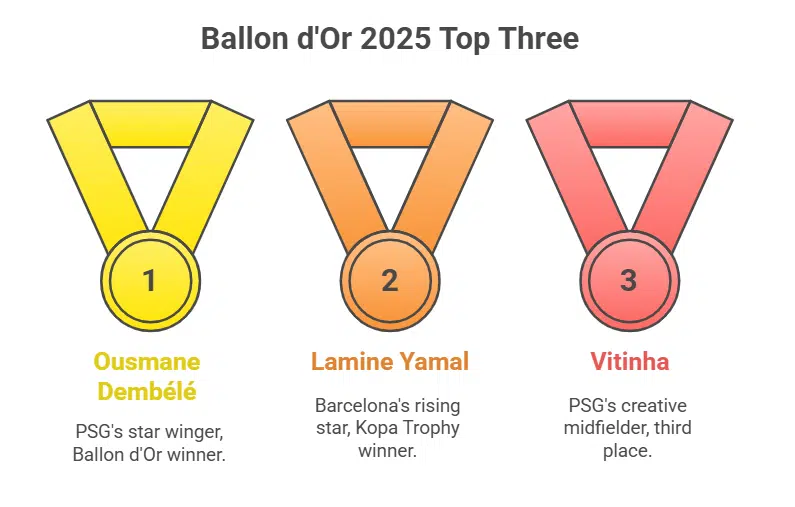
The Ballon d’Or is decided by a panel of international journalists who consider individual brilliance, team success, and impact in decisive matches. In 2025, the top three reflected the new balance of European football:
-
Ousmane Dembélé (PSG) – Winner
-
Lamine Yamal (Barcelona) – Runner-up, at just 18 years old, the rising star already proved himself among the elite. He also collected the Kopa Trophy for best U-21 player.
-
Vitinha (PSG) – The Portuguese midfielder’s creativity and dominance in PSG’s midfield secured him third place.
The rest of the top ten featured some of football’s brightest names: Mohamed Salah, Raphinha, Achraf Hakimi, Kylian Mbappé, Cole Palmer, Gianluigi Donnarumma, and Nuno Mendes. The heavy PSG presence confirmed the club’s dominance in 2025.
Other awards on the night included:
-
Women’s Ballon d’Or: Spain’s Aitana Bonmatí, who won for the third consecutive year.
-
Yashin Trophy: Recognizing the best goalkeeper.
-
Gerd Müller Trophy: Honoring the season’s top striker.
-
Socrates Award: For social and humanitarian contributions.
-
Men’s and Women’s Team of the Year: PSG received the men’s honor, reflecting their quadruple-winning season.
Wider Significance of Dembélé’s Victory
Dembélé’s win carries significance beyond personal achievement:
-
For France: It showcases the nation’s continued ability to develop elite players across generations. Unlike Argentina’s Messi-centric tally, France’s achievements reflect a broad and enduring football culture.
-
For PSG: The club’s ambition to dominate Europe finally paid off. Dembélé’s award, alongside the team’s Champions League win, underlined PSG’s rise from nearly menacing contender to confirmed European giant.
-
For Modern Football: Dembélé represents a shift from Messi-Ronaldo dominance to a more open era. New names like Lamine Yamal and Vitinha symbolize the changing landscape, while Dembélé’s perseverance through adversity shows that resilience can still lead to greatness.
From Injury Concerns to Global Recognition
Dembélé’s path has not been easy. At Barcelona, he was often sidelined by injuries and struggled to meet expectations after his high-profile transfer. Critics questioned whether he could ever fulfill his potential.
His move to PSG proved transformative. With better management of his fitness, tactical clarity under Luis Enrique, and a system built around maximizing his creativity, he reached the pinnacle of his career. His Ballon d’Or win is as much a story of redemption and perseverance as it is about raw talent.
France’s Enduring Legacy
From Raymond Kopa in 1958 to Ousmane Dembélé in 2025, French players have shaped the history of the Ballon d’Or across eras. Platini defined the 1980s, Zidane shaped the late 1990s, Benzema ruled in 2022, and now Dembélé has taken the crown. Each generation has delivered a global icon, ensuring that France remains one of football’s great talent factories.
By reaching eight collective awards, France has matched Argentina’s total, but through diversity of talent rather than the singular dominance of one man. It is a reminder that while Messi’s individual brilliance is unmatched, France’s success lies in its systemic production of world-class players.
Ousmane Dembélé’s 2025 Ballon d’Or win is a defining moment in modern football. It reflects his remarkable journey from injury struggles to global recognition, PSG’s rise to European supremacy, and France’s enduring legacy in the sport.
His name now sits alongside legends like Platini, Zidane, and Benzema, ensuring his place in the annals of football history. More importantly, his triumph sends a message: French football not only honors its past but continues to shape the future of the game.
The Information is Collected from ESPN and Yahoo.