
Do you ever wake up feeling a little lost? Many of us wonder if our daily routines actually matter in the grand scheme of things. We search for personal meaning in a world that can feel incredibly cold and indifferent. That heavy feeling is completely normal. The universe does not care about your dreams or your pain. Yet some people find hope anyway, and they create their own purpose from scratch. This way of thinking has a name, and it is called optimistic nihilism.
A growing number of young people use optimistic nihilism as their guide. The Kurzgesagt YouTube channel, which boasts over 25.2 million subscribers in 2026, posted a famous video about this philosophy. That specific video earned over 18 million views, proving that people desperately want to understand this idea.
They want to know if it can help them live better lives.
I am going to walk you through the exact steps I use, and I think you will be surprised at how easy it can be. So, grab a cup of coffee, and let us go through it together. I will show you everything you need to know.
What Is Optimistic Nihilism
Optimistic nihilism is a modern interpretation of an old idea. It says that life lacks inherent meaning and cosmic purpose. Instead of falling into despair, optimistic nihilists embrace the freedom this meaninglessness brings.
The core thought is simple. If nothing truly matters in the grand scheme of things, then individuals are free to create their own meaning. Philosophers like Friedrich Nietzsche and Albert Camus explored similar territory, but optimistic nihilism takes their work in a hopeful direction. The Kurzgesagt video brought this concept to millions of people online. It showed how a meaningless universe could actually liberate us, rather than depress us. Think of it like this. If the universe did not assign you a job, you get to pick your own career.
If cosmic forces did not predetermine your path, you design your own life. This transforms the idea that nothing matters into something positive and energizing.
Since life has no objective meaning, no grand authority dictates what you should do or who you should become. This absence of predefined fate opens doors instead of closing them. People can pursue personal joy, create their own goals, and build a fulfilling life based on what actually makes them happy.
The philosophy does not say that nothing has value. It says that value comes from us, not from some external source. Existentialist thinkers like Jean-Paul Sartre touched on this freedom, but optimistic nihilism adds an upbeat spin.
Rather than viewing the meaninglessness of life as a source of anxiety or existential despair, optimistic nihilists see it as liberation. They recognize that life is absurd, yet they choose to find happiness anyway. This outlook transforms how people approach their existence, their goals, and their relationships with others.
Key Principles of Optimistic Nihilism
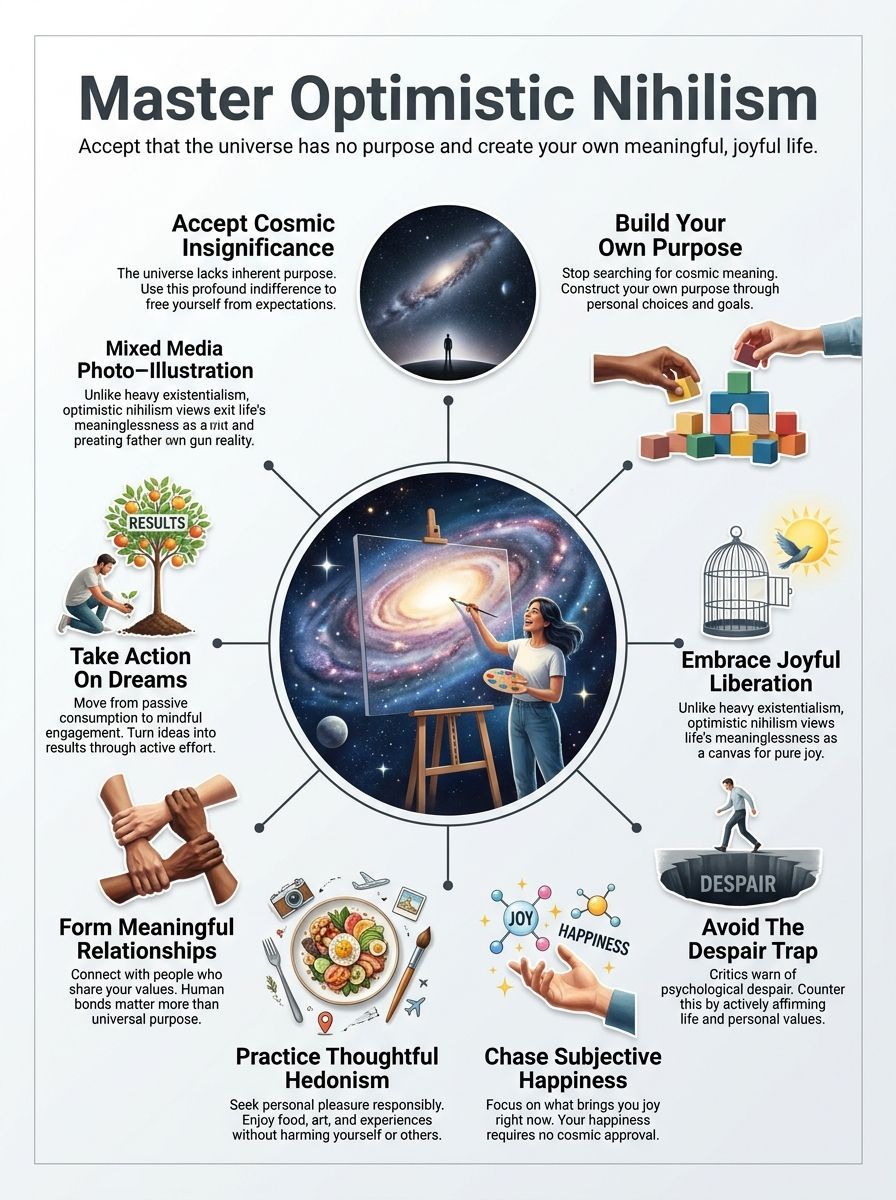
Optimistic nihilism rests on two core ideas that flip traditional thinking on its head. You get to build your own purpose once you accept that the universe does not hand you one.
Freedom from cosmic meaning
The universe contains an estimated 2 trillion galaxies, trillions of stars, and countless planets spinning through the void. In early 2026, the James Webb Space Telescope even confirmed a galaxy named MoM-z14 that existed just 280 million years after the Big Bang, roughly 13.5 billion light-years away. Our Earth is just a moist dust speck orbiting an average star in a medium-sized galaxy.
This cosmic perspective reveals a profound freedom from cosmic meaning. The universe was not created for humans, and it does not care about your goals, dreams, or struggles. This realization hits hard at first, and most people feel terrified when they grasp this truth.
“The universe’s indifference becomes your greatest gift, not your greatest curse.”
Yet this same truth offers liberation. You stop waiting for the cosmos to hand you a purpose, and you stop searching for inherited meaning written in the stars. Cosmic nihilism teaches that all values and goals are baseless from a universal standpoint.
Life has no inherent meaning handed down from above. Science and knowledge do not ease this burden, but they actually strengthen it. The observable universe may be millions of times larger than we can comprehend, making human existence feel incredibly insignificant.
But here lies the paradox. Insignificance sets you free, and you shed the weight of cosmic responsibility. You abandon the search for objective meaning or purpose. This freedom from cosmic meaning means you no longer chase dogma or inherited beliefs about what your life should become.
Instead, you gain the power to create your own meaning. You build personal purpose from scratch. Your life matters because you decide it matters, not because some universal force declares it so.
Creating personal purpose
You hold the power to create your own meaning, and that is where optimistic nihilism gets exciting. Life has no inherent value handed down from the cosmos, but you can give meaning to your days through choices that matter to you.
A 25-year-old has roughly 2,340 weeks left if they live to 70, so the clock ticks with real urgency. That finite time becomes precious precisely because it runs out. You are not chasing some cosmic purpose written in the stars. Instead, you are building one brick by brick through actions, relationships, and goals that resonate with your heart.
A 2025 Psychology Today article noted that up to 91% of people experience purpose anxiety as they struggle to define a grand life mission. Optimistic nihilism offers a cure for this anxiety by encouraging you to build purpose in small, actionable ways.
- Focus on process-oriented joy: Find daily activities that excite you, rather than obsessing over a massive end goal.
- Ignore social media pressures: Stop borrowing toxic, unattainable purposes from influencers.
- Invest in family and friends: A recent Pew Research Center survey found that 40% of Americans cite family as their top source of meaning.
- Seek active engagement: Make the most of your time by striving to improve the lives of others around you.
This active approach to meaning-making transforms nihilism from hopelessness into fuel for living well. You get to decide what matters, and that freedom is liberating.
Optimistic Nihilism vs. Existentialism and Absurdism
Optimistic nihilism, existentialism, and absurdism each offer different ways to handle life’s lack of meaning. They seem similar at first, but they take different paths. Understanding these differences helps you pick which philosophy fits your life best.
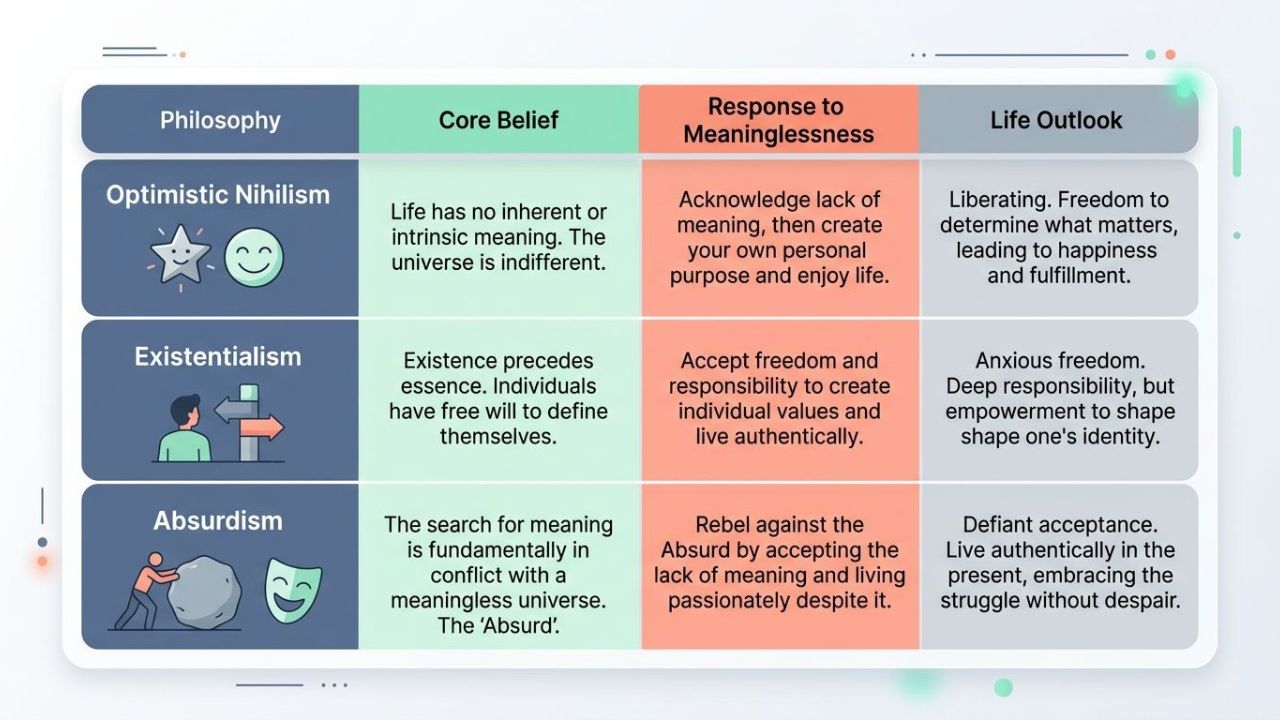
Optimistic nihilism strips away the heavy weight that existentialism carries. While existentialists stress your responsibility to create meaning, optimistic nihilists say that nothing matters, so you should do what makes you happy. That is the key difference.
“Existentialists view freedom as a burden, while optimistic nihilists view it as pure liberation.”
Absurdism sits between these two approaches. It refuses both existentialism’s serious responsibility and optimistic nihilism’s cheerful freedom. Instead, absurdism asks you to laugh at the contradiction. Albert Camus, a major absurdist thinker, argued that humans should accept life’s meaninglessness without pretending to find deep purpose.
Friedrich Nietzsche critiqued the decline of traditional morality in the Western world, which connects to all three philosophies. His work challenged people to question everything. Existentialism took his ideas and built responsibility into the framework.
Absurdism took his ideas and emphasized acceptance, while optimistic nihilism took his ideas and found joy in the liberation. The human experience involves realizing others have their own desires and aspirations, which contribute nothing to the universe’s existence. This realization hits different in each philosophy.
Existentialists feel the weight of this truth, while absurdists acknowledge it with a shrug. Optimistic nihilists smile at it, then go live their lives. Humans often feel insignificant in the vastness of space, which remains fundamentally indifferent to human existence.
This fact troubles existentialists deeply, but it matters less to absurdists. Optimistic nihilists actually find comfort here, because small size means less pressure to be grand or important.
Is Optimistic Nihilism Bad?
People argue that optimistic nihilism creates moral problems, yet others find it frees them to build lives that actually matter to them. Keep reading to discover whether this philosophy helps or hurts your well-being.
Critiques of optimistic nihilism
Ewan Morrison, an ex-nihilist himself, strongly criticizes optimistic nihilism as an oxymoron that cannot hold water. Morrison spent fifteen years as a self-identified nihilist and watched the postmodern arts scene of the 1990s collapse because of its own contradictions.
He argues that optimistic nihilism is incoherent and also a dangerous form of social contagion spreading rapidly through culture. Morrison’s core critique is direct.
“If everything is meaningless, then your life lacks value too. This logic creates a trap where you cannot escape the psychological despair that nihilism generates.”
Morrison warns that promoting optimistic nihilism harms a culture already struggling with purpose and meaning. A recent Harvard report titled “On Edge” found that 58% of young adults experienced little or no purpose in their lives over a single month. This lack of meaning directly correlated with much higher rates of anxiety and depression.
His lived experience as a former believer in nihilistic thought gives his warnings genuine strength. He discovered that a life devoid of meaning cannot be viewed positively, no matter how hard you try to spin it.
The dark side of nihilistic thought is revealed through the tragic stories of prominent figures admired by nihilists. Kurt Cobain, David Foster Wallace, Philip Seymour Hoffman, Chester Bennington, and Alexander McQueen all battled addiction and faced devastating outcomes.
These men embodied the nihilistic worldview, yet their lives reveal the practical consequences of rejecting intrinsic meaning and purpose. Active nihilism sounds rebellious and free, but it often leads to despair rather than affirmation of life. Morrison’s critique suggests that optimistic nihilism offers false hope to those seeking answers about the meaning of life.
Potential benefits of the philosophy
Optimistic nihilism frees you from the weight of cosmic meaning. You stop chasing some grand purpose handed down by the universe, and you get to create your own meaning in life.
According to a 2026 study by Lifeway Research, 68% of Americans say a major priority in their life is finding their deeper purpose. Optimistic nihilism provides a flexible framework to achieve this without the pressure of getting it wrong on a cosmic scale.
This shift feels like dropping a heavy backpack after a long hike. Life becomes precious because it is finite, and your existence matters more when you know it will end. You pursue what brings you joy, not what some external force demands.
“A meaningless life is not a sad life, but rather a blank canvas. You paint it with your own colors and designs.”
The philosophy lets you live without fear of failure. There is no cosmic scorekeeper judging your choices. You can chase pleasure, build relationships, or pursue goals that make sense to you alone.
This freedom from moral relativism, where right from wrong becomes your call, opens doors to authentic living. You actively engage with life instead of passively consuming information. Your sense of purpose comes from within, not from external pressure.
This approach to creating personal meaning lets you build a life that fits you perfectly. You stop wasting energy on things that do not matter to your goals.
The lack of inherent meaning becomes liberating, allowing you to chase subjective joy. You set your own purpose or goal, and you become the author of your own story, completely free to write chapters that reflect what you truly value.
Practical Applications of Optimistic Nihilism

You can use optimistic nihilism every day to make your life better and more enjoyable. This philosophy gives you real tools to find happiness, even when life has no meaning in the cosmic sense.
- Focus on what brings you joy right now. Since the universe as a whole does not hand you a purpose, you get to choose your own meaning. This shift from passive waiting to active choosing changes how you spend your time.
- Pursue activities that create personal purpose. Explore new skills or hobbies that excite you. You might start a daily journal in an app like Day One to document small wins, proving that your happiness does not depend on cosmic approval.
- Engage in hedonism thoughtfully. Seek pleasure without harming others or yourself. The philosophy encourages you to enjoy good food, music, art, and time with people you care about. Life is meaningless, so you might as well enjoy it.
- Take action on big dreams. You can explore the stars, work to cure diseases, or enhance emotional experiences. Many endeavors remain to pursue that can make your life feel full and worthwhile. You create value through your own efforts.
- Build meaningful relationships. Connect with others who share your values and interests. Community platforms like Meetup make it easier than ever to find these groups locally. Your bonds with others become the purpose you create.
- Move from passive consumption to active engagement. Challenge yourself to read books, watch videos, and then do something with what you learned. Action transforms ideas into real results.
- Accept the mystery of existence. Do not let the unknown paralyze you into inaction. Speculation about an unseen part of us exists, but having no means to measure or prove it changes nothing about your daily choices. You move forward anyway.
- Recognize its appeal. Teenagers and people under thirty embrace this philosophy because it works for them. Your generation gets to define what matters.
Final Words
Optimistic nihilism sits at a crossroads. It offers both promise and peril to those who embrace it. This philosophy gives people the freedom to build their own meaning when the universe offers none.
This freedom can feel incredibly liberating and powerful. Yet critics worry that this approach might harm younger generations who are already struggling with mental health and questions about purpose. The real test comes down to how individuals use these ideas in their daily lives.
You must decide whether you will use this mindset to create genuine joy or slip into emptiness. What matters most is finding balance and taking responsibility for your choices. Building connections makes life feel worthwhile, regardless of what the cosmos has in store.
Frequently Asked Questions (FAQs) on Optimistic Nihilism
1. What is optimistic nihilism explained in simple terms?
Optimistic nihilism means accepting that life has no built-in purpose, but you get to create your own meaning instead of feeling lost. It’s basically the idea that if nothing matters objectively, you’re free to decide what matters to you.
2. How does the definition of nihilism connect with famous thinkers like Nietzsche or Schopenhauer?
Nihilism is a concept explored by philosophers like Friedrich Nietzsche and Arthur Schopenhauer. Nietzsche wrote about this in works like “Thus Spoke Zarathustra” during the 1880s, arguing that recognizing life’s lack of inherent meaning can push us to create our own values. Rather than despair, he saw this as an opportunity for personal growth.
3. Is optimistic nihilist thinking bad for ethics or daily living?
Not at all. Many optimistic nihilists act with kindness and integrity because they choose to, not because they’re following external rules.
4. Can reading essays like The Myth of Sisyphus help understand this idea better?
Yes, Albert Camus’ 1942 essay “The Myth of Sisyphus” explores how we can find meaning even when life seems absurd. Thinkers like Jean-François Lyotard and Martin Heidegger also offer different perspectives on these questions.
5. Does believing in optimistic nihilism mean giving up on happiness or hope?
Nope, it often brings relief because you’re free to write your own story without following someone else’s script.