Opera has officially entered the burgeoning AI browser wars, launching Opera Neon, a premium, subscription-based browser designed to transform web interaction from passive viewing into active task automation.
Released to early-access users on September 30, 2025, Neon challenges emerging players like Perplexity and The Browser Company by introducing a suite of “agentic AI” features that aim to understand user intent and execute complex, multi-step tasks directly within the browser.
The move marks a significant strategic pivot for the veteran browser developer, betting that power users will pay a premium—reportedly $19.99 per month—for advanced AI capabilities that go beyond simple chatbots and information summaries. With its privacy-centric, on-device processing and a novel task-oriented interface, Opera is gambling on a future where the browser acts as a proactive digital assistant, fundamentally reshaping user productivity online.
Key Facts & Quick Takes
- What Happened: Opera launched “Opera Neon,” a new AI-focused browser, on September 30, 2025, available via a waitlist and a monthly subscription.
- Core Technology: Neon is built on the concept of “agentic AI,” where the browser can perform actions on the user’s behalf. Key features include “Tasks” for contextual workspaces, “Cards” for reusable prompts, and “Neon Do” for automating actions like form-filling and data comparison.
- Pricing & Availability: The browser is positioned as a premium product, costing $19.99 per month. Access is currently limited to users invited from a waitlist, with broader availability expected in the coming months.
- Competitive Landscape: Neon enters a fiercely competitive new market, going head-to-head with Perplexity’s “Comet” browser, The Browser Company’s “Dia,” and anticipated AI integrations from giants like Google Chrome (with Gemini) and OpenAI.
- Privacy Focus: A key differentiator, according to Opera, is that Neon’s “Neon Do” function operates locally on the user’s device, not in the cloud. This means it can interact with logged-in sessions without sharing passwords or sensitive data with external servers.
- Market Position: Opera holds a niche but stable position in the global browser market. As of September 2025, it accounted for approximately 1.74% of the worldwide market share across all platforms.
Context: The Dawn of the ‘Agentic’ Web
For decades, the web browser has been a window to the internet—a tool for fetching and displaying information. The rise of generative AI has begun to change that, with most major browsers integrating AI chatbots like ChatGPT or Gemini to summarize pages and answer questions.
However, a new frontier is emerging: “agentic browsing.” This paradigm shift envisions the browser not just as an information retriever, but as an action-taker. An agentic browser can understand a complex goal—like “plan a weekend trip to Paris for two under $1,000″—and then execute the necessary steps: searching for flights, comparing hotel prices across multiple tabs, and even filling out booking forms.
It is this vision that has fueled a new arms race. Perplexity, an AI-native search engine, launched its “Comet” browser earlier this year with a similar promise. The Browser Company, creators of the popular Arc browser, is also pivoting to an AI-centric model with its new “Dia” browser. Now, Opera, a company that has long innovated on browser features like tabs and built-in VPNs, is placing its most significant bet yet on this AI-driven future with Neon.
What Is Opera Neon? A Deep Dive into the Features
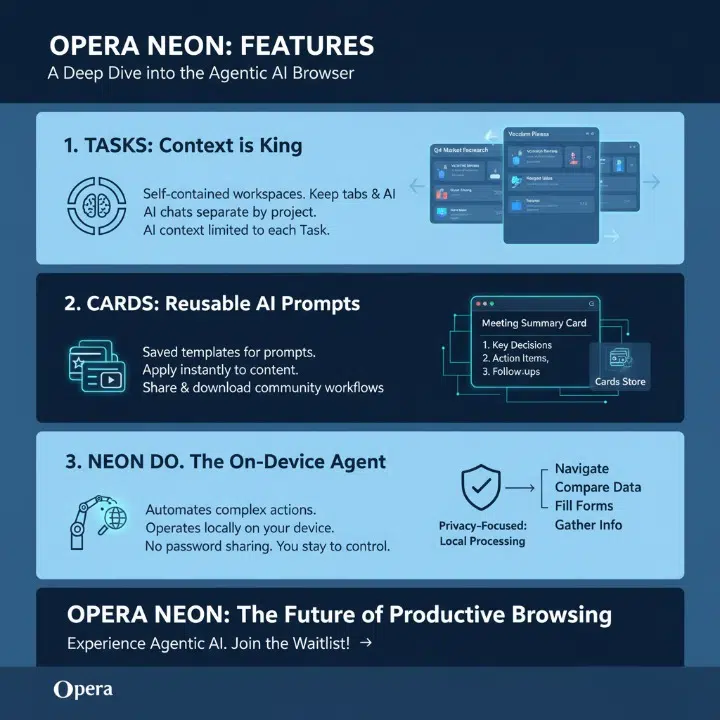
Opera Neon is not an update to the company’s flagship free browser but an entirely new, standalone product. Its architecture is built around three core concepts designed to manage complex digital tasks.
Tasks: Context is King
Neon introduces “Tasks,” which Opera describes as self-contained workspaces. Instead of a chaotic sea of tabs, a user can create a Task for a specific project, such as “Q4 Market Research.” All tabs, documents, and AI chats related to this project live within this Task. The key innovation is that the AI’s context is limited to that specific Task, preventing it from confusing information between, for example, your work research and your personal vacation planning.
Cards: Reusable AI Prompts
To combat the repetitive nature of prompting, Neon features “Cards.” These are essentially saved, reusable prompt instructions. A user could create a “Meeting Summary” Card that combines instructions like “identify key decisions,” “list action items,” and “summarize follow-ups.” This Card can then be instantly applied to any meeting transcript. Opera plans to launch a “Cards store,” allowing users to share and download community-created templates for common workflows.
Neon Do: The On-Device Agent
The most ambitious feature is “Neon Do,” the engine that performs the agentic actions. Activated within a Task, Neon Do can navigate websites, compare information across different sources, fill out forms, and gather data. Opera heavily emphasizes its local, on-device operation as a major privacy and security advantage.
“When you activate Neon Do within a Task, it starts operating inside your browser session, where you’re already logged in,” Opera explained in its official press release (PR Newswire, September 30, 2025). “There is no need to share passwords with cloud services or for repeated authentication flows… You can pause, guide, or take control at any moment.”
This local execution model contrasts with some cloud-based AI agents that may require screen recording or extensive permissions, raising data privacy concerns.
Latest Data & Statistics: Opera’s Uphill Battle
Opera’s bold move comes from a position of a niche player in a market dominated by giants. To succeed, Neon must convince users to switch from deeply entrenched ecosystems and, crucially, to pay for the privilege.
- Global Browser Market Share (September 2025):
- Google Chrome: 71.77%
- Apple Safari: 13.9%
- Microsoft Edge: 4.67%
- Mozilla Firefox: 2.17%
- Opera: 1.74%.
- Perplexity AI User Growth (as of July 2025): The closest competitor in the AI-native space, Perplexity, reported having approximately 30 million monthly active users and processing over 780 million queries per month. This indicates a significant and growing appetite for AI-centric web interaction.
- Opera’s Financials (Q2 2025): Prior to the Neon launch, Opera Ltd. reported strong Q2 2025 earnings, with revenue reaching $143 million, exceeding analyst expectations. This financial health provides the foundation for investing in ambitious projects like Neon.
Official Responses & Expert Analysis
Opera’s leadership has framed Neon as an essential evolution of the browser for a new, more demanding class of user.
“We built Opera Neon for ourselves – and for everyone who uses AI extensively in their day-to-day life,” said Krystian Kolondra, Executive Vice President of Browsers at Opera. “Today, we welcome the first users who will help shape the future of agentic browsing with us.
Early analysis from the tech press has been cautiously optimistic about the technology but skeptical about the subscription model. Commentators have pointed out that while Neon’s features are advanced, competitors are rapidly integrating similar AI tools into their free products. Kevin Raposo of KnowTechie questioned the price point, stating, “Sure, Opera’s offering might be fancier, but good luck getting people to pay $240 annually for browsing when Chrome does AI stuff for free.
The success of Opera Neon will likely depend on whether its unique features—particularly the privacy-focused “Neon Do” and the workflow efficiency of “Tasks” and “Cards”—can deliver enough value to justify a recurring cost in a market where the browser has always been free.
Impact on People: The Rise of the Power User
For the average web user, Opera Neon may seem like overkill. But for researchers, developers, students, and professionals who spend their days juggling complex information online, an agentic browser could be transformative. The ability to automate tedious research, comparison shopping, or data entry could unlock significant productivity gains.
An anecdote from Opera’s own promotional materials describes a user asking Neon to plan five dinners, generate a grocery list, and flag pantry overlaps—a complex, multi-step task that currently requires significant manual effort. If Neon can deliver on such promises reliably, it could create a new category of “power browser” for whom the monthly fee is a worthwhile investment.
What to Watch Next
The launch of Opera Neon is just the beginning. The key developments to watch will be:
- User Adoption: How quickly will Opera convert its waitlist into paying subscribers? Initial user feedback on performance, reliability, and true value will be critical.
- Competitive Response: How will Google, Perplexity, and others respond? Will they introduce more advanced agentic features into their free offerings, thereby undermining Neon’s value proposition?
- The Feature Roadmap: Opera has promised a community-driven “Cards store.” The evolution of Neon’s capabilities and the ecosystem built around it will determine its long-term viability.
- The Price Point: Market feedback may force Opera to adjust its subscription price or introduce tiered plans to attract a wider audience.
Opera Neon is a bold and innovative reimagining of what a web browser can be. By moving beyond simple information retrieval into the realm of intelligent task automation, Opera has firmly planted its flag in the future of the web.
However, it faces the monumental challenge of convincing users to pay for a tool that has historically been free, all while competing against the world’s largest technology companies. Whether Opera Neon becomes a niche tool for productivity enthusiasts or catalyzes a broader shift in how we interact with the internet remains to be seen, but its arrival has undeniably supercharged the race to build the browser of tomorrow.
The Information is Collected from PCMag and Opera Browser.