Some dates feel like quiet markers on a calendar. January 5 is not one of them. This day carries a major Indian space milestone that signaled long-term technological confidence. Beyond South Asia, January 5 connects to one of modern Europe’s most famous justice scandals, a wage decision that reshaped industrial labor, and cultural moments that changed how the world tells stories on stage and screen.
Below is an in-depth, reader-friendly “On This Day January 5” guide, with quick tables for scanning and deeper context where it matters most.
January 5 At A Glance
| Year | Event | Region | Why It Still Matters |
|---|---|---|---|
| 1589 | Catherine de’ Medici dies | Europe | Her rule shaped the Wars of Religion and the idea of “statecraft in crisis” |
| 1895 | Alfred Dreyfus is publicly degraded after conviction | Europe | A global reference point for justice, prejudice, and political trials |
| 1914 | Ford announces the “$5 day” wage | United States | A landmark moment in labor policy, productivity, and the modern middle class |
| 1933 | Golden Gate Bridge construction begins | United States | A symbol of public works, engineering confidence, and Depression-era resilience |
| 1952 | Lord Linlithgow (former Viceroy of India) dies | South Asia / UK | A reminder of colonial governance during WWII and the political costs it carried |
| 1953 | Waiting for Godot premieres in Paris | Europe | A theater revolution that still influences global storytelling |
| 1957 | Eisenhower Doctrine is introduced | Middle East / US | A Cold War blueprint that shaped later regional policies |
| 1971 | The first One Day International cricket match is played | Australia / Global sport | A turning point in sports broadcasting and modern cricket formats |
| 1972 | The U.S. announces the Space Shuttle program | United States | A decision that defined decades of human spaceflight planning |
| 2014 | Bangladesh holds an election amid boycott and violence | Bangladesh | A long shadow over trust, participation, and electoral competition |
| 2014 | India successfully launches GSLV-D5 with indigenous cryogenic stage | India | A milestone for independent access to space and strategic capability |
| 2024 | A Boeing 737 MAX 9 door plug blows out after takeoff | United States | A modern safety shock that renewed scrutiny of manufacturing and oversight |
The Bangalee Sphere
January 5 matters deeply in the Bangalee sphere because it ties together politics, public memory, and modern scientific ambition.
Historical Events
India: January 5, 2014 and a major ISRO confidence moment
On January 5, 2014, ISRO launched GSLV-D5 carrying the GSAT-14 satellite and successfully used an indigenous cryogenic upper stage. In simple terms, it was a proof-of-capability moment: a technically demanding engine type working reliably under real launch conditions.
Why it matters today is strategic and practical:
-
It reduces dependence on foreign technology.
-
It strengthens national communications infrastructure through more dependable satellite deployment.
-
It supports India’s long-term credibility as a spacefaring nation with end-to-end capability.
This is the kind of achievement that looks like “one day” on a calendar, but represents years of engineering persistence behind the scenes.
A wider subcontinent note: January 5, 1949 and Kashmir’s UN memory
January 5 also appears in the international history of the Jammu and Kashmir dispute through a UN Commission for India and Pakistan (UNCIP) resolution dated January 5, 1949. Interpretations of UN-era texts differ widely across politics and time, but the date remains part of the diplomatic memory of a conflict that still shapes South Asian security and identity.
A key point for readers: when you see January 5 in Kashmir-related history, it often reflects how documents become symbols. Even when realities change, the paperwork stays emotionally powerful.
Famous Births
Here are notable people born on January 5 with strong relevance to Bangalee and South Asian history and culture.
| Name | Born | Field | Why They Are Remembered |
|---|---|---|---|
| Mamata Banerjee | 1955 | Politics (West Bengal) | First woman Chief Minister of West Bengal; founded Trinamool Congress; major contemporary Bangalee political figure |
| Deepika Padukone | 1986 | Cinema | Global-facing Bollywood star; multiple major awards and cultural influence |
| Barindra Kumar Ghosh (Barin Ghosh) | 1880 | Revolutionary journalism | Jugantar founder-member; part of Bengal’s anti-colonial revolutionary network |
| Mansoor Ali Khan “Tiger” Pataudi | 1941 | Sport | Iconic Indian cricket captain; shaped India’s modern cricket leadership identity |
| Shah Jahan | 1592 | History | Mughal emperor linked to the Taj Mahal and Indo-Islamic architectural memory |
| Zulfikar Ali Bhutto | 1928 | Politics (Pakistan) | Major South Asian statesman; his career still influences politics and debate in Pakistan |
Famous Deaths
| Name | Died | Field | Legacy |
|---|---|---|---|
| Prabir Mitra | 2025 | Bangladeshi cinema | Veteran actor known for decades of work and major recognition, including national awards |
| Victor Hope, 2nd Marquess of Linlithgow | 1952 | Colonial administration | Longest-serving Viceroy of India; his tenure intersected with WWII, political repression, and major anti-colonial pressure |
Cultural/Festivals
January 5 does not belong to a single fixed Bangalee festival the way Pohela Boishakh does, but it often sits in a meaningful seasonal zone:
-
Winter cultural programming: book fairs, school cultural weeks, and seasonal gatherings often begin or intensify in early January across Bangladesh and West Bengal.
-
Sikh observances may fall nearby: Guru Gobind Singh’s birth anniversary is celebrated based on calendar calculations, and in some years it falls around early January.
-
Christian season traditions: in many communities, the days around January 5 connect to Epiphany season practices, including “Twelfth Night” traditions in some cultures.
International Observances & Holidays
January 5 is not one of the UN’s headline observance dates, but it is widely recognized through cultural and civic traditions.
Major International Days
-
There is no universally fixed UN International Day on January 5 in the way March 8 or December 1 is recognized globally.
-
However, Epiphany season traditions (especially in parts of Europe and Latin-influenced cultures) often place major religious observances on January 6, making January 5 an important “eve” in many communities.
National Days and Popular Modern Observances
-
National Bird Day (United States, popular observance): A conservation-themed day used by educators and wildlife groups to promote bird protection and habitat awareness.
Global History
United States
1914: Ford’s “$5 day” and the modern wage argument
On January 5, 1914, Ford Motor Company announced a wage policy famously linked to the “$5 day.” It became a symbol of industrial-era labor transformation.
Why this still matters is not nostalgia. It’s a living policy debate:
-
Can higher wages reduce turnover and improve quality?
-
Do better-paid workers fuel consumer markets in a way that benefits the whole system?
-
How much responsibility should industry carry for social stability?
Modern conversations about living wages, productivity, and corporate ethics still echo this decision, even if the economy has changed beyond recognition.
1933: Golden Gate Bridge construction begins
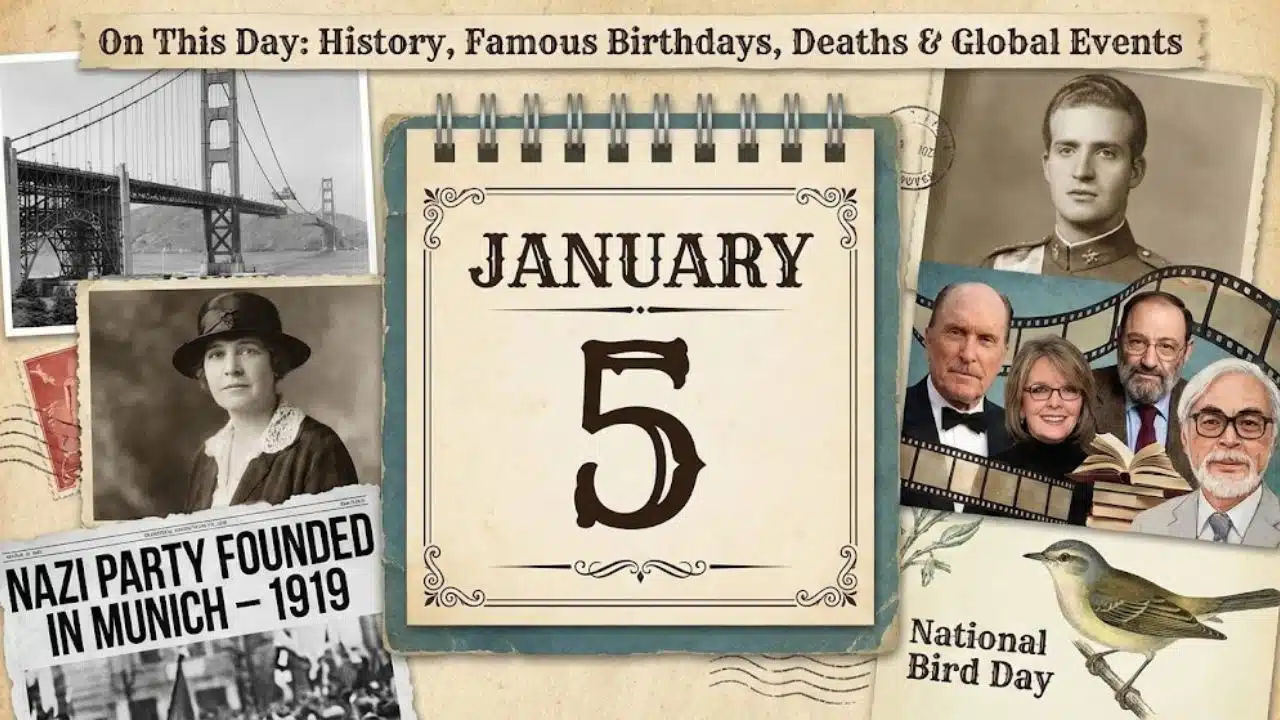
January 5, 1933 marked the start of construction on the Golden Gate Bridge, one of the world’s best-known engineering icons.
Its deeper significance is psychological as much as structural. During the Great Depression, big public works projects gave people something rare: visible proof that long-term planning could still happen in hard times. That lesson remains relevant today whenever societies debate infrastructure spending, jobs, and public confidence.
1972: Space Shuttle program announced
On January 5, 1972, the U.S. announced plans to develop the Space Shuttle. The Shuttle era later became controversial in cost and risk, but it also carried massive achievements.
Why this matters now is that large-scale science programs do not only build machines. They build institutions, workforce skills, and national identity around exploration.
2024: The Boeing 737 MAX 9 door plug incident
On January 5, 2024, a Boeing 737 MAX 9 experienced a door plug blowout shortly after takeoff, leading to rapid depressurization. The flight landed safely, but the event triggered intense scrutiny.
Why it matters today:
-
It reignited public attention to aircraft manufacturing standards.
-
It renewed pressure on regulators and industry quality control.
-
It became a cautionary tale about how “small parts” can carry massive risk.
Russia (and the former Soviet sphere)
1918: The Constituent Assembly moment and the fragility of democratic transitions
In revolutionary Russia, the Constituent Assembly’s short-lived role is often linked to early January 1918 (dates vary across old and new calendars). What matters is not the calendar debate. It is the political lesson: during revolutions, electoral legitimacy can be quickly overridden by power structures that claim a different mandate.
That idea continues to shape how historians interpret modern transitions, not only in Russia but in many societies emerging from crisis.
China
1967: The Shanghai “January Storm” begins
January 5, 1967 is associated with the Shanghai “January Storm,” a dramatic seizure of political control during the Cultural Revolution.
Why it matters today is that it shows how mass political campaigns can destabilize institutions fast. It also explains why later Chinese governance often emphasized stability and control as lessons drawn from periods of chaos.
United Kingdom
A medieval hinge: Edward the Confessor’s death and the road to 1066
King Edward the Confessor died in early January 1066. While the exact date is January 5 in many histories, what matters is the chain reaction: his death intensified a succession crisis that ended with the Norman Conquest.
Why it still matters today:
-
It shaped the English language, law, and land systems.
-
It still influences British historical identity and national storytelling.
Europe
1895: The public degradation of Alfred Dreyfus
On January 5, 1895, French officer Alfred Dreyfus was publicly stripped of rank after a treason conviction. The Dreyfus Affair later became a defining scandal in European political culture.
Why it matters today is painfully modern:
-
It shows how prejudice can shape institutions.
-
It shows how “national security” accusations can become political weapons.
-
It became a template for later debates about civil rights, media power, and accountability.
1953: Waiting for Godot premieres
On January 5, 1953, Samuel Beckett’s Waiting for Godot premiered in Paris, launching one of modern theater’s most influential works.
It mattered because it changed audience expectations. Theater no longer needed a neat plot to be powerful. It could be uncertainty itself, staged and made real.
Australia
1971: The first One Day International cricket match
On January 5, 1971, Australia and England played the first One Day International (ODI) cricket match at the Melbourne Cricket Ground.
Why it matters today:
-
ODI cricket reshaped sports broadcasting.
-
It helped create a new global sports economy.
-
It paved the path toward today’s shorter formats that dominate modern attention spans.
Canada
1998: The Ice Storm era begins its harshest phase
In early January 1998, a massive ice storm struck eastern Canada and parts of the northeastern United States. January 5 sits in the storm’s most damaging period.
Why it matters today:
-
It is still used as a benchmark for power-grid resilience.
-
It shaped emergency shelter planning and public communication strategies.
-
It remains a reminder that disasters can become “national memory” events.
Rest of World (Middle East, Asia, Africa, South America)
1957: The Eisenhower Doctrine and Cold War geopolitics
On January 5, 1957, the Eisenhower Doctrine was introduced, offering U.S. support to Middle Eastern countries resisting communist influence.
Why it still matters:
-
It helped normalize the idea of security commitments framed through ideology.
-
It influenced later intervention debates and alliance-building strategies.
-
It shaped how leaders across the region interpreted U.S. intentions during the Cold War.
Notable Births & Deaths (Global)
To keep this section high-impact, here are selected globally influential figures connected to January 5.
Famous Births
| Name | Born | Nationality | Why They Are Famous |
|---|---|---|---|
| Hayao Miyazaki | 1941 | Japan | Legendary animator-director; global cultural influence through Studio Ghibli films |
| Robert Duvall | 1931 | United States | Award-winning actor known for deep character realism |
| Umberto Eco | 1932 | Italy | Novelist and public intellectual; bridged history, philosophy, and popular culture |
| Konrad Adenauer | 1876 | Germany | First West German Chancellor; shaped postwar reconstruction and Europe’s direction |
| Bradley Cooper | 1975 | United States | Actor-director; major modern pop-culture figure |
Famous Deaths
| Name | Died | Nationality | Cause / Legacy |
|---|---|---|---|
| Calvin Coolidge | 1933 | United States | Former U.S. president; symbol of 1920s conservatism and pre-Depression politics |
| George Washington Carver | 1943 | United States | Agricultural scientist who uplifted farming through practical innovation |
| Ernest Shackleton | 1922 | Anglo-Irish | Polar explorer; iconic leadership legacy; died during his final expedition era |
| Charles Mingus | 1979 | United States | Jazz composer and bassist; a giant of modern music |
| Sonny Bono | 1998 | United States | Music and politics figure; death became a widely discussed public safety moment |
Takeaways
January 5 stands as a powerful reminder that every date on the calendar carries layers of human experience and historical meaning. From pivotal global events and groundbreaking achievements to the births of influential figures and the passing of those who shaped their times, this day reflects the continuous flow of history across cultures and generations.
Looking back on January 5 helps us appreciate how individual moments—big or small—contribute to the world we live in today. As history moves forward, remembering such days keeps us connected to our shared past while inspiring us to shape a more informed and thoughtful future.