
On Monday, the Nobel Memorial Prize in Economic Sciences was awarded to three economists—Joel Mokyr, Philippe Aghion, and Peter Howitt—for their contributions to understanding how innovation drives economic growth. Their work refines a central idea in modern economics known as creative destruction: the process by which new technologies and companies displace older ones, reshaping industries and sustaining long-term growth.
The three winners bring complementary approaches. Mokyr, an economic historian, draws on deep archival and institutional analysis to trace how innovation evolves over centuries and under changes in culture, institutions, and scientific progress. Aghion and Howitt adopt formal, mathematical frameworks to model when, and under what conditions, creative destruction leads to sustained growth. Together, they offer both the “what” and the “why” behind innovation-driven economy dynamics.
The Laureates: Backgrounds and Academic Journeys
-
Joel Mokyr is affiliated with Northwestern University and has long focused on the history of technology, mechanics of scientific revolutions, and long-run growth patterns. His work emphasizes how knowledge, culture, and institutions enable or constrain waves of innovation over centuries. At 79, Mokyr remains active in scholarly activity and has indicated no intention to retire, viewing academic inquiry as his lifelong vocation.
-
Philippe Aghion, aged 69, divides his time between institutions including the Collège de France, the London School of Economics, and INSEAD. His research spans growth theory, competition policy, and technology. He has also engaged in public policy, including roles in national advisory capacities.
-
Peter Howitt is a professor at Brown University whose collaborations with Aghion span decades. He has co-developed formal models that capture the dynamics of creative destruction, market entry, and innovation incentives.
In terms of the prize itself, the award allocates half of the monetary reward to Mokyr, and the other half is shared by Aghion and Howitt. Winners also receive a gold medal and diploma, in keeping with the traditions of the Nobel Prize ceremonies. The prize amount is 11 million Swedish kronor (approximately USD 1.2 million).
Deep Dive: What the Research Uncovered
Mokyr’s Long View: Institutions, Ideas, and Innovation
Mokyr’s work underscores that innovation does not arise in a vacuum. Instead, he traces the deep roots of scientific culture, educational systems, openness to ideas, and institutional frameworks that facilitate the accumulation and transmission of knowledge. He argues that for creative destruction to succeed repeatedly, societies must allow experimentation, tolerate failure, encourage freedom of inquiry, and preserve pathways for new entrants. Without these conditions, innovation can stall or become captured by entrenched interests.
His historical investigations span centuries: exploring how technological paradigms shifted, how scientific revolutions catalyzed economic change, and where institutional bottlenecks prevented diffusion of beneficial technologies. Mokyr’s contribution lies in linking long-term economic trajectories with the social, political, and intellectual infrastructure supporting innovation.
Aghion & Howitt: Modeling the Mechanics of Creative Destruction
Aghion and Howitt’s work complements historical insight by formalizing the processes behind creative destruction. In a landmark 1992 paper, they constructed a dynamic growth model in which firms invest in innovation to displace incumbents. Their framework shows that sustained growth depends critically on incentives, competition, and openness to entry. Specifically:
-
Innovations must not just appear but must outcompete existing technologies.
-
Incumbent firms must be unable to erect insurmountable barriers to competition.
-
The flow of new ideas must be continuous and cumulative.
-
Policy, regulation, and institutional friction can slow or stall the process.
This mathematical formalization allows measured predictions about how changes in policy, competition, and market structure affect growth trajectories. It also helps explain empirical puzzles: why some economies stagnate or fall behind, and why others thrive under persistent technological churn.
Why the Award matters now
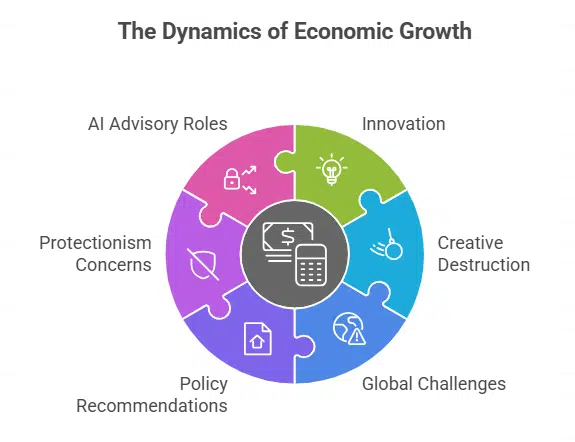
The Nobel committee emphasized that sustained economic growth is not a guarantee—it depends on continuous innovation and a favorable environment for creative destruction. Past eras saw long stretches of stagnation; the laureates’ work suggests that modern prosperity rests on maintaining mechanisms that allow new ideas to displace the old.
Their contributions resonate in current global challenges: rapid AI and digital transformation, trade tensions, debates over industrial policy, and concerns about incumbent capture in tech sectors. The laureates’ frameworks help inform how governments and institutions can avoid stagnation by preserving competition, enabling research, and resisting protectionist pressures.
Aghion has, in public and policy circles, voiced reservations about rising protectionism and trade barriers. He underscores that restricting openness or shielding incumbents may dampen innovation and slow global growth. Furthermore, in France, Aghion was involved in national AI advisory roles, helping recommend strategies to position the country globally in emerging technology.
The Wider Nobel Picture and Legacy
Formally, the award is known as the Bank of Sweden Prize in Economic Sciences in Memory of Alfred Nobel, established in 1968 to accompany the original Nobel prizes. Though not part of Alfred Nobel’s original bequest, it is awarded in the same ceremony each December 10 (the anniversary of Nobel’s death) and carries comparable prestige.
Since the economics prize’s inception, it has been awarded to nearly 100 laureates, but women remain heavily underrepresented. The 2025 award continues a longstanding pattern of male dominance in economics. Each new laureate adds to a lineage of thinkers whose work shapes theory, policy, and global economic conversation.
Questions and Challenges
-
Policy influence: Will governments adopt or reinforce policies that maintain competitive markets, reduce barriers to entry, and facilitate innovation ecosystems?
-
Extensions of theory: Can future research expand creative destruction frameworks to better account for issues like inequality, climate, or AI-related disruption?
-
Public diffusion: Will broader audiences appreciate that growth is not automatic but fragile—requiring constant creative renewal rather than passive stability?
This Nobel recognition signals that innovation, institutional foundations, and competitive dynamics are not abstract theory—they are central to how societies prosper or stagnate. Mokyr, Aghion, and Howitt remind us that maintaining a trajectory of progress is an active, deliberate pursuit.