Next-Generation Sequencing (NGS) has revolutionized science so much over the last twenty years. What previously took years of work and millions of dollars is now possible to achieve in days and at a fraction of the cost.
Besides being faster and less expensive, NGS has transformed the biological research of life itself. Scientists can now investigate both the smallest microbes and the most complicated human diseases. Read on to learn more.
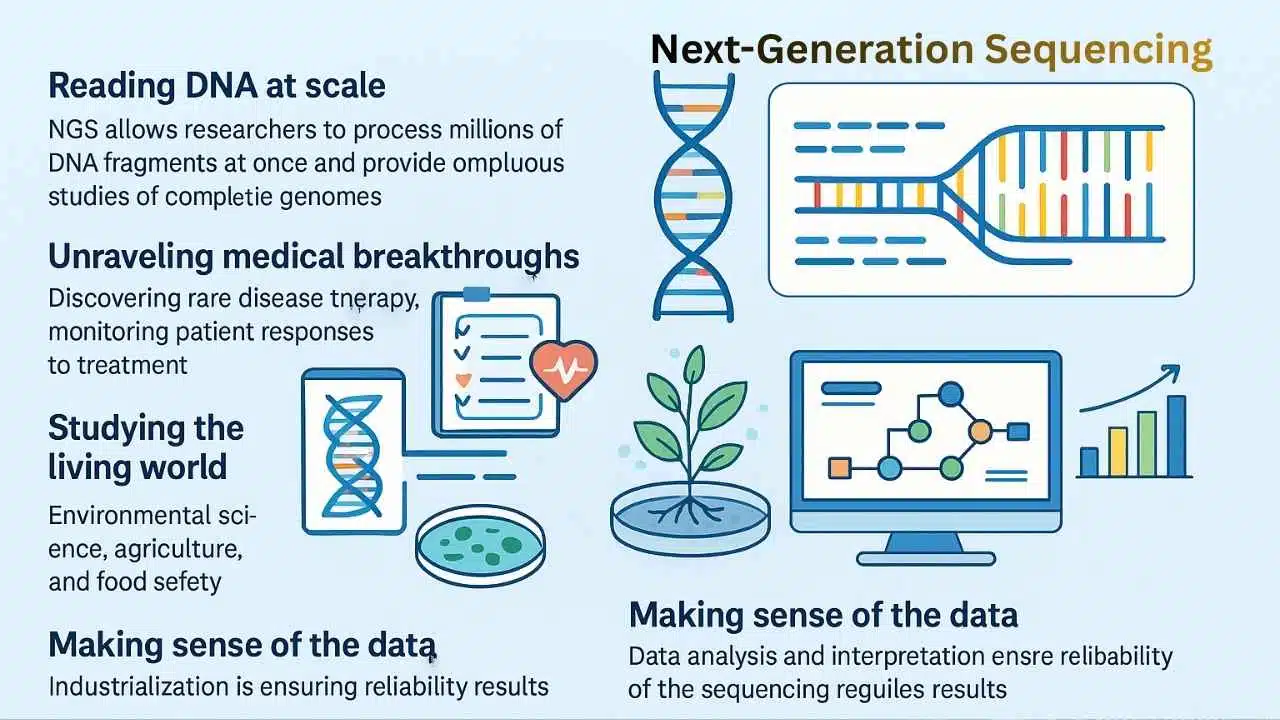
Reading DNA at scale
At its core, NGS enables researchers to process millions of DNA fragments at once and provide enormous volumes of data on genetic material. This sequencing method created opportunities that the traditional sequencing methods failed to.
Researchers are no longer restricted to the study of a single gene or a single organism at a time. Now, they can study complete genomes, communities of microorganisms, or complex expression patterns in a single experiment.
Such rich data generation has been enabling discovery in almost all areas of biology. Genetic studies that used to be done on a small scale can now entail thousands of genomes and can show patterns that were previously not evident. Such scale and precision are useful in evolutionary research, cancer research, and tracking of infectious diseases.
Unraveling medical breakthroughs
Health and medicine are two of the most prominent effects of NGS. Clinicians apply next generation sequencing for the following tasks:
- Discover genetic mutations that lead to rare diseases
- Personalize cancer therapy according to tumor genetics
- Monitor the response of patients to therapy.
The emergence of precision medicine, which is about customizing treatment based on the DNA of an individual, is nearly completely reliant on the power of NGS.
Sequencing also demonstrated its value in the world during the COVID-19 pandemic. NGS was applied to detect and monitor viral variants in real-time to enable scientists and health authorities to respond to new risks. It has the capacity to convert genomic information into viable information, fast and precisely. This has changed the face of reactions to outbreaks of infectious illnesses forever.
Studying the living world
NGS is not only applicable to human health. It is also useful in environmental science, agriculture, and food safety. It is used by ecologists to examine soil or water biodiversity and identify species that could not have been detected otherwise.
Agricultural scientists use sequencing to produce crops that are more resistant to disease and learn how plants and their pathogens interact with each other. Even the food industry can employ the NGS in order to trace the origins of contamination with unparalleled accuracy.
These uses demonstrate that sequencing is not a scientific research tool exclusive to white-coded scientists. It is a daily technology that is determining how we control health, food, and the environment.
Making sense of the data
Along with lots of data comes lots of responsibility. Data analysis and interpretation are as important as the sequencing itself. A single sequencing run is capable of producing terabytes of data. Modern laboratories use high-quality bioinformatics pipelines and quality control. This way, they can guarantee the reliability of results.
Final thoughts
Next-Generation Sequencing has become the workhorse of contemporary science. It is fueling discoveries that are transforming the world. The developments are pushing the field of science into a stage where sequencing will be as common as a blood test.