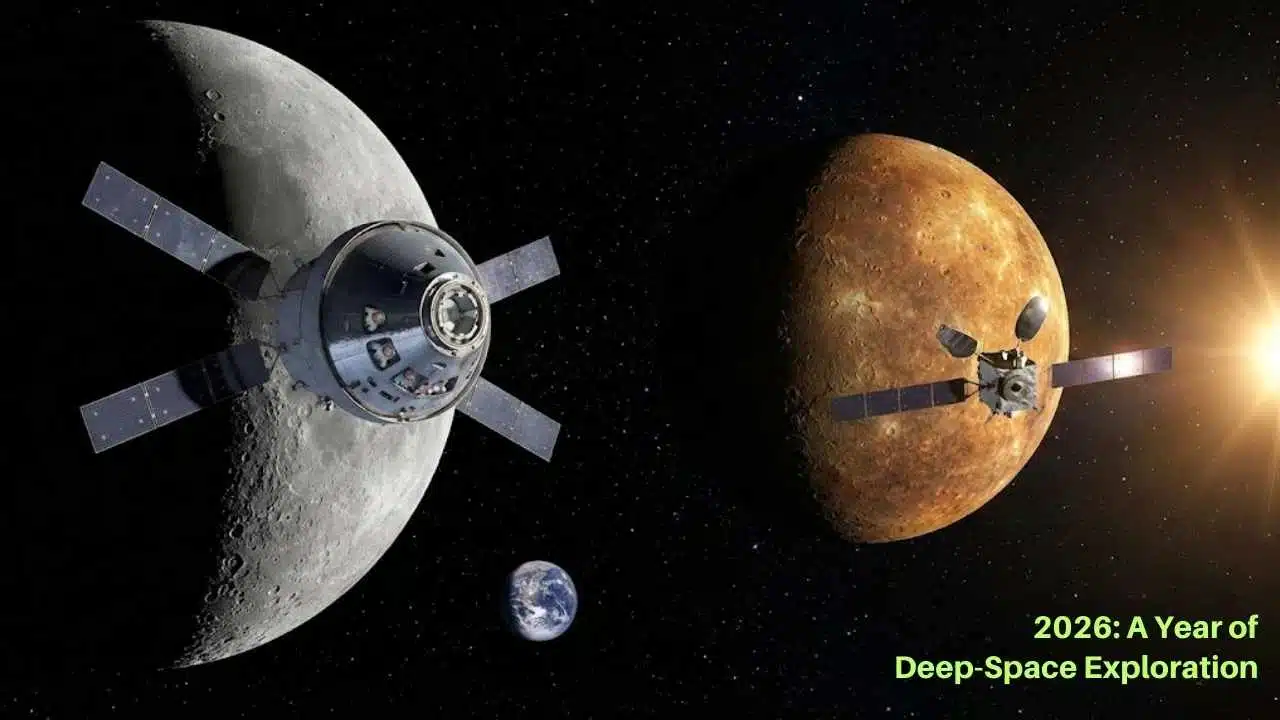
NASA plans to send four astronauts around the Moon in Artemis II as soon as February 2026, its first crewed lunar-distance mission in more than 50 years. In late 2026, ESA-JAXA’s BepiColombo is slated to enter Mercury orbit after an eight-year journey.
After decades focused on low-Earth orbit, two headline missions are now defining the next chapter of deep-space exploration: NASA’s Artemis II Moon Mission and the European Space Agency (ESA)-Japan Aerospace Exploration Agency (JAXA) BepiColombo mission to Mercury.
NASA says Artemis II is targeted to launch no later than April 2026, with “potential opportunities as soon as February,” sending a crewed Orion spacecraft around the Moon and back on a roughly 10-day test flight.
Meanwhile, BepiColombo is on track to enter orbit around Mercury in November 2026, enabling two orbiters to begin a new era of close-up science at the solar system’s smallest planet.
Artemis II Moon Mission: Who Is Flying And What They Will Do
NASA’s Artemis II crew includes Reid Wiseman (commander), Victor Glover (pilot), Christina Koch (mission specialist), and Jeremy Hansen (mission specialist) from the Canadian Space Agency (CSA).
Artemis II is designed as the first full crewed flight test of NASA’s integrated deep-space system—the Space Launch System (SLS) rocket and Orion spacecraft—after Artemis I flew uncrewed in 2022.
Why Artemis II Matters
Artemis II’s core job is validation: proving Orion can keep a crew alive and working for days in deep space and then safely return them to Earth. NASA describes the mission as a critical step in building a longer-term lunar presence and preparing for later missions, including future landings.
What The 10-Day Flight Tests
NASA highlights crewed evaluations of Orion’s life support (breathable air generation and removal of carbon dioxide and water vapor), including performance during higher-metabolic activity and sleep periods.
A Key Technical Issue: Orion’s Heat Shield And The “Modified Reentry” Plan
One of the most closely watched elements of Artemis II is Orion’s heat shield, after Artemis I showed an unexpected pattern of char material loss during reentry.
NASA says its investigation concluded the Artemis II heat shield can keep the crew safe, and the agency will proceed with the heat shield already attached—while adjusting Orion’s entry trajectory for the Artemis II return.
NASA’s findings describe how gases generated inside the heat shield’s Avcoat material did not escape as expected, contributing to cracking and loss of material. The agency says the thermal protection system is designed to ablate and protect the capsule from extreme temperatures during lunar-return speeds.
Timeline: Artemis II And BepiColombo’s Road To 2026
Here’s how the two missions line up across 2026, based on current agency targets and published schedules.
| Mission | Milestone | Timing (Current Target) | What It Enables |
| Artemis II | Launch opportunity opens as soon as February; targeted no later than April | Feb–Apr 2026 | First crewed lunar-distance flight test in Artemis era |
| Artemis II | ~10-day crewed lunar flyby mission | 2026 | Validates Orion/SLS performance with crew aboard |
| BepiColombo | “First light” calibration for key instruments after separation from transfer module | Sep 2026 | Instrument calibration and readiness checks before orbit science |
| BepiColombo | Mercury orbit insertion | Nov 2026 | Start of two-orbiter Mercury science campaign |
| BepiColombo | Routine science operations ramp-up | Spring 2027 | Full mapping/composition/magnetosphere science |
BepiColombo: Two Orbiters, One Of The Toughest Destinations In The Inner Solar System
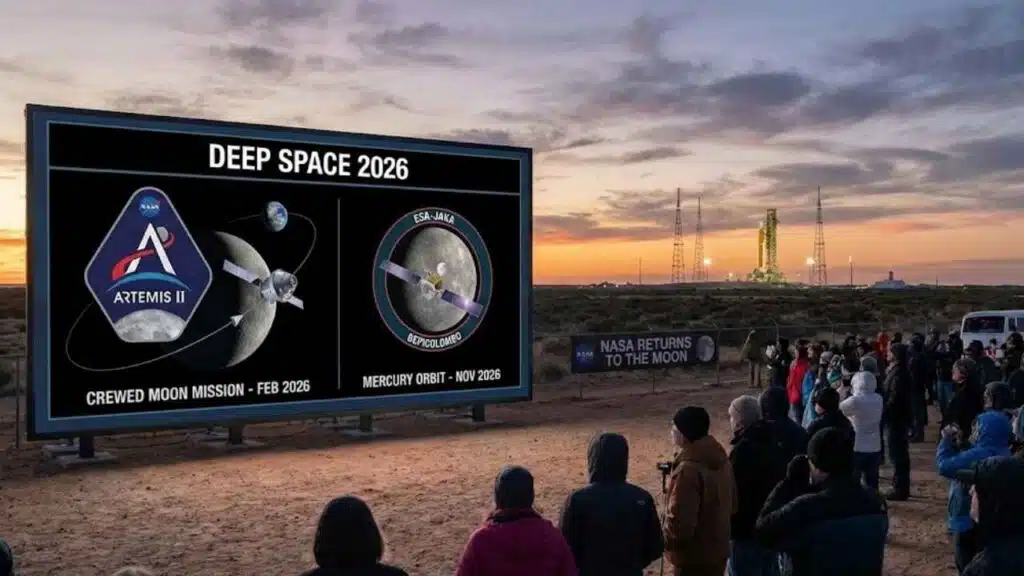
Mercury is notoriously difficult to study up close. The planet sits deep in the Sun’s gravity well, meaning spacecraft must shed enormous speed to be captured into orbit. BepiColombo has relied on a long sequence of gravity assists—swinging past Earth, Venus, and Mercury multiple times—to gradually reshape its trajectory.
ESA notes that across its cruise, BepiColombo has also used the journey itself for science—monitoring solar activity and investigating how the Sun’s gravity affects radio signals, alongside magnetic measurements taken during Mercury flybys.
What Makes This Mission Different
BepiColombo is built around two spacecraft operating together at Mercury:
- ESA’s Mercury Planetary Orbiter (MPO) for close-in surface and geochemistry mapping
- JAXA’s Mercury Magnetospheric Orbiter (Mio) for studying Mercury’s magnetic environment
ESA says that after arrival at Mercury in late 2026, the spacecraft will separate and maneuver to their dedicated polar orbits, with science operations beginning in early 2027.
New Science: X-Ray Mapping And The MIXS Instrument
A major scientific promise of BepiColombo is high-resolution mapping of Mercury’s composition using X-ray and other spectral measurements.
The University of Leicester—leading a Europe-wide consortium—highlights the Mercury Imaging X-ray Spectrometer (MIXS), which is intended to produce detailed X-ray measurements that help reveal what Mercury’s surface is made of. Leicester also states that the mission is expected to enter Mercury orbit on November 21, 2026, and that MIXS commissioning for science operations is planned for Spring 2027.
Leicester further explains that once the stack separates and the orbiters are operating independently, Mercury can be scanned in multiple bands—X-rays, visible/near-infrared, and infrared—supporting a more precise map of surface composition and thermal properties, including improved visibility of polar regions where water ice could exist in permanently shadowed craters.
What Each Mission Is Trying To Prove
Both missions are “pathfinders,” but in different ways—Artemis II is a human-spaceflight systems test, while BepiColombo is a long-baseline planetary science campaign.
| Mission | Primary Goal | Main Hardware | Key Measurements/Tests |
| Artemis II Moon Mission | Prove crewed deep-space flight readiness | SLS + Orion | Life support performance; deep-space operations; safe high-speed return with modified entry trajectory |
| BepiColombo | Explain Mercury’s evolution and environment | MPO + Mio + transfer module | Surface composition mapping (incl. X-ray spectroscopy); magnetic field and plasma environment; improved polar coverage |
The Artemis II Moon Mission is NASA’s next major step toward routine crewed operations beyond low-Earth orbit, with mission timing set for no later than April 2026 and opportunities as soon as February.
BepiColombo, by contrast, is reaching the payoff phase of an eight-year interplanetary transfer: a two-spacecraft observatory designed to deliver the most complete view yet of Mercury’s surface composition and magnetic environment once it arrives in November 2026.
If both timelines hold, 2026 will stand out as a year when deep-space exploration advances on two fronts at once—human testing around the Moon, and high-precision planetary science at Mercury.