You ask an AI a simple question, but the response doesn’t quite meet expectations. It may ramble, provide incomplete information, or completely miss the intended point. Rephrasing the question repeatedly often feels like guesswork, with little improvement in results.
One key truth stands out: well-crafted prompts lead to better answers from any AI tool. Mastering the most useful AI prompting techniques you haven’t tried yet is essential for unlocking more accurate and valuable responses.
This guide explores how to write smarter prompts using fresh and effective techniques. By the end, you will gain practical ideas to generate clearer, more precise answers every time you interact with AI. So, grab a cup of coffee and follow along.
What is Prompting in AI?
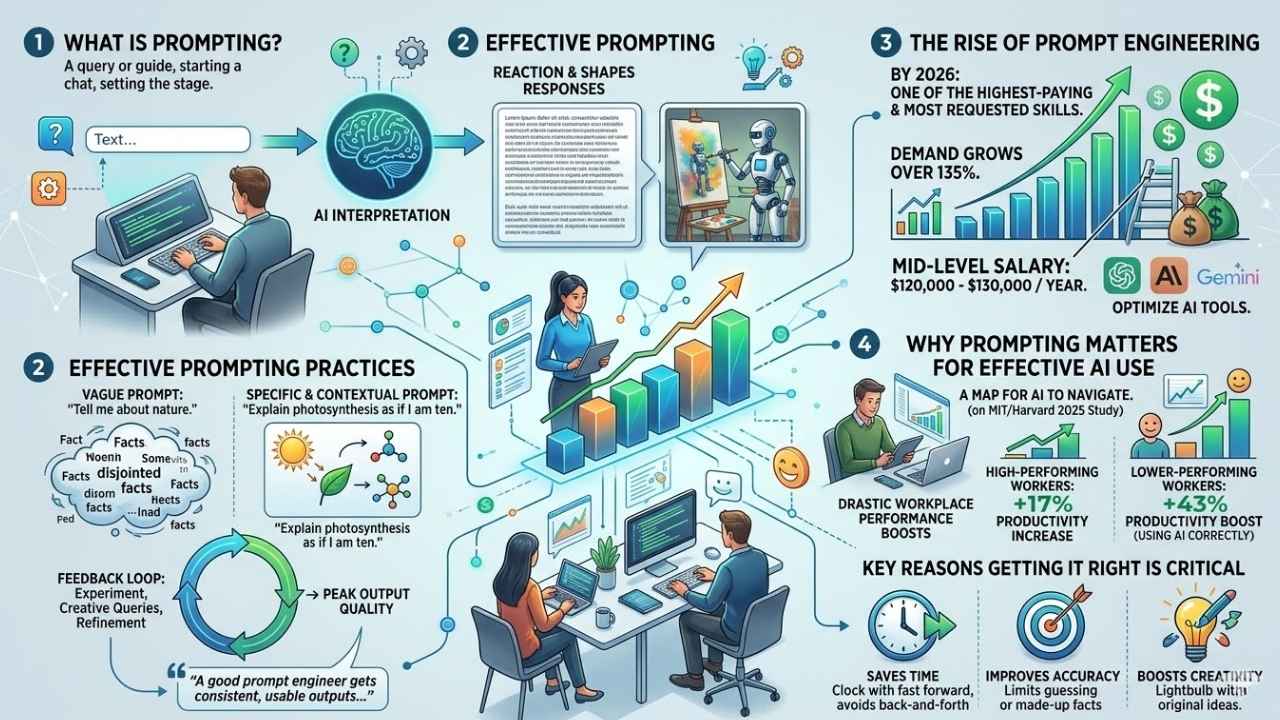
Prompting works like starting a chat with Artificial Intelligence, setting the stage for its response. It acts as a query or guide that shapes how AI Interpretation understands and reacts to your request.
In 2026, prompt engineering is one of the highest-paying and most requested skills in the US job market. Demand for this specific talent grew over 135 percent recently, and mid-level prompt engineers now earn an average of $120,000 to $130,000 a year. Top users rely on specific frameworks to squeeze more value from AI Tools like ChatGPT, Claude, or Google Gemini.
“A good prompt engineer is someone who gets consistent, usable outputs from AI tools, and knows exactly what to do when they do not.”
Many folks treat prompts like magic spells. They write something vague and hope for genius answers, but clarity wins every time. Short, clear language leads to targeted outputs instead of wild guesses from Conversational AI systems.
Add context if you want useful answers. “Explain photosynthesis as if I am ten,” gives more guidance than just asking “What is photosynthesis?” Power users experiment with creative queries and refine their instructions through feedback loops until they reach peak output quality.
Why Prompting Matters for Effective AI Use
Good prompts act like a map for Artificial Intelligence, showing it where to go and what you need. Clear words help AI understand your query, so you get the most useful response.
Even small changes in your sentence can boost how well Conversational AI understands your request. A recent 2025 study by MIT and Harvard researchers found that effective AI use drastically improves workplace performance. High-performing workers saw a 17 percent increase in productivity, while lower-performing workers achieved an incredible 43 percent boost just by using AI correctly.
Here are a few reasons why getting this right is so critical:
- Saves Time: You avoid spending hours going back and forth with the machine.
- Improves Accuracy: Specific language limits the AI’s tendency to guess or make up facts.
- Boosts Creativity: Good instructions can push the AI to generate highly original ideas.
A simple prompt often works better than a fancy one with lots of jargon or fluff. Ask directly, use specific language, and add just enough context for the machine to know what is up. Plain guidance always wins over confusion or vagueness in output quality every single time.
Key Basics of Writing Effective Prompts
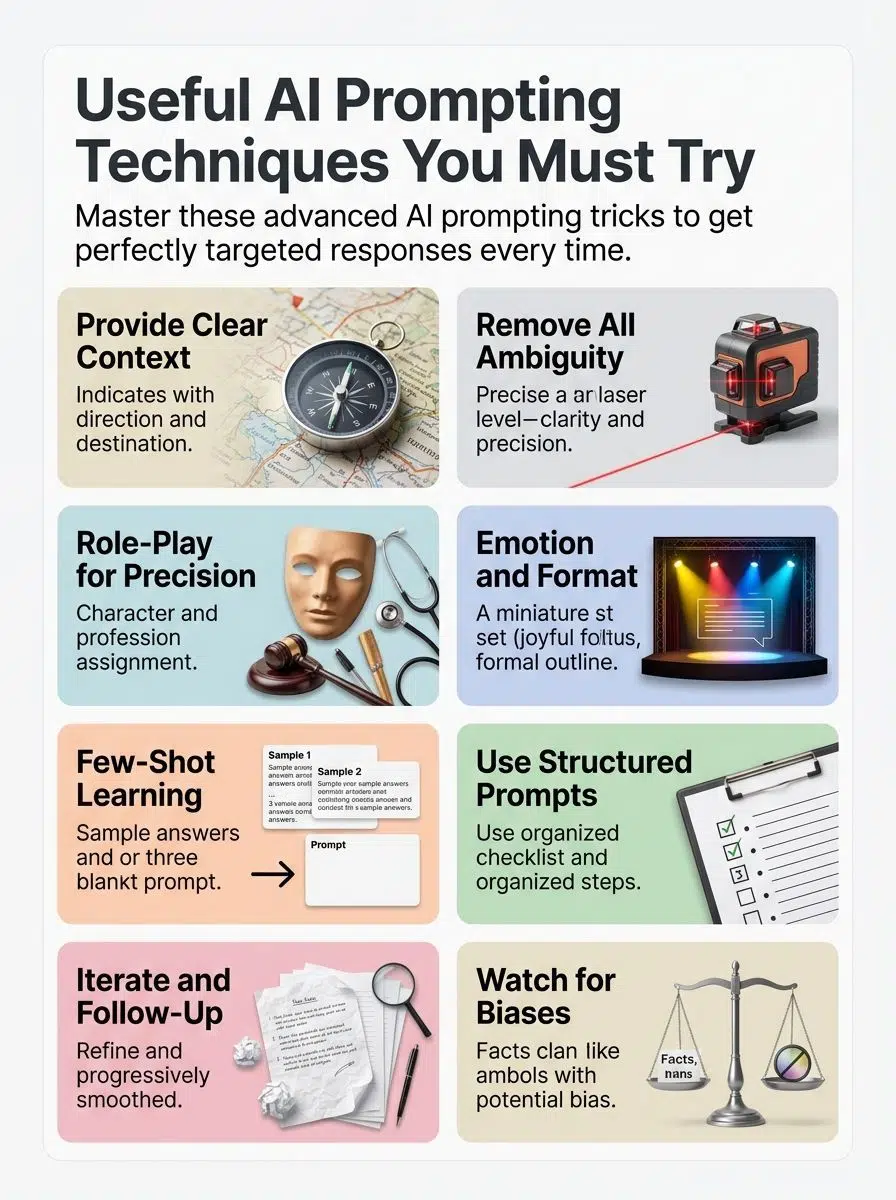
Crafting strong prompts is like giving clear directions to a friend, and you will want to stick around to see how simple tweaks can spark smarter answers.
Be clear, specific, and concise
Clear and specific prompts help Artificial Intelligence understand your requests without guessing games. Specificity removes confusion, saving time you might waste on follow-up questions or confusing rewrites.
Most top users know that concise language improves Interactive Queries and Response Optimization. One of the best ways to be specific is to use the RTF framework, which stands for Role, Task, and Format. This simple structure forces you to give the AI exactly what it needs.
| Prompt Type | Example Prompt | Why It Works |
|---|---|---|
| Basic (Too Vague) | Write a post about remote work. | The AI guesses the tone, length, and audience. |
| RTF Structured | Role: Act as an HR expert. Task: Write a persuasive post about remote work. Format: A bulleted list under 200 words. | The AI knows exactly who to be, what to do, and how to present it. |
The more detailed your guidance, the better the output. Think of each query as giving travel directions. You need to say precisely where to turn or stop, instead of pointing vaguely down a winding road.
Provide context to guide AI responses
Think of context as a map for AI. Artificial Intelligence, even with smart Natural Language Processing, can get lost without it. Including details about your goal or background helps the AI land closer to what you want.
The ability to provide context has exploded recently. In early 2026, models like Claude 4.6 and Google Gemini 1.5 Pro natively support 1-million-token context windows. This means you can upload massive amounts of background information, which is equal to about three thousand pages of text, directly into your prompt.
To provide great context, always include these elements:
- Your Target Audience: Tell the AI exactly who will be reading the output.
- The End Goal: Explain what you want to achieve with the final text.
- Background Data: Paste in relevant meeting notes, articles, or previous emails.
Top users layer in facts, instructions, and examples because they know specific prompts shape better answers. If you mention who will read the content or what result matters most, response optimization happens almost automatically.
Avoid ambiguity in your instructions
Use specific words so the AI knows exactly what you want. Vague requests lead to unexpected answers, much like asking a friend for something interesting and ending up with a cat video when you needed facts about Machine Learning.
Ambiguity is the leading cause of AI hallucinations. When a model faces an ambiguous query, it just fills the gap with something plausible rather than admitting it does not know. Recent 2026 data shows that while some top-tier models, like Google Gemini 2.0 Flash, have error rates below 1 percent for specific, grounded tasks, reasoning models can hallucinate over 30 percent of the time on vague, open-ended prompts.
Instead of saying “Tell me about technology,” ask for “Key artificial intelligence trends in 2026.” Clear prompts guide the system using precise language. Avoid double meanings, tricky phrases, or open-ended statements that could confuse even the sharpest Conversational AI tool. Effective guidance leads straight to useful answers and less back-and-forth.
Techniques to Improve AI Prompting
You can spark better AI answers with smart tweaks and playful ideas. These Innovative Techniques often turn average prompts into gold, making each question feel fresh and fun.
Role-playing for context-driven outputs
Step into the shoes of a teacher, customer, or expert, and see how AI acts. Give clear roles and set the scene for your prompt. For example, ask AI to play a travel agent helping plan a family trip in July 2026.
This approach helps Artificial Intelligence deliver sharper answers by sticking closely to its assigned character. Prompt Engineering becomes easier, making Creative Prompts feel like actual dialogue rather than dry instructions from an owner’s manual.
Here are a few highly effective roles you can assign:
- The Critical Editor: Ask the AI to review your work and point out logical flaws.
- The Industry Expert: Tell the AI to act as a seasoned financial advisor or senior software engineer.
- The Curious Beginner: Have the AI ask you questions one by one to help you brainstorm an idea.
Top AI users reach better responses this way because context steers interactive queries. Using role-play boosts User Engagement while making prompts more like real conversations.
Style unbundling to match tones or formats
Style unbundling lets you shape how an AI responds. Say you want your output to sound like a friendly teacher or mimic formal business English. You just ask for it in your query.
Top users know this trick well, using prompt engineering to swap tones fast and keep their communication clear as glass. For example, with the right words, AI can switch from playful advice about rainy days to serious answers about artificial intelligence.
Writers often need different formats too, not just new tones. You can use specific instructions to make the AI create lists, stories, emails, or bullet points on command. By guiding the format and mood directly, anyone can get effective outputs that match what they need every time. There is no extra guesswork needed by either side.
Emotion prompting to evoke specific emotional tones
Ask the AI to write with a specific feeling, and you can shape its reply like magic. For example, add “in a joyful tone” or “with empathy” to your prompt. The system picks up on these clues fast.
Interestingly, researchers have found that adding emotional stakes to your prompt actually improves the AI’s performance. Here are a few emotional prompts that boost accuracy:
- “This task is vital for my career.”
- “Please do your absolute best, I am relying on you.”
- “Take a deep breath and work on this step by step.”
Top users often tap into emotion prompting while chatting with conversational AI tools. This trick helps spark responses that seem human and relatable. Whether you want warmth, humor, or even gentle honesty in your output, clear language matters most for success here.
Advanced Prompting Strategies
Some tricks can take your AI questions from plain to powerful, like swapping out ingredients in a recipe until you get it just right. If you enjoy tinkering and testing new tools, these strategies might tickle your curiosity and spark fresh ideas.
Few-shot learning for improved training
Few-shot learning gives the AI a handful of examples before you ask it to generate new responses. This method acts like showing a student two or three math problems, then handing them one more and saying, “Now you try.”
People in the top 1 percent of AI users often lean on this trick to sharpen results fast. Studies on AI benchmarks show that few-shot learning can hit 76 to 81 percent accuracy on complex tasks with just 5 examples, whereas zero-shot learning performs significantly worse.
“Instead of crafting long explanations, place mini-guides and two or three direct examples straight into your request.”
Artificial intelligence platforms respond well if given context through these tiny samples. A prompt might say, “Here are some sample questions and answers,” before adding your own case at the end. You will notice stronger output almost instantly because clear patterns guide the system’s response optimization efforts with less trial and error.
Synthetic bootstrap for refining responses
Synthetic bootstrap lets you use AI to create its own prompts and responses, training itself step by step. Think of it as the AI practicing answers with fake test questions before giving you a final reply.
This process builds a feedback loop, where outputs get sharper after each round. Instead of crafting the perfect prompt yourself, let the machine tweak and refine its approach using examples it generates. Many modern AI platforms, like Anthropic’s Claude Console, now include built-in prompt generators that take your simple idea and rewrite it into a highly detailed, optimal prompt.
The top 1 percent of Artificial Intelligence users employ refinement techniques like this to squeeze out better performance from their tools. Complex tasks become simpler through repeated output adjustments. Suddenly, tricky problems turn into bite-sized challenges even kids can grasp. That is effective communication in the AI style.
Using structured prompts to enhance AI understanding
Structured prompts act like clear roadmaps for AI tools. They break big tasks into simple, ordered steps, making instructions easy to follow. This cuts out confusion and boosts the chance of getting spot-on responses.
In 2026, the absolute best practice for structured Prompt Design is using XML tags. Leading AI companies strongly recommend wrapping different parts of your prompt in tags like and . This gives the AI clear boundaries.
| XML Tag | Purpose in Your Prompt |
|---|---|
| Defines the persona the AI should adopt. | |
| Holds all the background information and data. | |
| Lists the exact steps the AI needs to take. |
The top users rely on organized frameworks like this to get better outputs from their queries. Clarity wins every time, and specific details create useful answers fast. With just a bit more structure and context in your prompt design, you turn vague questions into powerful Interactive Queries that deliver sharp results right away.
Tips to Optimize AI Prompting
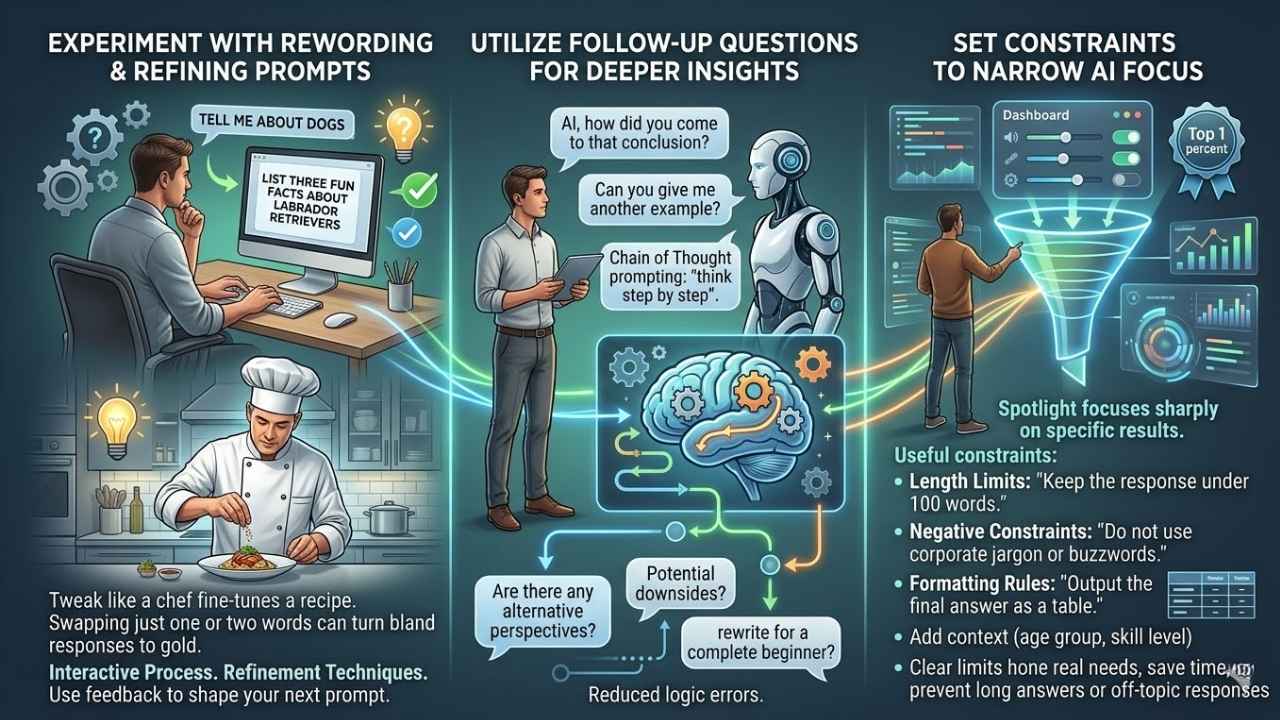
Sharpen your skills with these smart tricks, and get ready to discover how much more you can do with the right prompt.
Experiment with rewording and refining prompts
Tweak your prompts like a chef fine-tunes a recipe. Swapping just one or two words can turn bland responses into gold. Try asking the same question in different ways, using clear and specific language each time.
Prompt Optimization works best as an interactive process. Instead of searching for the perfect magic phrase on the first try, use feedback from each response to shape your next prompt. This approach mirrors how conversational AI learns through Refinement Techniques and query optimization.
For example, instead of “Tell me about dogs,” you could say, “List three fun facts about Labrador Retrievers.” That extra detail gives Artificial Intelligence something juicy to chew on. The more you experiment with Task Breakdown and interactive queries, the better your results become. Sometimes all it takes is one small tweak for things to click.
Utilize follow-up questions for deeper insights
Follow-up questions help you dig under the surface of an AI’s first reply. Ask, “How did you come to that conclusion?” or “Can you give me another example?” and watch as the AI reveals more details.
A highly effective follow-up method is called Chain of Thought prompting. You simply ask the AI to “think step by step” before giving its final answer. This forces the model to show its work, which drastically reduces logic errors. Here are a few great follow-up questions to try:
- Are there any alternative perspectives to this answer?
- What are the potential downsides to this approach?
- Can you rewrite that explanation for a complete beginner?
Interactive queries keep your conversation with AI lively and useful. Use follow-ups to clarify confusing points or expand on a response. This can help break complex tasks into smaller steps for clear answers or spark creative ideas that would not appear from a single query.
Set constraints to narrow AI focus
Give the AI clear limits, and watch your results get sharper. If you ask for a summary in exactly 50 words or request a list with no more than five bullet points, the AI hones in on your real needs.
This technique saves time by preventing long-winded answers or off-topic responses. The top 1 percent of users rely on strict constraints to control the AI. Here are the most useful constraints to apply:
- Length Limits: “Keep the response under 100 words.”
- Negative Constraints: “Do not use corporate jargon or buzzwords.”
- Formatting Rules: “Output the final answer as atable.”
Add context, such as an age group or skill level, to focus on what matters most. With just a bit of structure and guidance, interactive queries become much more effective and efficient for everyone involved.
Limitations of AI Prompting
AI can slip up, make odd mistakes, or show bias without warning. Sometimes it just misses the mark, which makes double-checking each answer a smart habit.
Be aware of AI’s flaws and biases
AI gives fast answers, but it does make mistakes. Sometimes you will see errors or even odd advice because the technology learns from lots of data, some of which is messy or biased.
According to the 2026 AI Hallucination Leaderboards, leading models still struggle with factual accuracy in highly specialized fields like law and medicine. While simple summarization tasks have error rates around 1 percent, asking an AI to perform complex, unguided reasoning can lead to failure rates of up to 30 percent.
Prompt engineering experts have found that even the best users still face these issues. Bias in machine learning creeps in when there are gaps or patterns in old data sets. Always double check tricky topics and be careful with sensitive questions. Even creative prompts can lead to weird responses, just like playing telephone with a robot who never sleeps.
Understand the potential risks of inaccurate outputs
Inaccurate outputs from Artificial Intelligence can trip you up fast. A single wrong detail in an AI response might lead to bad decisions or wasted time, especially if the prompt is too vague or lacks context.
The business impact of these errors is very real. A recent 2025 Deloitte enterprise survey found that 47 percent of enterprise AI users admitted to making at least one major business decision based on hallucinated or incorrect AI content.
“Relying on unchecked errors can spread misinformation, skew your work results, and damage your professional reputation.”
Even skilled users experience surprises because machines still miss subtle details and carry hidden biases from their training data. Crafting prompts with precise language and setting clear constraints shrinks these risks. It brings more value and fewer headaches as you explore prompting techniques for better user interaction and reliable outputs.
Final Thoughts
Mastering AI prompts is simpler than it seems, and the right prompt can make a significant difference. Clear instructions, relevant context, and straightforward language consistently produce better results from any artificial intelligence tool.
Techniques such as role-playing, emotion cues, and few-shot learning help refine responses quickly with minimal effort. Small adjustments can lead to noticeable improvements in output quality, making interactions with AI more efficient and effective.
For those looking to explore further, many online resources provide step-by-step guidance and practical examples. Trying a new approach—such as applying the most useful AI prompting techniques not commonly used—can lead to surprisingly creative and accurate results, even for everyday tasks like generating new meal ideas.