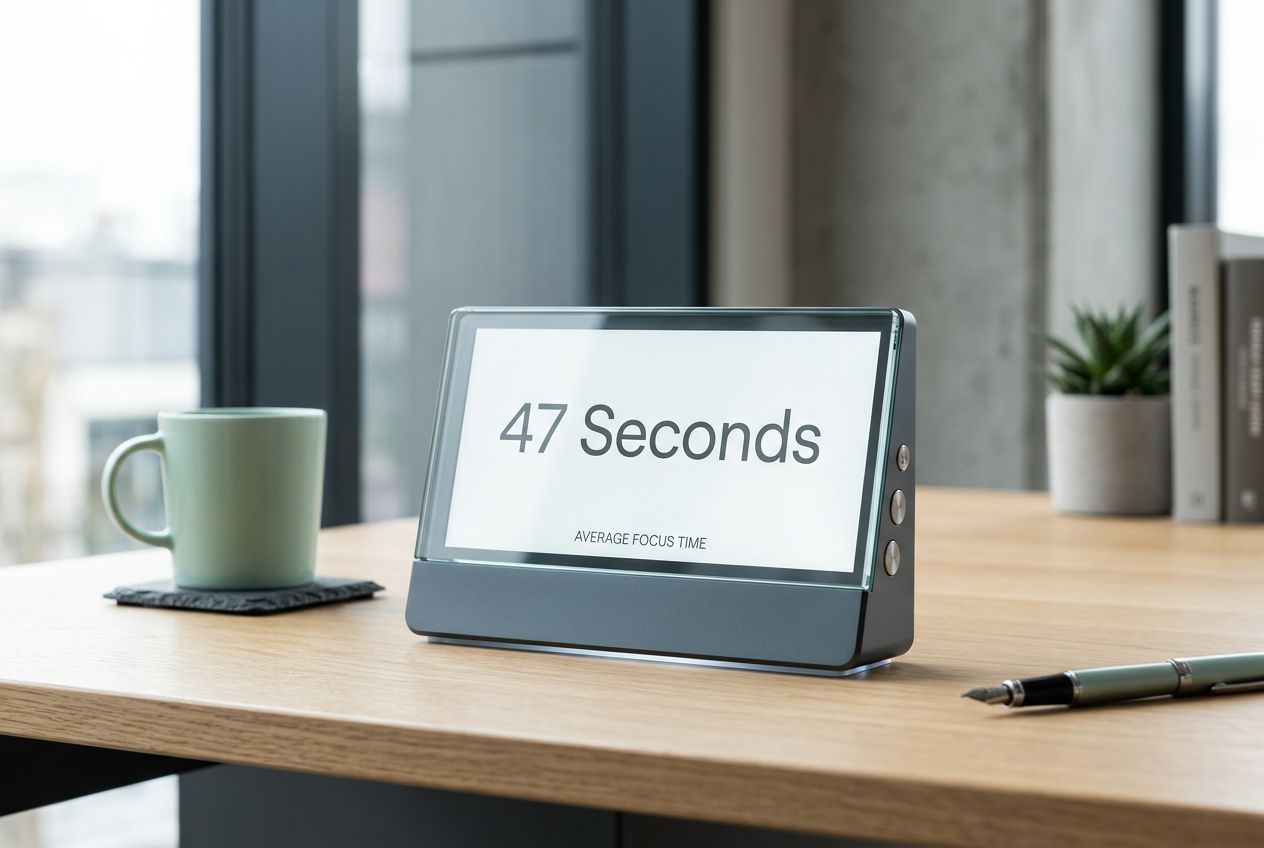
Do you ever feel like your mind is a web browser with a hundred tabs open? You sit down to work, but within minutes, you’re checking your phone or scrolling through emails. You are not alone in this struggle. Research from the University of California, Irvine, reveals a startling fact. The average person now focuses on a screen for just 47 seconds before switching to something else. It is no wonder we feel exhausted and scattered.
“Monk Mode” is catching attention as a powerful way to fix this modern problem. The idea takes inspiration from the disciplined lives of monks. It focuses on simplicity, deep work, and cutting out the noise.
I am going to walk you through exactly what Monk Mode is and how it works. We will look at the real science behind it and simple ways you can try it yourself. If you want to reach your goals faster, this might be the strategy you need. Let’s explore how it works.
What is Monk Mode?
Monk Mode is a period of heightened focus where you commit to a specific goal and eliminate distractions. Think of it as putting on blinders. You block out the chaos so you can sprint toward what matters most.
Definition and origins
The term borrows from the lifestyle of actual monks who live in seclusion to focus on spiritual growth. In the modern productivity world, it has evolved into a specific protocol for getting things done.
While the concept has existed in tech circles for years, it recently went viral thanks to influencers like Iman Gadzhi. He popularized a specific “Monk Mode Protocol” that many people now follow.
His version includes three non-negotiable daily rules. You must meditate for 10 minutes, exercise for 30 minutes, and avoid alcohol or drugs completely. This structure turns a vague idea into a clear, actionable challenge.
Philosophy behind Monk Mode
The core philosophy is that modern life is too noisy. We are constantly bombarded by notifications, news, and entertainment. This constant input destroys our ability to think deeply.
Monk Mode is about reclaiming your attention. It is not just about working harder. It is about removing the friction that stops you from working well.
Aristotle famously said:
We are what we repeatedly do.
This approach applies that wisdom by forcing you to practice focus every single day. It operates on the belief that if you can control your inputs, you can master your outputs.
The Core Principles of Monk Mode
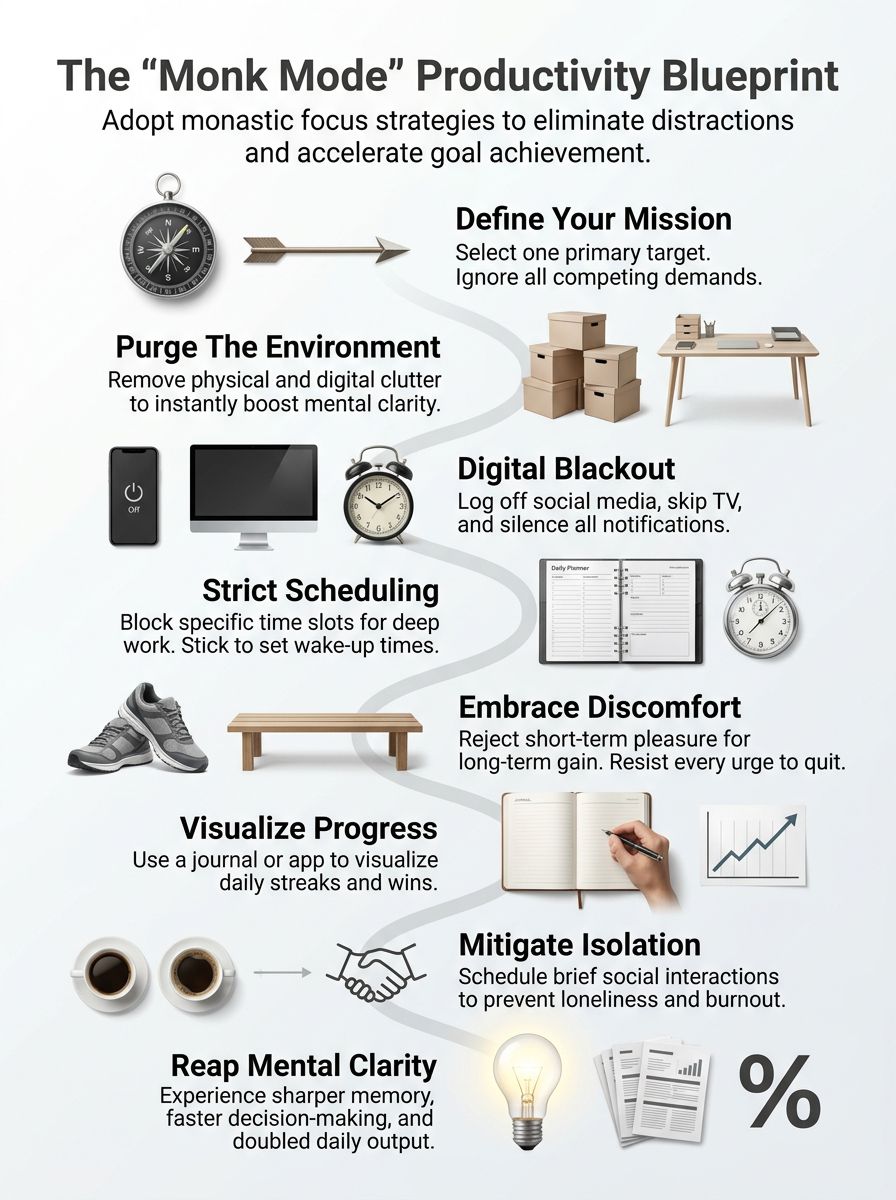
Monk Mode works because it is strict. It does not rely on willpower alone. It relies on a system of rules that keep you on track when motivation fades.
Elimination of distractions
Distractions are expensive. A study by Gloria Mark found that once you are interrupted, it takes an average of 23 minutes and 15 seconds to get back to your original task. That means a simple text message can cost you nearly half an hour of flow.

To fight this, Monk Mode practitioners use aggressive methods. Many use apps like Opal or Freedom to completely block social media during work hours. These tools make it impossible to “doomscroll” even if you want to.
Tim Ferriss often talks about the value of creating a “void” where work can happen. By physically removing your phone or unplugging your router, you create an environment where focus is the only option.
Intense focus on a single goal
Multitasking is a myth. The most successful people pick one major target and pour all their energy into it. This is often called “Deep Work,” a term coined by professor Cal Newport.
In Monk Mode, you might choose to write a book, launch a business, or learn to code. You do not try to do all three at once. You give that one goal your best hours every day.
Current data shows that the average knowledge worker gets only 2 to 3 hours of deep focus per day. If you can increase that to four or five hours, you will effectively double your productivity compared to your peers.
Commitment to self-discipline
The hardest part of this lifestyle is saying no. You have to say no to Friday night drinks, weekend trips, or binge-watching a new series if it interferes with your protocol.
There is a common belief that it takes 21 days to form a habit. However, a landmark 2009 study by Phillippa Lally at University College London found the average is actually 66 days. Monk Mode is often done in cycles of 30 to 90 days for this reason.
It pushes you past the initial excitement and into the phase where discipline becomes a permanent part of your character.
Benefits of Practicing Monk Mode
Why would anyone sacrifice their social life and comfort? The answer lies in the results. People who stick to this protocol often achieve in three months what takes others a year.
Enhanced productivity
When you stop context-switching, your brain becomes efficient. Context switching is the act of jumping between tasks, and it is a productivity killer. By focusing on one thing, you enter a “flow state” much faster.
Imagine your brain is a computer. Closing all the background apps makes the active program run smoother and faster. You make fewer mistakes and finish complex tasks with ease.
Reports from 2025 suggest that developers and creatives lose up to two hours daily just recovering from distractions. Reclaiming that time adds up to massive gains over a few weeks.
Improved mental clarity
Many users report a “Dopamine Detox” effect. When you stop flooding your brain with short videos and sugar, your mind quiets down. You stop craving constant stimulation.
This clarity helps you make better decisions. You might find that you sleep better and feel less anxious. The mental fog that comes from staring at screens all day begins to lift.
Development of self-discipline
Jocko Willink, a retired Navy SEAL, often says that discipline equals freedom. Monk Mode is a crash course in building that discipline.
Every time you resist the urge to check Instagram, you strengthen your willpower. This strength spills over into other areas of your life. You might find it easier to stick to a diet or save money because you have trained yourself to delay gratification.
Common Rules of Monk Mode
While you can customize your approach, most protocols share a few standard rules. These act as the foundation for your success.
This is the big one. Most people spend hours every day consuming content that does not help them. In Monk Mode, you cut this out.
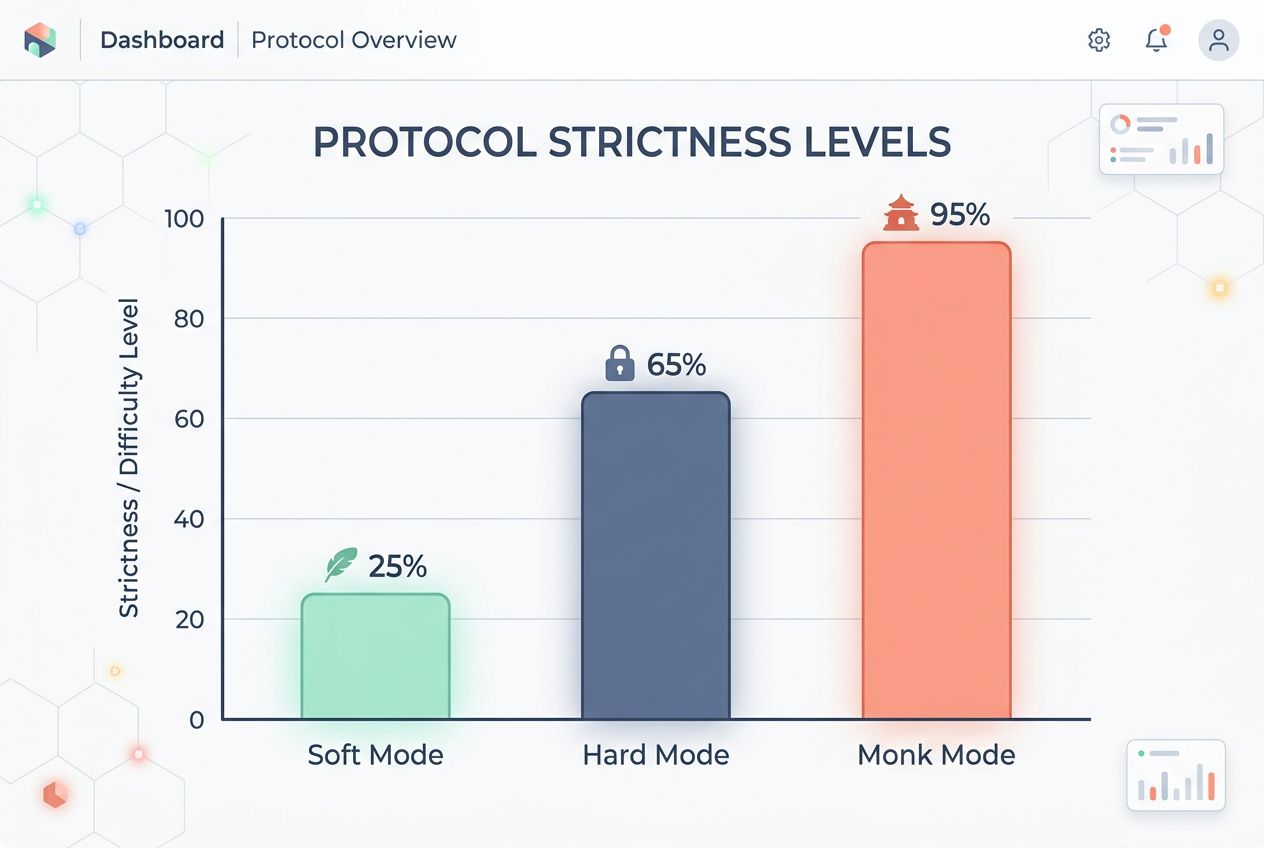
You can define how strict you want to be using a tiered system:
| Level | Rules | Best For |
|---|---|---|
| Soft Mode | Limit social media to 30 mins/day. No phone in the bedroom. | Beginners or parents. |
| Hard Mode | Zero social media. No Netflix/TV. Phone off during work. | Short sprints (1-2 weeks). |
| Monk Mode | Strict protocol. Daily meditation & exercise. No alcohol. | Deep transformation (30+ days). |
Setting clear daily goals
You cannot hit a target you cannot see. Each night, write down your top three objectives for the next day. This prevents you from waking up and wasting time wondering what to do.
Keep these goals “SMART”—Specific, Measurable, Achievable, Relevant, and Time-bound. Instead of “work on project,” write “complete the first draft of chapter two.”
Maintaining a structured schedule
Structure creates freedom. By planning your day in blocks, you ensure that your deep work happens when you have the most energy. For many people, this is early in the morning.
A popular method is the “90/20 rule.” Work with intense focus for 90 minutes, then take a 20-minute break to stretch or walk. This aligns with your body’s natural energy cycles, known as ultradian rhythms.
Steps to Implement Monk Mode
Ready to try it? You do not need to move to a mountain top. You can start right where you are with a few simple changes.
Preparing your environment
Your environment dictates your behavior. If your phone is on your desk, you will check it. A simple trick is the “Phone Foyer Method.” When you walk in the door, plug your phone into a charger in the entryway and leave it there.
Clean your workspace. Remove any papers or knick-knacks that are not related to your current task. A visual void helps create a mental void.
Establishing a routine
Start your day with a win. Many proponents follow the “5 AM Club” concept, using the quiet early morning hours for their most important work. Even if you wake up later, the principle remains the same.
Stack your habits. For example, immediately after you brush your teeth, sit down to meditate. Immediately after you finish work, go for your exercise. Connecting habits makes them easier to stick to.
Tracking progress and staying accountable
You need to see your progress to stay motivated. Use a physical calendar and mark an “X” on every day you successfully complete your protocol. This is famously known as the “Seinfeld Strategy.”
Apps like Habitica can gamify this process, treating your life like a role-playing game. Alternatively, use Forest to grow a virtual tree for every hour you stay focused.
Challenges of Monk Mode
It is not all smooth sailing. This level of discipline comes with real downsides that you should be prepared for.
Humans are social creatures. The US Surgeon General recently declared loneliness an epidemic, and Monk Mode can make this worse if you are not careful.
You might feel left out when friends go to happy hour, and you stay home. It is important to communicate your goals to your loved ones so they understand you are not ignoring them, just focusing for a short time.
Balancing intensity with sustainability
Burnout is a real risk. If you try to go from zero to 100, you might crash. This is similar to the criticism of the “75 Hard” fitness challenge.
Listen to your body. If you feel your performance dropping, it is okay to adjust your rules. The goal is long-term growth, not a short-term nervous breakdown.
Is Monk Mode Suitable for Everyone?
This strict approach is a tool, and like any tool, it is not right for every job or every person.
Situations where it may or may not be effective
Monk Mode is perfect for students studying for finals, entrepreneurs launching a product, or writers finishing a manuscript. It works best when you have a clear deadline.
It is likely not suitable for parents with newborns, doctors on call, or people in roles that require constant collaboration. If your job depends on being available, disappearing for four hours at a time might get you fired.
Adapting the approach to individual needs
You do not have to be a purist. You can try “Monk Mode Weekends,” where you focus strictly on Saturday and Sunday but relax during the week.
You can also use software to block distractions only during specific hours. The key is to find the level of friction that helps you focus without breaking your life.
Wrapping Up
Monk Mode opens the door to a new level of performance. It proves that you can control your attention in a world designed to steal it. By cutting out the noise, you make room for the work that actually matters.
You might feel a bit lonely or bored at first, but those feelings are often just withdrawal from constant stimulation. On the other side of that boredom is creativity and progress.
Start small. Try a “Soft Mode” for one week and see how much more you get done. You might be surprised at how much potential you have been hiding behind a wall of distractions.