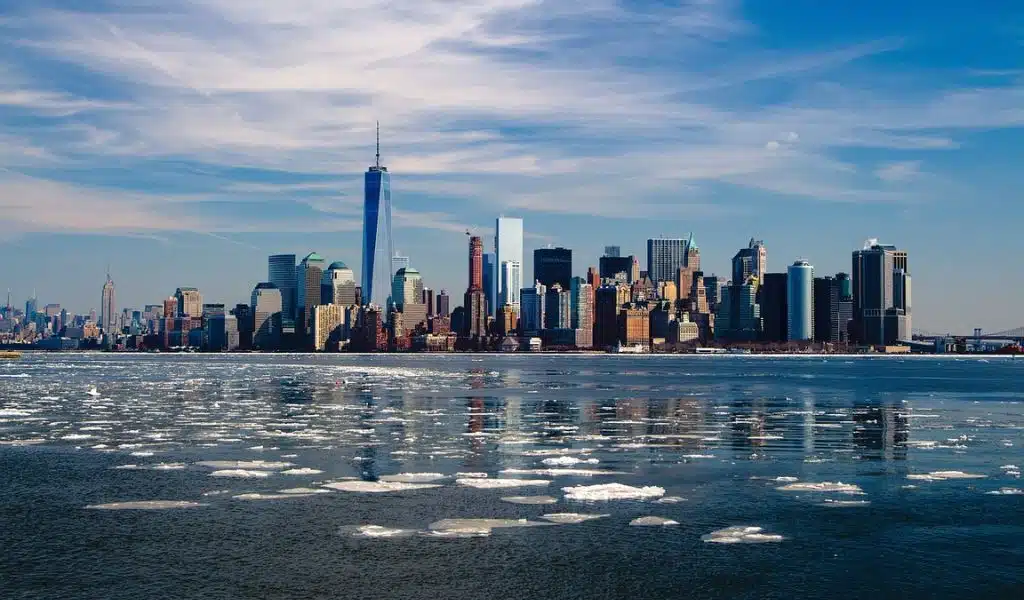
A new study shows that all of the buildings in New York City are making the city sink.
This slow change could be bad for a city where the sea level has been rising more than twice as fast as the world rate and is expected to rise between 8 and 30 inches by 2050.
Scientists also think that the climate crisis caused by humans will cause rainstorms like nor’easters and hurricanes to happen more often and with more force.
Tom Parsons, a research geophysicist at the US Geological Survey and the lead author of the study, said, “It will be a long time before the ocean just moves in.” “But we’ve had a couple of big hurricanes, Sandy and Ida, that brought a lot of rain to New York. The rain flooded the city, and some of the effects of urbanization have made it easier for water to get in.”
The paper, which was released in the journal Earth’s Future, tries to show how high-rise buildings near the coast, a river, or a lake could increase the risk of flooding in the future and that steps should be taken to lessen the effects that could be dangerous.
Sinking City Risks — and a Mystery
The researchers figured out how much the 1,084,954 buildings in New York City’s five boroughs weighed at the time. They found that the buildings weighed about 1.68 trillion pounds (762 billion kilos), which is about the same as 1.9 million fully loaded Boeing 747-400s.
The study team then used models to figure out what effects this weight would have on the ground. They compared these results to satellite data that showed the real geology of the surface. The rate at which the city is sinking was shown by that study: “On average, it sinks between 1 and 2 millimeters a year, but in some places it sinks as much as 4.5 millimeters a year,” Parsons said.
Subsidence is the technical term for the sinking or settling of the Earth’s surface due to natural or man-made reasons. A study done in September 2022 found that parts of 44 of the 48 most populated coastal towns are sinking faster than the sea level is rising. This new study takes a different method by looking at how the weight of New York City’s buildings affects the sinking of the land underneath them.
But the sinking isn’t all caused by the houses. Parsons said, “We could see a connection where there is construction on very soft soils and man-made fill.” “In other places, we see things sinking that are hard to explain. And there are many different reasons for it, like the postglacial relaxation that happened after the last ice age or the pumping of groundwater.”
According to the study, some parts of lower Manhattan, Brooklyn, and Queens are sinking at a faster rate than normal.
Parsons said, “Some of that seems to match up with building projects that are going on.” “But the north end of Staten Island is sinking, and I haven’t been able to figure out why. I’ve looked into all kinds of things, but it’s still a mystery.”
Mitigating Risk Around Sinking Cities
The study shows that subsidence can cause flooding even sooner than sea level rise, and not just in New York City. “It’s a world problem. My coauthors from the University of Rhode Island looked at 99 cities around the world, both coastal and inland. “The vast majority of them have subsidence problems,” Parsons said, giving the example of Jakarta, which is sinking so quickly that the Indonesian government is planning to build a new capital city somewhere else.
Scientist Sophie Coulson, a postdoctoral fellow at Los Alamos National Laboratory who was not involved in the study, said, “We know that sea levels are rising and shorelines are changing, and it is very important to understand how human activities, like releasing greenhouse gases, affect our warming world.” “This study looks at the effect of urban building loads on coastal land subsidence, which is an important human factor that has only recently come to light.”
She said that the authors employ a clever combination of computer models, satellite measurements, and GPS data to determine which areas of the city are most vulnerable and how quickly different parts of it will sink over the short and long term.
She stated that “New York City is one of the most densely populated coastal areas in the world, and a lot of its important infrastructure is built in low-lying coastal areas.”
“In order to prepare for future sea level rise, it is crucial to understand how and why the landscape is changing and where flooding is most likely to occur.”