
Microsoft made an unexpected announcement today, revealing a fresh new appearance for its Copilot AI search and chatbot experience on the web (previously called Bing Chat). Additionally, they introduced integrated AI image creation and editing features, along with a new AI model called Deucalion, which is responsible for powering a specific version of Copilot.
Furthermore, the software and cloud giant based in Redmond, Washington, has revealed a fresh video ad set to be broadcasted during the upcoming NFL Super Bowl, the ultimate pro football championship game featuring the Kansas City Chiefs and the San Francisco Giants teams.
The redesign of Microsoft’s Copilot landing page on the web focuses on creating a cleaner look with increased white space and reduced text. Additionally, the update introduces a visual carousel of “cards” showcasing various AI-generated images as examples of what users can create. The carousel also includes samples of the instructions or prompts that users can input to generate these images.
Presenting side-by-side images of the previous Bing Chat and the recently revamped Microsoft Copilot design for your convenient comparison:
The NYC AI Impact Tour
We are excited to announce that we will be in New York on February 29, collaborating with Microsoft to explore the delicate balance between the risks and rewards of AI applications. Please kindly request an invite to the highly exclusive event mentioned below.
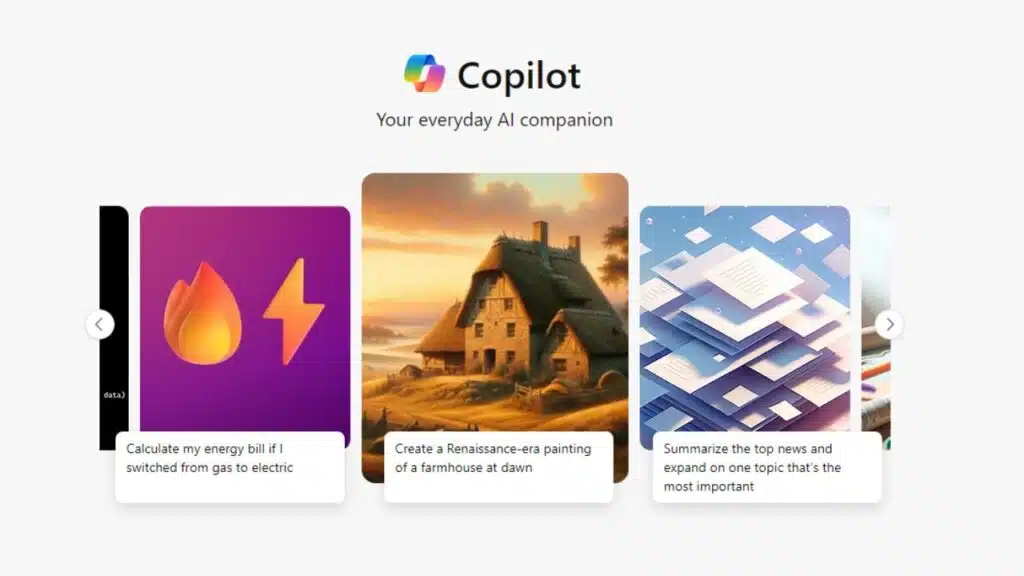
The new Copilot is now accessible to all users through the website copilot.microsoft.com and our Copilot app on iOS and Android app stores. However, please note that the AI image generation features are currently limited to English-speaking users in the United States, United Kingdom, Australia, India, and New Zealand.
A savvy pro-AI Super Bowl ad
The Super Bowl is undoubtedly one of the most highly anticipated and watched sporting events globally, attracting millions of viewers in the United States and beyond. The cost of airing advertisements during this event is exorbitant, with prices starting in the multi-million dollar range, even for a brief 30-second spot.
It’s worth noting that the cost for Microsoft is relatively small considering its current position as one of the most valuable companies in the world. This demonstrates the company’s commitment to strengthening the Copilot name and its association with generative AI. Microsoft is determined to convince everyday users to choose Copilot over competitors like Google for their web searches.
However, the ad takes it a step further. When you watch it (embedded above), you’ll notice how it efficiently demonstrates people using it to create storyboard images for movie scenes and code for a 3D open-world game.
It is evident from Microsoft’s message that Copilot has a wide range of capabilities beyond mere search functionality. It has the ability to generate content and even develop software on your behalf.
Focusing on film/TV, video game, and entertainment content despite pushback and deepfake scandals
It is worth mentioning the focus on the entertainment industry, which is currently witnessing a significant number of actors, writers, performers, musicians, VFX artists, and game makers voicing their concerns and advocating for increased safeguards against the potential threat of AI replacing their job prospects. Microsoft’s advertisement effectively addresses these concerns, presenting Copilot and AI as valuable creative tools for aspiring individuals.
Additionally, Microsoft is introducing fresh AI image generation and editing features to Copilot. These capabilities are powered by its Designer AI art generator, similar to how OpenAI’s DALL-E 3 image generation AI model is integrated into ChatGPT.
Designer AI is powered by DALL-E 3, thanks to the significant investment and support from Microsoft for OpenAI. According to a news release from Microsoft, written by Yusuf Mehdi, the executive vice president and consumer marketing chief:
With Designer in Copilot, you have the ability to do more than just create images. Now, you can easily customize your generated images with inline editing directly within Copilot. This feature allows you to stay in the flow of your chat without any interruptions. If you’re looking to make your images stand out, Copilot has got you covered. Whether you want to enhance the colors to make an object pop, blur the background to make your subject shine, or even experiment with different effects like pixel art, Copilot offers all these features for free. If you are a Copilot Pro subscriber, you now have the added convenience of resizing and regenerating images between square and landscape formats without having to leave the chat. Finally, we are excited to announce the upcoming release of our new designer GPT within Copilot. This innovative feature provides a dedicated canvas within Copilot that allows you to bring your ideas to life visually.
Microsoft continues to advance its AI image generation capabilities, aiming to enhance accessibility for users on mobile and desktop. This effort persists despite the recent scandal involving explicit and nonconsensual AI-generated deepfakes of musician Taylor Swift. These deepfakes, which circulated on social platforms and the web, were allegedly created using Microsoft’s Designer AI generator. Furthermore, there were additional local deepfake scandals reported in at least one U.S. high school.
The company appears to show little concern regarding the criticisms of AI misuse, as well as the ongoing lawsuit and federal investigation it is currently facing from multiple parties regarding its use of AI and partnership with OpenAI.
Deucalion is a New AI
Hidden within today’s announcements, without any explicit mention in the release, lies the revelation that Microsoft has incorporated a new AI model, Deucalion, into one version of Copilot.
In a recent post on X (formerly Twitter), Jordi Ribas, Microsoft Corporate Vice President and Head of Engineering for Copilot and Bing, announced the release of Deucalion. This new model has been carefully optimized to enhance the balanced mode, making it even more robust and efficient.
Today marks exactly one year since we introduced @Bing Chat. We’re excited to celebrate this milestone by sharing an early look at our Super Bowl ad. https://t.co/GdvaykgTk0
— Jordi Ribas (@JordiRib1) February 7, 2024
The “balanced” mode represents the intermediate category of results that Copilot is capable of generating. When using Copilot (and previously, Bing Chat), users have the option to choose between three modes: “creative,” “balanced,” or “precise.” These modes determine the amount of AI-generated output provided by the assistant. The more creative the mode, the more the assistant may generate its own output, which could potentially lead to more imaginative responses.
On the other hand, the “creative” mode is better suited for individuals who are looking for assistance with creative and open-ended projects like fictional worldbuilding, writing, and designing, rather than specific facts.
If you’re conducting research for school or work, you might find the “precise” and “balanced” modes to be more suitable. Indeed, “Balanced,” as the name suggests, aims to strike a harmonious balance by offering a combination of creative and precise/factual responses for users.
Now, one might wonder about the origins of the deucalion. Bing Chat was powered by OpenAI’s GPT-4, which is the same model that powers ChatGPT Plus, Team, and Enterprise. It’s logical to assume that the GPT-4 and GPT-4 Turbo/V are also used to power Copilot.
So, is Deucalion built on GPT-4 or perhaps Microsoft’s Phi-2? Based on Ribas’ statement about it being a “fine-tuned model,” it seems likely that Microsoft engineers have made additional adjustments to a version of GPT-4 to suit their specific needs. According to the documentation, OpenAI does indeed provide support for fine-tuning GPT 4.
Information about Deucalion is currently limited, but last week, Mikhail Parakhin, Microsoft’s CEO of Advertising and Web Services, shared on X that the company is currently testing it. He also mentioned that Deucalion is named after the son of Prometheus in Greek mythology.
We are continually improving Microsoft Copilot, testing a new version of the base model in a flight. Fun fact: its internal name is “Deucalion” (the son of Prometheus in Greek mythology). https://t.co/QdXfaUn6p1
— Mikhail Parakhin (@MParakhin) February 2, 2024
In Mikhail’s X post/tweet, it was a response to Vitor de Lucca, a third-party Windows developer and tech influencer. Vitor noticed that the answers provided in Copilot’s balanced mode were more comprehensive and improved.
Copilot Creative vs Precise vs Old Balanced vs New Deucalion Balanced pic.twitter.com/3mTfrlKLdi
— Vitor de Lucca 🏳️🌈 (@vitor_dlucca) February 5, 2024
Another example of Copilot’s Deucalion model flight, with flights 🙂 pic.twitter.com/5Kc3grEP8T
— Vitor de Lucca 🏳️🌈 (@vitor_dlucca) February 4, 2024
de Lucca shared on X that the translation capabilities of the new Deucalion-powered Balanced mode were found to be superior to the Creative mode.
The new Bing Deucalion on Balanced is also better for translations than creative lol
— Vitor de Lucca 🏳️🌈 (@vitor_dlucca) February 6, 2024