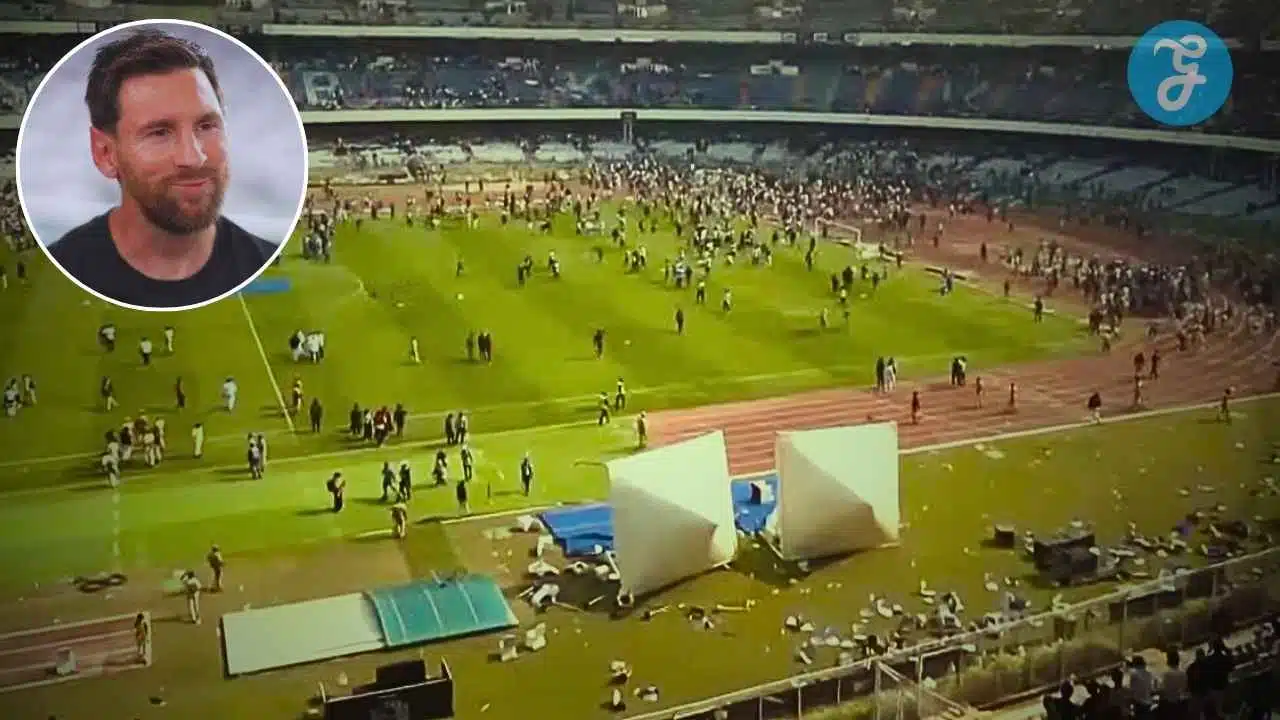
Kolkata, often called the “City of Joy,” lived up to its nickname in anticipation but descended into frustration on Saturday when a massive crowd at Salt Lake Stadium—Asia’s largest football venue with over 85,000 seats—erupted in anger. Thousands of passionate fans had shelled out hefty ticket prices, ranging from ₹2,000 for basic entry to as high as ₹12,000 for premium spots, all hoping for an unforgettable glimpse of Argentine soccer icon Lionel Messi during his rare India promotional tour.
What started as a dream event quickly spiraled into disorder, marked by protests, vandalism, security breaches, and heavy police intervention, leaving many questioning the planning behind one of the most hyped sports spectacles in recent Indian history. The World Cup-winning captain, fresh off his 2022 Qatar triumph and global stardom with Inter Miami, arrived at the Vivekananda Yuba Bharati Krirangan (commonly known as Salt Lake Stadium) around 11:30 a.m. Accompanying him were his longtime strike partner Luis Suárez and fellow Argentina teammate Rodrigo De Paul, turning the visit into a mini-reunion of football royalty.This marked Messi’s first return to the iconic venue since 2011, when he had dazzled in an exhibition match, fueling years of fan nostalgia and sky-high expectations for this 2025 India tour stop. Promoters had billed it as a grand celebration, complete with promises of interactive moments, a full stadium lap by the players, and even celebrity cameos to blend football fervor with Bollywood glamour.
What Went Wrong During Messi’s Brief Appearance?
As Messi’s convoy pulled up near the touchline, excitement peaked with thunderous “Messi, Messi” chants echoing through the packed stands. He stepped onto the lush green pitch, smiling and waving briefly to the sea of blue-and-white Argentine flags and Inter Miami jerseys waving frantically from the terraces. But almost instantly, a thick wall formed around him: a mix of VIP guests, event organizers, local celebrities, politicians, and a heavy security detail that seemed more like a human fortress than a welcome party. Messi managed only a short walk along the sideline—far short of the promised full lap that would have let fans in every section cheer him up close—before turning back toward the tunnel, exiting well ahead of the scheduled time slot.
From the upper tiers and distant stands, visibility was a nightmare. The giant LED screens, meant to beam close-ups across the stadium, malfunctioned or focused awkwardly on the entourage rather than the star, frustrating families who had traveled hours or taken days off work. Children in Messi kits cried out in disappointment, while adults grumbled about the irony of paying premium prices only to strain for a blurry silhouette. The air thickened with boos as realization set in: this wasn’t the accessible hero worship they had been sold. Instead of mingling or even kicking a ball around as teased in pre-event hype, Messi remained cordoned off, his appearance clocking in at mere minutes.
Discontent boiled over rapidly. Fans began hurling water bottles, plastic chairs, and debris onto the pitch, ripping down sponsor banners and hoardings that lined the field. Fibreglass seats cracked under furious kicks, and groups surged against barricades, with some successfully breaching them to spill onto the grass. The once-electric atmosphere turned anarchic, evoking memories of past crowd troubles at Indian stadiums like the 1989 Hillsborough parallels in scale, though contained quicker here. Overwhelmed stewards called in riot police, who resorted to baton charges and lathi sticks to push back the crowds, dispersing intruders and restoring order after nearly an hour of turmoil. The ugly scenes not only marred Messi’s visit but cast a shadow over Kolkata’s reputation as a football-mad city, home to storied clubs like Mohun Bagan and East Bengal.
Fans Lash Out at VIPs, Organizers, and Broken Promises
The backlash hit hard from ordinary ticket-holders who felt robbed. Parents shared heartbreaking stories of kids’ shattered dreams—one father recounted how his young son, decked out in a Messi jersey bought specially for the day, sobbed after waiting hours in the December heat only to see a distant huddle. “We are very disappointed… It feels like a total scam for the people,” another fan vented, echoing sentiments captured in on-site interviews. High-rollers were equally incensed: one man who dropped ₹12,000 on a “VIP” ticket lamented not catching even a clear glimpse of Messi’s face, watching helplessly as ministers, politicians, and film stars monopolized the space around him.
Adding fuel was the no-show of Bollywood king Shah Rukh Khan, whose rumored attendance had been a massive draw in promotional posters and social media teasers, blending soccer fandom with cinematic allure. Critics accused organizers of overpromising to boost sales—tickets flew off shelves within hours of going live—while underdelivering on logistics like crowd flow, screen tech, and player access. Whispers of political favoritism swirled, with claims that local leaders turned the event into a photo-op, prioritizing selfies over fan experience. Calls for full refunds grew louder, with online petitions and social media storms demanding accountability from the private organizers tied to the tour promoters. This fiasco highlights recurring issues in India’s mega-events, where hype often outpaces infrastructure, from IPL matches to international concerts.
Political Firestorm: CM Banerjee Apologizes, BJP Points Fingers
West Bengal Chief Minister Mamata Banerjee, a vocal football enthusiast and former club president herself, was en route to the stadium with her entourage when chaos unfolded. Deeply shaken, she took to X (formerly Twitter) to express her horror: “I am deeply disturbed and shocked by the mismanagement witnessed today at Salt Lake Stadium.” She extended a heartfelt apology to the “thousands of sports lovers and fans” who gathered in good faith, revealing her own intent to join the celebration. Banerjee swiftly pledged a high-level committee to probe every angle—what led to the lapses, who bears responsibility, from security firms to event planners—and recommend ironclad measures to safeguard future gatherings. Her response underscored the state’s commitment to sports as a unifier, amid ongoing debates over stadium upgrades and crowd safety protocols.
The opposition pounced quickly. BJP state president Sukanta Majumdar (earlier reports mentioned Samik Bhattacharya in initial reactions) slammed the incident as a damning indictment of TMC governance, accusing “fraudsters driven by greed” of exploiting Messi’s star power for profit. He alleged that ruling party leaders egged on organizers more interested in personal glory—snapping pictures with the GOAT—than ensuring fair access for paying fans. “This brings disrepute to Bengal,” he declared, framing it as part of a pattern of mismanaged spectacles under the current regime. The exchange ignited a familiar political slugfest in poll-bound West Bengal, where football rivalries often mirror deeper divides, potentially overshadowing Messi’s tour legs in Hyderabad and beyond.
In the end, what could have been a triumphant chapter in Messi’s global legacy—bridging South American flair with Indian passion—served as a cautionary tale. As cleanup crews swept debris from the pitch and fans vented online, questions linger: Will refunds come through? Can probes deliver real change? And how will this dent India’s appeal for future international stars?