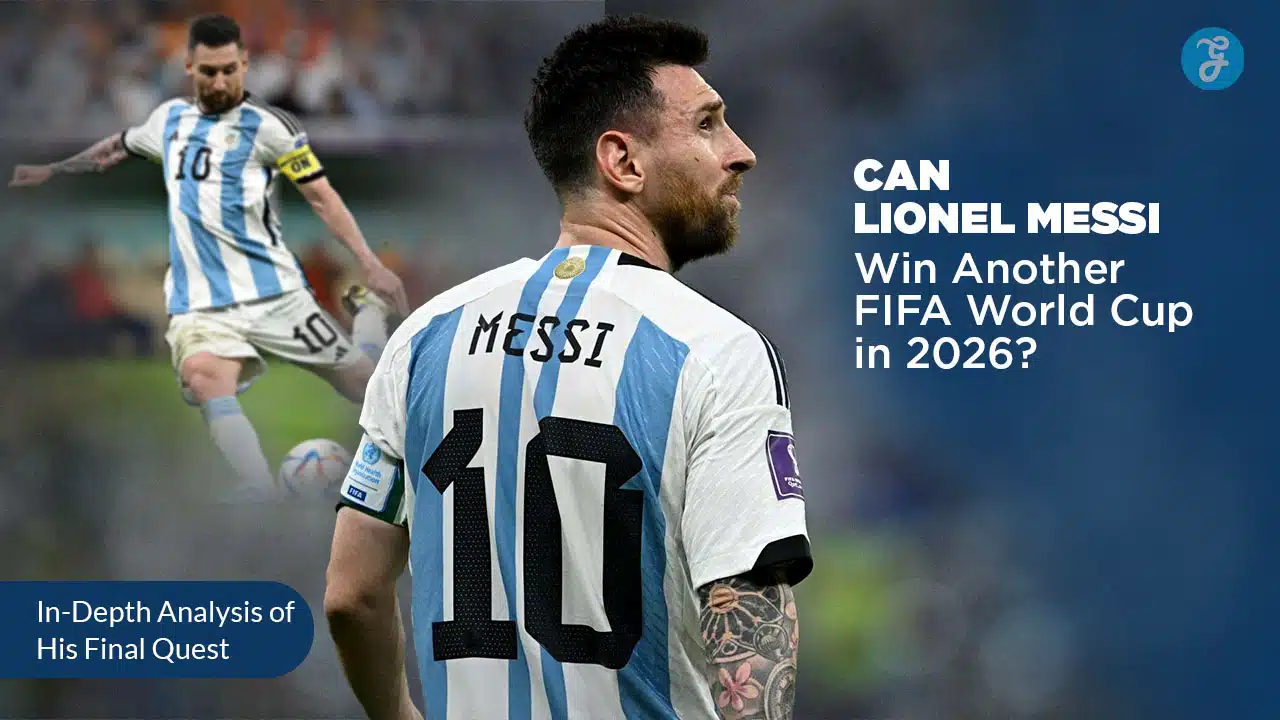
Diego Maradona dragged Argentina to the World Cup in 1986 and somehow hauled them back to the final in 1990, injured, kicked, and surrounded by a far more limited team—only to lose to West Germany.
Lionel Messi has already done the 1986 part in his own way with Qatar 2022. The question for 2026 is Maradona’s second act: At 39, with a stronger team around him than Maradona ever had, can Messi lead Argentina to another World Cup—and complete the perfect epilogue to his career?
Let’s unpack that with data, context and a bit of imagination.
Maradona 1986–1990 vs Messi 2022–2026: Two Parallel Arcs
Before talking predictions, it helps to see the symmetry.
World Cup finals: Maradona vs Messi
| Player | Finals Reached | Years | Age in Final(s) | Titles | Final Opponent(s) | Result Line |
| Diego Maradona | 2 | 1986 (Mexico), 1990 (Italy) | 25 & 29 | 1 | West Germany (both) | 3–2 win (1986), 0–1 loss (1990) |
| Lionel Messi | 2 (so far) | 2014 (Brazil), 2022 (Qatar) | 27 & 35 | 1 | Germany (2014), France (2022) | 0–1 AET loss (2014), 3–3 AET, win on pens (2022) |
Messi’s 2022 triumph in Qatar wasn’t just “Maradona 2.0.” It surpassed almost every statistical measure:
- 13 World Cup goals and 8 assists in 26 games, more than any other male player has ever combined in the tournament.
- Record 26 World Cup appearances, passing Lothar Matthäus and overtaking Maradona’s Argentina appearance record in the same tournament.
- 7 goals and 3 assists in 7 games at Qatar 2022, plus the Golden Ball as best player.
Maradona’s legend was built on a single, transcendent World Cup plus a heroic run to another final. Messi has already matched the narrative arc. The 2026 World Cup is about whether he can surpass it.
What Messi Did in Qatar 2022—And Why It Matters for 2026
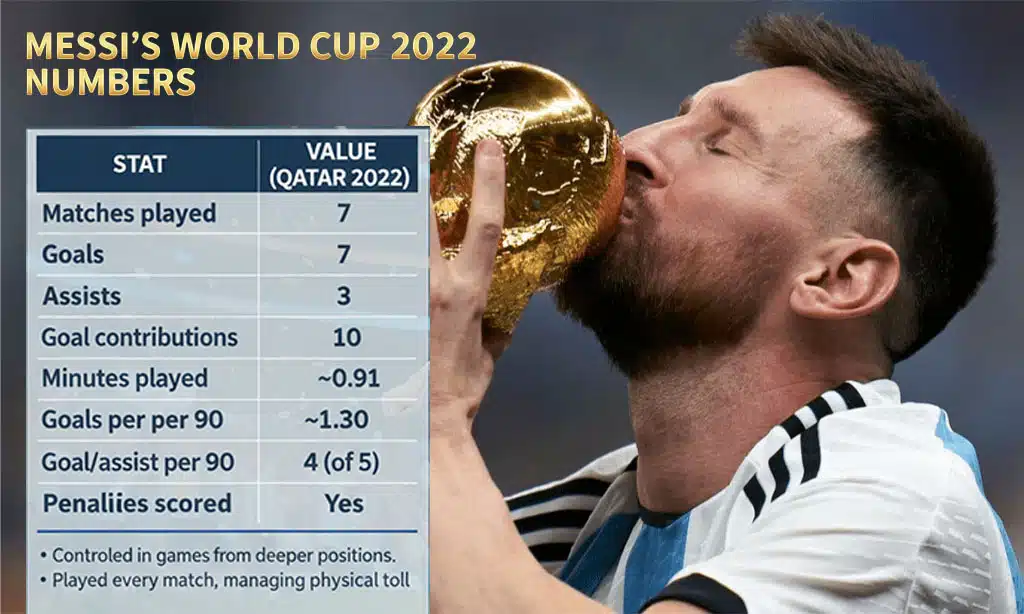
Messi’s 2022 World Cup isn’t just a trophy in his cabinet; it’s a tactical blueprint for how a slightly older genius can still dominate a month-long tournament.
Messi’s World Cup 2022 Numbers
From detailed World Cup tracking:
| Stat | Value (Qatar 2022) |
| Matches played | 7 |
| Goals | 7 |
| Assists | 3 |
| Goal contributions | 10 |
| Minutes played | 690 |
| Goals per 90 | ~0.91 |
| Goal/assist per 90 | ~1.30 |
| Penalties scored | 4 (of 5) |
| Golden Ball | Yes |
He:
- Scored in the group stage, round of 16, quarter-final, semi-final and final—every knockout round.
- Controlled games from deeper positions, more like a No. 10 than a classic winger.
- Played every match, showing he can manage the physical toll over a month if the team structure protects him.
2026 will not ask him to be the 2011 Barcelona Messi. It will ask him to be the 2022 Messi again—with older legs, but even more experience.
Messi & Argentina After 2022: A Team That Got Better, Not Worse
The big difference with Maradona’s story: after 1986, Argentina’s squad arguably declined and became more defensive and limited. Messi’s Argentina has gone the other way.
Copa América 2024: Back-to-Back Continental Kings
In July 2024, Argentina beat Colombia 1–0 after extra time at Hard Rock Stadium to win the Copa América again. Lautaro Martínez scored the winner; Messi limped off injured but the team carried him over the line.
Key takeaways:
- Argentina claimed a record 16th Copa América title, the most of any nation.
- Coach Lionel Scaloni won his fourth major trophy with the national team (Copa 2021, Finalissima, World Cup 2022, and Copa 2024).
- Even when Messi wasn’t fully fit, the team structure and depth (Martínez, Di María, Mac Allister, De Paul, Enzo Fernández, and Romero) carried the load.
This is crucial for 2026: Argentina is no longer a team dependent on Messi to function. He is a force multiplier, not a life-support machine.
Dominance in World Cup Qualifying
CONMEBOL qualification for 2026 has reinforced that point:
- Argentina finished top of the South American qualifying table, with 12 wins, 2 draws and 4 losses, scoring 31 and conceding just 10 (38 points from 18 games).
- They became the first South American team to mathematically qualify, helped by a 4–1 demolition of Brazil in March 2025—achieved without Messi or Lautaro Martínez on the pitch.
That 4–1 over Brazil matters symbolically. It tells us:
- The collective is strong enough to crush elite opposition even when the captain isn’t available.
- Younger leaders (Álvarez, Mac Allister, Enzo, and Cuti Romero) are comfortable stepping into the spotlight.
Messi’s International Numbers Since the World Cup
Messi has not retired. Far from it—he’s been selectively active:
- 115 goals in 196 appearances for Argentina, making him their all-time top scorer and the top male South American scorer ever.
- In 2025 alone: 3 goals and 3 assists in 5 internationals, including 2 goals in World Cup qualifiers.
Even with managed minutes and occasional absences, he’s still producing roughly a goal contribution per game for the national team.
The 2026 World Cup Environment: Expanded, Hot, and Unpredictable
Messi’s second title chase will not happen in a vacuum. The 2026 tournament is structurally very different from 1986 or 2022.
New Format, More Games
FIFA’s expanded 2026 format looks like this:
- 48 teams instead of 32.
- 12 groups of 4 (not 3 as originally floated).
- Top 2 from each group + 8 best third-placed teams → 32-team knockout bracket.
- 104 matches overall, up from 64.
For a team that goes all the way, that can mean:
| Stage | 2022 (32-team) | 2026 (48-team) |
| Group matches | 3 | 3 |
| Knockout matches | 4 | 4 |
| Total if champions | 7 | 7 |
The number of games for a champion is the same, but:
- The field is deeper and more chaotic.
- More third-placed qualifiers mean some weaker teams can sneak into knockouts—but also clutter the path.
Geography, Heat and Travel
The 2026 World Cup is spread across the USA, Canada and Mexico.
- Long travel distances between venues.
- Matches in potential extreme summer heat in parts of the U.S. and Mexico, even with some climate-controlled stadiums.
- Training loads and recovery will be a major factor—especially for older players.
For a 39-year-old Messi, load management will be everything. Scaloni’s staff will have to treat him like a Formula 1 car: fewer laps, but timed perfectly.
Will Messi Even Be There—and in What Condition?
Here is the first big “if.”
What Messi Himself Has Said
Messi has sent mixed but honest messages about 2026:
- He has openly expressed the desire to be there: “I would like to be there… It would be wonderful to defend the title.”
- But he has also stressed physical condition: he will only go if he feels he can “contribute and be important.”
- In September 2025, he admitted he is “not sure” he will make it, citing age, muscle problems and the strain of recent Inter Miami seasons.
In short: desire, yes; guarantees, no. Reuters and Olympic coverage now frame it as likely his record sixth World Cup, but only if his body allows.
Club Form as a Predictor
At Inter Miami, even deep into his late 30s, Messi is still producing elite numbers:
- 41 goals and 27 assists in 46 MLS league appearances since joining in 2023.
- 54 goals in 62 matches across all competitions for Miami.
If, by mid-2026, he’s still producing at anything close to that level—even with some injuries—it’s hard to imagine Argentina leaving him at home.
Tactical Role in 2026: From Protagonist to Specialist?
Assuming Messi is there, he will be 39, not 35. So what would his likely role be?
The 2022 Template—Evolved
In Qatar, Messi played as:
- A right-sided playmaker drifting inside.
- A second striker at times, with Álvarez doing much of the pressing.
- The primary penalty taker, free-kick taker, and set-piece brain.
In 2026, Scaloni will probably:
- Lower his defensive burden even more—letting others press while he stays in the central channel.
- Use him as a deeper No. 10 in early group games, then push him closer to the goal in knockout matches.
- Accept that he might not play 90 minutes every three days—but still be decisive in 60–70 minute bursts.
Supporting Cast Built to Protect Him
Look at the core around Messi:
- Julián Álvarez (25 in 2025), Lautaro Martínez, Enzo Fernández, Alexis Mac Allister, Rodrigo De Paul, Cristian Romero, Nahuel Molina, and Nicolás Otamendi’s successors—all in or entering their prime.
- This group just defended the Copa América and dominated CONMEBOL qualifying.
In contrast to Maradona’s 1990 squad—which leaned into a bruising, defensive style—Messi will have a more balanced, technically richer team around him. That makes it easier to imagine him as the brain rather than the engine.
How Strong Is Argentina Compared to the Field?
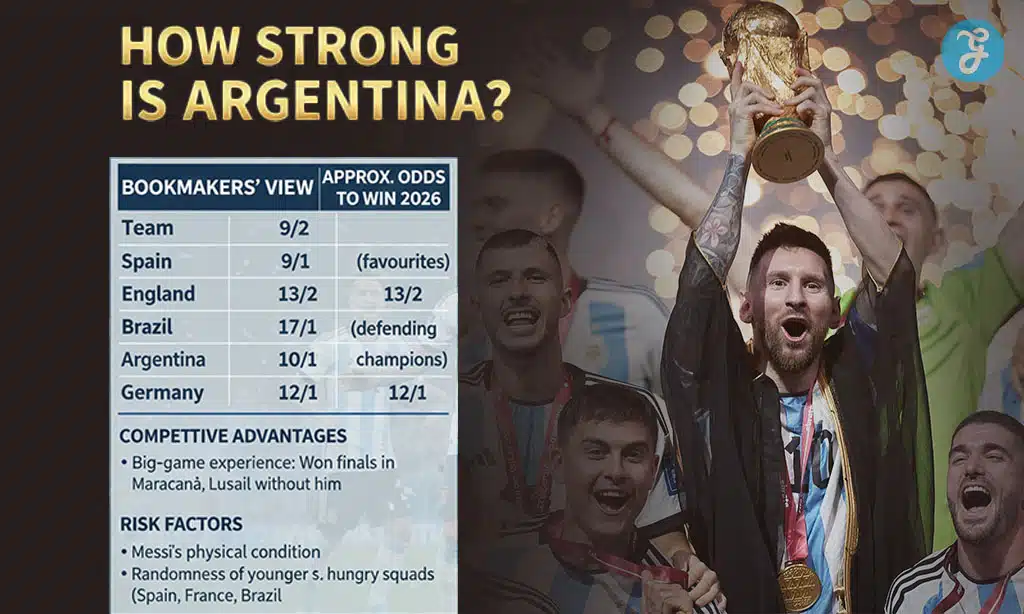
It’s not enough that Messi is great. The 2026 field is brutal.
The Bookmakers’ View
Recent odds from major bookmakers framed the 2026 favorites roughly like this:
| Team | Approx. Odds to Win 2026 |
| Spain | 9/2 (favourites) |
| England | 6/1 |
| France | 13/2 |
| Brazil | 7/1 |
| Argentina | 8/1 (defending champions) |
| Portugal | 10/1 |
| Germany | 12/1 |
Argentina are not runaway favorites, but they’re firmly in the top five—and that’s before we even know the draw.
Competitive Advantages
- Continuity: Scaloni has been in charge since 2018; this core has played together through three major title wins.
- Big-game experience: This group has already won finals in Maracanã, Lusail and Miami Gardens.
- Shape without Messi: The 4–1 over Brazil without him showed they can dominate even if he’s only available for key games.
Risk Factors
- Messi’s physical condition—a single muscle or tendon can change everything.
- The randomness of knockouts (one bad day, one red card, one penalty shootout).
- The rise of younger, hungry squads (Spain’s post-Euro 2024 core, a rebuilt France, an angry Brazil).
Even if Messi plays brilliantly, a second title is never guaranteed.
Maradona 1990 vs (Potential) Messi 2026
If Argentina reaches another final with Messi in 2026, the parallels with Maradona in 1990 will be irresistible.
Key differences
| Aspect | Maradona 1990 | Messi 2026 (projected) |
| Age | 29 | 39 |
| Physical condition | Injured, heavily fouled, slower | Older, but protected by better sports science and squad rotation |
| Team style | Defensive, pragmatic, often ugly | Possession-based, structured, flexible |
| Supporting cast | Limited attacking depth | Lautaro, Álvarez, Di María’s successors, multiple creators |
| Pre-tournament form | Club turmoil, Napoli battles | Coming from Inter Miami but with a stable national setup |
The question isn’t whether Messi can repeat Maradona’s 1990 feat of reaching another final. His team is arguably better equipped to win it.
Can Messi Actually Win a Second World Cup in 2026?
Short answer: It’s possible, even plausible—but conditional. Let’s break it down into three scenarios.
Scenario 1: Messi Fit and Functioning Like 2022 (or slightly below)
- Plays 60–80 minutes most games.
- Remains the primary creative hub and set-piece taker.
- Argentina’s core stays healthy.
In this world, Argentina are top-tier contenders:
- Among the favorites are Spain, France, England and Brazil.
- Capable of beating anyone in a one-off game.
- Depending on the draw, it’s entirely realistic to imagine Messi lifting a second trophy—something even Maradona never managed.
Scenario 2: Messi Present but Limited
- Plays reduced minutes, used more as an impact sub or in specific matches.
- Can’t press or cover ground consistently.
- Younger players carry more workload.
Even here:
- Argentina are still contenders, just not clear favorites.
- Messi’s role becomes more about decisive moments—late free kicks, threaded passes in tight games—rather than constant control.
This is arguably the most Maradona-1990-esque version: a hobbling genius still bending games with brief flashes.
Scenario 3: Messi Misses the World Cup
This would be the sharpest twist.
- Oddsmakers would likely move Argentina down a tier, but not out of the conversation.
- The 4–1 win over Brazil and back-to-back Copa Américas prove the team has its own identity.
Could they still win it? Yes—but then the story becomes “Argentina after Messi,” not “Messi’s second World Cup.”
Final Words: Can He Do What Maradona Couldn’t?
Maradona won one World Cup and lost one final. Messi has lost one final and won one World Cup.
A second title in 2026 would do three things at once:
- Give him the one achievement Maradona never reached—two World Cup trophies.
- Turn his post-2022 career at Inter Miami and with Argentina into the greatest “second act” football has seen.
- Close, perhaps forever, one of sport’s longest-running debates.
Can Lionel Messi create another World Cup title with Argentina in 2026?
- The data says Argentina is strong enough, and he’s still influential enough, that it’s a real possibility.
- The reality is age, injuries, and the randomness of knockout football mean nothing is guaranteed.
But if one player in modern football has shown a habit of bending probability, it’s the man who turned Qatar into his personal stage.
If he walks into New Jersey on 19 July 2026 with the armband on, fit enough to influence the game, nobody should be surprised if Lionel Messi does what even Maradona couldn’t: win the World Cup twice.