
You work hard on your website, but search engines still seem confused about what you do. Maybe your business gets lost under strange search terms, or Google mistakes your brand for someone else’s. That can make it tough to stand out online and bring the right visitors to your site. Here is a simple fact: Entity SEO helps search engines “get” who you are and what you offer. This strategy goes further than basic keywords. It helps machines understand people, places, brands, and ideas with real clarity.
I’m going to break down how Entity SEO works and how it can boost your digital identity in easy steps. You might be surprised at how clear things get next!
What Is Entity SEO?
Entity SEO helps search engines know exactly who or what you are online. Think of it as giving your website a face and name, so Google doesn’t mix you up at the big internet party.
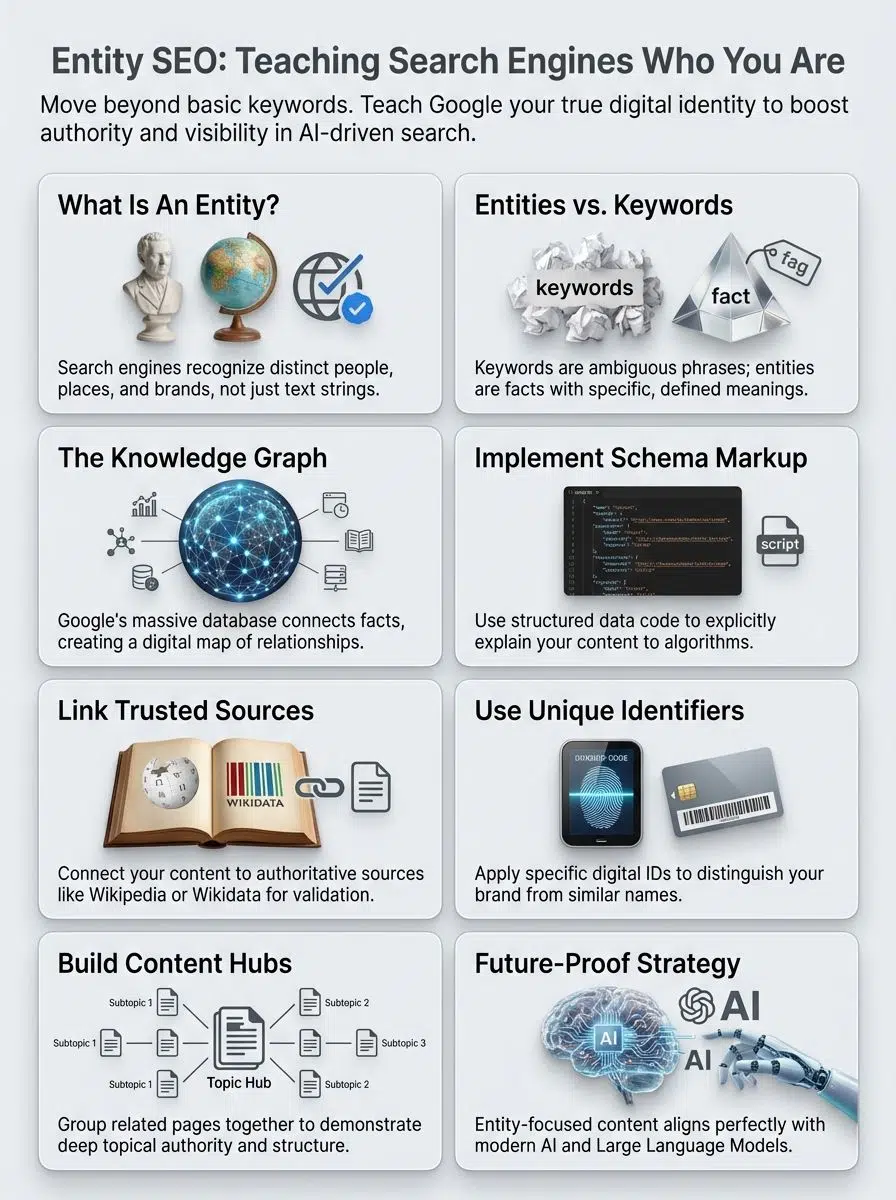
In my work analyzing the remote work economy for Editorialge, I see this confusion often. A search for “Zoom” could mean a camera lens, a fast movement, or the video conferencing tool we use every day. Entity SEO is the process of teaching Google which “Zoom” you are.
Definition of an Entity
Think of an entity as a real thing or idea that search engines recognize, like “Chicago,” “Nike,” or even “Cooking.” An entity stands alone because it has its own meaning, no matter the language.
Google stores billions of these entities in its Knowledge Graph. It tracks details such as names, types, and connections.
“An entity is anything that can be distinctly identified.”
Entities help define digital identity for people and brands online. Unlike keywords, entities focus on facts and concepts instead of word matches. This helps improve authority and trustworthiness for your site in semantic search results.
Difference Between Entities and Keywords
After learning about entities, it helps to see how they differ from keywords. Entities stand for actual things, like people or brands. “Nike” is an entity because it points to a specific company with lots of facts tied to its name.
Keywords are just simple words or phrases that people type in search boxes. They give hints but don’t always show deeper meaning.
| Feature | Keyword Focus | Entity Focus |
|---|---|---|
| Core Unit | Strings of text (e.g., “best laptop”) | Real-world objects (e.g., “MacBook Pro”) |
| Context | Ambiguous; relies on guessing | Precise; relies on unique IDs |
| Goal | Match search terms | Establish identity and relationships |
Take the word “apple.” As a keyword, it could mean fruit or tech. Google’s algorithms must guess which one you want. If you use an entity like Apple Inc., the search engine knows right away you seek information on technology and brand authority.
Entities help boost trustworthiness since they carry facts that match searches with digital identity and context much better than plain keywords ever could. This helps raise online visibility as well as content relevance without confusion over similar terms.
Why Is Entity SEO Important?
Entity SEO shines a spotlight on who you are for search engines. It makes sure your digital identity stands out in a crowded field. If you aim to spark real authority and trust online, learning this skill can open new doors.
Improved Search Engine Understanding
Google uses entities to give context to your website, brand, or product. Search engines recognize facts and relationships about people, places, or things instead of just matching search queries with keywords.
With structured data like schema markup, you help search engines build a knowledge graph that acts almost like a digital map of who you are.
A clear digital identity improves how search engines see your brand.
Think of it this way: if Google knows “Apple” is both a fruit and a tech company in Cupertino, California, it can show the right results for each user. Entities boost recognition, so even simple questions get smart answers. This leads to better visibility for your content and higher authority in online searches.
Enhanced Content Relevance
Better search engine understanding leads right into making content more relevant. Entity SEO helps match your words to real concepts and subjects. If you write about “Apple,” the system can spot if you mean the fruit or the tech company based on context clues.
For example, mentioning “iPhone” or “Cupertino” signals the tech giant. Mentioning “pie” or “cinnamon” signals the fruit. Using structured data and schema markup adds extra meaning for algorithms. Search engines grasp your digital identity, brand authority, and why a page matters for each search query.
This link between entities boosts trustworthiness in information retrieval. It also helps connect related topics on your site. This guides readers deeper down the rabbit hole of useful answers while raising online visibility at every step.
Higher Visibility in Search Results
Using Entity SEO can move your business closer to the top spots on Google. Search engines see your digital identity, connect it with key facts, and show you for more search queries.

This is critical because over 58% of searches in 2025 were “zero-click” searches. This means users got their answer directly from a panel or snippet without visiting a website.
For example, adding structured data tells algorithms exactly who you are and what you offer. This helps boost authority and trustworthiness in search results. If Google knows your brand through its Knowledge Graph or links from trusted sites like Wikipedia, it highlights that information in bold panels.
People searching for concepts related to your company will spot you faster than others relying only on keywords. Your content stands out among a sea of blue links because entities support richer snippets and visual knowledge panels.
As Google uses advanced techniques like Natural Language Processing for recognition tasks, entity-driven pages become stronger magnets for organic traffic. Next comes learning how Google makes use of these connected entities in the background.
How Google Uses Entities
Google sees the bigger picture, not just a jumble of words. It connects facts and ideas, like stringing beads on a necklace. This helps search engines match your site to what people really want.
Google’s Knowledge Graph
Google’s Knowledge Graph acts like a giant map of facts. It connects people, places, brands, and things into neat webs and groups. The system uses structured data from trusted sites such as Wikipedia or Wikidata to pull in accurate details.
Introduced in 2012, it helps search engines spot entities instead of just scanning for keywords. For example, if you type “Apple,” the Knowledge Graph helps tell if you mean the technology company or the fruit.
But here is a warning. In June 2025, Google performed a massive “Clarity Cleanup,” removing over 3 billion low-quality entities from its graph. This means simply having an entity isn’t enough anymore; it must be verified and high-quality to stay on the map.
This graph makes entity recognition smart and quick for algorithms. Your digital identity and brand authority can show up right inside search results boxes called knowledge panels. This boosts authority, trustworthiness, and online visibility with one click, or even a glance, making your business info pop out more than a plain blue link ever could.
Natural Language Processing (NLP) for Entity Detection
Natural Language Processing, or NLP, scans web content to spot names, places, brands, and other entities. It breaks sentences apart, picks out important words, and figures out how they relate. This helps search engines like Google understand if “Apple” is a fruit or a tech company from your text alone. With AI-driven search tools using NLP every day, entity recognition boosts online visibility for websites.
Using semantic search and the power of the Knowledge Graph makes search smarter. Schema markup tells algorithms more about your digital identity and links you to trusted sources such as Wikipedia or Wikidata.
With accurate entity detection in place since late 2012 through machine learning models like BERT (introduced in 2018), sites now gain higher relevance in results simply by being clear about who they are and what they cover.
Integration with Core Algorithms
Google mixes entity recognition right into its core algorithms. These algorithms use data from the Knowledge Graph and structured data, like schema markup, to make sense of your digital identity.
Algorithms link you with your brand authority, trust factor, and content relevance. Each search query gets matched not just by keywords but also by entities. These are facts about people, places, or topics that machines can check.
- Contextual Matching: The algorithm studies context clues in text for better information retrieval.
- Accuracy Checks: Even tiny details matter; a misspelled name or missing fact could confuse AI-driven search models.
- Trust Signals: Trusted sources like Wikipedia help boost brand recognition because Google trusts them for accuracy.
Schema markup acts as a spotlight on these connections, so nothing gets lost in translation between user intent and results shown on the page. Schema Markup (Structured Data) now steps up to play an even bigger role in Entity SEO strategies.
Key Elements of Entity SEO
Curious how your site can stand out in search results and boost digital identity? Keep reading. You might spot something that clicks for your brand.
Schema Markup [Structured Data]
Schema markup works like a secret code for search engines. It tells Google, Bing, and others what your content means instead of just what it says.
A bakery website can use schema to tag itself as a place that sells cakes or bread, not just list words about flour or sugar. For tech companies, using specific schemas like SoftwareApplication or SaaS is crucial for precise categorization.
This helps search engines connect facts faster and show special results like recipes or company details. Structured data builds a stronger digital identity by making information clear. Many brands use schema markup to boost online visibility and trustworthiness in semantic search results.
Tools such as Schema.org make adding this code simple; even small businesses can improve their entity recognition without hiring a tech wizard. Using a schema supports better rankings because it aligns with Google’s algorithms for knowledge graph and AI-driven search features.
Entity Linking to Trusted Sources
Structured data gives search engines a clear map. Linking your entities to trusted sources, such as Wikipedia or Wikidata, gives more proof of what you mean. Search engines use these links as digital references. They check if a person, brand, or concept really matches the information on strong sites.
For example, say your page talks about Elon Musk. Link his name directly to his official Wikipedia entry using proper markup or plain hyperlinks for context. This helps with entity recognition and improves authority signals in search queries.
Don’t just stop at Wikipedia. Linking to specialized databases like Crunchbase for startups or IMDb for media adds another layer of verification that Google trusts. Google’s algorithms spot these connections fast and boost online visibility and trustworthiness in results. No detective hat needed!
Contextual Content Optimization
After linking entities to trusted sources like Wikipedia or Wikidata, it matters just as much to shape your content by context. Search engines hunt for clues that show how ideas fit together.
For example, if you write about digital identity, also mention related terms like brand authority, semantic search, and knowledge graph in natural ways. Sprinkle facts and details throughout the page so readers and search engines both see clear connections.
Google uses algorithms to measure if your information matches what people expect from their searches. If someone wants tips on online visibility or trustworthiness, give them practical advice right where those topics come up.
Avoid stuffing keywords everywhere; instead, use them smoothly inside sentences that make sense together. By doing this, you help Google better understand who you are and boost your chances of getting noticed in featured snippets or AI-driven search results.
How to Implement Entity SEO
Ready to boost your site’s digital identity and trust with search engines? Learn hands-on steps that make your content stand out like a pop star at a talent show.
Step 1: Identify and Define Entities on Your Page
Scan your page for key nouns and concepts. These are your entities. People, places, brands, products, and dates all count as entities in search engine optimization.
For example, “Editorialge,” “Chicago,” and “Remote Work Economy” help show digital identity. A great way to find these is by using a free demo from a Natural Language Processing tool like TextRazor or InLinks. These tools show you exactly which entities a machine sees in your text.
Each entity links to real-world facts or topics that users look for online. Describe each entity in clear words so both readers and search engines know what you mean. Use simple language that leaves no room for doubt. Call a spade a spade. If it’s a brand like “Editorialge,” say so right away.
List important details, such as location or role, if it helps add trustworthiness and clarity to the content. This makes content relevant while building authority with algorithms built on semantic search and information retrieval tools like Google’s Knowledge Graph.
Step 2: Add Schema Markup to Highlight Entities
Add schema markup to your page so search engines spot your key entities. Use simple code in the webpage’s HTML, like JSON-LD or Microdata.
For example, tell Google about “Aisha Reynolds” as a person, or mark “Savannah College of Art and Design” as an organization. You can generate this code easily using Merkle’s Schema Markup Generator. This helps digital identity stand out in semantic search and boosts brand authority.
Schema markup acts like a highlighter for facts on your site. It tells algorithms what each entity means. It clarifies who you are, places mentioned, and even products shown. Sites that use structured data often see higher online visibility and better results in AI-driven search updates from Google since 2012. Even big brands boost their trustworthiness with this simple step.
Step 3: Use Unique Identifiers to Strengthen Connections
Every entity on your page should have its own ID, like a digital fingerprint. Think about ISBN numbers for books or Twitter handles for people. These unique IDs help search engines match data to the right person, place, or thing.
They can link your business listing with sources like Wikidata or trusted industry directories. Google’s Knowledge Graph relies on these connections to boost brand authority and trustworthiness.
Search engines see “Acme Corp” in many places, but an official Wikidata QID ties all mentions together. This direct line makes algorithms smarter and raises your online visibility in semantic search results. Now you’re ready to build strong content hubs that show real topic authority.
Step 4: Build Content Hubs for Topic Authority
Content hubs act like a spider web, pulling all your pages about one main subject into one spot. A hub could be a page about “Smart Home Security in the US” and link out to details on cameras, alarms, or tips for renters. Each linked article boosts the value of the main page and builds more trust with search engines.

Google’s Knowledge Graph loves clear structure. It matches facts across your site and outside sources such as Wikipedia or Wikidata. Using content hubs shows you cover key topics fully, not just single keywords.
Strong digital identity and authority grow from this strategy, making it easier for users and search engines to recognize you as a trustworthy source. Schema markup works even better when used across hub-and-spoke pages tied to core entities.
Examples of Entity SEO in Practice
Ready to see real-life tips on how brands teach search engines who they are? Keep reading. You might spot ideas you can use today!
Leveraging Wikipedia and Wikidata
Wikipedia and Wikidata hold strong trust with search engines. Adding links to your brand’s Wikipedia or Wikidata pages shows Google that your entity is real and notable. They contain structured data that matches the way search engines collect facts for their knowledge graphs.
Information from these sites often appears in Google’s Knowledge Panels. For example, linking your business or public figure page to a matching Wikipedia entry can boost online visibility fast and support better entity recognition.
Search engines scan these sources daily, picking up fresh updates about digital identity, history, and core details like birth dates or headquarters locations. Use them as anchors for schema markup on your site to help search queries return more accurate results tied directly back to you.
Optimizing for Knowledge Panels
Google’s Knowledge Panels can make your brand stand out. Provide reliable details on your website, such as business name, logo, address, founding date, and important people. Use schema markup to show search engines the right facts about your digital identity and brand authority.
Add trusted links from places like Wikidata or industry profiles to build trustworthiness. Keep all information accurate and up-to-date. Link your content with well-known entities using semantic search concepts, so Google connects you to recognized topics in its Knowledge Graph.
Show expertise by having a clear description of who you are and what makes you different from others in your field. Next up: see how this works for image and video searches too.
Using Entities in Image and Video Search
Entities help search engines sort images and videos by meaning, not just words. For example, tagging a photo of the Eiffel Tower with “Eiffel Tower,” “Paris,” and “landmark” links it to real concepts in the knowledge graph.
Instead of picking up random keywords stuck in file names or ALT text, smart algorithms use entity recognition to spot faces, objects, places, and even moods shown on screen.
This is becoming massive. In 2026, Google Lens is processing over 20 billion visual searches every single month. If your images aren’t optimized with entity data, you are invisible to this huge audience.
As people upload more content every year, clear identification matters. Structured data like schema markup teaches search engines how your media connects to known entities such as brands or products.
This boosts your chance of showing up for visual searches about those topics while building trustworthiness. More accurate results mean higher online visibility for digital identity and brand authority, too; you’re not lost in the sea of cat pictures anymore!
Benefits of Entity SEO
Watch your site step into the spotlight, catching eyes and clicks from search engines that truly “get” what you do. With a clearer digital identity, your brand stands out as trustworthy and credible to both people and machines.
Increased Organic Traffic
Clear entity recognition boosts your site’s chances of ranking high in search results. Google uses knowledge graphs to link valuable information about people, places, and things. If your content fits into these structures with strong schema markup, you become easier for search engines to find and understand.
More users click through when they see familiar brands or trusted facts show up in answer boxes and panels. That means steady growth in visits from real people searching for what you offer. Brands like Wikipedia and Wikidata win big here, because their data helps direct more eyes their way again and again.
Better Alignment with AI-Driven Search
After traffic starts flowing, smart search engines begin their real magic. AI-driven algorithms like Google’s use semantic search to understand digital identity and content relevance. Entities, such as people or brands, become anchors in this system. They help machines connect your information across the web, boosting authority and trust.
| Metric | Standard Result | Entity-Rich Result |
|---|---|---|
| Click-Through Rate | Baseline | +25% to +82% (Study Data) |
| Zero-Click Visibility | Low | High (Featured Snippets) |
| Voice Search Ready | No | Yes |
Think of schema markup as a signal flag for these bots. It shows exactly what your site stands for in plain code. If you link to trusted sources like Wikipedia or Wikidata, it sharpens entity recognition even more.
As AI gets smarter with processing language and context, strong entity SEO means your brand can ride the wave instead of swimming upstream against algorithm changes. This level of optimization helps match content to what users truly mean by their queries, even if they phrase things differently every time they search.
Establishing Brand Authority
Strong brand authority tells search engines you are a leader in your field. Search engines use entity recognition to check how well your brand stands out across the internet. Schema markup helps share clear signals about your business’s identity and trustworthiness.
Linking to trusted sites like Wikipedia or Wikidata boosts digital identity, gives weight to facts, and improves search engine optimization power. Brands with strong authority show up higher on results pages. Reviews, awards, expert links, and consistent mentions across sources all help build this strength over time. Think of it like showing up at every game. People start seeing you as part of the team.
Google looks for these signs when choosing who gets top spots in AI-driven searches or Knowledge Panels, making sure users see trusted names first.
Future of Entity SEO
Entity SEO will keep changing as AI learns faster. Stay curious. Fresh tools and new search ideas are just around the corner.
Role of Entities in Large Language Models (LLMs) and AI
Large Language Models, like ChatGPT and Google’s Gemini, use entities to better understand digital identity and meaning. They spot people, places, brands, or things in your text. These models link facts from trusted sources such as Wikidata or Wikipedia during search engine optimization.
Instead of just matching keywords, they connect related concepts. This method helps AI answer tough questions with more accuracy. Search engines train LLMs on billions of texts every year. In 2025, AI Overviews appeared for over 13% of all US search queries, proving that entity recognition is now a core part of the search experience.
Connections between words give the model context and relevance for each query. Content using structured data, like schema markup, stands out more clearly to these systems. The right associations make information easier to find in both regular searches and new AI-driven features like Knowledge Panels or voice results.
Expanding Entity SEO Beyond Text-Based Content
Search engines now understand pictures, videos, and even audio. Google uses its Knowledge Graph to link images of your brand logo with your digital identity. Image alt texts boost entity recognition for both people and products.
Product photos on shopping sites act as new signals for search engine optimization. Videos help create authority, too; YouTube descriptions packed with schema markup tie those clips to brands or topics.
Podcast transcripts give algorithms more clues about who you are and what you offer. Infographics use labeled data, so semantic search tools can learn connections faster than ever before.
Even charts in blog posts now feed information retrieval systems thanks to AI-driven tools that scan content beyond just words. Brands gain visibility by making sure every image, video, or graphic points back to the right entity through structured data tags or clear context cues in captions and metadata.
Wrapping Up
Entity SEO shapes how search engines see your digital identity. Think of it as showing Google and Bing exactly who you are, not just what you do. Brands that use structured data and schema markup get a boost in trustworthiness and online visibility. Entity recognition helps connect your content to bigger networks like Wikipedia or trusted business directories.
Algorithms now care about context, not just keywords. Sharing clear facts about your people, products, and services builds authority fast. AI-driven search keeps getting smarter at understanding names, companies, places, and ideas through concepts like the knowledge graph.
Staying current with these changes in semantic search makes sure your information gets noticed for the right reasons. So, start small with one schema tag today, and see where it takes you.