Picking the right business structure can save you thousands in taxes. Many business owners waste money each year because they chose the wrong setup. The tax rules for LLCs, S-Corps, and C-Corps are very different.
Your choice affects how much cash stays in your pocket after tax day.
The IRS treats each business type in its own way. For example, C-Corps face double taxation where profits get taxed twice. First at the company level, then again when owners receive money.
Your business size, growth plans, and income goals all matter when making this choice. This guide will show you the tax pros and cons of each option. Ready to stop overpaying?
Key Takeaways
- LLCs offer pass-through taxation with less paperwork, but owners pay 15.3% self-employment tax on all profits.
- S-Corps can save owners money by splitting income between salary and distributions, avoiding self-employment tax on the distribution portion.
- C-Corps pay a flat 21% federal tax rate, but face double taxation when owners take profits as dividends.
- Your business size matters when choosing a structure – small firms often do well with LLCs, medium businesses save with S-Corps, and large companies benefit from C-Corps.
- The right structure should match both current needs and future plans – consider growth goals, investor needs, and how you’ll use profits before deciding.
Key Tax Differences Between LLC, S-Corp, and C-Corp
The tax structures of LLCs, S-Corps, and C-Corps impact your bottom line in very different ways. Each option comes with its own set of tax rules that can either save you money or cost you more depending on your business size and goals.
Pass-Through Taxation vs. Double Taxation
Pass-through taxation means business profits go straight to your personal tax return. This happens with LLCs and S corporations. You pay tax once at your personal income tax rate. No business tax applies first! S Corps pass income, losses, and credits directly to shareholders.
This setup saves money for many small business owners.
C Corps face double taxation, which hits profits twice. First, the company pays a 21% federal corporate tax on all earnings. Then, owners pay personal income tax on any money they take as dividends.
This double hit can cost more than pass-through options. Many small business owners avoid C Corps for this reason, unless they need to keep profits in the business or want to attract big investors.
Self-Employment Tax Considerations
Business owners face big tax bills with different company types. LLCs pay a full 15.3% tax for Social Security and Medicare on all profits. This hits your wallet hard! For example, if your LLC makes $125,000 and spends $10,000, you’ll pay self-employment tax on the whole $115,000 profit.
That’s on top of your regular income tax.
S Corps offer a smart way to cut this tax burden. You can pay yourself a fair salary and take the rest as profit shares. You only pay the 15.3% tax on your salary part. The rest gets taxed as regular income without the extra self-employment costs.
Many small business owners save thousands each year this way. C Corps have a totally different setup with their own tax rates, which might work better for larger firms that keep profits in the business.
Tax Rate Implications
Tax rates hit your wallet differently based on your business type. C Corps pay a flat 21% federal tax rate on all profits. This rate stays the same no matter how much money the company makes.
For S Corps, profits flow to your personal tax return where rates can climb from 10% all the way up to 39.6%. LLCs offer more options. You can pick how you want to be taxed. Many LLC owners love the QBI deduction that can slash taxes by up to 20%.
Your choice matters most when your business starts making good money. The gap between paying 21% as a C Corp versus nearly 40% as an S Corp owner gets very real at higher income levels.
Small business owners must look at both today’s needs and tomorrow’s goals. A startup that needs to keep cash might prefer C Corp rates to reinvest profits. Growing companies that want money to flow to owners might like pass-through status better.
The right structure can save you thousands in taxes each year. Your industry, growth plans, and how you’ll use profits should guide this big choice.
Pros and Cons of an LLC for Tax Efficiency
LLCs offer small business owners a sweet tax deal with pass-through status that keeps money in your pocket. But watch out – as your profits grow, you might miss out on the tax breaks that S-Corps can give you on self-employment taxes.
Advantages for Small Businesses
LLCs offer small business owners big tax perks. You can pick how the IRS taxes you – as a solo owner, partner, S Corp, or C Corp. This choice lets you match your tax plan to your business needs.
The best part? Your personal stuff stays safe if your business gets sued. Your home, car, and savings won’t be at risk for business debts.
Small firms love LLCs because they need less paperwork than corporations. You don’t have to hold board meetings or keep complex records. This saves time and money for busy owners. Plus, LLCs work well for companies with foreign members since there are no limits on who can join or how many people can own parts of the business.
This open structure makes growth easier as your small business expands.
Limitations of LLC Taxation
LLCs face some big tax hurdles that owners should know about. The self-employment tax hits LLC owners hard at 15.3% on all profits. This tax covers Social Security and Medicare costs that employers normally split with workers.
Let’s look at real numbers: if your LLC makes $125,000 with $10,000 in expenses, you’ll pay self-employment tax on the full $115,000 profit. That’s on top of your regular income taxes! Unlike S-Corps, LLC owners can’t pay themselves a lower salary to cut this tax bill.
Another problem is that LLCs can’t issue stock. This makes it tough to raise money for growth. Many investors want shares in return for their cash, but LLCs can only offer membership interests.
This limits your options when you need funds to expand. The pass-through tax status works great for small firms, but as profits grow, the tax bite gets bigger too. Many LLC owners find themselves paying more taxes than they would with other business types as their income rises.
Pros and Cons of an S-Corp for Tax Efficiency
S-Corps shine with their ability to save owners money through salary-dividend splits that dodge some self-employment taxes. But watch out – these tax perks come with strict rules about who can own shares and how many shareholders you can have.
Tax Savings Through Pass-Through Status
S-Corps offer big tax perks through pass-through status. Your business profits flow directly to your personal tax return, which means no corporate tax hits your money first. This setup helps you dodge the double tax trap that C-Corps face.
You can also trim your tax bill by taking part of your income as salary and part as distributions. The distributions don’t get hit with self-employment taxes, saving you up to 15.3% on that portion.
The 2017 Tax Cuts and Jobs Act made pass-through status even better. Now you can cut up to 20% off your Qualified Business Income before it gets taxed. For a business making $100,000 in profit, this could mean $20,000 that won’t face income tax at all.
Your personal tax rates might range from 10% to 39.6%, but you’ll pay these rates just once on your income, not twice like with some other business types.
Ownership Restrictions
S-Corps come with strict rules about who can own them. You can only have up to 100 shareholders in an S-Corp, and all must be U.S. citizens or legal residents. This limits your options for bringing in foreign investors.
The IRS also says S-Corps can only issue one class of stock, which makes profit sharing less flexible. Many growing businesses find these limits too tight when they need to raise money.
These rules don’t exist for LLCs or C-Corps, which can have any number of owners from anywhere in the world. If your business plans include getting money from non-U.S. investors or going public someday, an S-Corp might block your path to growth.
Pros and Cons of a C-Corp for Tax Efficiency
C-Corps offer a sweet deal with the current 21% federal tax rate, which beats what many business owners pay on personal income. But watch out for the double tax trap – your profits get taxed at the corporate level first, then again when you take money out as dividends.
Benefits of Lower Corporate Tax Rates
C-Corps enjoy a flat 21% corporate tax rate. This rate stays the same no matter how much money the business makes. Small business owners can keep more profits in the company at this lower rate.
The saved money helps buy new equipment or hire more workers. Many business owners find this tax setup works well for growth plans.
The tax savings also boost a C-Corp’s ability to attract money from outside investors. With more cash on hand, these companies can sell stock to raise capital. This makes C-Corps perfect for businesses that want to grow big or go public someday.
The lower tax rate gives these companies an edge when competing with foreign businesses too.
Drawbacks of Double Taxation
C-Corps face a big tax bite from two sides. First, the company pays a 21% federal tax on all profits it makes. Then, owners get hit again when they receive dividends, as they must pay personal income tax on this money too.
This double tax can eat up a large chunk of business earnings. Many small business owners find this setup costs them more in the long run compared to pass-through entities like LLCs or S-Corps.
The pain doesn’t stop at taxes. C-Corps also deal with higher costs for legal work, payroll systems, and insurance. They must follow strict rules and file more reports than other business types.
These extra tasks take time and money away from growing the business. For most small companies, the tax burden plus these added costs make C-Corps less tax-efficient unless they plan to seek venture capital or go public.
How to Choose the Best Structure for Tax Efficiency
Picking the right business structure can save you big money at tax time. Your choice should match how you run your business now and what you plan for the future.
Aligning Tax Benefits with Your Business Goals
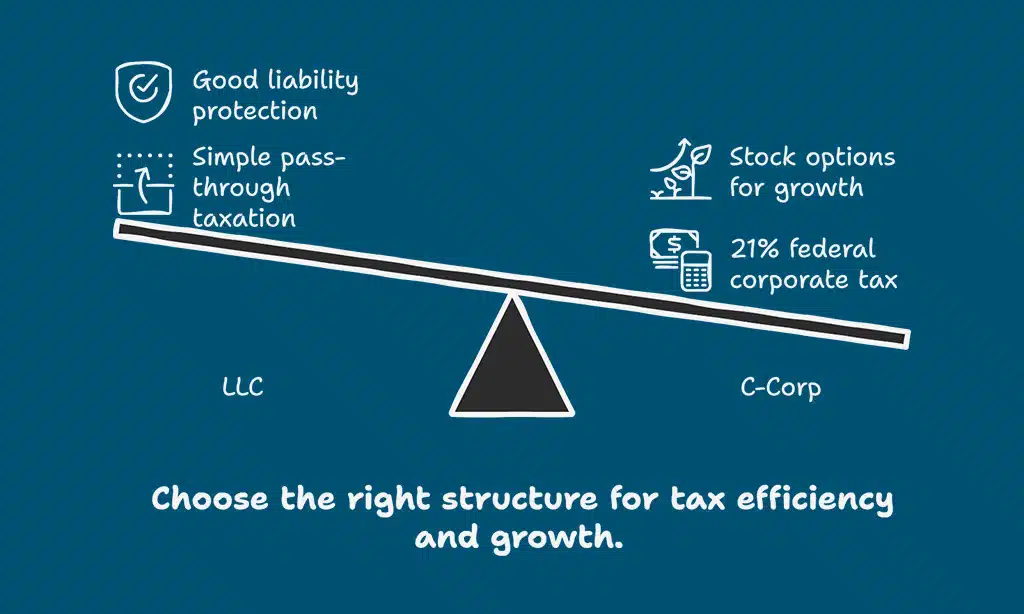
Your tax plan must match what you want for your business. A small shop that plans to stay small might pick an LLC for simple pass-through taxation. This lets profits flow right to your personal tax return.
You pay less in paperwork and still get good liability protection. But if you aim to grow fast and need to keep money in the business, a C-Corp might work better. The 21% federal corporate tax rate could save you money if you make a lot of profit.
Your choice affects more than just taxes. S-Corps can cut self-employment taxes by paying you a fair salary plus dividends. This works great for service businesses with steady profits.
For firms seeking venture capital or planning an IPO, C-Corps offer the stock options and growth path investors want. The best structure fits both today’s tax needs and tomorrow’s business goals.
Talk to tax pros who know your field. They can help you balance tax savings with your growth plans and management style.
Factors to Consider: Business Size, Industry, and Growth Plans
Your business size plays a big role in picking the right tax structure. Small shops often do well with LLCs because they need less paperwork and have simple record-keeping. Medium firms might save more with S-Corps by cutting self-employment taxes.
Large companies with growth goals may benefit from C-Corps, which can sell stock and raise money faster.
Your industry matters too. Service businesses like consultants often pick pass-through entities to avoid double taxation. Tech startups planning for venture capital should look at C-Corps since most investors prefer this structure.
Think about where you want your business to go in five years. If you plan to stay small, an LLC might work best. If you want to grow fast and maybe go public one day, a C-Corp offers the right path for raising capital and giving stock options.
When to Switch Business Structures for Better Tax Outcomes
Your business might need a new tax structure when your profits hit certain levels or your company goals change. Watch for signs like paying too much in self-employment taxes as an LLC, or missing out on C-Corp benefits when seeking investors.
Identifying Key Indicators for Change
Your business might need a new tax structure if you spot certain signs. Big growth in profits often signals it’s time for a change. If your LLC makes lots of money, you might pay too much in self-employment taxes.
Switching to an S-Corp could save you cash. Another key sign is adding new owners. S-Corps limit you to 100 U.S. citizen owners, while C-Corps allow foreign investors. This matters if you want money from outside the U.S.
Money needs also point to structure changes. Need cash for big growth? C-Corps attract venture capital better than other types. They can sell stock and go public with an IPO. Tax bills can also tell you it’s time to switch.
If you pay high personal income taxes on business profits, a different structure might help. Look at your tax returns each year. High payments for Social Security and Medicare taxes might mean an S-Corp would work better for your company.
Takeaways
Picking the right business structure can save you big money on taxes. LLCs offer simple tax filing and flexibility, while S-Corps can cut self-employment taxes for growing companies.
C-Corps work best for larger firms that need to keep profits in the business. Your choice should match both your current needs and future plans. Talk to a tax pro before you decide – they can help you spot tax breaks you might miss on your own.
FAQs on LLC vs S-Corp vs C-Corp
1. What is the main difference between LLC, S-Corp, and C-Corp for tax efficiency?
An LLC offers pass-through taxation where profits go directly to owners’ personal tax returns. S-Corps also have pass-through taxation but can save on self-employment taxes. C-Corps face double taxation on corporate profits and dividends but have a flat corporate tax rate.
2. How does limited liability protection work in these business structures?
All three business structures (LLC, S-Corp, and C-Corp) shield owners from personal liability for business debts. Your personal assets stay safe from business liabilities. This protection is a key reason many sole proprietors switch to these formal entities.
3. Which business entity is best for raising capital?
C Corporations are tops for raising capital. They can issue different classes of stock, attract venture capital, and even go public through an IPO. S-Corps have stock but with strict limits. LLCs use membership units instead of stock, making them less attractive to big investors.
4. Do I need a board of directors for my business?
C-Corps must have a board of directors and hold annual meetings as part of corporate governance. S-Corps need similar but simpler corporate structures. LLCs don’t require boards or formal meetings, making them less complex to run.
5. How do filing requirements compare between these business structures?
LLCs have the simplest filing needs, often just an annual report. S-Corps must file articles of incorporation, Form 2553 for S status, and follow strict rules about who can be owners. C-Corps have the most paperwork, including articles of incorporation, bylaws, and complex tax filings.
6. Can I switch from one business structure to another?
Yes, you can change your business structure as your company grows. Many start as LLCs and later convert to S-Corps to save on self-employment taxes. Moving to a C-Corp is common when seeking outside investments or planning an IPO.