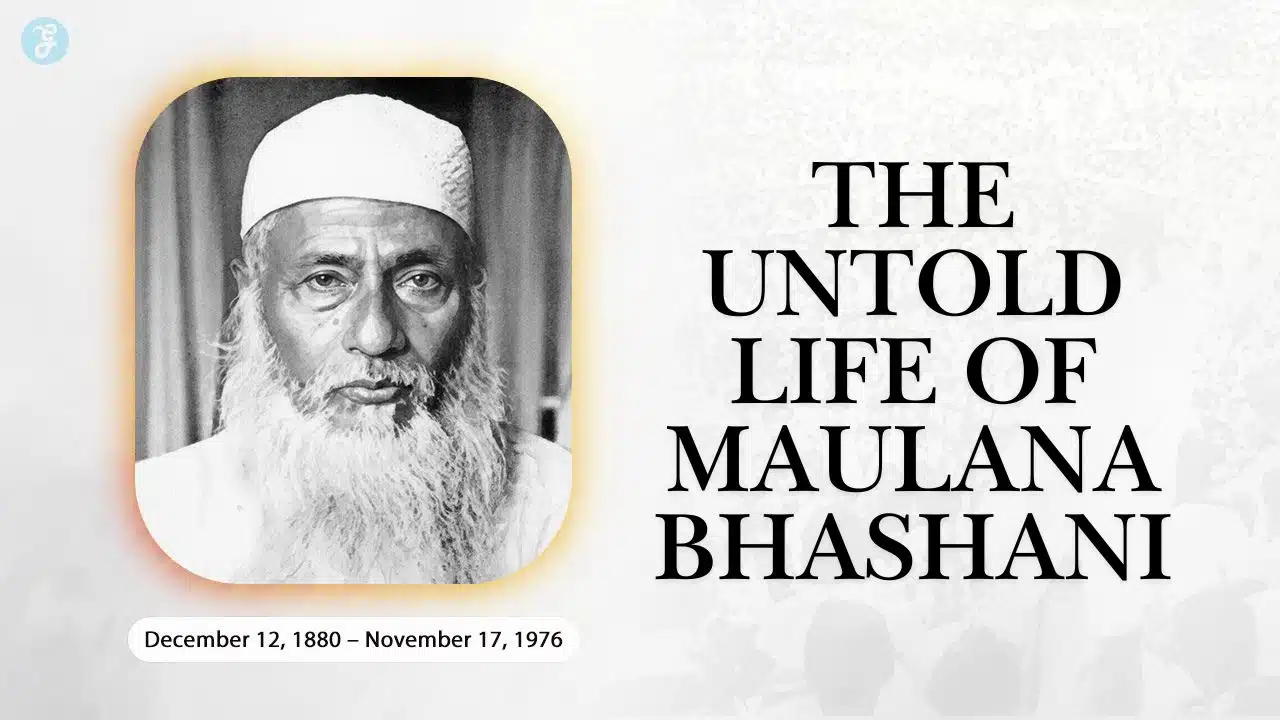
To truly understand the political history of Bangladesh, one must examine the Life of Maulana Bhashani, a journey that spanned the anti-colonial struggle, the Pakistan movement, and the liberation of Bangladesh. He was not just a politician; he was a phenomenon. In a region often dominated by elite, English-speaking intellectuals, Maulana Abdul Hamid Khan Bhashani stood out as a man of the earth.
He lived in a bamboo hut, wore coarse handloom clothes, and walked barefoot among the peasantry, yet his voice shook the foundations of the British Raj and the Pakistani military junta alike. Known affectionately as Majlum Jananeta (Leader of the Oppressed), Bhashani defied the conventional boxes of political ideology. He was a devout Islamic scholar who championed Socialism. He was a mentor to Sheikh Mujibur Rahman, yet a fierce critic of the Awami League when he felt they strayed from the people’s cause.
His life was a paradox to the West, who dubbed him the “Red Maulana,” but to the rickshaw pullers, farmers, and laborers of Bengal, he was simply their guardian. This article explores the life of Maulana Bhashani in depth: his early struggles, political transformation, key movements he led, and the legacy he left behind.
Early Life: From Dhangara Village to Deoband
Maulana Bhashani was born on December 12, 1880, in the village of Dhangara in Sirajganj (then part of the Pabna district). His start in life was far from privileged. Born into a middle-class peasant family, he faced tragedy early, losing his father, Haji Sharafat Ali Khan, and his mother at a young age. This early exposure to loss and hardship perhaps sowed the seeds of his lifelong empathy for the destitute.
His education was not secular but deeply religious. He was sent to the famous Deoband Madrasa in Uttar Pradesh, India. It was here, amidst the study of theology and Islamic jurisprudence, that young Abdul Hamid was exposed to the anti-British revolutionary fervor of Sheikh-ul-Hind Mahmud Hasan. Deoband was not just a seminary; it was a breeding ground for anti-colonial thought. The teachers there preached that fighting against foreign occupation was a religious duty.
After his education, Bhashani did not immediately jump into electoral politics. Instead, he spent years as a Sufi wanderer. He traveled through the villages of Bengal and Assam, teaching the Quran and witnessing firsthand the crushing poverty of the rural peasantry under the Zamindari system. This period was his “research” phase—he wasn’t reading about poverty in books; he was living it.
Awakening of a Rebel: Early Activism under British Rule
After returning from Deoband, Bhashani worked as a teacher in Kagmari (Tangail) and later moved between parts of Bengal and Assam. He saw firsthand how peasants were exploited by zamindars (landlords), moneylenders, and colonial authorities.
In the 1910s and 1920s, he gradually entered mainstream politics:
- He interacted with leaders of the Indian National Congress, including Chittaranjan Das, which drew him into nationalist politics.
- Over time, he was associated with organisations like the Congress, Swaraj Party, and later the All-India Muslim League, reflecting the shifting political landscape of the period.
He also became active in Assam, where many Bengali Muslim peasants had migrated to clear forests and cultivate land. There, he emerged as a defender of their rights, winning election as a Member of the Assam Legislative Assembly (MLA) in 1937, representing Dhubri (South).
Even at this stage, one key thread in the life of Maulana Bhashani was clear: he sided consistently with the poor, the landless, and those pushed to the margins.
The Making of a Leader: The Assam Era (1919–1947)
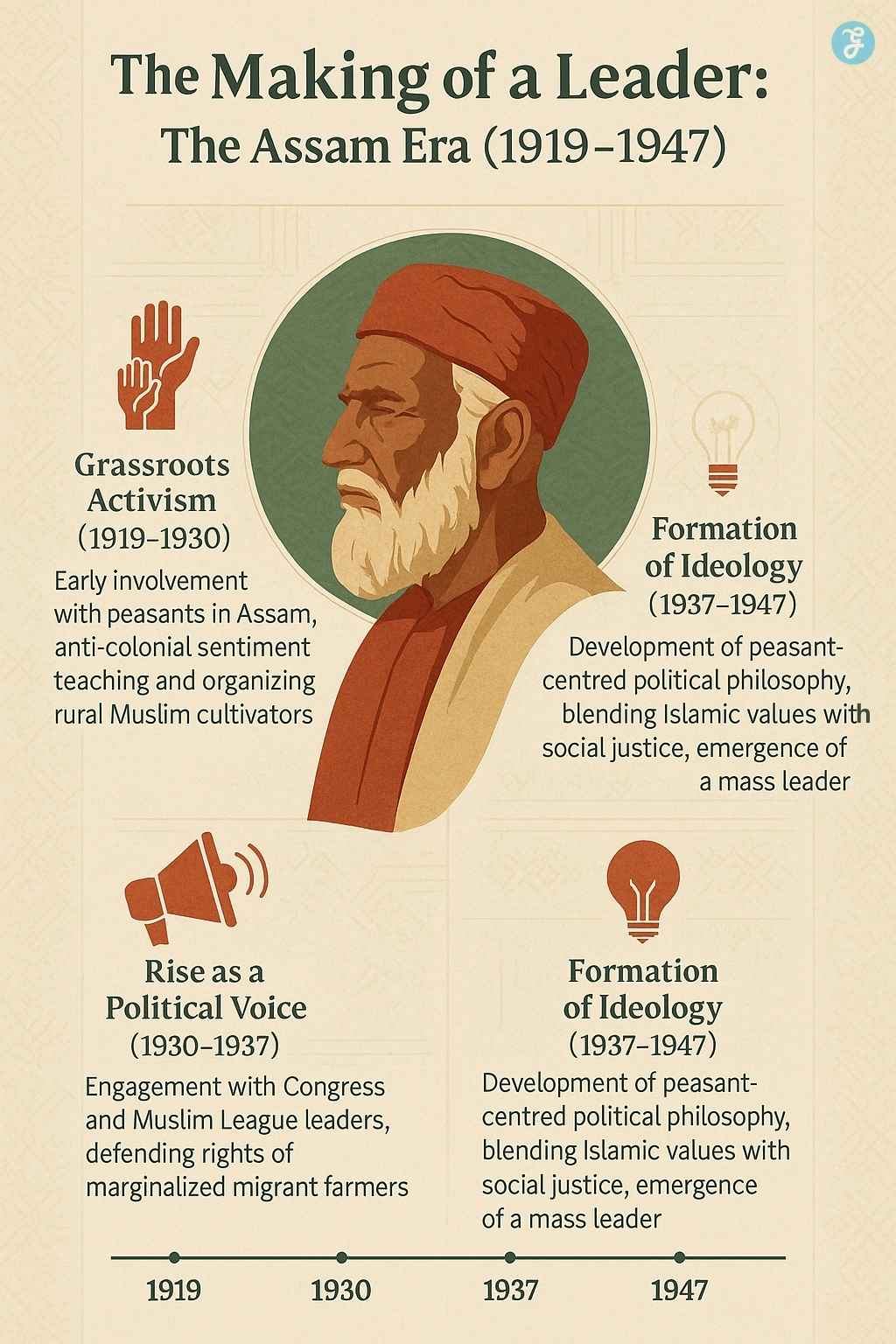
In the early 20th century, thousands of landless Bengali Muslims were migrating to the fertile valleys of Assam to find work and land. The local British administration and feudal lords, threatened by this influx, implemented the notorious “Line System.”
The Line System was a segregation law that drew a literal line on the map; Bengali immigrants were not allowed to settle or buy land beyond this line. It created a ghettoized, exploited class of people who lived in constant fear of eviction.
The Birth of “Bhashani”
Bhashani arrived in Assam and immediately began organizing these marginalized farmers. His most legendary feat during this time was organizing a massive peasant conference on the silt island (char) of Bhashan Char in the Brahmaputra River. The island was prone to flooding and erosion, symbolizing the precarious lives of its inhabitants. By rallying the peasants there to stand their ground against eviction, he earned the moniker that would stick with him forever: Bhashani (He of Bhashan Char).
He founded the Assam Muslim League and became its President, but unlike the elite Muslim Leaguers in Dhaka or Calcutta, Bhashani’s league was a party of the proletariat. He spent decades fighting the Line System, arguing that God’s earth was open to all and that artificial borders should not condemn families to starvation. His role was also pivotal in the 1947 Sylhet Referendum, where he campaigned tirelessly to ensure Sylhet became part of East Bengal (Pakistan) rather than staying in India, a move driven by the Muslim majority’s hope for freedom from Hindu Zamindars.
Partition and the Birth of East Pakistan
The Partition of India in 1947 changed everything. Bengal was split, and Bhashani shifted his political home to what became East Pakistan.
In this new state, it quickly became obvious that power was concentrated in West Pakistan, and the Bengalis of the East faced political, economic, and cultural discrimination. Bhashani, now a respected religious scholar and experienced politician, became one of the central figures organizing resistance.
Founding President of the Awami Muslim League (1949)
After the partition of 1947, Bhashani returned to East Bengal, hoping that the new state of Pakistan would bring justice to the poor. He was quickly disillusioned. The Muslim League government, dominated by West Pakistani elites and feudal lords, showed little interest in land reform or the rights of Bengali speakers.
The Rose Garden Palace Meeting
Realizing the need for a true opposition, Bhashani gathered disgruntled leaders on June 23, 1949, at the historic Rose Garden Palace in Dhaka. There, the Awami Muslim League was born. Bhashani was elected as the Founding President, Shamsul Huq as General Secretary, and a young, fiery student leader named Sheikh Mujibur Rahman as Joint Secretary.
This trio—Bhashani, Huq, and Mujib—formed a formidable team. Bhashani provided the grassroots credibility and the peasant base; Mujib provided the organizational muscle and student support.
As president, Bhashani gave the party a strong rural base. While many urban intellectuals supported the new platform, it was Bhashani who could draw tens of thousands of peasants to rallies with his simple dress, powerful speech, and moral authority.
The Language Movement and Bengali Identity
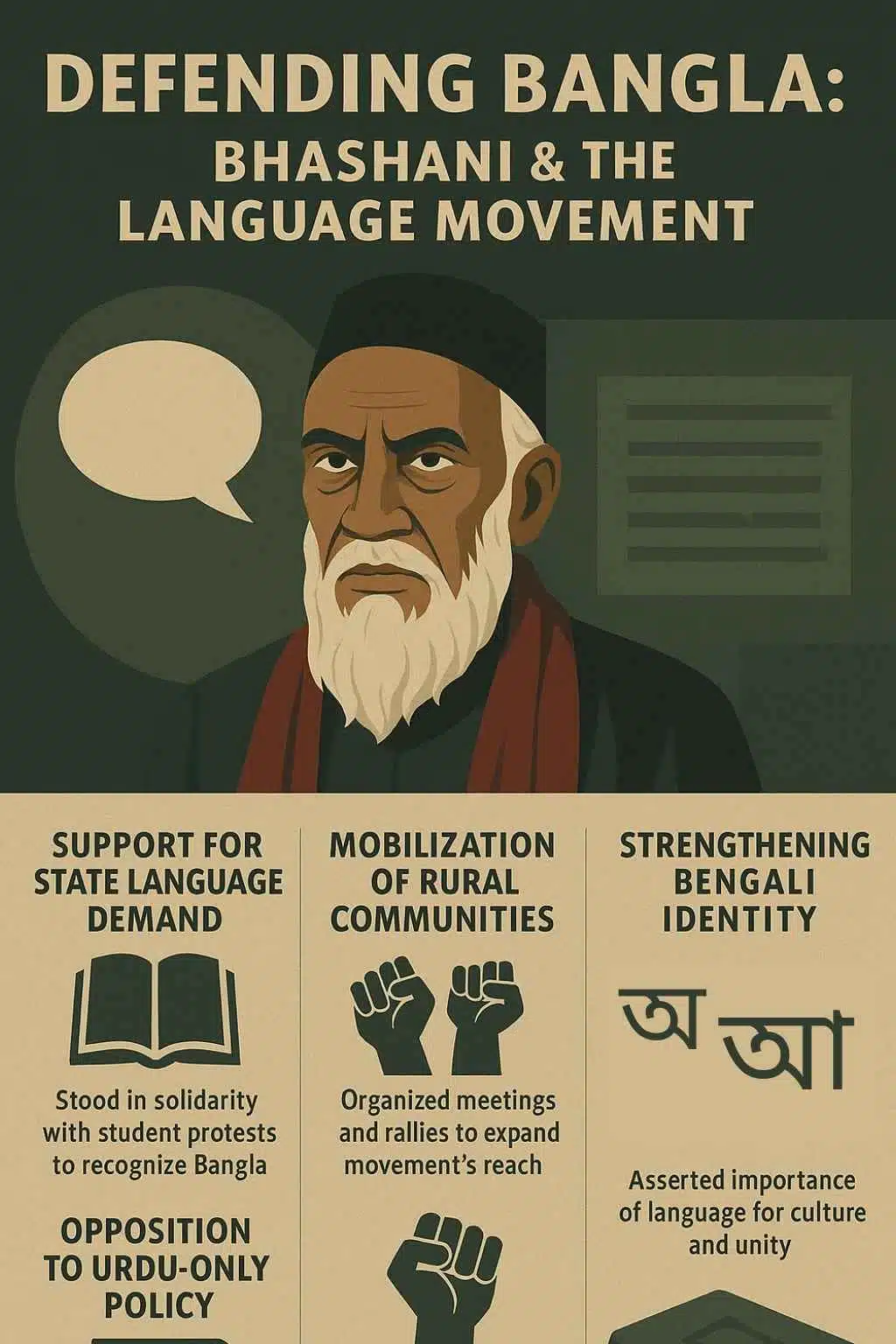
In the early 1950s, the Pakistani state tried to impose Urdu as the sole state language, sparking outrage in Bengali-majority East Pakistan.
Bhashani was one of the few national leaders who fully backed the students during the Language Movement of 1952. While others hesitated, Bhashani demanded that Bangla be made a state language. His support legitimized the student protests in the eyes of the rural population. By 1954, the mood in East Pakistan had turned decisively against the Muslim League.
Bhashani joined forces with Huseyn Shaheed Suhrawardy and A.K. Fazlul Huq to form the Jukto Front (United Front). They campaigned on the famous “21 Points” manifesto. Bhashani’s rallies were electric; he traveled deep into the villages, explaining in simple dialects how the central government was exploiting them. The United Front routed the Muslim League in the election, a victory largely credited to Bhashani’s mass mobilization.
The Great Split: Kagmari Conference (1957)
By the mid-1950s, a rift was forming within the Awami League. On one side were the centrists led by Suhrawardy, who favored a pro-American foreign policy and military pacts like CENTO and SEATO. On the other hand was Bhashani, who believed in non-alignment, Afro-Asian solidarity, and closer ties with China.
The Kagmari Conference
The tension boiled over at the cultural and political conference held in Kagmari, Tangail, in February 1957. This event is a watershed moment in Bangladesh’s history. During the conference, Bhashani delivered a prophetic warning to the West Pakistani ruling class. He declared that if the economic exploitation of East Pakistan did not stop, the people of the East would be forced to say “Assalamu Alaikum” (Goodbye) to Pakistan.
This was one of the first public hints at secession, shocking the political establishment. Suhrawardy, then the Prime Minister of Pakistan, tried to defend the pro-US pacts, but Bhashani would have none of it. He believed these pacts were tools of imperialism.
National Awami Party (NAP) and the Turbulent 1960s
Unwilling to compromise his anti-imperialist principles, Bhashani walked away from the party he founded. In July 1957, he formed the National Awami Party (NAP). This new party became the home for leftists, communists (who were banned from operating openly), and progressive intellectuals. It marked Bhashani’s definitive shift toward a distinct brand of politics that fused faith with radical socialism.
NAP’s agenda included:
- Provincial autonomy for East Pakistan
- Secular, democratic politics
- Socialist-oriented economic reforms
During the Ayub Khan military regime (from 1958 onward), NAP became a major opposition force. Under Bhashani’s leadership, NAP was particularly strong among peasants and workers. The party later split into pro-Moscow and pro-Beijing factions, with Bhashani leading the pro-Beijing wing, which maintained a more radical, anti-imperialist line.
Bhashani also popularised militant forms of protest, such as “Gherao”—a tactic in which officials or owners were surrounded by workers until demands were heard.
“Red Maulana”: Religion, Socialism, and Peasant Struggle
Bhashani’s ideology during this period is often termed “Islamic Socialism.” He argued that the Quranic concept of Rububiyat implies that Allah is the sustainer of all. Therefore, a society that allows a few to hoard wealth while others starve is a violation of divine law. This interpretation allowed him to be a pious Maulana and a radical socialist simultaneously, confounding his critics.
The China Connection
In 1963, Bhashani visited the People’s Republic of China and met with Mao Zedong. The two leaders reportedly bonded over their shared rural roots and distrust of Western imperialism. This visit cemented Bhashani’s pro-China stance, which would later complicate his position during the 1971 war (as China supported Pakistan). However, locally, it bolstered his image as a revolutionary.
The 1969 Mass Uprising
While Sheikh Mujibur Rahman was imprisoned during the Agartala Conspiracy Case, a leadership vacuum emerged. The movement against the dictator Ayub Khan seemed to be losing steam. It was Bhashani, then in his late 80s, who reignited the fire. He declared a policy of Jalao-Gherao (Burn and Surround), urging the masses to besiege government offices.
His call to action brought the rural peasantry into the streets, merging with the urban student movement. The pressure became unbearable for the regime. Ayub Khan was forced to withdraw the conspiracy case and release Sheikh Mujib. It is often said that while Mujib was the symbol of Bengali nationalism, Bhashani was the battering ram that broke down the prison doors.
“Voter Baksho Lathi Maro.”
In 1970, a massive cyclone devastated coastal East Pakistan. Bhashani was the first leader to reach the remote affected areas. Appalled by the central government’s apathy toward the dying victims, he returned to Dhaka and famously boycotted the 1970 general elections, chanting “Voter baksho lathi maro” (Kick the ballot box). He believed that participating in elections under a military junta that didn’t care about its people was futile. Instead, in November 1970, he publicly called for an independent East Pakistan, months before the official declaration of independence.
Life of Maulana Bhashani During the Liberation of Bangladesh (1971)
As tensions between East and West Pakistan worsened in the late 1960s, Bhashani increasingly spoke in favour of “Swadhin Bangla” (Independent Bengal). He refused to participate in the 1970 elections, predicting they would not solve the underlying conflict.
When the Pakistan army launched Operation Searchlight on March 25, 1971, they burned Bhashani’s home in Santosh. He narrowly escaped and made his way to the Indian border.
Despite his past differences with the Awami League and his pro-China leanings, Bhashani threw his full weight behind the Liberation War. He became the Chairman of the All-Party Advisory Council to the Mujibnagar Government. Living in exile in India/Dehradun, the 90-year-old leader lived in simple conditions and wrote letters to world leaders.
On 22 January 1972, after about nine months in India, he returned to an independent Bangladesh, seeing his long-cherished dream realised.
The Final Battles: Haq Katha and Farakka (1972–1976)
After independence, Bhashani returned to a devastated Bangladesh. He did not seek power. While his former protégé, Sheikh Mujib, became the Prime Minister, Bhashani took up the role of the opposition.
He saw that the new country was plagued by corruption, looting of relief goods, and a lack of food. To voice his dissent, he started a weekly newspaper called Haq Katha (The Truth). The paper was incendiary. It exposed corruption within the ruling party and criticized the government’s close ties with India. It became so popular that it rivaled major dailies in circulation, until it was eventually banned.
The Farakka Long March
His final act of defiance came in 1976. India had commissioned the Farakka Barrage, which diverted water from the Ganges River, causing desertification in northern Bangladesh. Bhashani, now 96 years old and frail, organized the Farakka Long March.
On May 16, 1976, he led thousands of people towards the border. His speech that day was thundering: he warned that Bangladesh would not accept being dried out by its neighbor. This march internationalized the water dispute and remains a symbol of Bangladesh’s fight for environmental sovereignty.
The Builder: Educational Legacy and the Santosh Project
While history remembers Maulana Bhashani primarily as an agitator who tore down regimes, he was equally passionate about building institutions. He believed that political freedom was meaningless without intellectual emancipation. Unlike many politicians who focused on urban development, Bhashani’s vision was strictly rural.
The Santosh Dream
His crowning achievement in this regard was the development of Santosh in Tangail. He envisioned Santosh not just as a village, but as a modern education hub for the peasantry. He established the Santosh Islamic University (now Mawlana Bhashani Science and Technology University) with a unique curriculum that combined Islamic values with modern science and technical skills. His logic was simple: a farmer’s son should know the Quran, but he must also know how to operate a machine.
Institutions Across the Land
His educational crusade wasn’t limited to Tangail. Throughout his life, he is credited with establishing nearly 19 primary schools and three colleges, including the Mohipur Haji Mohsin College in Joypurhat and the Nazrul College in Tangail.
He famously said,
“I want to build a university where the students will not wear suits and ties, but lungis and panjabis. They will work in the fields with one hand and hold a book in the other.”
This philosophy of “dignity of labor” was decades ahead of its time in the subcontinent’s education system. By omitting this side of him, we risk painting him only as a destroyer of status quos, ignoring his role as a creator of future generations.
Personal Life: Simplicity, Faith, and Fearlessness
Despite his fame, Bhashani lived a starkly simple life. He usually wore coarse cotton clothes and a trademark red or ochre shawl, walked barefoot or in simple sandals, and preferred rustic food. He often stayed among ordinary villagers in Santosh, Tangail, which became closely associated with his name.
He was shaped by the Deobandi movement and Sufi influences, spending much time in prayer and reflection. Unlike many leaders, he did not accumulate wealth or build a political dynasty. He had little patience for hypocrisy, whether from religious leaders, politicians, or foreign powers.
He married more than once and had several children, but his public persona remained that of a leader who belonged first to the people, not to a private life.
Death and Final Resting Place
Maulana Bhashani passed away on 17 November 1976 at Dhaka Medical College Hospital, at around the age of 96.
He was buried at Santosh, Tangail, the place from which he had led so many movements and where countless ordinary people came to pay their respects. His funeral drew a huge crowd, reflecting how deeply the life of Maulana Bhashani had touched the masses.
Legacy: How History Remembers Maulana Bhashani
Maulana Bhashani is remembered as a founding president of the Awami League, the creator of the National Awami Party, and one of the most influential champions of left-leaning, peasant-based politics in Bengal. His ideological clarity and mass appeal made him a key force behind the Bengali liberation movement.
Unlike contemporaries such as Sheikh Mujibur Rahman, the Father of the Nation, or Huseyn Shaheed Suhrawardy, a prominent statesman of Pakistan, Bhashani is often regarded as the “uncrowned emperor of the poor,” a leader who rejected comfort, privilege, and political convenience.
He consistently chose the harder path, walking away from powerful positions, refusing elections he felt were unjust, and standing firmly with peasants and workers even when it isolated him from political elites. His legacy endures as a symbol of moral courage, grassroots leadership, and an unwavering commitment to justice.
Controversies and Criticisms: A Leader Who Invited Debate
Despite his enormous popularity, Maulana Bhashani was never free from controversy. His unconventional choices, ideological shifts, and confrontational style often put him at the center of political debate.
His support for socialism and ties to leftist movements — especially the pro-Beijing faction of NAP — led critics to label him a “communist agitator.” Conservative leaders accused him of importing foreign ideologies, though he argued that socialism aligned with the Islamic obligation to protect the poor.
One of the most debated decisions in the life of Maulana Bhashani was his refusal to participate in the 1970 general elections. Critics say this weakened leftist representation. Supporters argue he foresaw the escalating crisis that would soon lead to the war of independence.
Another controversy is tensions with Sheikh Mujibur Rahman. Some accuse Bhashani of being too harsh on Mujib’s post-independence government. Others believe this made him the necessary voice of accountability in a fragile new nation.
There were also misunderstandings about his religious identity. Because he embraced socialism, some questioned whether he abandoned Islamic principles. But those who knew him personally described him as deeply spiritual, often in prayer, fasting regularly, and leading a simple communal religious life.
His controversies did not diminish him — they made him more human, more complex, and more historically intriguing.
Frequently Asked Questions About The Life of Maulana Bhashani
Who was Maulana Abdul Hamid Khan Bhashani?
Maulana Bhashani was a Bengali political leader, Islamic scholar, and peasant-rights activist known for his socialist ideals and major influence on the political movements that led to Bangladesh’s independence.
Why is he called the “Red Maulana”?
He earned the title for his left-leaning, pro-socialist politics and his strong advocacy for peasants, workers, and anti-imperialist causes.
What was his role in the Language Movement of 1952?
Bhashani supported the demand for Bangla as a state language and helped mobilize rural support, strengthening the movement’s political legitimacy.
What happened at the Kagmari Conference in 1957?
At Kagmari, Bhashani symbolically said “Assalamu Alaikum” to Pakistan, signaling growing Bengali frustration and foreshadowing the future independence movement.
What is Maulana Bhashani’s lasting legacy?
He is remembered as a fearless champion of the poor, founder of key political parties, and a guiding ideological force behind the liberation of Bangladesh.
Final Words: The Life of a Revolutionary Leader
The Life of Maulana Bhashani was a century-long struggle for justice. He was a man who could have held the highest offices in the land but chose the life of a mystic revolutionary. He served as the vital “left conscience” of Bangladesh politics—always pulling the center toward the poor, the landless, and the voiceless.
Today, as we look back at his life, we see a model of leadership that is incredibly rare: selfless, fearless, and utterly devoted to the common man. He taught a nation that silence in the face of injustice is a sin, a lesson that resonates just as loudly today as it did when he first cried “Khamosh!” (Silence!) to the tyrants of his time.