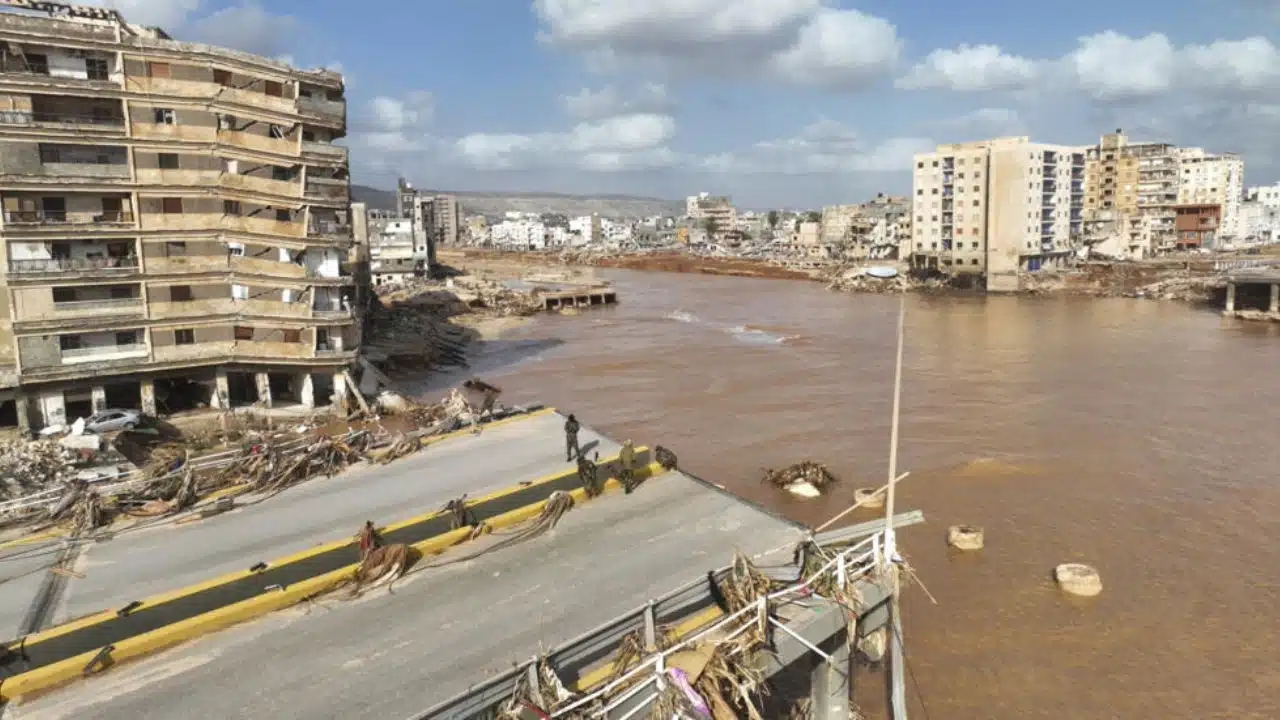
The tragedy is Africa’s deadliest storm on record, with seven of the top 30 deadliest weather disasters in Africa since 1900 occurring in the last two years.
On Sunday and Monday, Africa’s deadliest storm in recorded history slammed eastern Libya, killing hundreds and putting an already struggling society through a massive recovery effort. According to EM-DAT, the international catastrophe database, Storm Daniel’s preliminary death toll of 5,300 in Libya as of Wednesday morning surpassed the 1927 floods in Algeria (3,000 fatalities) as the deadliest storm in Africa since 1900. Storm Daniel is also the deadliest storm in the world since Super Typhoon Haiyan killed 7,354 people in the Philippines in 2013.
Storm Daniel caused the biggest flooding in the port city of Derna (population 90,000), when the neighboring Derna and Abu Mansur dams, both roughly 50 years old, failed, allowing a wall of water to tear through the heart of town along the Wadi Derna, which is a dry riverbed for much of the year. Floodwaters swamped some structures and caused others to collapse, carving a passage 100 meters (320 ft) wide.
On Wednesday, Derna was remained largely inaccessible, making it difficult to estimate the flood’s full scope. For more than a decade, the conflict-torn eastern and western portions of Libya have operated mainly apart from one another, complicating efforts to solve the disaster.
According to Reuters, the head of the Wahda Hospital in Derna reported 2,300 deaths on Tuesday. Later that day, a spokesperson for eastern Libya’s interior ministry told the Associated Press that the dead toll in Derna had risen to more than 5,300, and the Libyan Red Crescent Society believed that at least 10,000 people were missing. Flooding in other parts of northeast Libya killed hundreds more people.
Medicanes, Storm Daniel, and Floods in Libya
Storm Daniel, a medicane (shorthand for Mediterranean tropical-like cyclone) that traveled southward into Libya as an unusually well-formed system with gale-force winds reported northwest of its core, delivered the torrents that triggered the Libya floods. Daniel will undoubtedly be the most lethal and expensive medicane ever documented.
The term “Medicane” refers to storms that exhibit tropical features just off the coast of southern Europe. (A medicane has no official definition, though one organization is seeking to construct one.) Medicanes are rarely full-fledged tropical systems with a warm core since they develop from cold-cored upper-level lows, and the Mediterranean seas aren’t large or warm enough to support a major hurricane. Moreover, despite the name’s meaning, only few medicanes generate sustained winds as strong as a Category 1 hurricane.
If a normal medicane occurred outside of the Mediterranean, it would be categorized as a subtropical storm and given a name by the National Hurricane Center, but there is no formal agency in charge of naming subtropical or tropical storms in the Mediterranean. The Greek meteorological office dubbed Daniel since it caused fatal flooding in Greece and Turkey last week when it transitioned from a cold-core upper low to a medicane..
After the center of Daniel moved onto the Libyan coast near Benghazi, about 100 miles west-southwest of Derna, analysis from the University of Wisconsin-Madison’s MIMIC-TPW2 system revealed that precipitable water – the amount of moisture above a point at ground level – was in the 51-76 millimeters (2-3 inch) range around the center of Daniel. Such moisture readings would be outstanding even in late July throughout the United States’ Gulf Coast, which has a far wetter climate than coastal Libya. Additionally, you can also read about- Libya Flood Death Toll: Derna flooding Could Take 20,000 Lives, Thousands Still Missing
Each year, one or two medicanes form in the Mediterranean, but they seldom make their way to Libya. Derna receives only 10.8 inches of rain per year, with cool-season storms accounting for more than 90% of that total from October to April. As Daniel’s moisture-laden winds were propelled upward by striking the compact Jebel Akhdar plateau (Green Mountains), an enormous amount of rain was squeezed out. The plateau can reach heights of up to 900 meters (3,000 feet) above the Mediterranean shore.
The largest rainfall total in Daniel recorded by Libya’s poor observation network occurred in Bayda, when flooding killed at least 50 people. Bayda is located on the Jebel Akhdar plateau, approximately 40 miles west of Derna. From 8 a.m. Sunday to 8 a.m. Monday, the city recorded 414.1 millimeters (16.30 inches). In comparison, the September average in Bayda is 6 mm (0.24 inches), and the yearly average is 540 mm (21.26 inches).
Medicanes Are Expected to Become Fewer but Stronger as the Earth Warms
The meteorological poor luck of Daniel touching ashore right above a tight zone of higher elevation contributed to the Libya flood calamity. But that’s only half the tale. Human-caused climate change is increasing the ability of tropical cyclones and other storms to deliver heavy rain by drawing more water vapor from the oceans into a warming atmosphere.
Over the last 40 years, the Mediterranean Sea has warmed by about 2 degrees Celsius (3.6 degrees Fahrenheit). According to the Spanish research organization CEAM, the Mediterranean’s daily average sea surface temperatures this summer set new records for July (reaching 28 degrees Celsius or 82°F for the first time in any month) and August.
The Intergovernmental Panel on Climate Change observed in its recent Sixth Assessment Report that the long-term outlook for medicanes is similar to that of tropical cyclones: fewer, but stronger on average. “A growing body of literature has consistently found that the frequency of medicanes decreases under warming, while the strongest medicanes become stronger.” The IPCC also stated that “the frequency of Mediterranean wind storms reaching North Africa, including medicanes, is projected to decrease, but their intensities are projected to increase, by the mid-century and beyond.”
Dr. Liz Stephens, an associate professor of climate risks and resilience at the University of Reading, summarized, “Climate change is thought to be increasing the intensity of the strongest medicanes, and we are confident that climate change is supercharging the rainfall associated with such storms.”
Climate warming may have an impact on mid-latitude atmospheric blocking in the summer, which caused Storm Daniel as well as record heat in central Europe and another cold-core low that caused flooding in Spain. Possible explanations include disproportionate warming in the Arctic compared to mid-latitude areas, while the impacts of Arctic warming on “weather weirding” are still being explored and discussed.
Compounding the Disasters: Increased Vulnerability
Climate change does not happen in a social or environmental vacuum. Changes in ecosystems, housing patterns, and infrastructure can overlap in ways that exacerbate the risks posed by a changing climate by increasing our vulnerability to extreme weather events, whether it’s the proliferation of non-native grasses in Hawaii or frenzied development along the Gulf or Atlantic coast.
In the case of Libya, poor upkeep of the Derna-area dams may have contributed to this week’s disaster. According to Sky News, last year’s research by civil engineer Abdelwanees A R Ashoor (Omar al Mukhtar University) cautioned that the city’s inherently flood-prone topography may lead to calamity if local dams were not adequately maintained.
According to the World Meteorological Organization, Libya’s meteorological organization issued warnings for Daniel three days in advance, and a state of emergency was imposed for sections of eastern Libya. It’s unclear how much of a difference these warnings made, especially considering Storm Daniel’s unusual nature and the sudden start of floodwaters in Derna.
Climate Change Is Making African Weather Disasters More Severe
Despite recent advances in weather forecasting technology and increasing catastrophe awareness and preparedness, Africa has experienced an unprecedented number of devastating weather-related disasters in the last two years. The Libyan disaster is the seventh weather-related disaster to kill at least 500 Africans since 2022; 23% of Africa’s 30 deadliest weather-related disasters since 1900 have occurred in the last two years. This foreboding statistic could be a portent of things to come, as increased vulnerability, a growing population, and more extreme weather events caused by climate change create an increase in catastrophic calamities.
Climate science advancements have enabled scientists to investigate whether human-caused climate change influenced a specific tragedy, a subject known as attribution science. Scientific attribution studies have identified a human climate change influence in more than 20 African extreme weather events since 2000, including 13 droughts, seven floods, and two heat waves. Drought and catastrophic flood-producing rains in Africa, as in other parts of the world, have been linked to climate change in multiple World Weather Attribution group (WWA) investigations.
- WWA determined that “climate change has made events like the current drought much stronger and more likely; a conservative estimate is that such droughts have become about 100 times more likely.”
- A WWA research on the South African floods of 2022, which killed 544 people, published in May 2022, determined that “greenhouse gas and aerosol emissions are (at least in part) responsible for the observed increases [in rainfall].”
- A separate WWA analysis indicated that human-caused climate change rendered the summer 2022 floods in West Africa “about 80 times more likely and approximately 20% more intense.”
- However, the World Wildlife Fund’s June 2023 assessment for the floods that killed 603 people in Rwanda and the Democratic Republic of the Congo stated that “the scarcity of data does not allow us to draw any conclusions on the role of climate change in the floods.”