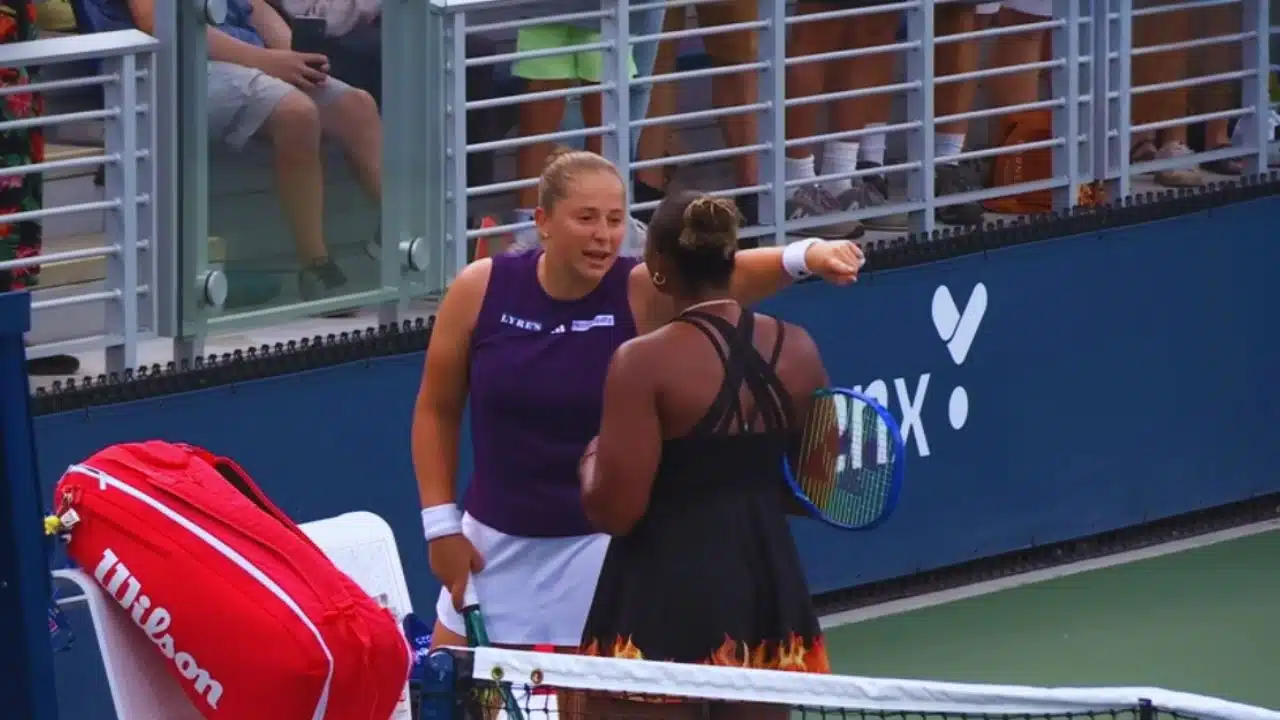
The 2025 US Open saw a dramatic moment during the second-round clash between Latvia’s Jelena Ostapenko and American Taylor Townsend. The match itself ended with Townsend securing a convincing straight-sets victory, 7–5, 6–1, but the on-court tension didn’t end with the final point.
As the two players approached the net for the customary handshake, they became engaged in a heated verbal exchange. Ostapenko, clearly upset, accused Townsend of having “no class” and “no education.” The words, spoken in frustration, quickly went viral across social media and major sports outlets, sparking debate not only about sportsmanship but also about cultural sensitivity and racial undertones in tennis.
The Source of the Dispute
According to Ostapenko, the argument stemmed from an incident during the match where Townsend benefitted from a net cord. In tennis tradition, when a ball clips the net and still goes over to win a point, it is customary—and considered good etiquette—for the player who benefits to say “sorry” as a sign of acknowledgment.
Ostapenko claimed that Townsend failed to do so, which she interpreted as disrespect. On Instagram, Ostapenko later wrote:
“There are some rules in tennis which most of the players follow and it was the first time ever that this happened to me on tour. If she plays in her homeland, it doesn’t mean that she can behave and do whatever she wants.”
For Ostapenko, this breach of etiquette was the spark that ignited her frustration, leading to the remarks at the net. However, what might have been intended as criticism of sporting manners quickly took on a larger meaning once interpreted in the broader social and racial context of tennis.
Ostapenko’s Public Apology and Clarification
Three days later, Ostapenko took to Instagram to issue an apology. In her statement, she admitted that English is not her first language and explained that by “education,” she was referring to tennis etiquette, not academic intelligence or personal background.
She wrote:
“English is not my native language, so when I said education, I was speaking only about what I believe as tennis etiquette, but I understand how the words I used could have offended many people beyond the tennis court.”
The Latvian player went further, acknowledging that her words were poorly chosen and could carry unintended offense. She emphasized her commitment to growing and learning both as an athlete and as a person, recognizing that athletes carry responsibilities beyond the boundaries of competition.
Townsend’s Professional Response
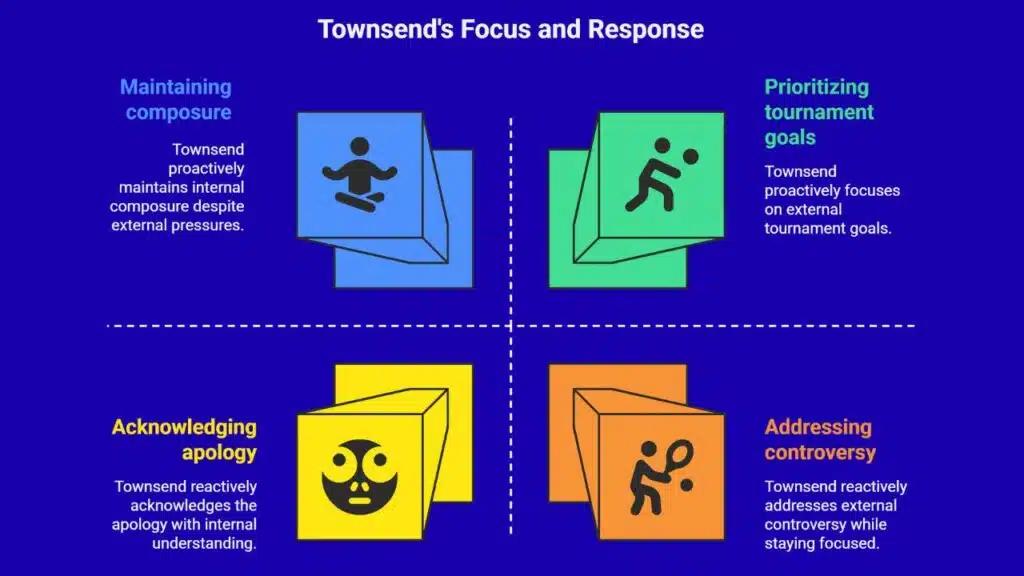
Despite the controversy swirling around the incident, Taylor Townsend remained focused on her tennis. After partnering with Kateřina Siniaková to win her doubles match, Townsend was asked about Ostapenko’s apology.
She admitted she hadn’t seen the apology and hadn’t been contacted directly by Ostapenko. Nevertheless, she responded with composure:
“That’s nice that she did that. That’s fine, that’s cool. At the end of the day, I think it’s a learning lesson for her… you can’t push your expectations on other people.”
Townsend stressed that her priority remained her performance on court and her larger goals in the tournament, pointing out that distractions—whether controversies or outside criticism—had no place in her pursuit of success.
Her focus has paid off. Following the win against Ostapenko, she went on to defeat world No. 5 Mirra Andreeva 7–5, 6–2, advancing to the fourth round of the US Open. There, she is set to face two-time Grand Slam champion Barbora Krejčíková with a place in the quarterfinals at stake.
Strong Reactions Across the Tennis World
The incident did not go unnoticed among fellow players and commentators. Naomi Osaka, a four-time Grand Slam champion, was particularly outspoken. She told reporters that Ostapenko’s choice of words carried troubling implications:
“I think obviously it’s one of the worst things you can say to a Black tennis player in a majority-white sport… I know Taylor, and I know how smart she is, so she’s the furthest thing from uneducated.”
Osaka emphasized that the phrase “no education” has historically been weaponized against Black athletes and professionals in ways that extend far beyond tennis. She noted that while Ostapenko may not have intended this context, ignorance of cultural and racial history is no defense against the harm such language can cause.
Coco Gauff also weighed in, supporting Townsend and underlining her resilience and professionalism. For Gauff and Osaka, the issue highlighted a broader challenge facing tennis as it continues to evolve into a more inclusive sport.
The Role of Tennis Etiquette and Cultural Sensitivity
While the US Open incident began with a discussion about etiquette, it quickly became a flashpoint for larger conversations. Tennis, unlike many other sports, has a deep tradition of unwritten codes—such as apologizing for a lucky net cord, maintaining respectful handshakes, and observing certain on-court courtesies.
When those traditions are broken, especially in a high-stakes Grand Slam event, emotions can run high. However, in today’s global sporting environment, players’ words are scrutinized not only for sportsmanship but also for their cultural and social implications.
The Ostapenko-Townsend exchange illustrates how quickly a comment made in frustration can escalate into a broader controversy, especially when layered with issues of race, culture, and international visibility.
The Bigger Picture
This controversy also serves as a reminder of how elite athletes carry dual responsibilities: to compete fiercely and to represent themselves in a global spotlight. Ostapenko’s clarification and apology may not erase the sting of her original remarks, but they show an awareness of the power of language in shaping perceptions.
For Townsend, the episode has further highlighted her composure, focus, and resilience in navigating challenges beyond the tennis court. With strong performances continuing into the later rounds of the US Open, she has demonstrated the ability to let her tennis speak louder than the controversy.
The Information is Collected from CNN and Sky Sports.