Faruq Mahfuz Anam, better known simply as James, is celebrated as the undisputed Guru of Bangladeshi rock. His story is not just about music but about shaping an entire cultural movement that bridged generations. From his early days in Chittagong to becoming the frontman of the legendary band Feelings, James carved a new sound that blended Western psychedelic and blues rock with the heart of Bangla folk. This experiment gave birth to a style that millions still cherish today.
When Feelings transformed into Nagar Baul in 1999, James redefined what it meant to be an urban mystic, fusing raw rock energy with the lyrical soul of Bangladesh. His songs like Anonna, Palabe Kothay, and Dukhini Dukkho Korona became anthems, while his Bollywood playback hits like Bheegi Bheegi proved his versatility beyond borders.
Today is his 61st birth anniversary. Happy Birthday, James. This article explores the James Journey from Feelings to Nagar Baul, tracing how he became a true rock icon of Bangladesh, inspiring countless bands and earning a timeless place in Bangla rock history.
Early Life and Musical Influences
James was born on October 2, 1964, in Naogaon, Bangladesh. His family later moved to Chittagong, where he spent his formative years. Growing up in the 1970s and 1980s, James was drawn to music from an early age. He developed a deep fascination with the guitar, which soon became an extension of his identity.
Like many aspiring musicians of his generation, he was influenced by Western rock icons such as Eric Clapton, Led Zeppelin, The Doors, and Mark Knopfler. Yet, James didn’t just imitate—he sought to blend the raw, electrifying energy of Western rock with the lyrical spirituality of Bangladeshi folk traditions.
This cultural cross-pollination gave birth to his unique style, which would later revolutionize the country’s music scene.
The Birth of “Feelings”
In the late 1970s, James joined a group of like-minded musicians in Chittagong and formed the band Feelings. The group initially started small, performing in local clubs and college events, but their sound was something new: a daring experiment that combined psychedelic rock riffs with the mysticism of Baul lyrics.
The band quickly gained attention in Dhaka, the cultural capital of Bangladesh. While mainstream Bangladeshi music at the time leaned toward folk and soft melodies, Feelings brought a raw, rebellious edge. Their songs resonated with the frustrations and dreams of a young generation eager for something different.
Transition to “Nagar Baul”
By the late 1990s, James had become the central force of the band. In 1999, the group officially changed its name from Feelings to Nagar Baul.
The name itself carried deep meaning. “Nagar” translates to “urban,” and “Baul” refers to the mystic minstrels of Bengal. Thus, Nagar Baul symbolized a new cultural identity: an urban mysticism where the struggles of city life merged with the timeless philosophy of Baul traditions.
This was more than a rebranding—it was a reinvention. James’ vision transformed the band into a movement that reflected the spiritual search of modern urban youth while keeping the electric pulse of rock alive.
James’ Rise to Rock Stardom
With albums like Anonna (1989), Palabe Kothay (1995), Dukhini Dukkho Korona (1997), and Thik Achhe Bondhu (1999), James became a household name in Bangladesh. His deep voice, guitar mastery, and philosophical lyrics struck a chord with fans who found his music both rebellious and comforting.
James didn’t just play music—he created experiences. His concerts were electrifying, with thousands chanting his songs in unison. Tracks like Jail Theke Bolchhi and Ei Raat Tomar Amar became anthems of youth rebellion.
But James’ influence didn’t stop at the borders of Bangladesh. In the mid-2000s, he entered Bollywood playback singing with iconic tracks such as
-
Bheegi Bheegi (Gangster, 2006)
-
Chal Chalein (Woh Lamhe, 2006)
-
Alvida (Life in a… Metro, 2007)
These songs made him a familiar voice in India, further extending his reputation as a versatile artist.
Legacy and Influence on Bangladeshi Rock
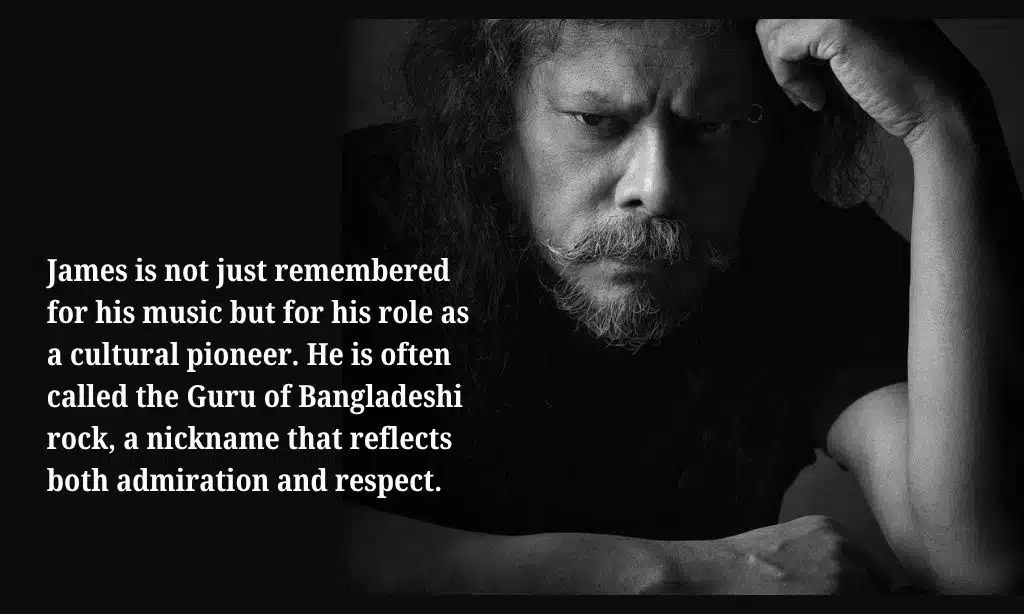
James is not just remembered for his music but for his role as a cultural pioneer. He is often called the Guru of Bangladeshi rock, a nickname that reflects both admiration and respect.
His band Nagar Baul is regarded as part of the “Big Three of Bangla Rock” alongside LRB (Ayub Bachchu) and Ark. Together, they defined an entire era of Bangladeshi rock and set the stage for the next generation of bands.
Awards like the Bangladesh National Film Award for Best Male Playback Singer (for Desha: The Leader in 2014 and Swatta in 2017) highlighted his versatility beyond the rock stage.
Most importantly, James’ influence continues to ripple through young musicians who still look to him as a model of authenticity and passion.
James in the 21st Century—Still Relevant
While many artists fade over time, James has managed to stay relevant. After more than a decade-long break from new releases, he returned with comeback singles like I Love You and Shobi Bhul, proving that his creative fire still burns brightly.
In the age of streaming platforms like Spotify, Apple Music, and YouTube, James’ songs continue to attract new listeners. Younger fans discover his classics online, while longtime followers eagerly attend his concerts, where he performs with the same intensity as ever.
This proves that the James Journey from Feelings to Nagar Baul is not just a story of the past—it’s a living legacy still unfolding today.
Takeaways: James Legacy as a Rock Icon
The James Journey from Feelings to Nagar Baul is more than a story of one man’s rise to fame—it is the history of Bangladeshi rock music itself. From the experimental days of the Feelings band’s history to the powerful identity of Nagar Baul, James proved that music could be both rebellious and deeply rooted in culture. His nickname, the Guru of Bangladeshi Rock, reflects not just his influence as a performer but also his role as a mentor and inspiration to countless young musicians.
Even today, James remains a rock icon of Bangladesh, with his classic Nagar Baul songs still echoing in concerts and digital platforms. His Bollywood playback success added another dimension to his career, but his heart has always stayed with the soul of Bangla rock.
As the music scene evolves, James’ legacy continues to inspire—reminding us that true artistry is timeless. From Feelings to Nagar Baul, his journey is a symbol of passion, resilience, and the everlasting power of rock music.
FAQs About James: From Feelings to Nagar Baul
1. Who is James in Bangladeshi music?
James, whose full name is Faruq Mahfuz Anam, is known as the Guru of Bangladeshi rock. He started his career with the band Feelings, which later became Nagar Baul. With his unique mix of psychedelic rock, blues, and Baul-inspired lyrics, James transformed Bangladeshi music culture and remains one of the country’s most iconic musicians.
2. Why did Feelings change its name to Nagar Baul?
In 1999, the band Feelings was officially renamed Nagar Baul, meaning “urban mystic.” The name reflected James’ vision of blending traditional Baul philosophy with modern rock sounds. This transition marked a new chapter in Bangladeshi rock history, solidifying James’ role as a rock icon of Bangladesh.
3. What are some of James’ most famous songs?
James has delivered numerous timeless hits. Popular Nagar Baul songs include Anonna, Palabe Kothay, Dukhini Dukkho Korona, and Thik Achhe Bondhu. Beyond Bangladesh, he gained recognition in India for Bollywood songs like Bheegi Bheegi and Chal Chalein.
4. Why is James called the “Guru” of Bangladeshi rock?
Fans call James the Guru of Bangladeshi rock because of his pioneering role in shaping the country’s rock scene. Through his journey from Feelings to Nagar Baul, James inspired generations of musicians and created a legacy that continues to influence Bangla rock.
5. Is James still active in music today?
Yes, James remains active in music. Recently, he released comeback singles like I Love You and Shobi Bhul after more than a decade. His concerts still attract thousands of fans across Bangladesh and India, and his work continues to stream widely on digital platforms.