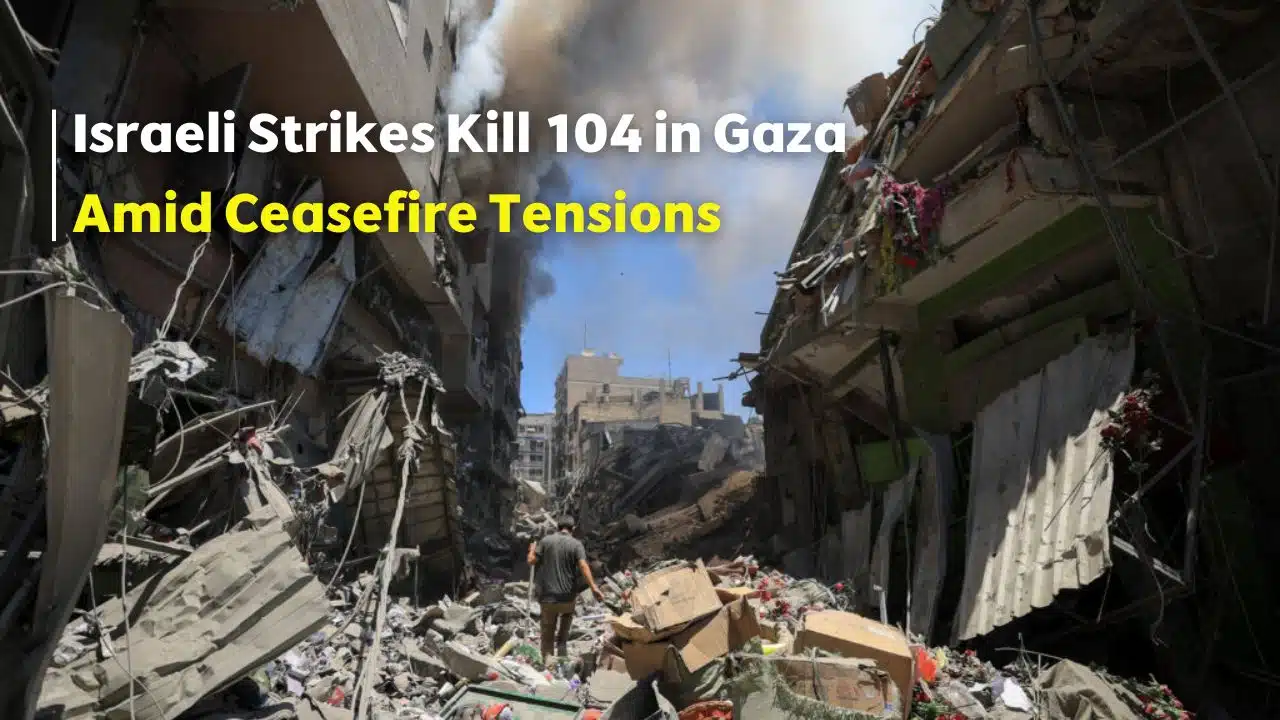
Heavy Israeli strikes killed over 100 Palestinians, including at least 35 children, across the Gaza Strip overnight and into Wednesday, October 29, Palestinian health officials reported. The intense bombardment shattered a fragile, 18-day-old ceasefire, marking the most serious escalation in months.
The strikes, which the Gaza Civil Defence agency called a “catastrophic and terrifying” violation, were launched after an Israeli soldier was killed in southern Gaza and a dispute over the return of hostage remains. In a volatile turn, the Israeli military announced Wednesday morning that following the operation, the ceasefire was “back in effect.”
Key Facts: The Overnight Escalation
- Death Toll: At least 101 Palestinians were killed in less than 12 hours, according to the Gaza Civil Defence. Other reports from local hospitals and TRT World place the toll between 81 and 91, with at least 35 children confirmed among the dead.
- Ceasefire Status: The Israeli military stated Wednesday that “enforcement of the ceasefire has begun anew” after the strikes were completed.
- The Trigger: Israel said the strikes were a response to two events: an attack in Rafah that killed an Israeli soldier and Hamas’s alleged violation of the truce terms regarding the return of hostage remains .
- Hamas Response: The Palestinian group denied involvement in the attack on the soldier, reiterated its commitment to the truce, and called the Israeli bombardment a “blatant violation.
- U.S. Stance: U.S. President Donald Trump, who brokered the truce, said the ceasefire was “not in jeopardy,” adding that Israel “should hit back” after its soldier was killed .
- Overall Toll: The war, which began in October 2023, has killed more than 68,531 Palestinians, according to a Gaza Ministry of Health report on October 28.
Ceasefire in Tatters as Gaza Mourns
The truce that had brought a measure of calm to the Gaza Strip, part of a 20-point U.S.-brokered plan implemented on October 10, was violently undone overnight. Witnesses reported strikes across the enclave, from Gaza City in the north to Khan Younis and Rafah in the south.
Mahmud Bassal, a spokesperson for the Gaza Civil Defence agency, described a “catastrophic and terrifying” situation. “At least 101 fatalities were brought to hospitals, including 35 children and a number of women and elderly, as a result of Israeli air strikes in less than 12 hours,” Bassal told news agency AFP. He called it a “clear and flagrant violation of the ceasefire agreement.”
The strikes hit homes, tents sheltering displaced civilians, and a mosque in Gaza City’s Sabra neighbourhood, according to witnesses and Palestinian news agency Wafa. Hospitals, already shattered by over two years of conflict, were overwhelmed.
Dr. Mohammed Abu Selmia, director of Shifa Hospital, told The Associated Press that the death toll was likely to rise, as many of the wounded were in critical condition. The Al-Aqsa Hospital in Deir al-Balah, Nasser Hospital in Khan Younis, and Al-Awda Hospital in central Gaza all reported receiving dozens of bodies, a large percentage of them women and children.
The Flashpoint: How the Truce Unraveled
The sudden and intense escalation followed a day of rising tension, culminating in an order from Israeli Prime Minister Benjamin Netanyahu for “immediate and powerful strikes.The decision was reportedly triggered by two primary incidents.
The Soldier’s Death in Rafah
On Tuesday afternoon, an Israeli soldier, identified as Master Sgt. Yona Efraim Feldbaum, 37, was killed by what the Israeli military called “enemy fire” in the southern Gaza city of Rafah. The attack, which Israeli media said involved an anti-tank missile and gunfire, was seen by Israel as a major breach of the truce.
Hamas, in a statement, insisted its fighters had “no connection to the shooting incident in Rafah” and reiterated its commitment to the ceasefire. The group accused Israel of “fabricating false pretexts” to justify a new offensive.
The Hostage Remains Dispute
Compounding the firefight was a furious dispute over the terms of the hostage exchange. Under the ceasefire, Hamas is required to return the remains of all Israeli hostages.
Israeli officials accused Hamas of a “clear violation” after the group on Monday returned body parts that Israel claimed belonged to a hostage whose remains its own troops had recovered two years prior . The Israeli military released drone footage which it claimed showed Hamas members “staging a false discovery” of the remains.
Hamas, in turn, accused Israel of obstructing its efforts to locate bodies amid the vast destruction and blamed Israel for violating the truce. Following Netanyahu’s order to strike, Hamas announced it was delaying the planned handover of another hostage’s remains
Diplomatic Fallout and Official Responses
The violence sent shockwaves through the region and drew a swift response from Washington.
United States: Speaking to reporters aboard Air Force One during an Asia tour, U.S. President Donald Trump defended Israel’s action while insisting the truce would hold. “They killed an Israeli soldier. So the Israelis hit back. And they should hit back,” Trump said. He added that “nothing’s going to jeopardise” the ceasefire
Israel: Top Israeli officials were adamant in their response. Defence Minister Israel Katz said the attack on IDF soldiers “crosses a glaring red line” and that Hamas would “pay many times over. Hours later, after the bombardment, the Israeli military’s statement claimed a “renewed enforcement of the ceasefire,” suggesting the operation was a limited, punitive action rather than a full-scale return to war.
Palestinian Factions: Hamas called the strikes a “blatant violation” and called on international mediators, including the U.S., to “pressure Israel to stop”.
The Data: A New Spike in a Devastating War
Today’s casualties represent the deadliest 24-hour period since the ceasefire began on October 11. The figures highlight the war’s staggering human cost.
- Statistic 1: The Overnight Toll (Oct 29, 2025) The death toll from the overnight strikes varies by source as reports are confirmed.
- Gaza Civil Defence: 101+ killed, including 35 children
- TRT World: 91+ killed, including 35 children
- Associated Press: 81+ killed This discrepancy is common in breaking news, as hospital morgues and rescue teams update their counts.
- Statistic 2: Total Ceasefire-Era Toll Even before this latest escalation, the ceasefire had been marked by violence. As of October 28, 2025, before the overnight strikes, Gaza’s Health Ministry reported that 93 Palestinians had been killed and 324 injured in various Israeli attacks since the truce began on October 11. Today’s toll of over 100 people was killed in less than 12 hours, a massive acceleration of violence.
- Statistic 3: The Total War Toll (Oct 2023 – Present) The Gaza Ministry of Health’s latest comprehensive update, released on October 28, 2025, stated that 68,531 Palestinians have been killed and 170,402 injured since the war began on October 7, 2023
What to Watch Next
The immediate future of Gaza hinges on whether the “renewed” ceasefire holds. The day’s events demonstrate that the truce is exceptionally fragile and that the core issues of the conflict remain unresolved.
- Risk of Retaliation: The key question is whether Hamas or other Palestinian factions will retaliate for the killing of over 100 people, potentially locking both sides into a new cycle of violence that leads to the truce’s permanent collapse.
- Mediators’ Role: The U.S., Egypt, and Qatar, who mediated the truce, will be scrambling to de-escalate tensions and secure a more stable commitment from both sides.
- Hostage Negotiations: The dispute over remains is a major sticking point. The next phase of the truce, which reportedly involves further prisoner-for-hostage swaps and reconstruction, is now in serious doubt.
The situation on the ground remains catastrophic, with the UN warning that 1.5 million people in Gaza are in urgent need of humanitarian aid. For the civilians who once again spent the night under bombardment, the claim that the ceasefire is “back on” offers little comfort amid the ruins.