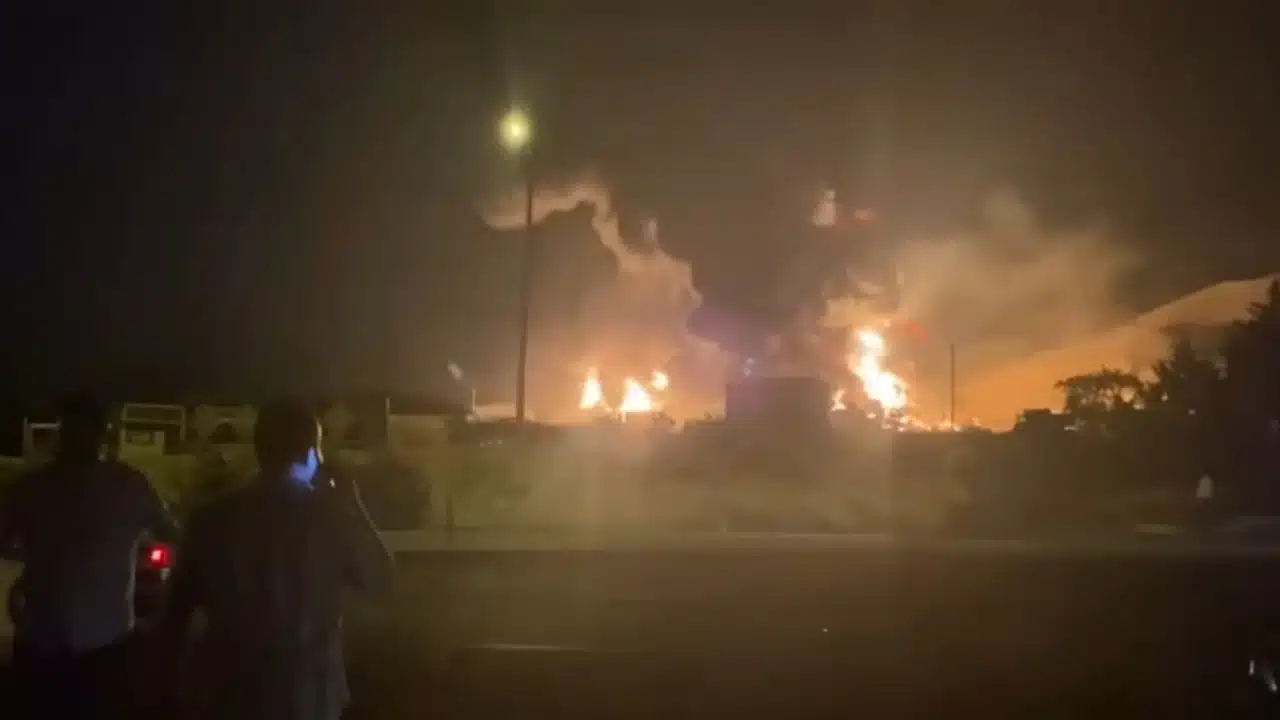
Tensions between Israel and Iran reached new heights on Monday as the Israeli military launched a new wave of airstrikes deep inside Iranian territory.
The latest attacks have targeted not only military installations but also public infrastructure, including a hospital and a municipal fire station, prompting renewed concerns about civilian safety and the growing humanitarian fallout.
Farabi Hospital in Kermanshah Damaged During Nearby Airstrike
One of the most alarming incidents occurred in Kermanshah, a city in western Iran, where Farabi Hospital sustained significant damage after an Israeli airstrike reportedly struck a nearby industrial workshop suspected of being connected to Iran’s military operations. Although the hospital itself was not the intended target, the shockwaves and debris from the nearby explosion shattered windows, collapsed ceilings, and caused structural damage throughout the building.
Iran’s state-affiliated Fars News Agency released videos showing the aftermath: gurneys overturned, equipment damaged, and shattered glass strewn across patient rooms. Hospital staff could be seen helping patients evacuate or moving them to safer areas, with emergency services working through the rubble. While no fatalities were immediately confirmed from the hospital incident, local health officials reported multiple injuries among both patients and staff due to flying debris and building collapse.
Municipal Fire Brigade Building in Ilam Also Hit
In a separate incident, Israeli drones struck a municipal fire brigade facility in the city of Musian, located in Iran’s Ilam province, close to the Iraq border. According to News Agency, the attack caused fires to erupt near the facility, ironically forcing local firefighters to respond to destruction within their own compound. Videos circulating online showed flames and smoke engulfing parts of the station, with emergency responders struggling to contain the damage.
Residents nearby reported a loud blast followed by sirens, causing panic and prompting some families to flee their homes. Eyewitness accounts described a “sudden inferno” that erupted shortly after drones buzzed overhead. Iranian emergency authorities condemned the attack as a clear violation of international law targeting civil defense structures.
Iran Claims to Down Multiple Israeli UAVs
Following these events, Iranian state defense forces claimed that their air defense systems intercepted and destroyed several Israeli drones operating in western Iran. According to Tasnim News, among the drones shot down were MQ-9 Reapers and at least seven other advanced unmanned aerial vehicles (UAVs). These drones, often equipped for long-range surveillance and precision targeting, are central to Israeli air operations.
Iranian military personnel released footage that purportedly showed several downed drones, with smoke rising from crash sites in the Kermanshah and Ilam regions. Tehran emphasized that these UAVs were engaged in unauthorized surveillance and offensive operations against civilian infrastructure.
Over 50 Israeli Aircraft Strike Missile Launch Sites
Meanwhile, Israel’s Brigadier General Effie Daffrin, spokesperson for the Israel Defense Forces (IDF), confirmed that the Israeli Air Force had conducted a large-scale coordinated operation involving more than 50 fighter jets. These aircraft, he stated, targeted over 120 surface-to-surface missile launchers spread across various Iranian provinces.
According to the IDF, the missile launchers were either in use or on standby to be fired at Israeli cities. General Daffrin claimed that these strikes had destroyed nearly one-third of Iran’s total missile launcher capacity, crippling Tehran’s ability to continue its missile offensive in the short term. “This was a precision strike operation to neutralize immediate threats to our population,” he said.
Though independent military analysts were unable to verify the exact number of launchers destroyed, satellite imagery and regional monitoring organizations confirmed significant activity and multiple strike impacts near missile storage and launch sites.
Israel Warns Iranian Civilians: “You Will Pay the Price”
Israel’s Defense Minister, Israel Katz, delivered a stark warning to Tehran, directly blaming Iran’s leadership for provoking the conflict. In a televised statement, he said, “Iran started this war by launching missiles into our cities. Now, Iranian civilians will unfortunately pay the price if this continues.”
While Katz’s statement was widely interpreted as a threat of further escalation, the Defense Minister clarified that Israel does not intentionally target civilian populations. He urged Iranian citizens to stay away from military bases, launch sites, and defense ministry buildings, emphasizing that those areas remain legitimate military targets.
Israeli media echoed Katz’s stance, noting that the airstrikes were focused on disabling Iran’s strategic capabilities, rather than punishing its people. However, humanitarian groups and foreign diplomats have expressed concern over the growing risk to non-combatants, especially after the hospital and fire station incidents.
Broader Conflict and Global Reactions
These latest developments are part of a broader and fast-escalating military confrontation between Israel and Iran, triggered by mutual attacks that began four days ago.
- Iran launched a barrage of hundreds of ballistic missiles and drones toward Israel late last week, striking several cities including Haifa and Tel Aviv.
- According to Iran’s Health Ministry, more than 220 Iranians have died since the conflict began, with at least 90 percent of them being civilians. On the Israeli side, reports suggest at least 24 deaths and over 100 injuries.
- The IDF has since declared control over Iranian airspace, enabling deeper and more frequent strikes on targets across Tehran, Kermanshah, Isfahan, and beyond.
- International powers, including the United Nations, G7 nations, Turkey, and Russia, have urgently called for de-escalation. Some countries are urging both sides to agree to a ceasefire and enter neutral-ground negotiations before the situation spirals into a regional war.
What This Means Moving Forward
| Aspect | Detail |
| Civilian Infrastructure Hit | Hospital and fire station damaged; raises humanitarian concerns. |
| Iran’s Defense | Claims multiple Israeli drones downed; public alarm growing. |
| Israel’s Air Campaign | Over 120 missile sites hit; one-third of Iran’s launchers destroyed. |
| Escalation Risk | Israeli officials warn of further strikes; Iranian retaliation possible. |
| Diplomatic Pressure | Global calls for ceasefire intensify amid fear of wider conflict. |
This is one of the most volatile military escalations between Israel and Iran in recent history. With both countries accusing the other of violating international law and civilian protection norms, the potential for further destruction and casualties remains high. The world watches as regional powers, humanitarian agencies, and global leaders call for urgent diplomacy and restraint.
The Information is Collected from CNN and MSN.