The iPhone 15 series has just recently hit shop shelves, but stories of hot handsets are already circulating, and not in the way Apple had anticipated. High-temperature reports from users (as well as members of the Android Authority team) focus on the more powerful iPhone 15 Pro and Pro Max varieties, implying that the new and powerful Apple A17 Pro chipset may be to blame for the overheating handsets. However, we’ve heard stories of the phones getting heated when charging, which seems unusual given their meager 20W peak charging power through USB-C.
I took our iPhone 15 Pro (which we bought for testing and review purposes) to the lab to discover out what was wrong.
Apple’s A17 Pro Chip Is a Problem
We grabbed a temperature gun and recorded the peak temperatures on the phone’s back during various workloads to see whether there was a problem. To compare, we did the same tests on the Google Pixel 7 Pro and the Samsung Galaxy S23 Ultra, both without cases, no background tasks, and enough time to cool down between runs. Let’s get right to the findings.
Temperature Tests on the iPhone 15 Pro
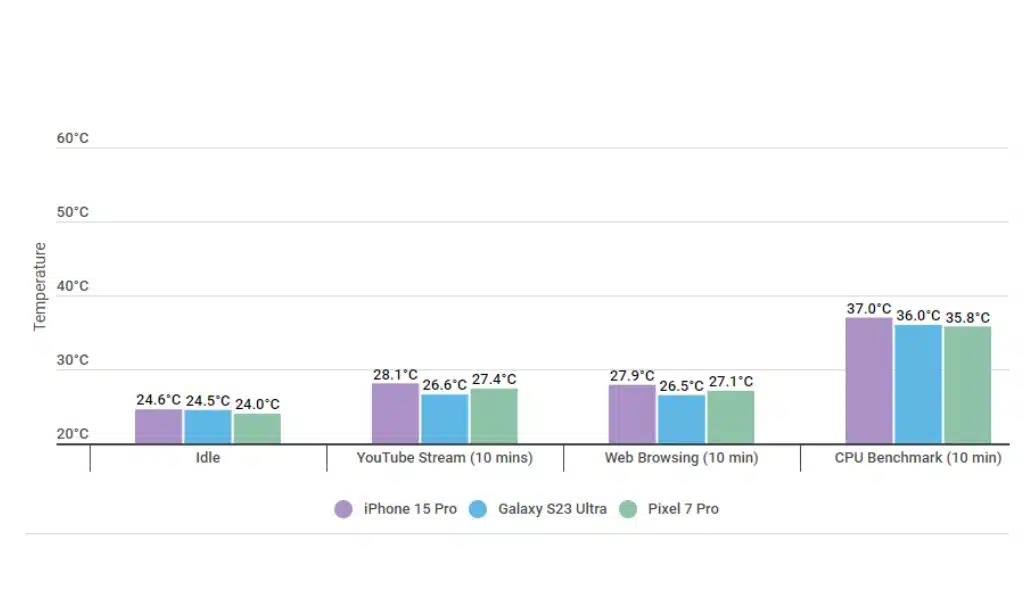
To begin, the iPhone 15 runs somewhat hotter than the S23 Ultra and Pixel 7 Pro when performing common tasks like video streaming and online browsing. However, the margin is not so large that the phone becomes troublesome for certain tasks. Staying below 30°C keeps you cool enough to not be noticed.
With Geekbench 6, we see the same trend: Apple’s phone is 1°C or 2°C warmer than the competition but in the same ballpark. When performing hard tasks, the iPhone 15 Pro is obviously warm to the touch, but not uncomfortably so, and not significantly hotter than our two comparison points. The iPhone 15 Pro is 2.5% to 5% hotter on average across these tests, which may or may not be noticed depending on what you’re doing.
However, as we move into more challenging seas with more SoC components, it becomes evident that the A17 Pro chip is a problem. When you turn on the six-core GPU, heat soon rise. After five minutes of running the 3DMark Wild Life stress test, our iPhone 15 Pro reaches 40°C. Wait until the end of the 20-minute run, and the phone’s peak temperature of 47°C is almost too hot to hold. The Galaxy S23 Ultra performs poorly as well, but the iPhone 15 Pro is 5.7% hotter, and any handheld device topping 50°C with any workload is concerning.
The most notable difference is highlighted in our 4K/60 video recording test. After only five minutes, the iPhone 15 Pro is around 7°C hotter than the S23 Ultra and 4°C hotter than the Pixel 7 Pro, a phone that is already well known as overheating. Worse, after extending the test to 10 minutes, the iPhone 15 Pro greatly exceeds a reasonable degree of hand comfort.
In all of our testing, the iPhone 15 Pro consistently outperforms the Galaxy S23 Ultra and Pixel 7 Pro in terms of temperature. The margin is often minor, but the overriding tendency is that the more Apple’s latest silicon is pushed, the more visible this difference becomes. Clearly, accusations about the iPhone 15 Pro and Pro Max running hot are justified.
iPhone 15 Usb-C Charging Runs Hot Too
So, the iPhone 15 Pro appears to be rather hot in general, but what about reported charging issues?
Unlike Android, iOS does not provide a method for obtaining reliable internal battery readings, therefore we have resorted to monitoring the maximum external casing temperature. Keeping this in mind, the battery’s operating temperature is likely to be 2°C to 4°C higher than the values we obtained externally, depending on how efficient Apple’s cooling system is. We used an approved 30W Apple USB-C charger and the provided USB-C to USB-C cable to evaluate the charging capabilities of the iPhone 15 Pro.
iPhone 15 Pro Charging Power, Temperature, and Time Testing
Peak casing temperature reached 36.1°C (we measured an even higher 40.2°C on a Pro Max), indicating that the device is using power above Apple’s 20W limit. It’s long been rumored that these phones charge faster than Apple claims, and that appears to be the truth, but with a power limit enforced to keep temperatures in line. If the Pro Max spikes more power than the Pro, it could explain why we’ve seen even greater temperature claims elsewhere.
We did not use the phone during this charge test, but we did observe temps exceeding 40°C during web browsing and viewing movies while charging the iPhone 15 Pro. If you conduct any tasks while charging, the phone gets unpleasant to handle. Apple tries to mitigate this by slowing charging speeds when the phone becomes too hot. It scaled down to 5W in extreme circumstances, which takes many hours to fill the phone.
The scale of the problem is demonstrated by comparing the external temperature of the iPhone 15 Pro to the inside battery data of the Samsung Galaxy S23 Ultra. Remember that Apple’s charging peaks at around 20W, whereas the S23 Ultra can handle up to 45W. Based on the external temperature data, Samsung’s peak internal temperature of 35.5°C is lower than Apple’s, which we estimate hits somewhere between 38°C and 40°C (this is often where other manufactures limit temps). Furthermore, our iPhone 15 Pro warmed up much faster, indicating yet another issue with heat dissipation.
While our results aren’t as concerning as the temperatures found when stressing the A17 Pro processor, they are nonetheless on the high side, given the iPhone 15 Pro’s comparatively low power levels and slow charging speeds. It takes an agonizing 90 minutes to fill the phone.
Does the iPhone 15 Get Hot?
There’s no doubting that the iPhone 15 Pro we tested is extremely hot – far too hot. Despite the fact that the phone’s A17 Pro processor theoretically has a manufacturing edge over the competition we tested. It’s constructed on a more efficient 3nm TSMC node, as opposed to 4nm for the Snapdragon 8 Gen 2 inside the Galaxy S23 Ultra and 5nm for the Tensor G2 in the Pixel 7 Pro. However, it appears that Apple took advantage of this advantage to push additional performance (such as the additional GPU core), resulting in high temperatures when the processor is stressed.
Similarly, the phone’s charging metrics are underwhelming when compared to the fastest-charging Android phones. Not only are the speeds slow, but the phone is warm to the touch while charging, and internal temperatures are likely to be significantly higher, which bodes ill for long-term battery life. The iPhone 15 Pro Max appears to be much worse in this regard, with greater power spikes leading to even higher temperatures.
The final result is two phones that, although not constantly hot, can certainly be pushed to higher temperatures by the same customers Apple is targeting. Workloads that cause the iPhone 15 Pro and Pro Max to reach those too-hot-to-hold temperatures are most likely to be applied by gamers, multitaskers, and videographers. If you were planning on purchasing the latest iPhone, you might want to wait a little longer to see if Apple can address this issue in an upcoming software update. If you’ve already purchased one, I’d remove the case when charging and allow the phone to cool down after using demanding applications.