You check your phone at dinner, reply to emails during movie nights, and wake up thinking about unread messages. Does that phantom buzz in your pocket follow you everywhere? It feels like you are chained to your job, no matter where you go or what time it is. You are definitely not the only one feeling this way. According to a 2025 report from Aflac, a staggering 72% of American workers face moderate to high stress levels, with Gen Z reporting the highest rates of burnout.
This nonstop pressure hurts our happiness and health in ways we might not notice right away. In this post, you’ll learn why the “always on” culture makes life harder and how specific strategies regarding how to set boundaries can give you real freedom again.
Ready for a break? Let’s walk through the steps together.
Understanding the “Always On” Culture
Work never really sleeps, does it? Many people feel like their jobs follow them everywhere, even to the dinner table or while relaxing at home. This phenomenon has a name, and understanding it is the first step to fixing it.
Definition and characteristics
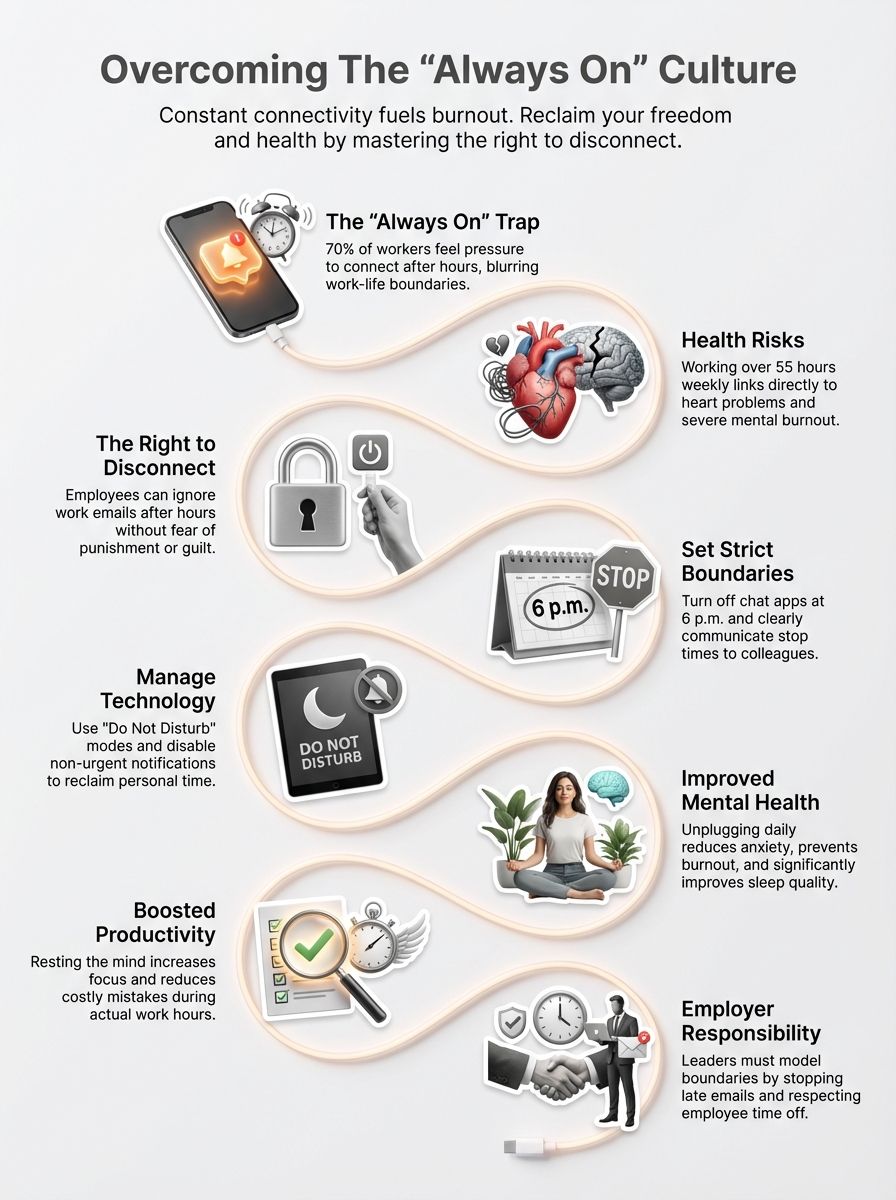
“Always on” culture means employees feel they must answer calls, emails, and chats at all hours. Messages ping during dinner or even bedtime, and many people carry work phones everywhere they go.
Remote work has made this habit grow fast. In the United States, the lines between “office” and “living room” have erased completely for many. A 2022 study by researchers Kim and Chon found that just the expectation of being reachable causes anxiety, even if no one actually emails you. This is often called “anticipatory stress.”
People often blur the line between work and home life. Tasks spill over into weekends or vacation days. This leads to high stress and burnout. Healthy boundaries fade away, making it tough for anyone to relax after a long day.
You can’t pour from an empty cup, as the saying goes, so taking a break is key for your own well-being!
The impact on mental health and productivity
After looking at what it means to be “always on,” let’s see how this can hurt both your head and your work. Long hours tied to emails or chat apps chip away at rest time, keeping stress high.
In 2021, the World Health Organization linked working over 55 hours a week to more heart problems and burnout. More recently, 2025 data from Growthalista highlights that employees experiencing burnout are 2.6 times more likely to seek a new job. Your body feels tired, but so does your mind.
Productivity takes a nosedive as focus breaks up with every ping from the phone or computer. It takes about 23 minutes to fully regain focus after an interruption. Mistakes sneak in faster when you juggle messages while trying to get tasks done.
People feel the pinch even harder during remote work since the lines between “job” and “home” blur together. Without clear stop times, many lose motivation and start dreading Mondays before Sunday dinner is cold.
The Right to Disconnect
The right to disconnect means people can switch off from work, without guilt or fear. While some places in the world have strict laws about this, the United States is just starting to have this conversation.
What it means
People need time to rest and recharge without work calls, emails, or pings. The right to disconnect means workers can log off after hours without fear of losing their jobs or being judged by bosses or coworkers.
Many countries have put rules in place to support this idea. France was the pioneer, passing a law in 2017. Now, businesses with over 50 employees must set up clear times when workers are not expected to respond.
This movement helps protect mental health and boosts employee wellness. In places like Spain, Italy, and Australia, labor laws support work-life balance by stopping late-night messages or weekend meetings during personal time. This gives people more control over stress management at home and helps keep burnout from taking root.
Global laws vs. US reality
While Europe has led the way, the United States is beginning to catch up. Here is how the landscape compares:
| Region | Legal Status | What it Means for You |
|---|---|---|
| France & EU | Active Laws | It is illegal for employers to require after-hours communication without a specific agreement. |
| California (US) | Proposed Legislation | Assembly Bill 2751 (introduced in 2024) proposed defining “nonworking hours” legally, though it has faced legislative delays. |
| New York City | Proposals | City officials have discussed similar “right to disconnect” bills, focusing on banning retaliation for not answering calls. |
Even without a federal law in the US, the “Right to Disconnect” is becoming a standard best practice for forward-thinking companies. Now let’s cover how you can build these walls yourself, even if the law hasn’t caught up yet.
Steps to Overcome the “Always On” Culture
Many people feel glued to their screens, tied up in endless work chats and emails. You can bring back real balance with a few smart changes. Freedom is closer than you think, and you don’t need to wait for a new law to claim it.
Identify your limits and priorities
Check how many hours you can work before feeling tired. If your mind starts to wander or your eyes glaze over, it is time to pause. Notice if too much remote work or nonstop notifications make you stressed or cranky at home.
Put mental health first, even if the culture says to stay busy. List out what matters most each day using a method like the Eisenhower Matrix, which separates the “Urgent” from the “Important.”
Some tasks cannot wait, while others can sit on the bench for a bit. For example, finishing that report might be key, but reading every email right away is not as urgent. Place yourself and your family high on this list.
Set clear boundaries for work and personal time
Draw a line between work hours and your free time. Say no to checking emails after your shift ends, even if you see one pop up during dinner. Set a rule, like turning off work chat apps at 6 p.m., or shutting down your laptop once the clock hits five-thirty.
Post a simple message in your remote work calendar. A great “Out of Office” status looks like this: “I am offline for the evening to recharge. I will respond to your message when I return at 9:00 AM ET.”
Protect weekends and evenings for rest or family time. Block out slots on your digital calendar for breaks and stick to them just as seriously as meetings. Tell coworkers about these boundaries so they know not to expect instant replies late at night.
This habit helps fight burnout, boost mental health, and keep that much-needed work-life balance going strong.
Communicate expectations with colleagues and employers
State your work hours clearly. Tell your team that if you do not answer emails after a set time, like 6:00 pm. Ask for the same in return from others to show respect for their boundaries, too.
If you need quiet time for deep focus or family, say so early on. Use the term “asynchronous communication” when talking to your boss. Explain that you work better when you process emails in batches rather than reacting instantly.
Agree on response times with your boss and coworkers, especially during remote work. Create out-of-office replies or calendar notes so everyone knows when you are offline. Open talks about these things can prevent burnout and reduce stress for everyone.
This helps protect mental health and keeps productivity high without blurring personal time and office tasks.
Use technology to support disconnection
After setting clear expectations with your team, smart use of technology can help shut off work noise. Try switching off email and chat notifications after office hours; it’s a simple tap, but it brings calm.
You can use specific tools to enforce your downtime:
- Opal or Freedom: These apps block distracting apps (like Slack or Outlook) on your phone during set hours, so you literally cannot open them.
- Slack “Do Not Disturb”: Set a schedule in Slack to automatically pause notifications from 6 PM to 9 AM. Your team will see a “Zzz” icon next to your name.
- Forest: A gamified timer that grows a digital tree while you stay off your phone. If you leave the app to check email, your tree dies.
Remote work often blurs lines between rest and hustle; tech boundaries draw those lines back. Some companies use shared calendars to mark personal time, this supports employee wellness by making these limits visible to others.
Just because our devices never sleep doesn’t mean we shouldn’t either! Turn gadgets into helpers in your quest for real work-life balance instead of letting them run the show.
Benefits of Disconnecting
Switching off helps your mind rest, makes life feel lighter, and might even make you enjoy work more. Keep reading to see how small breaks can spark big changes.
Improved mental health and reduced stress
Logging off from work emails after hours feels like a breath of fresh air. Stress drops, and your mind rests better at night. A 2022 study showed that people who unplug each day report less burnout and lower anxiety levels.

France passed a law in 2017 giving workers the legal right to disconnect outside working hours, making many feel more relaxed and happier. In the US, employees who establish these habits report similar relief, even without the legal mandate.
Less pressure to be “always on” means you enjoy family dinners without checking your phone every five minutes. Your mood improves, even if the group chat is blowing up with work updates.
Remote work should not mean being chained to your device all day; instead, setting clear limits helps real mental health changes take root, one boundary at a time.
Enhanced work-life balance
Moving from better mental health, a stronger work-life balance also plays a big role. People feel happier at home and at work if they can unplug after hours. In France, a 2017 labor law gives workers the right to ignore emails outside of office hours.
Many companies now set rules that protect evenings and weekends. Simple steps help too. Turning off work alerts on your phone or setting an auto-reply helps personal time stay peaceful.
With clear boundaries, families enjoy dinner without screens buzzing; hobbies get more attention; bedtime feels restful again. This shift supports long-term productivity and keeps burnout far away.
Increased focus and productivity
Stepping away from screens and setting work boundaries helps your mind rest. Workers in France, where the right to disconnect law began in 2017, feel less burned out and say their concentration goes up during work hours.
Fewer meetings after hours means fewer distractions. Emails do not steal your attention late at night or on weekends, so you stay sharper the next day.
People who unplug often finish tasks faster and make fewer mistakes. Short breaks for a walk or a new activity refresh your brain for better problem-solving, too. Teams that respect limits see more creative ideas and stronger results at work.
Even remote employees notice they get more done without constant pings from group chats or calls after office time ends.
Challenges in Implementing the Right to Disconnect
Some challenges can pop up while trying to disconnect, especially in places with strong peer pressure to always be available. Some workers worry about what their bosses or coworkers will think if they switch off after hours. Many find it tough to unplug, with work messages always just a tap away.

Fear of repercussions in the workplace
Many workers stay online after hours because they worry about losing their jobs or missing a chance for promotion. If someone turns off their phone or ignores emails, it can seem risky.
In France, labor laws protect the right to disconnect, but in many places, these protections do not exist yet. Remote work makes this fear stronger. People feel pressure to answer calls at all times, so bosses see them as reliable.
This type of stress can cause burnout and hurt mental health quickly. Even if you want a better work-life balance, it might feel like stepping on thin ice if your boss expects you to always be available.
Peer pressure to remain available
Co-workers often check email late at night or reply to messages during vacation. This habit can spread like wildfire in remote work teams. Some people feel left out or lazy if they do not stay connected 24/7, so they push themselves harder.
Group chats and team apps make this even worse. You hear your phone buzz, and you wonder if it’s urgent work news. Stress grows as the fear of missing something rises.
It is easy to get trapped in this cycle, chasing every ping until burnout hits hard. Clear boundaries help break the pattern and support real work-life balance for everyone involved. Your mental health will thank you later!
Balancing flexibility with disconnection
Workers like remote work for its flexibility. You can handle family needs or take a walk after lunch, yet face a flood of emails even at night. This freedom can backfire if you never disconnect from work apps or group chats.
One message at bedtime leads to another, and suddenly your mind races with deadlines instead of sleep. Setting clear rules helps keep the balance.
Some teams shut off Slack after 6 p.m.; others mark weekends as no-email zones unless urgent. A French labor law since 2017 gives people the right to ignore messages outside office hours, making time for rest and mental health a real priority.
Flexible working is only healthy when paired with strong boundaries, so both well-being and productivity stay on track.
How Employers Can Support the Right to Disconnect
Bosses set the tone for healthy work habits, plain and simple. When leaders show respect for time off, everyone feels safer to step back and recharge without guilt.
Establish clear policies
Clear policies set the tone for work-life balance. Rules help everyone know what is expected. Forward-thinking companies are now adopting “Comms Charters”, written documents that explicitly state how and when the team communicates.
A policy might include rules like:
- The “Core Hours” Rule: Everyone must be online between 10 AM and 2 PM, but other hours are flexible.
- No “Naked” Pings: Every message must include context, so no one stresses over a vague “Can we talk?” message.
- Scheduled Sending: Encouraging staff to use the “Schedule Send” feature so emails written on Sunday night don’t arrive until Monday morning.
Regular talks about these rules also help remove any confusion. People will feel safer turning off their phones at dinner or bedtime.
Encourage a culture of respect for boundaries
Teams grow stronger when people respect each other’s work and personal limits. Leaders can model this by not sending emails late at night or on weekends. Colleagues can show care by not expecting instant replies after hours, even during remote work.
Small actions like setting “do not disturb” times help protect employee wellbeing and ward off burnout. Respect spreads fast in a workplace that values communication about time off and flexibility.
A healthy culture cheers for digital detox breaks, reminding everyone that their mental health matters as much as deadlines do. People thrive with productivity and lower stress when boundaries are honored day after day.
Provide training on time management and digital well-being
Respecting boundaries builds trust and comfort among workers, but skills help people keep those boundaries in place. Training focused on time management teaches staff to plan tasks, set work goals, and leave room for breaks.
Simple tools like daily planners or calendar apps can make a big difference. With these habits, finding work-life balance feels less like chasing after smoke.
Workshops on digital well-being shine a light on healthy screen use. People learn how blinking icons or late-night email pings add stress and burnout risk. Staff discover tricks to unplug after hours; they silence notifications, shut down work chat apps, and put away devices before bed.
These steps lower stress levels fast and give minds space to rest, which boosts employee wellness across the board.
Set Boundaries Around Personal Time and Stick to Them
Draw a line between work and home life. Turn off email alerts after hours. Block out time on your calendar for family, friends, or hobbies. If you get asked to join late meetings often, tell your boss what times you are not available. Use clear words like “I do not answer work calls after 6 PM.” Be firm but polite. Guarding your free time helps protect against burnout and keeps you healthy.
Even just 30 minutes away from screens can boost your mood and help with stress management. Remote workers need strong boundaries since their office is also their living room now; close the laptop at the end of the day to mark that work is done. Small changes every day build up into a better work-life balance over time.
Downgrade Your Relationship With Your Phone
After setting boundaries for your time, it helps to look at how you use your phone. Phones pull us in; every buzz and beep can break focus or steal calm. Turn off non-urgent notifications. Place the device out of reach during meals, breaks, or after work hours. Many find a simple rule useful: keep phones face down when working or resting.
Try leaving your phone in another room before bed; blue light cuts into sleep quality according to studies from Harvard Medical School. Challenge yourself with small changes like using an old-fashioned alarm clock instead of a digital one on your smartphone.
Less screen time gives back mental space for hobbies, chats with loved ones, and better stress management. Even employers see gains since unplugged workers are less likely to burn out and more likely to focus on real tasks instead of scrolling through endless updates.
Final Words: Living BIG
Breaking free from the “always on” culture starts with simple steps like setting limits, turning off work alerts, and making your home your safe zone. These tips do not need fancy tools or long hours; they just call for small changes you’ll notice fast.
Giving yourself time to disconnect can boost focus, protect mental health, and help you feel less stressed about remote work. How to set boundaries may feel tricky at first, but the rewards show up in better sleep, more energy, and a stronger work-life balance.
If this topic sparks a fire in you or leaves questions buzzing in your mind, check out guides on digital detox or chat with someone who’s made these shifts before you take the leap.
Your life is yours. Unplug sometimes so you can live big and stay bright, even when work tries to keep that porch light burning all night long!