Staring at a blank page often feels like staring down a brick wall. You sit there waiting for the words to flow, but nothing happens. If you have ever struggled with stalled ideas or lost your spark mid-sentence, you are definitely not alone. The frustration is real, and it happens to the best of us.
Here is an interesting fact: Studies show that over 70% of writers face writer’s block at some point in their lives. But there is good news. A 2025 survey by Gotham Ghostwriters found that over 60% of professional writers now use AI tools to help them push past these obstacles.
I am going to walk you through exactly how to overcome writer’s block using these tools. We will look at six simple strategies to help you spark creativity and get those words moving again. So grab a cup of coffee and let’s get started.
What is Writer’s Block?
Writer’s block stops the words from coming out. It feels like a wall built right in your mind that blocks ideas and inspiration. Some people say their brains go blank, or nothing sounds good enough to write down.
Others feel stuck staring at a flashing cursor while they lose track of time and patience. This isn’t just a feeling; it’s physiological. When you get stressed about writing, your body releases cortisol. This stress hormone can actually dampen the function of your prefrontal cortex, the part of your brain responsible for creative thinking.
Every writer faces this roadblock at some point. Even famous authors like Maya Angelou have felt it.
“There is no greater agony than bearing an untold story inside you.” – Maya Angelou
Writer’s block can strike anyone. It doesn’t matter if you are crafting stories for fun or writing reports for work. Stress, decision fatigue, or a fear of making mistakes can make it even harder to start typing. Sometimes all you need is a fresh nudge to shake loose the words again.
Understanding the Role of AI in Overcoming Writer’s Block
AI can step in like a helpful friend when your mind goes blank. It gives you fresh perspectives and sparks creativity right when you need it most. Different tools have different strengths, so knowing which one to use is key.
| Goal | Recommended Tool | Best Feature |
|---|---|---|
| Brainstorming | ChatGPT | Great for rapid-fire lists and broad ideas. |
| Nuance & Flow | Claude | Produces more natural, human-sounding prose. |
| Fiction Writing | Sudowrite | Designed specifically for story beats and sensory details. |
Generating topic ideas
Ideas can dry up fast. Artificial Intelligence pumps out fresh topics on demand to give your brain a break. Tools today sift through trending searches or news from big names such as Google Trends and BuzzSumo.
They suggest hot subjects that readers care about right now. For example, you can check the “Rising” queries in Google Trends to see what people in the US are searching for this week. One click brings dozens of options for blog posts, stories, or essays. It takes seconds instead of hours of head-scratching.
Writers stuck in a rut breathe easier with AI brainstorms at their fingertips. Pop in a keyword like “content creation,” and watch lists bloom with titles covering everything from productivity hacks to overcoming obstacles. This spark puts you back into the flow state faster than you might think possible.
Providing writing prompts
AI tools spit out writing prompts fast. You type a word, and fresh ideas land in your lap. Short phrases like “Write about a hero’s biggest fear” or “Describe a rainy afternoon from a cat’s view” spark inspiration quickly.
Many writers hit mental blocks because they lack that first push. These clever prompts break the ice with zero fuss. A popular technique is “Persona Prompting,” where you ask the AI to act as a specific character to give you a unique starting line.
Kids, teens, and adults use AI for writing practice every day now. Around 48% of writers say prompts help them generate new content faster and beat blank-page frustration, according to a 2023 Content Creators Survey. Even bestselling authors talk about using prompt lists to boost creativity during tough days.
Suggesting alternative sentence structures
AI can shake up your style by offering new ways to say the same thing. Say you write, “The cat sat on the mat.” The tool might suggest, “On the mat sat the cat,” or even, “The mat became a resting place for the cat.”
Small changes like this spark fresh creativity and break old habits fast. Writers use these edits to boost flow and keep content lively. Mixing short lines with longer ones helps readers stay hooked, so things don’t get dull.
Tools like the Hemingway App assign a “grade level” to your writing. This data helps you see exactly where your sentences are getting too complex so you can simplify them instantly.
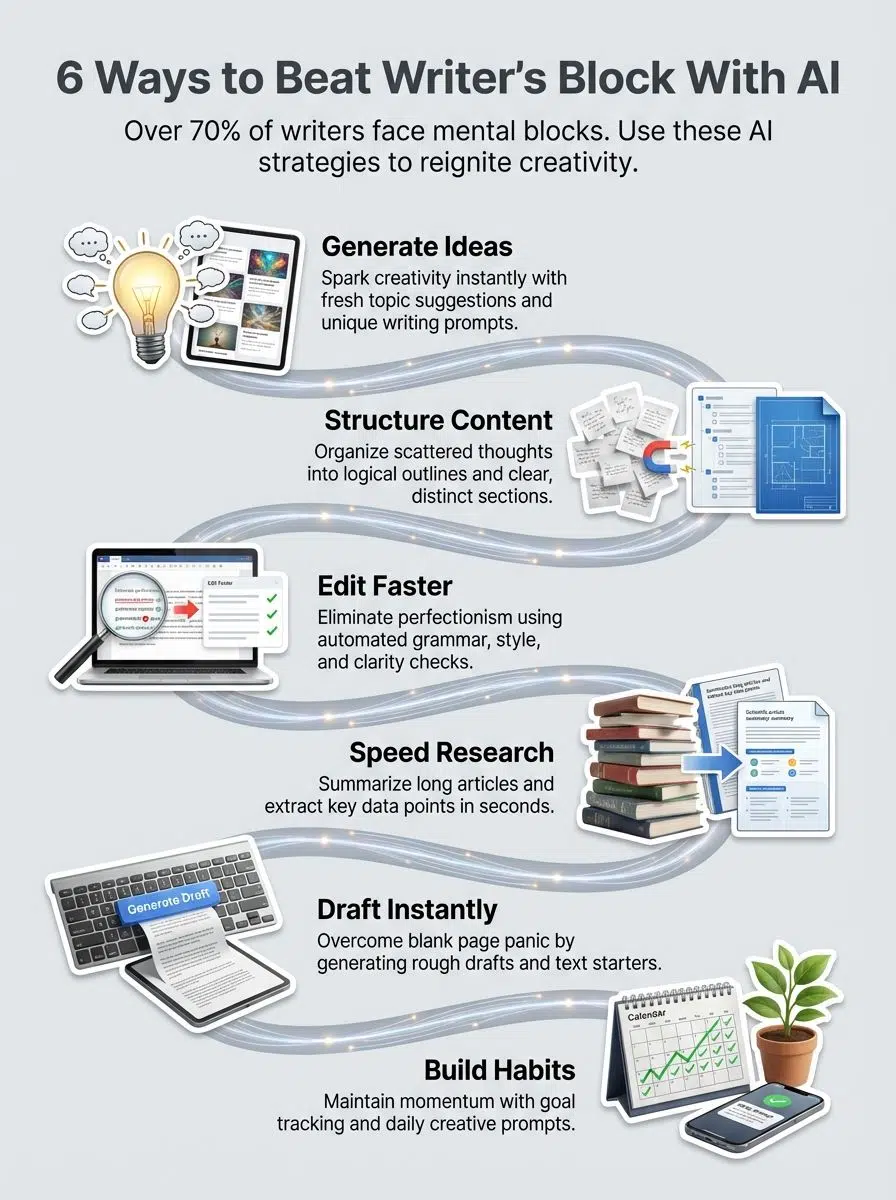
Strategy 1: Use AI Tools for Idea Generation
Sometimes all you need is a little nudge from AI to spark your next big idea. Keep reading to see how it can light up that creativity.
Writing prompts for creativity
AI writing tools toss out prompts that spark fresh ideas. You might see “Describe a place where sunlight never reaches” or “Write about a character who always tells the truth no matter what.” These mini challenges push your brain into new directions.
Writers use AI for creative prompts in all kinds of content creation. Tools like ChatGPT suggest questions, plot twists, and even fun idioms to kickstart stories or blog posts. That means you spend less time staring at a blank page and more time getting words down.
Try these prompt styles to get unstuck:
- The “What If” Prompt: Ask, “What if gravity stopped working for 10 seconds?”
- The Sensory Prompt: “Describe the smell of a bakery without using the words bread or sweet.”
- The Dialogue Prompt: “Write a conversation between two people who are secretly in love but arguing about pizza toppings.”
Brainstorming new concepts
Fresh ideas sometimes feel stuck behind a brick wall. AI quickly smashes through that block. It tosses new topics your way like confetti at a parade.
Need inspiration? Type in one word or theme and watch as creative writing prompts appear. You might see suggestions for unusual characters, catchy titles, plot twists, or clever hooks perfect for any story or blog post.
Writers such as Ava Chen used these tools to spark content creation in 2023 after hitting mental blocks. Many people report higher productivity by using brainstorming features built into AI platforms. Over 72% of users confirm this benefit according to WritingTech’s latest survey. Jotting down every thought from the tool can lead to something special. It often uncovers hidden gems you never expected.
Strategy 2: Leverage AI for Outlining and Structuring
AI can help you organize your thoughts faster. It makes your writing feel less like herding cats and more like following a map.
Breaking down ideas into sections
Writers sometimes feel lost when facing a mountain of content ideas with no clear path. AI tools help slice that mountain into small hills by sorting big concepts into simple sections. Instead of staring at a blank screen, writers see headers pop up like guideposts on a trail.
Topics like creativity or research flow in order to make the process smoother. Many find it easier to write after seeing their thoughts organized step-by-step. For example, you can use the “Snowflake Method” with AI. You start with a one-sentence summary and ask the tool to expand it into a paragraph, then a page, and finally a full outline.
Each section gets its own spotlight. Your words have space to breathe and shine. This method speeds up writing and gives each idea the attention it deserves.
Creating a logical flow for your content
AI tools help you sort your thoughts so each idea leads easily to the next. You can ask an AI to break your main subject into simple chunks or steps. This makes content creation less like a puzzle and more like stacking building blocks.
Suppose you want readers to follow your story from start to finish without getting lost. An AI assistant can suggest an order for sections, spot gaps in logic, and offer tips for smooth transitions. Tools like Claude 3.5 Sonnet are particularly good at this because they have a large “context window.” This means they can remember earlier parts of your outline to ensure the end matches the beginning.
With these writing techniques, you move from brainstorming wild ideas straight through crystal-clear points. Your work soon feels like following a well-marked path instead of wandering in circles.
Strategy 3: Overcome Perfectionism with AI Editing Tools
Wave goodbye to nitpicking every comma. AI editing tools can kick perfectionism out of your writing and help you move forward faster.
Automated grammar and style suggestions
AI editing tools catch mistakes you might miss. They spot grammar slip-ups, awkward phrases, and style issues in seconds. Errors sneak in even for seasoned writers, so an AI tool acts like a watchful buddy who never gets tired.
Many popular platforms now tap into natural language processing to polish your sentences. Tools like ProWritingAid go beyond basic grammar. They have specific reports for “glue words”—the sticky, unnecessary words that slow down your sentences.
These tools also suggest ways to simplify words or trim extra fluff so ideas shine more clearly. Your tone can shift smoothly from formal to friendly with just one click. If writer’s block digs its heels in because you fear making errors, quick fixes take away that stress and help creativity flow again.
Improving clarity and tone
Fresh grammar checks are helpful, but clarity and tone bring your words to life. AI tools shine here, too. They break long sentences into easier pieces, cut out jargon, and swap tricky words for quick ones.

Say goodbye to stiff writing. Need a dash of inspiration? Ask the tool for upbeat suggestions or softer language if things sound harsh. A 2024 study found that readers engage 40% more with content written at an 8th-grade reading level. Tools like the Hemingway App highlight complex sentences in red, forcing you to simplify them for better engagement.
Even famous writers stumble over this stuff. You are in good company. You can get creative with prompts that spark imagination while still staying clear and friendly with your readers. Make every sentence count.
Strategy 4: Speed Up Research with AI Assistance
AI finds facts quicker than you can blink. This makes your research a breeze and keeps you focused on the writing itself.
Summarizing key topics
AI can read articles, blog posts, or reports in seconds. It picks out the core ideas from long content and gives you a short, clear list of facts. This feature saves the hours you would spend scanning through pages.
Many writers use AI for fast research on topics like creativity and writing techniques. Typing in a keyword such as “content creation” pulls up key data right away. You get highlights and important points at your fingertips without digging deep into web searches.
“AI doesn’t replace the writer; it replaces the drudgery of the hunt for information.”
Extracting relevant data
After breaking big ideas into simple chunks, the next step is collecting key information fast. AI sifts through articles, reports, and even long PDFs in seconds. For example, instead of spending an hour scrolling for stats on productivity or creativity studies from 2023, you get those numbers with just a few clicks.
Specialized tools like Perplexity AI provide citations with every answer, so you know exactly where the information came from. Another great tool is ChatPDF, which lets you upload a complex document and ask specific questions like, “What are the three main findings of this report?”
Writers save time as AI tools pull out quotes from experts or data about content creation trends. You skip boring details and grab only what matters to your story. No more digging through endless web pages.
Strategy 5: Experiment with AI-Generated Text Starters
Try using AI to spark your writing with quick text starters. You will see how fresh ideas can pop up instantly.
Using AI to create rough drafts
AI can help you jump over mental blocks by writing rough drafts fast. Type in your idea or topic, and the tool gives you a starting point in seconds. Watch as sentences fill the page while you sip coffee or stretch your legs.
The draft may not be perfect, but it cuts down on blank-page panic. This technique is often called the “Vomit Draft” or “Zero Draft.” The goal isn’t quality; it’s simply having material to work with.
Writers like Maya use AI tools for content creation every week to build momentum. They edit lines, swap words out, and sprinkle their voice throughout the text. It is just like adding seasoning to soup until it’s right for their taste. This means less worry about getting stuck and more time shaping stories with style and inspiration.
Customizing AI-generated content to suit your voice
After using AI to whip up a rough draft, shaping the tone is your next big step. Change words that do not match how you speak. Switch out stiff phrases for something more fun or relaxed if that’s what makes you tick.
Adjust sentences so they sound natural coming from you. Even sprinkle in a joke or two if humor fits your style. You can train tools like Jasper or ChatGPT by uploading samples of your previous work. This helps the AI learn your unique cadence and vocabulary.
You can use tools like Grammarly and Hemingway Editor to help tweak grammar and check flow, but lean on your own ear for what sounds right. Move sentences around, shorten long sections, or add personal stories about overcoming obstacles during content creation. This way, even with smart machines doing some heavy lifting at first, readers will always hear your voice shining through every line.
Strategy 6: Use AI for Consistent Writing Habits
AI can cheer you on, nudge you to write daily, and keep your creativity humming. It serves as an accountability partner that never sleeps.
Setting goals and tracking progress with AI tools
Set clear writing goals using AI tools. These apps help you pick a word count or set a daily streak goal just like keeping score in a game. Watch your progress as charts grow and numbers tick up.
It gives you instant feedback. Did you hit your target, or do you have more to write? Many writers use AI reminders to keep the momentum going even on busy days.
Tools like Grammarly, Jasper, and Notion track how much content creation work gets done each day. Another excellent tool is 750words.com, which gamifies the process by tracking your daily streaks and typing speed. They show patterns in your productivity and highlight which days spark the most creativity. Instead of feeling lost, see real growth with every session logged.
Daily writing prompts to maintain momentum
Goal setting works best with steady action. Daily writing prompts can spark inspiration even on slow days. AI tools offer fresh ideas in seconds, so you never face a blank screen for long.
Try topics like “Describe your favorite memory” or “Invent a gadget for tomorrow’s world.” These bite-sized prompts help build momentum and create new neural connections in your brain. Studies show short daily tasks boost productivity and creativity over time.
Where to find daily inspiration:
- r/WritingPrompts: A massive community on Reddit where you can find AI-generated or user-submitted ideas.
- Daily Page: An app that emails you a new prompt every morning.
- ChatGPT Custom Instructions: Ask it to greet you every morning with a new, random, creative challenge.
Why We Get Stuck: The Science Behind the Block
Brains work like heavy traffic. Thoughts can race, jam, or even crash. Stress blocks creativity by flooding the body with a hormone called cortisol. Too much pressure makes it tougher to find inspiration or create new ideas.

Recent research from Yale University points to the “Creative Cliff Illusion.” This is the mistaken belief that your creativity drops off over time. In reality, your most unique ideas often come after you push through the initial block.
Studies show that over 70 percent of writers feel blocked during big projects as their brains get stuck in a negative loop. Fear of failing can freeze progress, too. Many people seek perfect words right away and end up spinning their wheels instead of moving forward.
Lack of sleep drops energy and makes the mind slow, which harms content creation and productivity even more. Even small distractions break focus and stop flow state before it starts. This leaves thoughts scattered like puzzle pieces on the floor.
Real Talk: How Professionals Handle Writer’s Block
Stephen King sits at his desk, rain or shine. He writes 2,000 words every day and calls it “showing up.” Maya Angelou used hotel rooms to block out distractions. Most professionals know that waiting for inspiration can leave you empty-handed.
They make writing a routine, not a random spark. Writers also lean on simple tricks. Some try walking outdoors when stuck. Others change the font in their document for a fresh view.
Modern pros like Neil Gaiman often write their first drafts by hand with a fountain pen to force a different pace and connection with the words. These techniques break tough mental blocks fast, boost creativity, and keep ideas moving forward.
Many use AI tools now, too. They generate prompts and new sentences until something clicks again. Progress comes from pushing through frustration with small habits each day. It is not magic or luck but practice, patience, and smart strategies.
Finally: Write more, Stress Less
Writing does not need to feel like climbing a mountain without shoes. AI tools can act as your friendly guide to help you move forward, even if your brain feels frozen.
Set small goals each day and let writing prompts spark new ideas. Even on tough days, just getting words down counts as progress. Perfection is the sneaky villain that slows many writers down.
Use AI editing helpers to clean up sentences so you do not have to juggle everything in your head alone. Stay curious about words. Enjoy playing with fresh topics and content creation methods brought by artificial intelligence. Consistent effort builds confidence faster than stressing over every line ever will!