
Do you lose track of your trades? You jot down notes, yet miss key details like entry and exit points or market conditions. Many traders skip a trading journal. They rely on memory, and that can lead to bad calls.
A trading journal boosts your risk management and trading strategies. It logs entry and exit points, position sizing, and your emotional state. You can use a simple spreadsheet or a note app to track performance metrics and market analysis.
This post shows you how to set up your journal, record trade details, and spot patterns. Keep reading.
Key Takeaways
- Log each trade with date, symbol, entry and exit prices, position size, stop-loss, take-profit, fees, and profit or loss in dollars and percent. For example, record a long of 100 options at $2.50 on Feb 1, 2024, exit at $2.75 with a stop at $2.30.
- Note market conditions and key events like the April 3 Fed minutes, the bullish S&P 500 trend on April 5, or the May 3 jobs report. Track volume changes, RSI, moving averages, and support/resistance to spot repeatable patterns.
- Rate your mood on a 1–5 scale before, during, and after each trade. Jot stress, confidence, shaky hands, or calm signs. Compare mood ratings to your win rate (aim 50–65 %), profit factor (> 1.5), and risk/reward ratio (1 to 3) for strategy tweaks.
- Use templates and automation tools to cut errors and save time. A standard grid reduces risk‐management mistakes by 27 %, FX Replay boosts data accuracy by 31 %, and automation lifts pattern recognition by 23 %. Try Evernote or Google Sheets.
- Review your journal weekly or monthly. Chart win rate, profit factor, and equity curves. Highlight your top five wins and bottom five losses. This routine gives clear insights, refines strategies, and builds trading discipline.
Simplify the Process
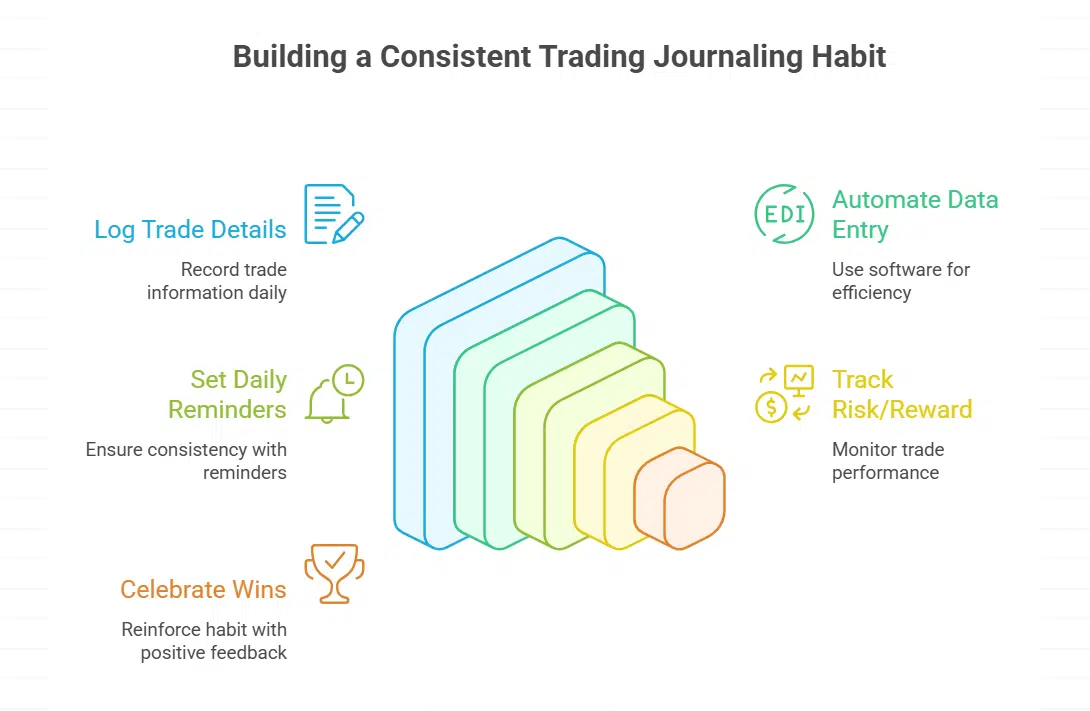
Open your trading journal with a simple template. Spend ten minutes each day to log trade details and risk management notes. Use a digital notebook like Evernote trading journal for easy access.
Automate data entry with FX Replay or a similar software.
Set a daily reminder so you never skip a session. Note entry and exit points, market conditions, and your mindset. Track the risk/reward ratio for each trade. Celebrate small wins to keep your habit strong.
Choose the Right Format for Your Journal
Pick a digital app if you need analytics on the move. Excel or Google Sheets let you track entry and exit points and run risk/reward ratio calcs. A paper notebook helps you write by hand.
That boosts memory. A hybrid plan lets an app grab numbers and you fill in thoughts on paper. FX Replay logs trades and calculates performance. You review metrics and jot reflections.
Try Evernote trading journal for user-friendly tags and mobile access. A cloud sheet can sort trades by trading style, market conditions, and technical indicators. Pivot tables help you spot patterns in equities or forex trading.
A simple log gives you clear data for analysis on position sizing, trade details, and risk management. Pick the system that fits your workflow and lets you keep a sharp trading journal.
Include Essential Details in Your Journal
Jot entry and exit points, market conditions, risk/reward ratios, chart signals and your mood in a note app, and turn raw notes into clear data—keep reading to see more.
Trade Entry and Exit Points
Record each buy or sell price in your trading journal. Note exact entry and exit prices. Add trade direction, whether you went long or short. Mark position size plus entry and exit times.
For example, log a practice account long of 100 options at $2.50 on Feb 1, 2024 at 11:30 AM, then exit at 12:45 PM at $2.75. Set stop-loss at $2.30 and take-profit at $2.80 in a note-taking app like Evernote.
This step builds solid risk management.
Calculate risk per trade as a dollar amount or percent of account. Note commission, swap and fee. Add profit or loss in cash and percent terms. Use those numbers in pattern recognition and data analysis to refine your trading strategies.
Track win rate by dividing wins by total trades. Aim for a 50–65 percent rate to boost trading performance.
Market Conditions and Observations
The S&P 500 showed a bullish trend on April 5, with daily charts forming higher highs and higher lows. Fed minutes from April 3 spiked volatility metrics, sending the VIX up 15 percent.
Traders used 5-minute and hour timeframes for scalps and swing entries. Volume rose 20 percent, while liquidity thinned in small caps right after the speech. RSI and moving averages guided entries, and price action showed a double bottom near 3800.
Sector scans showed tech stocks led gains, while energy names lagged behind. Support levels at 3850 held firm, and resistance at 3900 capped upside moves. They logged volatility bands in their trading journal, and tracked volume swings around the May 3 jobs report.
A clear risk/reward ratio of 1 to 3 helped keep position sizing tight and boost trading habits.
Track Emotional and Mental States
Log your emotional state before each trade, during execution, and after you close a position in your trading journal. Rate stress or confidence on a 1–5 scale, note any jittery or calm signs.
Use a tool like Evernote or a grid manager to boost self-awareness, tag entry and exit points alongside mood.
Note if a winning streak made you overconfident or a losing run caused you to hesitate. Write down if your heart raced like a race car or if you felt calm, it matters. Jot physical cues, like shaky hands or fatigue, that might hurt accuracy.
Watch how these states shift risk management and strategy refinement. Compare energy and focus ratings with trade details to spot patterns in trading habits and performance.
Use Templates or Automation Tools
Templates keep your trading journal running like a well-oiled machine. They capture entry and exit points, risk/reward ratio, technical indicators, and market analysis without letting you skip key metrics.
Standardized grids cut risk management errors by 27 percent. You can tweak those grids for forex trading, futures, or stocks. A tool like FX Replay auto logs your trades and metrics.
It boosts data accuracy by 31 percent and trims manual work.
Evernote trading journal and other platforms let you tag and filter trade details fast. Automation nudges you to jot down your trading psychology and position sizing. Consistent logs ramp up pattern recognition accuracy by 23 percent.
This time-saver frees you to refine trading strategies and track demo account progress without feeling buried.
Organize Your Journal Effectively
Keep order to make your trading journal shine. You tag each entry to find patterns faster.
- Log each trade with date, time, symbol, entry and exit points. Readers capture trade details for pattern recognition and performance analysis.
- Tag entries by strategy, like breakout, reversal, or momentum. This lets you filter trades by trading strategies quickly.
- Divide notes by trading style in a spreadsheet or Evernote trading journal. Add a demo account section to test tactics without risking money.
- Use a consistent template with fields for market conditions, technical indicators, and risk/reward ratio. Uniform format cuts misinterpretation and reduces analysis errors by 19 percent.
- Score execution quality on entry timing, stop loss, position size, exit points, and trading psychology. A scoring system drives strategy refinement and trading discipline.
- Add a daily summary with total trades, P&L, market sentiment shifts, and key events. This practice tracks portfolio management, risk management, and profitability.
- Schedule a weekly or monthly review to chart portfolio growth, return on investment, and key performance indicators. Regular reviews boost decision making and risk tolerance.
- Choose a spreadsheet or chart platform for easy filtering by tag, date, or emotion state. This setup speeds search and supports ongoing self-reflection.
Review and Reflect on Your Data
Data review keeps your trading habits honest. It shines a light on hidden patterns.
- Scan daily, weekly, monthly logs to spot shifts in market conditions, timeframes and trade triggers, this helps you refine your risk management and position sizing.
- Chart win rate, profit factor and risk/reward ratio from each session for clear strategy validation and to guide your pattern recognition work.
- Highlight top five wins and bottom five losses each month in your note app or demo account record, this builds your trading psychology muscle and pinpoints tactical moves to adjust.
- Compare equity curves across forex trading and derivative trading logs to see how monetary policy or interest rates influenced your return on investment, this boosts your market analysis skill set.
- Note emotional states like fear or greed alongside trade details, use simple ratings to track your trading discipline and reveal skill gaps.
- Leverage technical indicators such as Bollinger bands to test if a setup succeeds or fails, this drives quantitative review and strategy refinement.
- Tap into mentor feedback or trading group chat for external accountability and fresh perspectives on your trading system and performance.
- Set milestones to celebrate gains and tweak rules, keep record of progress over time for ongoing growth and improved decision making.
Identify Patterns and Trends in Your Trades
Filter your journal entries by time, asset, strategy, or mood. That practice uncovers repeatable patterns. Correlate win rates with morning sessions or volatile markets. You might spot a 60 percent win rate in low-volatility forex trading around the Tokyo session.
Compare planned trades against spontaneous ones in your Evernote notebook or an Excel sheet. That check reveals rule breaks and discipline gaps.
Track emotional highs and lows next. Tag each entry with a number for stress or calm. Then map those tags to profit factors and average win/loss ratios. Aim for a profit factor above 1.5 and a ratio above 1.5 to 1.
Cut entries with drawdowns over 20 percent. Use RSI as a technical indicator to spot entry points. Chart news events like nonfarm payrolls or Fed updates too. Scoring trade execution quality also helps spot trends for strategy tweaks.
Adjust Strategies Based on Insights
Trading journal notes show patterns in your trade details. You spot winning setups and losing setups fast. Tune your trading strategies to those insights. Gear up reward-to-risk ratio on your entry and exit points.
Aim for trade expectancy above zero to prove your edge.
Slash position size and tighten stop losses after three straight losses. This 3-Loss Rule protects your capital and soothes your mind. Skip trading in slow market hours. Shift funds to markets or systems that log steady wins.
Use a note-taking app or a practice account for live tests. Apply basic statistical analysis to track risk management and market analysis.
Stay Consistent with Your Journaling Practice

Set routine reminders to log every trade. Update the journal after each entry, capturing trade details, entry and exit points, and market conditions. Use OneNote or Google Sheets to track risk management and performance.
Record wins and losses to build a complete record. Keep this log indefinitely. Ten minutes a day can cement a strong habit.
Share your journal with a mentor or group for accountability. This move boosts self-awareness and trading discipline. It sharpens pattern recognition and hones trading psychology. Regular review guides strategy refinement and improves return on investment.
A consistent routine drives long-term growth.
Avoid Overcomplicating the Process
Capture essential metrics such as entry and exit points, position size, risk/reward ratio, and correlations. Log every trade in your trading journal to avoid selective entry bias. Drop details that fail to inform your trading strategies.
Use a spreadsheet template or Evernote trading journal to standardize data entry. A study shows that poor organization and missing performance metrics lower risk management by 27%.
Simplicity helps traders stick to a routine. Focus on process and strategy documentation instead of just profit and loss. Embrace a structured format for market analysis and trading psychology notes.
A streamlined system cuts overwhelm and boosts consistency. Position sizing and risk percentages become clearer in a concise journal.
Takeaways
A solid journal keeps you honest, like a clear mirror for your trades. It helps you spot patterns in your trading strategies and risk limits. You can log entries in an electronic ledger or a note-taking app with handy templates.
Automation tools chop work time, letting you focus on market analysis and position sizing. Stick to this habit daily, and watch your skills grow step by step.
FAQs on How to Create a Painless Trading Journal
1. Why keep a trading journal?
It acts like a diary for trades, where you log entry and exit points, position size, risk/reward ratio, and trading style. You can review your market analysis and past market conditions. This cuts guesswork and builds trading discipline.
2. What trade details go in the journal?
Record the date, time, instrument, entry and exit points, stop loss, and take profit. Add your reason, for example a pattern recognition signal or technical indicator trigger. Note your trading psychology, like fear or greed. Mark if you trade forex market, cfd trading, or stocks. These details sharpen your market analysis.
3. How do I track risk management in a trading journal?
Log your risk/reward ratio and risk per trade. Note how you size your position, based on your trading system or demo account tests. Check if your stop loss and take profit match your plan. Write why a trade lost or won to keep your risk management on track.
4. How can I refine trading strategies with a journal?
Review past trades often, compare wins and losses across different market conditions. See which strategies, like trend following or breakout plays, worked best. Tweak or drop the ones that fail. Think of it as tuning an engine, you adjust parts until it runs right.
5. Can a trading journal boost trading psychology?
Yes. Jot down emotions, like fear during a dip or thrill after a win. Spot mental traps, then apply goal setting and trading discipline to avoid them. You can test ideas in a demo account before trading live. Your journal becomes your personal coach.
6. How do I measure performance with a trading journal?
Calculate return on investment by tracking gains and losses. Count your win rate and average profit per trade. Note long-term stats like ROI or total equity change. Share these results with your broker-dealer or investment adviser, it proves your progress.