

Most people assume that starting a software company requires a computer science degree, a massive team, and millions in venture capital. In reality, the most profitable opportunities for beginners often lie in the opposite direction: building small, focused tools that solve one specific problem very well.
You have likely noticed that the software market is crowded with giants like Salesforce or Zoom. But savvy entrepreneurs are finding success in the gaps these giants ignore, building “Micro-SaaS” products that generate reliable monthly income with minimal overhead.
From what I have seen, the barrier to entry has never been lower. With the rise of powerful no-code platforms, you can now build fully functional software without writing a single line of code. A 2025 report from Aventis Advisors notes that SaaS companies are seeing median revenue multiples rebound to 3.8x, meaning even small tools can lead to life-changing exits.
In this guide, I will break down exactly how to build and sell Micro-SaaS Tools, how to find a profitable niche, the specific no-code stack you need to build your tool, and the roadmap to your first sale.
Understanding Micro-SaaS
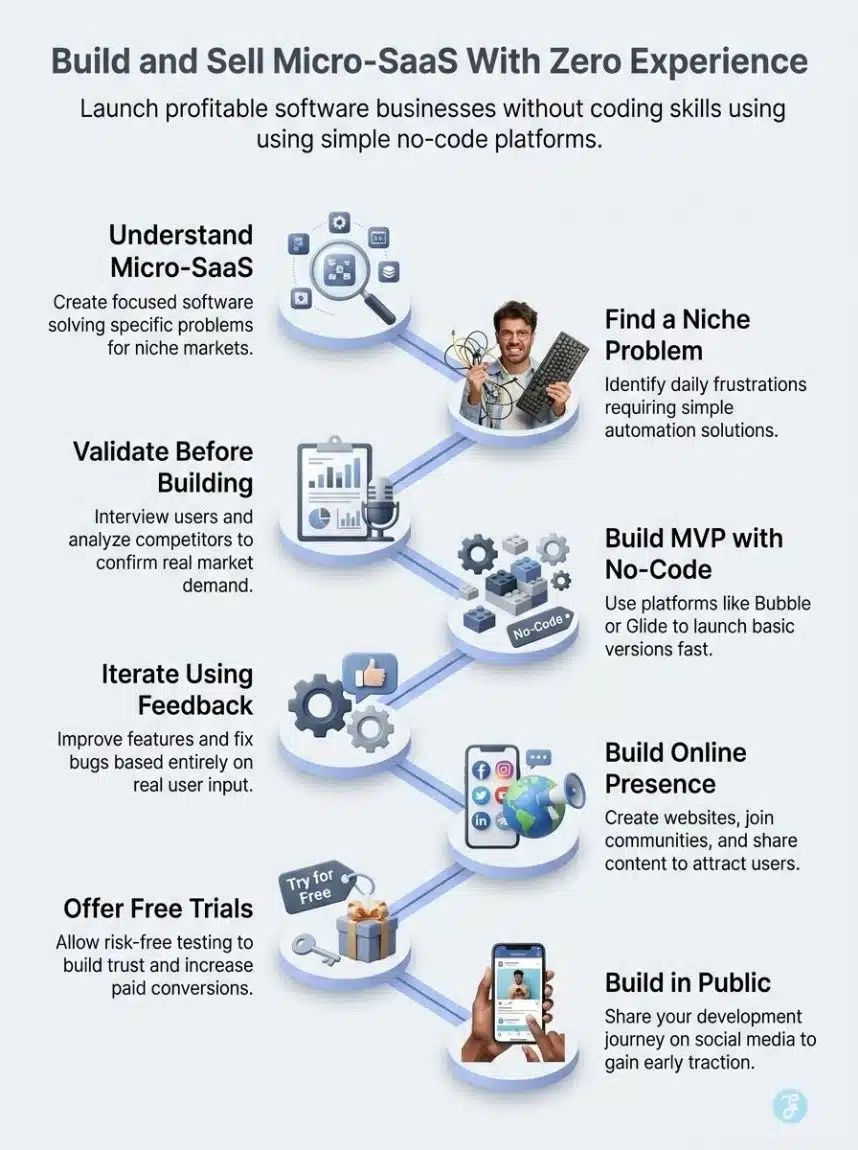
Micro-SaaS tools are small, focused software products that solve one problem well. Unlike traditional startups that aim for world domination, these businesses prioritize profitability and lifestyle for a solo founder or a very small team.
What is Micro-SaaS?
A Micro-SaaS is a software product that targets a niche market with a dedicated solution. Instead of trying to be everything to everyone, you focus on a specific user, such as a plugin for Shopify store owners or a scheduling tool for mobile pet groomers. These tools operate on a SaaS (Software as a Service) model, where users pay a recurring subscription fee.
The beauty of this model is its simplicity. You do not need complex infrastructure. One person can often handle the entire operation, from support to development, especially when leveraging automation. For instance, Simon Bennett built SnapShooter as a solo side project to handle server backups. It grew steadily because it solved a critical pain point for developers, eventually leading to an acquisition by DigitalOcean.
“Micro-SaaS isn’t about hitting a billion-dollar valuation; it’s about building a sustainable income engine with high profit margins.”
Benefits of Building Micro-SaaS Tools
Why are so many solo founders flocking to this model? The primary advantage is capital efficiency. You do not need investors. With modern no-code platforms like Bubble or Glide, your monthly hosting and tool costs can be under $100 to start.
Profitability comes much faster here than in traditional tech startups. Since your costs are low, you might only need 50 to 100 paying customers to replace a full-time salary. According to data from Acquire.com (formerly MicroAcquire), profitable SaaS startups in 2024 sold for a median multiple of 4.3x their trailing twelve-month profit. This data confirms that building a small, healthy business is a viable path to wealth.
You also maintain full control. You decide the features, the pricing, and the pace. Automation tools like Zapier or Make allow you to put tedious tasks on autopilot, giving you the freedom to focus on growth or your personal life. This makes Micro-SaaS an ideal entry point for anyone looking to build assets with zero prior coding experience.
Finding the Right Idea

The biggest mistake I see beginners make is trying to build a “better” version of a popular tool. Do not try to build another project management app. Instead, look for “boring” problems in underserved industries.
Identifying a Niche Market
A niche market is a small, specialized segment of customers who have specific needs that are not being met by big companies. To find these, you need to look where others aren’t.
- Audit Niche Communities: Browse specialized Subreddits (e.g., r/HVAC, r/smallbusiness) to find threads where people complain about their current workflow.
- Look for Spreadsheet Fatigue: If a business is running a critical process on a messy Excel sheet, that is a Micro-SaaS waiting to be built.
- Analyze Review Sites: Go to G2 or Capterra and read the 2-star reviews of popular software. Users often explicitly state exactly what feature is missing.
- Explore “Unsexy” Verticals: Industries like cemetery management, parking lot striping, or septic tank routing often have zero software competition and a high willingness to pay.
- Check Trends on Exploding Topics: Use tools like Google Trends or Exploding Topics to see what new queries are rising in 2025.
- Follow the “Mom Test”: Based on the principles from Rob Fitzpatrick, don’t ask if your idea is good. Ask people about their past behaviors and current problems to get honest data.
Solving a Specific Problem
Once you identify a group, pinpoint one expensive or frustrating problem they face daily. Your solution should save them time or make them money immediately.
For example, instead of “CRM for everyone,” build “CRM for Chimney Sweeps” that handles their specific inspection forms. Specialized tools can charge a premium because they fit the workflow perfectly without requiring days of customization.
| Generic Idea (Avoid) | Micro-SaaS Niche (Target) | Why It Wins |
|---|---|---|
| General Email Marketing Tool | Email Automation for Craft Breweries | Pre-made templates for seasonal releases appeal directly to brewers. |
| Project Management App | Client Portal for Wedding Planners | Handles specific timelines, vendor contracts, and bride/groom communication. |
| Standard Invoicing Software | Compliance & Invoicing for Notaries | Automatically includes state-specific legal clauses required for notaries. |
Validating Your Idea

Before you spend months building, you must verify that people will actually pay for your solution. Validation prevents you from building a product nobody wants.
Conducting Market Research
Start by assessing the landscape. Is there a hunger for this solution? You want to find evidence of “intent to buy.”
- Keyword Analysis: Use SEO tools to check if people are searching for “software for [niche]” or “how to automate [task].” Even low volume (100-500 searches/month) is great for Micro-SaaS.
- Competitor Gaps: If the only existing solutions are clunky enterprise software from the 1990s, you have a massive opportunity to win with a modern interface.
- Direct Outreach: Send cold DMs or emails to potential users. Ask about their current challenges, not your solution.
- Pre-Selling: The ultimate validation is a credit card swipe. Can you get 5 people to pre-order for a discount before the product exists?
Gathering Feedback from Potential Users
You need a feedback loop to refine your concept. This step moves you from “guessing” to “knowing.”
- Create a Landing Page: Use a simple builder like Carrd to describe your value proposition. Collect emails from interested visitors.
- Use Forms for Insight: Embed a Tally or Typeform survey asking visitors what their biggest pain point is regarding the problem you are solving.
- Offer a Concierge Service: Before building software, solve the problem manually for a few clients. If you can’t solve it manually, software won’t fix it either.
- Join the Conversation: Participate in Indie Hackers or relevant Facebook groups. Share your concept and listen to the brutal honesty of strangers.
- Track Click Data: Run a small Google Ads campaign ($50 budget) targeting your problem keywords to see if people actually click on your ad.
Building Your Micro-SaaS Tool
This is where the magic happens. In 2026, you do not need to hire a developer or learn Python. The “No-Code” revolution allows you to build complex applications visually.
Choosing No-Code or Low-Code Platforms
Your choice of platform dictates what you can build. Select the tool that matches your product’s complexity.
- For Web Apps (Bubble): Bubble is the gold standard for full-stack no-code apps. It allows for complex logic, databases, and user accounts. It’s powerful but has a steeper learning curve.
- For Mobile Apps (FlutterFlow or Glide): If your users need a mobile experience, Glide is incredible for turning spreadsheets into apps instantly. FlutterFlow offers more power, letting you export real code for the App Store.
- For Client Portals (Softr): If your tool is primarily displaying data from Airtable or Google Sheets, Softr is the fastest way to build a professional-looking portal.
- For Automation (Make or Zapier): Use these to connect different tools. For example, when a user signs up in Softr, Make can automatically send them an onboarding email and create a Stripe customer.
Creating an MVP [Minimum Viable Product]
Your goal is to launch the simplest version that solves the core problem. We call this the MVP.
- Define the Core Feature: Identify the one action that delivers value. If it’s a receipt generator, just generate receipts. Ignore dark mode, multiple languages, or complex profiles for now.
- Timebox the Build: Give yourself a strict deadline, such as two weeks. This forces you to cut unnecessary features.
- Use Templates: Most no-code platforms have marketplaces with pre-built templates for SaaS, marketplaces, or CRMs. Start with a template to save 80% of the work.
- Integrate Payments Early: Use Stripe Payment Links or Lemon Squeezy. Do not launch without a “Buy” button; you are building a business, not a hobby.
- Leverage AI Assistance: Use tools like ChatGPT or Cursor to write custom code snippets or formulas if you hit a limitation in your no-code tool.
Iterating Based on User Feedback
Once your MVP is live, your job shifts to listening. Your first version will be imperfect, and that is okay.
- Install Analytics: Tools like PostHog or Google Analytics help you see where users drop off.
- Ask “Why”: When a user cancels, trigger a simple email asking why. This qualitative data is worth more than any chart.
- Fix Friction First: Prioritize bugs that stop people from paying or using the core feature over adding new “nice-to-have” ideas.
- Release Often: In the Micro-SaaS world, you can update your app daily. This speed builds trust with early users who see their feedback being implemented.
Marketing and Selling Your Micro-SaaS
The best product does not always win; the best-known product often does. You must spend as much time on marketing as you do on building.
Building an Online Presence
You need to be discoverable where your customers are looking for answers. Credibility is your currency.
- Optimize Your Landing Page: Your headline should clearly state the benefit, not the features. Instead of “AI-powered database,” say “Save 10 hours a week on data entry.”
- Content Marketing: Write simple, helpful articles that answer specific questions your niche asks on Google. Long-tail keywords (e.g., “how to manage cemetery plots Excel”) are easier to rank for.
- Directory Listings: Submit your tool to SaaS directories like BetaList, G2, and specialized directories for your niche.
- YouTube Demos: A 2-minute video showing your tool solving the problem is often more effective than pages of text.
Leveraging Social Media and Communities
Social media is not just for memes; it is a primary sales channel for indie founders.
- Build in Public: Share your journey on Twitter (X) or LinkedIn using the #buildinpublic hashtag. Share your wins, losses, and revenue numbers. This transparency attracts early adopters and supporters.
- Answer Questions: Monitor Quora and Reddit for questions your tool answers. meaningful, helpful replies that casually mention your tool as a solution.
- Cold Outreach: Identify potential customers on LinkedIn or via public business directories and send a personalized, low-pressure message asking if they struggle with the problem you solve.
Offering Free Trials to Attract Early Users
Reducing risk for the buyer is essential when you have zero brand recognition.
- Freemium vs. Free Trial: For Micro-SaaS, a time-limited free trial (e.g., 14 days) often works better than a permanently free plan, as it encourages a purchase decision.
- No Credit Card Required: letting users try the tool without entering payment details increases sign-up rates significantly.
- Onboarding is Key: Send a sequence of automated emails during the trial that guides the user to their first “aha!” moment.
- Lifetime Deals (LTDs): Consider launching on AppSumo to get a cash injection and hundreds of early users, though be careful not to support them forever for a one-time fee.
Scaling Your Micro-SaaS Business
Once you have steady revenue, you can shift gears from “survival” to “growth.” Scaling a Micro-SaaS is about efficiency, not just headcount.
Improving Features Based on User Needs
Your users are your best product managers. They will tell you exactly what needs to be built to increase the value of your tool.
- Public Roadmaps: Use a tool like Canny to let users vote on features. This ensures you build what the majority actually wants.
- Focus on Retention: It is cheaper to keep an existing customer than to find a new one. Add features that make your tool “sticky” and hard to leave.
- Raise Your Prices: As your product improves, grandfather early users in at the old rate and increase prices for new users. This increases your margins immediately.
Exploring Automation to Manage Growth
As a solo founder or small team, you cannot afford to do manual work. Automation is your leverage.
- Automate Support: Create a comprehensive knowledge base or use an AI chatbot to handle common queries.
- Streamline Operations: Use Make.com to automate invoicing, user onboarding, and even social media posting.
- Systematize Feedback: Automatically pipe user feedback from emails directly into your project management tool (like Trello or Notion).
- Monitor Churn: Set up alerts when a high-value customer’s usage drops, so you can reach out before they cancel.
Expanding to New Markets or Niches
If you have dominated one niche, look for adjacent markets. A tool for “Notaries” might easily be adapted for “Real Estate Agents” with minor tweaks.
- Clone and Tweak: You can often duplicate your existing no-code app, change the terminology, and launch it for a new vertical.
- Localized Versions: If your tool is successful in the US, consider translating it for European or Latin American markets where competition might be lower.
- White Labeling: Allow agencies to use your tool under their own brand for a higher monthly fee. This is a powerful way to increase revenue without finding individual users.
Overcoming Common Challenges
The journey isn’t a straight line. You will face obstacles, but anticipating them gives you an advantage.
Managing Limited Resources
You will always feel like you don’t have enough time. The key is ruthless prioritization. If a task doesn’t directly lead to revenue or retention, question if it needs to be done at all. Use tools like Trello to track tasks and prevent overwhelm. Remember, in Micro-SaaS, “perfect” is the enemy of “shipped.”
Retaining Customers
Churn is the silent killer of SaaS businesses. According to 2025 benchmarks from Agile Growth Labs, Small and Medium Business (SMB) SaaS typically sees monthly churn rates between 3% and 7%. If your churn is higher, your product has a “leaky bucket” problem.
“A high churn rate means you are filling a bucket with a hole in the bottom. Fix the product value before you pour more marketing money in.”
To fix this, improve your onboarding and ensure users get value in their first session. Personal outreach from the founder can also drastically reduce churn in the early days.
Key Tips for Success
To wrap up, here are the fundamental principles that separate the dreamers from the doers.
Start Small and Stay Focused
Resist the urge to expand your scope. A tool that does one thing perfectly for one person is infinitely more valuable than a tool that does ten things poorly for everyone. Your “small” idea allows you to move faster than big competitors.
Build in Public to Gain Early Traction
Do not hide your idea. Competitors are too busy with their own problems to steal yours. By sharing your progress, you build an audience that wants you to succeed. Platforms like Twitter and Indie Hackers are supportive communities where transparency leads to trust and, ultimately, customers.
Final Words
How To Build And Sell Micro-SaaS Tools is a practical, accessible path to digital entrepreneurship, even if you have zero coding experience. By leveraging no-code platforms, focusing on niche problems, and automating your operations, you can build a valuable asset that generates recurring revenue.
Dr. Megan Ellis, PhD in Computer Science from MIT and former lead product manager at TinyTools Inc., emphasizes that the core of this success lies in specificity. Her extensive work in software development suggests that the most successful founders are those who listen intently to a small group of users rather than trying to shout at the masses.
The data support this approach: with low startup costs and healthy exit multiples, the risk profile of Micro-SaaS is uniquely favorable for beginners. Whether you want a side income or a full-time business, the tools are ready. The only missing piece is your execution.
If you are ready to stop trading time for money, identify a problem today, open a no-code editor, and start building. Your first user is out there waiting for a solution.






























