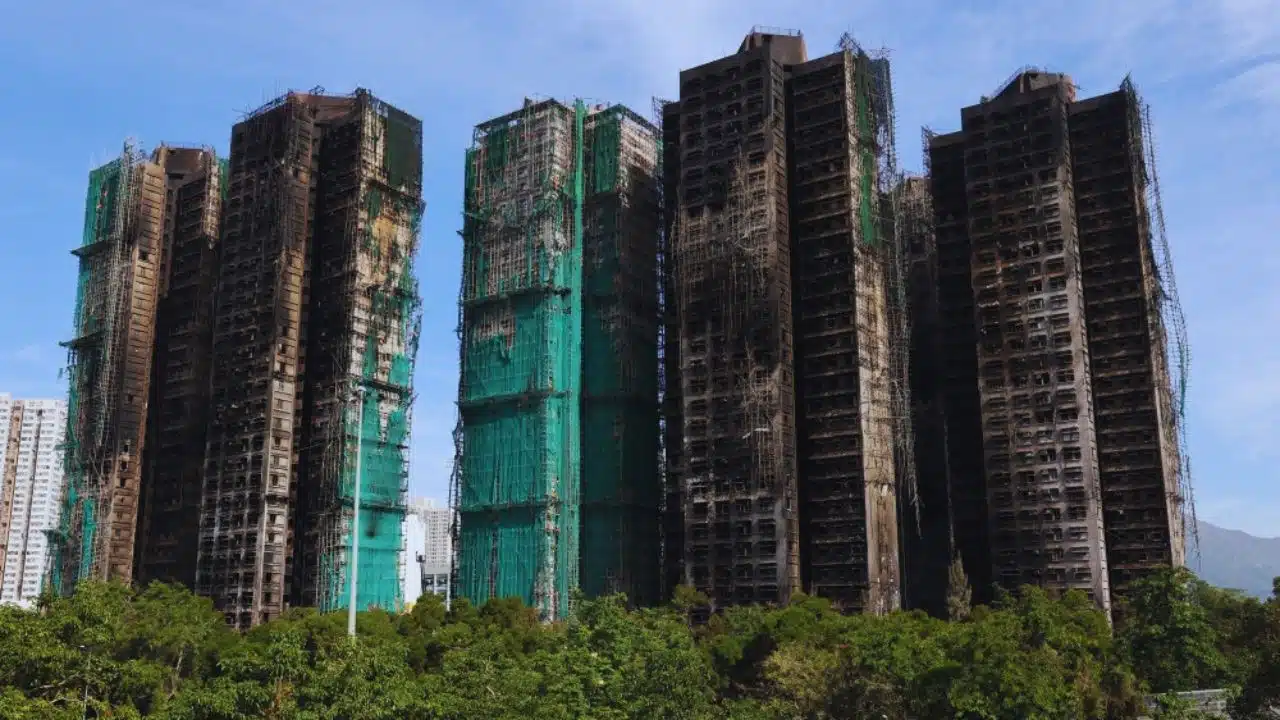
Hong Kong is in official mourning and simmering with grief‑tinged anger after a catastrophic apartment fire killed at least 128 people and left scores more missing, even as Beijing’s national security authorities issued a stark warning against using the disaster to “disrupt” the city. Silent vigils, petitions and small protests are emerging around the devastated housing estate and across the city, testing how much public expression Hong Kong’s tightened political system will tolerate.
City in mourning after deadliest fire in decades
Authorities say the blaze tore through seven tower blocks in a large public housing estate near the border with mainland China, making it Hong Kong’s deadliest fire since a 1948 warehouse inferno that killed 176 people. At least 128 residents are confirmed dead, more than 80 injured and roughly 150–200 still unaccounted for, with officials warning the toll is likely to rise as recovery efforts continue.
The government has declared three days of official mourning, with flags of both Hong Kong and China flying at half‑mast and top officials, led by Chief Executive John Lee, observing three minutes of silence outside government headquarters. Memorial sites and condolence books have been set up across the city, where residents queue to lay flowers, light incense and leave handwritten notes to families who lost loved ones in the blaze.
Safety failures and criminal probes
Investigators say the fire spread with devastating speed across the 32‑storey blocks, which were wrapped in bamboo scaffolding, plastic sheeting and foam insulation for renovation, materials that appear to have helped carry flames between towers. Officials have since acknowledged that fire alarms in the estate, home to more than 4,600 people, were not functioning properly when the blaze broke out.
Police and anti‑corruption investigators have opened parallel criminal and graft probes into how renovation contracts were awarded and whether safety rules were ignored, arresting at least 11 people including construction firm executives and others linked to the project. Residents and local media have reported that tenants had repeatedly complained about blocked escape routes, flammable materials and malfunctioning alarms more than a year before the tragedy, only to be told by officials that the estate posed “relatively low” fire risks.
Grief turns to anger, under tight control
Public anger has so far been expressed largely through quiet vigils, petitions and residents’ groups rather than the mass street rallies that defined Hong Kong’s 2019 pro‑democracy protests. Volunteers have flooded the area with donations and support, organizing round‑the‑clock efforts to provide food, clothing, basic supplies and temporary assistance to hundreds of displaced families.
Two online petitions, one launched by a neighborhood concern group and another by an overseas Hong Kong resident, have quickly drawn thousands of signatures demanding an independent inquiry, full disclosure of safety inspections and legal accountability for officials and businesses found negligent. At smaller gatherings near the fire scene and at memorial sites, participants have held moments of silence and displayed messages questioning how such a disaster could happen in a city that prides itself on efficiency and modern infrastructure.
Beijing warns against “disruption through disaster”
As frustration grew, China’s national security office in Hong Kong issued an unusually sharp statement, warning that any attempt to use the tragedy to “disrupt Hong Kong through disaster” would be punished under the national security law and the newer Safeguarding National Security Ordinance. The message, amplified by state‑aligned media, accused unnamed “anti‑China” forces of trying to exploit grief and demanded that the city government act firmly against those who turn mourning events into platforms for political dissent.
Authorities in Hong Kong are reported to be on high alert for any sign that vigils or petitions might evolve into broader unrest reminiscent of 2019, when months of mass protests prompted Beijing to impose the sweeping national security law and overhaul the city’s electoral system. Police have maintained a visible presence around the burned estate, memorial sites and central districts, with officers monitoring gatherings and, in some cases, checking the identities of participants and journalists.
Tragedy as a test of Hong Kong’s new order
The disaster is widely seen by analysts and residents as an early, severe test of the Beijing‑backed administration’s promise to deliver better housing, governance and safety after crushing the protest movement and tightening political controls. For many working‑class families living in crowded estates, the fire has become a symbol of deeper frustrations over inequality, aging infrastructure and a perception that ordinary people’s warnings are often ignored until it is too late.
Beijing’s top leaders, including President Xi Jinping, have expressed condolences and called for “all‑out” efforts to support survivors, while major Chinese companies have pledged financial aid and the Hong Kong government has announced a relief fund for affected households. Whether those steps, together with transparent investigations and visible accountability, will be enough to calm anger and rebuild trust in Hong Kong’s post‑2019 political order remains one of the central questions now hanging over the city’s grief‑stricken skyline.