The shift to remote and hybrid work has permanently altered how we view our living spaces in the UAE. Whether you are freelancing from a high-rise in the Marina or managing a team from a townhouse in The Springs, finding the right Home Office Ideas Dubai offers is essential for maintaining focus. The challenge for many residents isn’t a lack of discipline, but a lack of defined space.
Dubai properties, from compact studios in JVC to sprawling villas in Arabian Ranches, offer unique layouts that often lack a dedicated “study.” However, you don’t need a spare room to be productive; you just need a “zone.” By carving out specific nooks tailored to deep work, you can mentally separate your “off” hours from your “on” hours, boosting productivity by creating physical boundaries.
Key Takeaways
-
Identify Your Zone: You don’t need a whole room. A corridor, closet, or balcony can work if set up intentionally.
-
Light Matters: Switch your bulbs to “Cool White” (4000K) in your work zone to stay alert.
-
Watch the AC: Avoid direct drafts to prevent fatigue and headaches.
-
Separate Work/Life: Even in a studio, use visual dividers or “pack away” rituals to disconnect at the end of the day.
-
Upgrade Connectivity: Thick concrete walls require Mesh Wi-Fi systems for reliable video calls.
The Shift to Hybrid: Why the ‘Kitchen Table’ No Longer Works
For a long time, “working from home” in Dubai meant a temporary setup on the dining table or a laptop balanced on the sofa. However, as the UAE solidifies its status as a global hub for digital nomads and the hybrid working model becomes the standard for major Dubai firms, temporary fixes are no longer sustainable.
Recent trends in remote work interior design UAE show a clear move away from makeshift setups. Working from communal areas like the living room or kitchen often leads to “role blur”—where the brain struggles to switch off from work mode because the environment doesn’t change. To maintain mental health and peak performance, your environment must signal to your brain when it is time to focus and when it is time to relax. This is why establishing a designated physical boundary, no matter how small, is critical for long-term productivity.
Smart Zoning: Overcoming the Square Footage Challenge
The primary hesitation many residents face when looking for Home Office Ideas Dubai is the perceived lack of space. In prime locations like Dubai Marina, Downtown, or the Palm Jumeirah, the cost per square foot is high, meaning extra rooms are a luxury.
However, productivity isn’t about having a 200-square-foot study with mahogany bookshelves; it is about “Strategic Zoning.”
Strategic Zoning is the art of identifying “dead space”—underutilized corners, transitional areas, or vertical gaps—and repurposing them. Whether you are in a compact studio in JVC or a townhouse in Town Square, every property has these hidden pockets. The goal is to transform these underused areas into functional “micro-offices” that offer ergonomic support without dominating your living quarters.
Here are 17 proven productivity zones tailored specifically for the architecture and lifestyle of Dubai.
The “Hidden” Hacks: Maximizing Dubai Apartments
For residents in high-density areas like Business Bay, Downtown, or JLT, square footage is a premium commodity. These zones focus on “disappearing” workspaces that don’t clutter your living area.
1. The “Cloffice” (Walk-In Wardrobe)
Many master bedrooms in Dubai apartments feature deep walk-in wardrobes or alcoves. By removing a section of the clothing rails, you can install a compact desk. The soft surroundings (clothes, carpets) offer excellent sound dampening—perfect for Zoom calls.
Pro Tip: Use a motion-sensor light strip above the desk so you aren’t working in the shadows of your shirts.
2. The Maid’s Room Transformation
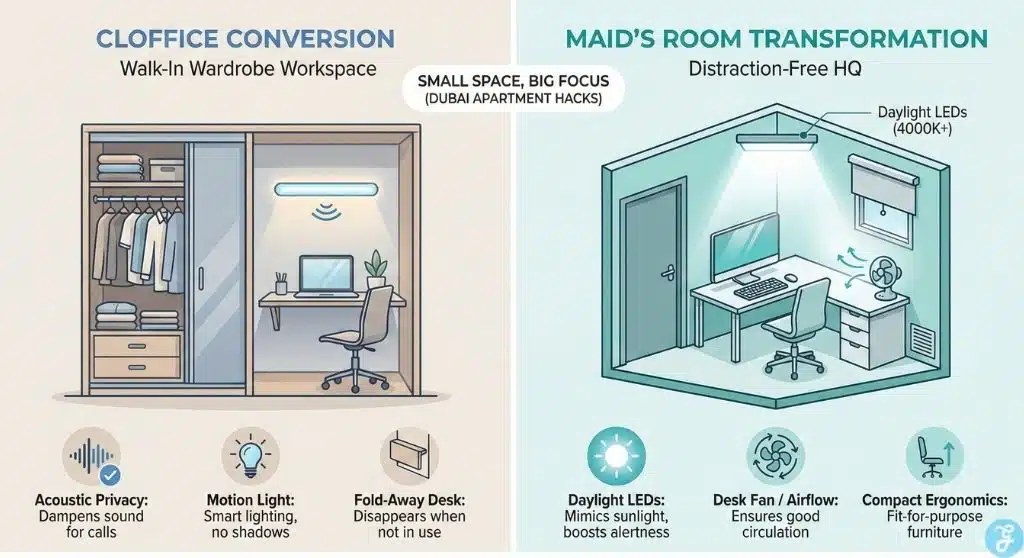
This is perhaps the most trending maid room conversion idea Dubai has seen recently. These rooms are often used for storage, but they are ideal distraction-free HQs.
-
Lighting is Key: Since many maids’ rooms lack large windows, lighting is critical. Avoid warm “yellow” bulbs, which induce sleep. Opt for “Daylight” LED bulbs (around 4000K-6500K) to mimic natural sun.
-
Ventilation: Ensure the AC vent is clean and add a small desk fan to keep air circulating in the smaller volume of space.
3. The Corridor “Floating” Nook
Large apartments in older buildings (like JBR or The Greens) often feature wide, long hallways. A “floating” wall-mounted desk here creates a workstation without eating up floor space. Because it has no legs, the room still feels open and airy.
4. The Bedroom Vanity Swap
In smaller bedrooms, replace the traditional dressing table with a hybrid desk-vanity. A modern console table with drawers can hold a laptop during the day and makeup/skincare in the evening. Keep the design clean and minimal to avoid visual clutter in your sleeping zone.
5. The “Floating” Window Bay
If you are lucky enough to have floor-to-ceiling windows, do not block the view. Install a clear acrylic or glass floating shelf across the window width. This allows you to work with a view of the skyline while keeping the apartment feeling open.
| Desk Type | Best For | Pros | Cons |
| Wall-Mounted (Floating) | Corridors / Small Bedrooms | Zero floor footprint; airy look. | Fixed location; cannot be moved easily. |
| Ladder Desk | Living Room Corners | Vertical storage; stylish design. | Limited desk depth. |
| Fold-Down (Murphy) | Guest Rooms / Studios | Completely hidden when not in use. | Requires drilling/installation. |
| Standing Converter | Kitchen Islands | Health benefits: flexibility. | It can look bulky if not stored away. |
Flexible “Nomad” Zones: For Agile Working
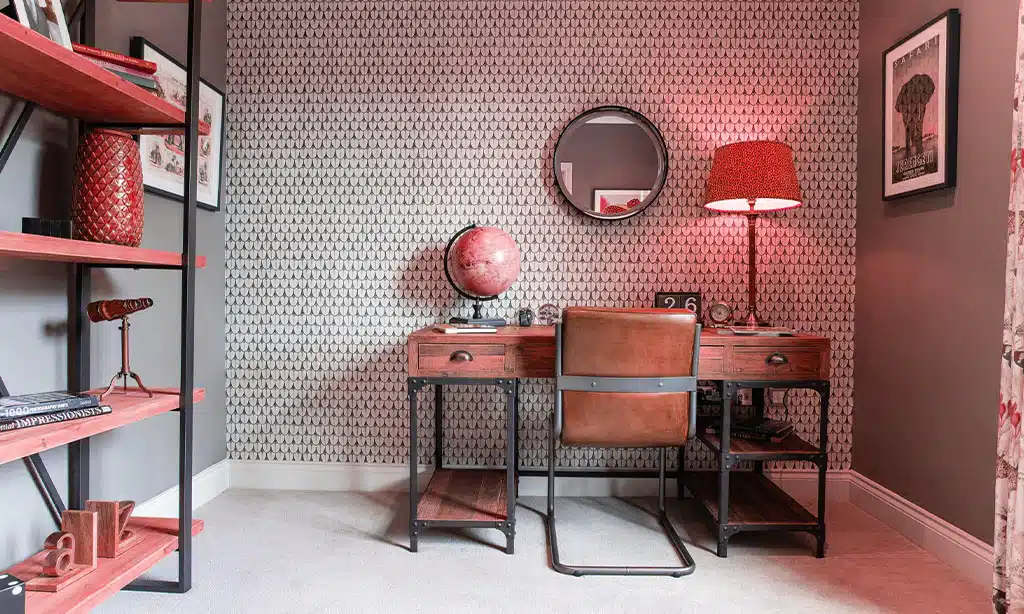
If you prefer moving around to avoid stagnation, these zones allow for flexibility.
6. The Seasonal Balcony Office
Strictly for the “Winter Season” (October to April), the balcony is an underutilized asset.
-
The Setup: Use a foldable, weather-resistant table.
-
The Glare: You will need a laptop hood or an anti-glare screen protector, as the Dubai sun is bright even in winter.
-
Why it works: Fresh air and natural light are proven mood boosters.
7. The Living Room Partition
In open-plan studios (common in Arjan or Sports City), psychological separation is vital. Use an open-shelf bookcase (like an IKEA Kallax) to physically separate the “sleeping” zone from the “working” zone. It lets light filter through but clearly defines the boundary.
8. The Portable “Nomad” Cart
Instead of a fixed desk, use a rolling 3-tier cart. It holds your laptop, noise-canceling headphones, water bottle, and notepads. You can wheel it to the kitchen for the morning light and to the living room in the afternoon to chase the best AC airflow.
9. The Dining Table “End-Cap”
If you must work at the dining table, dedicate one specific end to work. Use a “tray system”: when the workday ends, the mouse, notepad, and laptop go onto the tray and into a cupboard. This ritual physically signals to your brain that the workday is over.
10. The Sofa Console Shift
Place a high console table behind your sofa. Pull up a bar stool, and you have a standing/sitting desk that faces the TV or living room (great for monitoring kids playing) but keeps you out of the “lounge slouch” position on the couch.
Villa & Luxury Zones: Utilizing Space
For those in villas, the luxury of space allows for more permanent and ergonomic setups.
11. The Landing Library
Villas in The Villa or Mudon often have a massive, unused open space at the top of the stairs (the landing). This is the ideal “Command Center” for a family office where two or more people can work simultaneously.
12. The Under-Stair Sanctuary
Specific to townhouses, the triangular space under the stairs is often wasted storage. Custom joinery can turn this into a cozy, acoustic-friendly deep work pod.
13. The Sunroom / Conservatory
If you have extended your villa, a sunroom offers maximum light. However, you must install heavy-duty solar blinds (Solar control fabrics) to manage the midday heat and prevent your laptop from overheating.
14. The Vertical Garden Corner
Biophilic design is a huge trend to counter the desert landscape. Set up your desk in a corner and create a “green wall” using floating shelves of Pothos, Snake Plants, or high-quality artificial greenery. Looking at plants reduces eye strain and lowers stress.
15. The Guest Room “Murphy” Nook
You likely have guests visiting for a few weeks a year. For the other 48 weeks, that room sits empty. Install a wall-bed (Murphy bed) system that folds up to reveal a desk. This keeps the guest room functional for the family but usable as a prime office year-round.
16. The Kitchen Island Standing Desk
Dedicate the far end of a large kitchen island as a “standing desk” for quick admin, email triage, or calls while grabbing coffee. It encourages movement and prevents sitting for 8 hours straight.
17. The Building Amenity Lounge
While technically outside your unit, modern buildings (like those in Emaar Beachfront or Creek Harbour) are designing lobby “co-working lounges.” Treat this as an extension of your home office. If your Wi-Fi drops or construction noise starts next door, this is your backup zone.
The Budget Breakdown: High vs. Low
Creating a productivity zone doesn’t require a CEO’s salary. Whether you are bootstrapping a startup in a studio or fitting out a permanent villa office, here is what you can expect to spend in the current market.
| Category | The “DIY” Saver (AED) | The “Pro” Upgrade (AED) | What You Get |
| Desk | 300 – 600 | 1,500 – 4,000 | Standard IKEA/Pan Home vs. Solid Wood or Sit-Stand Motorized. |
| Chair | 250 – 500 | 1,200 – 5,000+ | Basic swivel vs. Herman Miller/Steelcase ergonomic support. |
| Lighting | 50 – 150 | 400 – 800 | Desk lamp vs. Philips Hue Smart Lighting ecosystem. |
| Acoustics | 100 – 200 | 1,000+ | Rugs/Curtains vs. Acoustic wall paneling & soundproofing foam. |
| Tech/Monitor | 600 – 900 | 2,500+ | Single standard monitor vs. Curved Ultrawide 4K display. |
| TOTAL EST. | ~1,300 AED | ~7,000+ AED |
Pro Tip: If you are on a budget, prioritize the chair over the desk. You can work on a cheap table, but a bad chair will cost you thousands in physiotherapy later.
The Dubai Essentials: Tech & Comfort
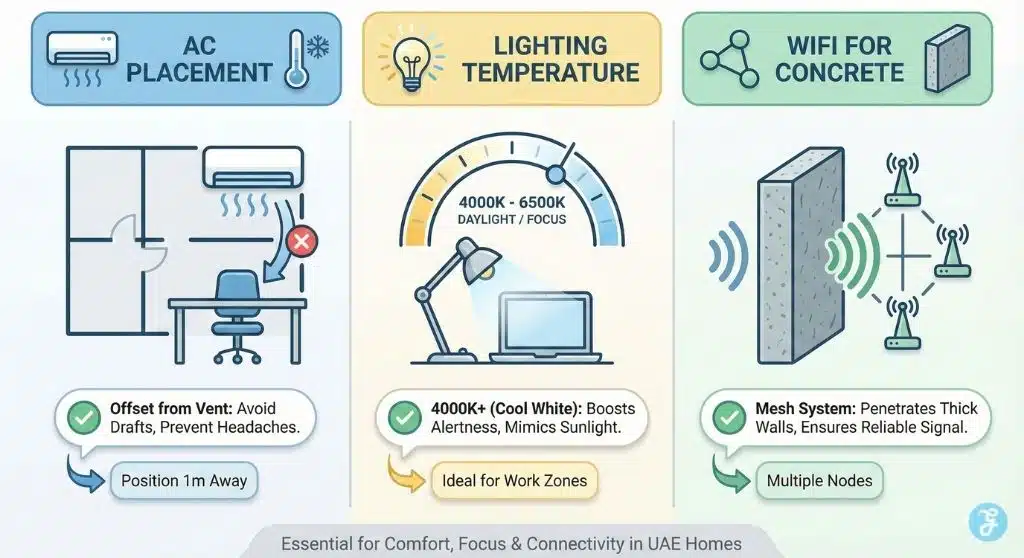
No matter which zone you choose, three factors will dictate your success in this region: Cooling, Lighting, and Connectivity.
The AC Factor
Never position your desk directly under the AC vent. The constant draft will cause tension headaches and dry eyes. Always offset your desk by at least 1 meter from the direct airflow.
Lighting Temperature Guide
The color of your lightbulbs matters immensely for productivity.
| Kelvin (K) | Color | Best For | Where to Use |
| 2700K – 3000K | Warm Yellow | Relaxing, Reading | Bedrooms, Living Rooms (Avoid for work) |
| 3500K – 4000K | Cool White | Focus, Alertness | Home Office, Kitchens |
| 5000K – 6500K | Daylight | High Concentration | Maid’s Rooms, Windowless Nooks |
Connectivity in Concrete
UAE buildings are built with thick concrete and steel reinforcement, which is terrible for Wi-Fi signals. If you set up a workspace in a maid’s room or a corner far from the router, you will experience lag.
-
The Fix: Do not rely on a single router. Invest in a Mesh Wi-Fi System (like TP-Link Deco or similar). These create a “blanket” of coverage that penetrates concrete walls much better than standard range extenders.
The Renter’s Rulebook: Modification Do’s & Don’ts
Since over 70% of Dubai residents are expatriate renters, understanding what you can and cannot do to your property is vital to protecting your security deposit.
Green Light (Safe to Do)
-
Freestanding Furniture: Any desk or shelf that doesn’t attach to the wall.
-
Command Strips: Use heavy-duty adhesive strips for hanging whiteboards or art. They hold up to 7kg and peel off without damaging paint.
-
Curtain Rods: Most landlords accept drilling for curtain rods (essential for glare control) as long as you fill the holes when leaving.
-
Area Rugs: The best way to cover unsightly tiled floors and dampen sound without changing the flooring.
Red Light (Requires Landlord NOC)
-
Wall Painting: Changing that “Magnolia” wall to “Deep Navy” usually requires repainting it back to the original color upon vacating, or you will be charged.
-
Built-in Joinery: Custom shelves in alcoves or under-stairs that are glued/screwed permanently.
-
Electrical Work: Moving an outlet to suit your desk position.
The “Reinstatement” Clause: Always check your tenancy contract. Most standard Dubai contracts state the property must be returned in the “same condition.” If you drill holes for a floating shelf, be prepared to hire a handyman to “fill and paint” before your final inspection.
The Dubai Sourcing Black Book: Where to Shop
Don’t know where to find the items mentioned above? Here is a quick local directory based on your style and budget.
1. For the Budget-Conscious (Value)
-
Dragon Mart (International City): The ultimate destination for tech accessories (monitor arms, cables, LED strips) and budget office chairs. Haggling is expected.
-
IKEA (Jebel Ali / Festival City): The gold standard for affordable desks (Trotten/Bekant series) and pegboard organizers.
-
Pan Home / Danube Home: Great for mid-range furniture that often goes on 50-70% sale.
2. For the Style-Obsessed (Aesthetics)
-
West Elm / Pottery Barn: For “Mid-Century Modern” desks that look beautiful in a living room.
-
The Bowery Company: Excellent for industrial, chic, and minimalist Scandinavian accessories.
-
Custom Joinery: Visit the Al Quoz industrial area. Many small carpentry workshops can build a custom wood desk to your exact measurements for half the price of a branded store.
3. For the Ergonomic Pro (Health)
-
The Workspace Options (Sheikh Zayed Road): High-end ergonomic solutions.
-
Computer Plaza (Al Ain Center – Bur Dubai): The specific spot for high-performance monitors, mechanical keyboards, and mesh Wi-Fi systems.
Frequently Asked Questions (FAQs)
1. Do I need landlord permission to modify a maid’s room into an office?
Generally, if the changes are cosmetic (painting, freestanding furniture, changing lightbulbs), you do not need permission. However, if you are drilling into tiles, installing permanent joinery, or modifying electrical wiring, you must check your tenancy contract and get an NOC (No Objection Certificate) from the landlord/developer.
2. What is the best way to soundproof a home office in Dubai?
Dubai apartments often have tiled floors that echo. To dampen sound: add a thick rug, use upholstered furniture, and hang heavy curtains (even if there is no window, hanging a curtain on a wall absorbs sound). For maid’s rooms, acoustic foam panels are a cheap and effective solution.
3. Is it practical to work from a balcony in Dubai?
Only seasonally. From late October to April, it is delightful. From May to September, the humidity and heat make it impossible for electronics (and humans) to function safely outside. Always have an indoor backup zone for the summer months.
4. Where can I buy ergonomic office furniture in Dubai?
For budget-friendly options, IKEA and Homebox offer decent ranges. For mid-range, look at workspace collections from Mahogany or specialized ergonomic stores like the office furniture shops in Karama/Dragon Mart (requires bargaining). For high-end ergonomics, brands like Herman Miller have authorized dealers in the UAE (e.g., Aesthetix).
5. How can I boost the Wi-Fi signal in a “bunker” style room?
Standard Wi-Fi extenders often fail in UAE concrete structures. A “Powerline Adapter” (which sends internet through your electrical wiring) or a “Mesh System” (a set of 2-3 units that talk to each other) are the only reliable solution for rooms with thick walls or metal doors.
The Bottom Line: It’s About Mindset, Not Square Footage
Ultimately, creating the perfect productivity zone in Dubai isn’t about having a sprawling villa or a limitless budget. It is about intentionality. Whether you are converting a maid’s room in the Marina or styling a balcony in The Greens, the goal remains the same: to build a physical boundary that protects your mental focus.
Don’t wait for the “perfect” office. Start small, adjust your lighting to cool white, upgrade your chair, or claim that unused corner today. As the city continues to embrace hybrid living, your home needs to evolve with you. By implementing just one of these changes, you aren’t just moving furniture; you are reclaiming your time, your health, and your peace of mind.